- Speaker #0
Essential medicines are a matter of production, profitability, and EU sovereignty. We often talk about access in terms of price, but access also depends on the availability of mature medicines. These mature medicines have low margins and global supply chains that are fragile. Karine Pignon defends a simple idea, production must remain economically viable in Europe. Since this interview, she has created a trade association to defend local pharmaceutical production. It's not just an industrial issue, it's a matter of sovereignty.
- Speaker #1
To me, they are essential. During the COVID period, we had zero production delays. It means that those guys, despite the fact that people were dying everywhere, in every neighborhood,
- Speaker #2
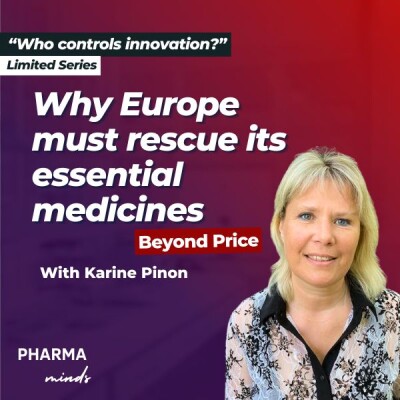
they kept going and producing. I still get chills. I tell myself there are people who risk their lives to go and produce. This episode was recorded with the support of LXO and MedFrance. Hello everyone, welcome to this new episode of PharmaMind. Thank you dear listeners for being more and more numerous to follow these episodes. Today we are hosting a woman who is shaking up the codes of pharma. We are hosting Karine Pinon. Hello Karine. Hello. Karine is the CEO and founder of Exo Laboratories and we're going to dive into a fascinating journey, the creation of a pharmaceutical laboratory that defends French production and European production and mature medicines. So. I think it's going to be a great example to show that you can be an entrepreneur in pharma and succeed while remaining authentic and committed.
- Speaker #1
A vast program.
- Speaker #2
It's a vast and ambitious program. So you begin with just two molecules, right? Then you say, OK, let's move on to mature products.
- Speaker #1
Is it? Yeah. So why mature products? Yes, because in fact, it's true that in pharma, we tend to stick to, let's say, talking mostly about innovation because that's what shines, actually. And it's true that personally, we're delighted to have innovative products. And that's what makes the news. Now, when we look a bit at what French people consume, that is to say, in their everyday chronic pathologies, 95% of the time, French people take mature products that are sometimes genericized, sometimes not. So why aren't they genericized? Sometimes because they are purely French products. So in fact, the generic manufacturer says there's not much interest because there's not much volume. Generic equals low price. So if you don't make much margin necessarily, there needs to be more volume to make more money. It's a bit mathematical. And so as a result, these mature products, which are often called essential products or MITM, major therapeutic interest medicines, these drugs make up the daily life of French people for pathologies like diabetes, hypertension, including CNS pathologies, the central nervous system, everything like antidepressants and so on. All of that and the majority consists of mature products at 95%. These mature products, which will also be responsible for the significant increase in life expectancy. Today, if we reach 90 years old, it's because cardiovascular issues are managed, diabetes is managed, etc. So these products have a definite interest. And then for big pharma, they say to themselves, I have to do R&D. So I'm looking for blockbusters. And so as a result, I have less interest in these mature products, which means that effectively they're going to divest themselves of these mature products because they are products that take time. And so they want to focus on blockbusters. That's why we must never pit the two models against each other. There are two different models that need one another. Big Pharma needs these companies that keep mature products alive because that's what sustains one's... Again, 95% of pathologies. And they also fund, in a way, a bit of their innovation, because when we buy them, we buy them at a high price. And so it's money they reinvest into R&D. So the two models aren't in opposition, but we're at different stages of the molecule's life cycle management. So these mature products, to me, they are essential. And then it's a bit like the same trend we see, I don't know, with clothes. You see, with clothes, people say... we have to stop systematically buying new clothes and so on. Secondhand items also have their own value. I don't mean to say a mature product is secondhand, but in a way, why look for something new, something innovative that will inevitably be more expensive if we can treat things the same way with products that are certainly less innovative, but they get the job done. So from a citizen's perspective, it's very interesting because we couldn't you afford it if we were all paying 1,000 euros a box to treat hypertension. The economy wouldn't survive. It's already struggling enough today, but that would be terrible. So that's really it. It's saying it's okay to have a Ferrari when you have a cancer that's super complicated. and so on. But if in the end, the Megane or the Laguna gets you there and does its job, why pay so much? So really these mature products, that's how my interest in them comes about, right? And there you go.
- Speaker #2
Yeah. Okay. So you're saying these are in fact medicines that have a significant and important place in the healthcare system and not sufficiently valued. Is that right?
- Speaker #1
I got into these mature products, not by chance as it happens, because that's what I'd done at Proctor And then very quickly, I came across an association called MedFrance, which is the association that represents SMEs. And so I realized that, well, I joined just as a board member and so on. And I realized just how many SMEs there are doing the same thing and fighting for the recognition of this French production, while also highlighting that these mature products, which have often faced price cuts because it was you the logic of the CEPS, the Economic Committee, to lower prices to keep social security profitable. In fact, we've reached such a low point. In terms of profitability, sometimes these mature products are no longer profitable.
- Speaker #2
All right. Do you have an example of products like that?
- Speaker #1
Well, there are plenty. There are plenty. One thing you need to understand is that successive price drops mean that little by little, we reach the bottom of the margin level. So I... I had a product called Theraline where we were at 89 cents for 50 tablets. And it became all the more crazy because 89 cents for 50 tablets. So we're not even at the price of a baguette, right? Let's be clear. When inflation hits, we get to roughly between 20 and 25 percent increase in manufacturing costs because electricity is more expensive. Aluminum is more expensive. Everything is more expensive. And in fact, that's where you see that the whole thing becomes completely crazy. That is to say, the price of the medicine stays the same. The margin continues to decrease. And so, in fact, my manufacturer who was in France was losing money. My API manufacturer was losing money every time they produced the product. In the end, we're out of stock. And I'm liable to get penalties, fines, because I'm out of stock. And all that to complete the picture is that this product counts. towards my turnover, even if I make zero margin or even I was losing at the time more than 20 cents per box sold. It counts towards my turnover. So I'm going to pay the safeguard clause on this turnover, which is penalizing for me. So that's where we get to something totally heretical. And so as a result, in this case, I finally got a price increase, but three years later. So it took, that's where very small companies. They don't have the necessary cash flow to be able to deal with that. Me now, today, I have 80 million euros in turnovers. So naturally, I see the future a bit more clearly, but very small businesses can't operate in it. That's why we at MedFrance are really trying to support them, to bring them to the forefront of these extreme situations, to highlight them and tell them that it's not okay for us to lose our margin.
- Speaker #2
Because in most government minds,
- Speaker #1
and so on, they think, yes, but it's okay because they make the margin on other products. That's the case when you're talking about Sanofi. There you go. You're a big player. You have innovative products, mature products. You can actually afford to have products where you make less margin. But when you're just a small company, an SME making 10, 15 million euros in turnover, but with products that all have the same characteristic, they're low price products. So yes, it's a problem. We're really working on this at MedFrance to try to make people understand that while we say health is priceless, medicine does have a cost. Because yes, 0.89 to produce 50 tablets, all of that has costs and it can't just come out to 0.89. It's just mathematics, especially if you manufacture in France, because we mustn't forget that manufacturing in France necessarily costs more than manufacturing in very distant countries.
- Speaker #2
Yeah, I have 10,000 questions coming to mind right now. The first one is just an example to show what type of products are there. Actually, are there immature products? Yeah, sure. Well, then you mentioned, for example, vitamin K.
- Speaker #1
Yes, well, I mentioned vitamin K because there it's even more critical for vitamin K. So here we're talking about products used in intensive care. We're dealing with products that are sterile and so on. So you imagine the little vial. So there you go. And I think we're at less than one euro for vitamin K. And so as a result, there are only SMEs left today that manufacture vitamin K in France. It's a very small volume, very small volume and very, very unprofitable. And when there were, after COVID, all the problems we had with glass, glass really very significantly increased. We were at great risk, hence the famous health sovereignty. And what's a shame is that this health sovereignty, which was so important post-COVID today, we are already starting to forget it. And when you created this lab, were there already labs for... 100% mature products that existed? Well, yes, in France, yes. There was one in Lyon, but there were others elsewhere. In Germany, notably, there's a huge one that has snapped up many, many mature products. There are some in England too. Well, they're pretty much everywhere, I'd say, in various countries. In France, we have two that are quite significant. And then there are lots of small ones. Today, at MedFrance, we... We have a scope of about 136 companies. So with scopes in terms of turnover that are very different, it can range from, I'd say, barely 1 million to several, well, up to 150, 200, 300 million, you know, right? So we have this characteristic where 65% are mature products and we mostly target the French territory. That is to say... when you look at it, about 70% of everything that comes out of our SMEs is destined for the French territory. In SMEs, we mostly talk about mature products that aren't genericized, so they still have a certain specificity. The bulk of mature products are genericized though, right? So behind that, so there are alternatives. But as we can clearly see, when there was a problem, for example, with amoxicillin, well... all the amoxicillin generics had the same problem. So that's where you have to look to see where the problem comes from. And then often people tell you it's a problem that is multifactorial. But the multifactorial usually has a common denominator, which is the economic balance, meaning that if you have an economic balance that is broken, well, indeed, all the elements of the chain are in difficulty. And so the fact of giving a real price back to medicines allows for rebalancing. In my example, we decided to share the price increase with our CDMO, our manufacturer. So in fact, we ensure that every time they deliver the quantities necessary for market consumption, we compensate them in a higher way, right? To try precisely because it's a commitment, this price increase, we weren't just giving it, you know, it's not a blank check, right? It's not a gold card they pulled out for us. We were told price increase if there is compliance and no shortages. So as a result, it's a mutual commitment that we have and fair compensation allows for that.
- Speaker #2
Stockouts from the legal angle?
- Speaker #1
Yes.
- Speaker #2
So I imagine it's contractual. It becomes contractual.
- Speaker #1
Yes, absolutely. It's contractual. And beyond that, you should know that, well, any stockout must be reported on TrustMed and so on. Anyway, there are things that are extremely well, I'd say, mapped out. But these shortages, they have, once again, often a common point, a common denominator, because even if it affects at some point different actors in the chain, often the driver is still economic. And besides, the proof is that at the dispensing level, this is what's absolutely crazy in France, is that at the dispensing level, we managed to say we're going to pay a pharmacist one euro. euro zero two per box delivered, which is really good. I have no problem with that. But so one euro zero two per box delivered means that the pharmacist has one euro zero two net margin on the box delivered. And behind that, we aren't able at the manufacturer or operator level to guarantee a minimum margin. And until we have that, until we've actually decided what the minimum margin is that we should make on a medication. Well, then after that, it's just not possible, you know.
- Speaker #2
Are these discussions you're having right now?
- Speaker #1
These are discussions we're having. So we're having some very interesting discussions. So obviously the DGE and BERSI are quite open to the subject. Afterwards, what's very complicated is that when we talk about a minimum margin on a tablet, it's not the same as on a sachet. It's not the same as on an ampoule for injection. So as a result, all of this is, it requires a lot of things, a lot of discussions and so on.
- Speaker #2
The administration doesn't move very fast either, let's be honest. But in any case, there are people who understand that you can't treat a big farmer and SMEs the same way from a tax or reporting perspective. Well, that's understandable, I see.
- Speaker #1
So at MedFrance, our goal is precisely to help these companies promote their production, especially if it's French. Then we have a second point, which is to be more transparent with the patient. And I think the pharmaceutical industry lacks transparency. That's something that always frightens me.
- Speaker #2
And just to finish on the previous topic, it's that as a result, you're asking for things to achieve a certain level of margin. And the big pharma companies, which, for example, have a balancing capacity because there's innovation, does that mean, in fact, they should be treated differently?
- Speaker #1
Today, we simply do not know.
- Speaker #2
Today, they're not treated differently. Today,
- Speaker #1
we still don't know how to finance the innovations that are coming, because indeed, we're all glad if we have cancer, if we have an illness, etc., to have access to this innovation. So as citizens, we're all very much aligned on the subject. But today, these innovations, they cost more and more. They're expensive to develop, I mean, in R&D, etc. And today, we don't know how to finance them, because we don't look at what the benefit will be either, that they'll bring because it might be fewer days of hospitalization, it might be many things. And all of that isn't valued, quantified and so on. But, well, it's not just France. You know, all countries are in the same situation. But in any case, there are real issues on which I was going to say, well, we also need to reflect. Then there are questions that are borderline societal. It's how far I push innovation. Because at some point, we might have to tell ourselves that we all have to die one day after all. So the goal isn't to reach 130 years. It's not necessarily that either.
- Speaker #2
Can I ask you your... So what would be the ideal scenario? Basically, what would that look like, even if it's a bit complex to do it in two or three sentences?
- Speaker #1
I think that, first of all, the two systems really should be clearly separated. We decide what we want to be with an economy which will be complex because you have companies that are also binary.
- Speaker #2
Take people like Pierre Fabre.
- Speaker #1
They have both mature products. and innovative products. So it is going to be very complicated.
- Speaker #2
Then for France, it's the global market?
- Speaker #1
That's right. So in my opinion, we're going to have to try to separate the two models because the two models can't follow the same rules, even though in terms of regulatory quality, we agree that everyone should be the same. But from a tax perspective, it's different because we're not dealing with the same models.
- Speaker #2
Actually, the difference will only become more obvious.
- Speaker #1
Well, yes. inevitably. And then afterwards, there are plenty of political debates. So there are savings to be made. We're all convinced of that, consuming better, prescribing better, all of that is certain. Personally, I think that in particular, there's work to be done with the pharmaceutical academies, the medical academies, precisely to manage this aspect of consuming better and prescribing better. less waste in hospitals as well, because with fewer and fewer staff, there are inevitably inefficiencies, let's say, in the system, necessarily a cost, but it's perhaps an investment by society. But then I'd say these are reflections where we should get everyone thinking about the subject, philosophers and so on, to understand what we want to devote to health. Today, we do have an armament budget. It doesn't, we say, we're going to put several billion into our moment. which I can understand. We're all aware that we're just surrounded by crazy people. So we're okay with saying we invest to protect ourselves. We can perhaps also invest in health care. But it's really a societal discussion.
- Speaker #2
Yes, these are major projects of,
- Speaker #1
it's about saying, yes, it's an investment and there won't necessarily be a return on investment that will be, the return on investment will be a better quality of life and years of life. And we don't penalize small molecules and industrial sectors. Exactly. And so my second topic was transparency. It's very important to me.
- Speaker #2
Transparency towards the patient.
- Speaker #1
Yeah, transparency towards the patient, because I find that we desperately lack transparency regarding the place of manufacture. Today, when you buy something on Amazon, they tell you where it was made. In the pharmaceutical industry, we tell you where the medicine is released. you you might have a nice address in Rueil-Malmaison, even though the product was actually made in China. So for us, this French production should not only be valued, but not just because it's French production, it's also because patients have the right to know and must know where it was made. And I'm convinced we'd all be okay with paying a bit more if we knew it was made in France or in Europe, because clearly this local manufacturing is already a CSR initiative. Basically, we can't claim to be CSR compliant everywhere except for medicine. So that's the first thing. Secondly, it creates jobs. And thirdly, it explains why it might be a little more expensive. Because environmental standards aren't the same. Because labor is more expensive. Because it costs. more to manufacture. So we're okay with, say, when we buy a jar of local jam, we think it's normal for it to cost more than Bonne Maman, which is industrial. It's the same for medicine. So that can justify a 50 cent or one euro premium to say, at least I'm consuming locally. It has an information sharing approach. Exactly.
- Speaker #2
And did you choose from the start to manufacture in Europe, in France?
- Speaker #1
Yes. Today at Helixol Laboratory, 90% of our production is in Europe and 55% in France, including 55% in France, including the API. So it's a real choice. Was it a rationale from the beginning to say at first it was a bit by chance, then I got involved with the association. So it's like obelisks falling into the cauldron.
- Speaker #2
You couldn't turn back?
- Speaker #1
Now I'm hooked on it because I think it's so important to be consistent in your approach that I consequently feel whole. I look at myself in the mirror every morning. I apply this. I stand by it. I advocate for it and so on because I have this approach that's totally consistent. And I'm proud, just as I'm proud to have created jobs at Hiluxo and so on. I'm also proud to uphold these values, not just for the sake of patriotism.
- Speaker #2
It's just that we feel like we're creating something that has meaning. Exactly. That's just it. I have a thought that comes to mind because I also see many pharmaceutical entrepreneurs who have this approach of I'm doing it because it makes sense. And anyway, no matter what happens, I'll do it. And sometimes it's saying, for now, I'm not making money on it, but I know that eventually I will do everything I can to show KPIs and demonstrate things so that it becomes profitable. I don't know if that resonates with you, if you have examples like that of saying basically of seeing a big picture in saying, I want it to be united. I want it to go in this direction. Actually, I'll manage so that it... Yes. Well, anyway,
- Speaker #1
it's our job. I mean, honestly, in an SME, it's still very, very complicated, you know, day to day. So I think we have to be deeply committed to believe in it and to go all the way, you know, that's for sure. Because, no, but there are troubles every day. You have a colleague resigning. You have an API suddenly that's no longer being made. you do an industrial transfer and suddenly... It doesn't work anymore. So there are always troubles. So we really all need to be convinced of the merits, of the meaning it gives to go all the way. That's obvious. The direction? Yes. Exactly. Now, what I still find a bit of a shame is that I frankly find that in entrepreneurship and more specifically SMEs, they aren't really defended, less defended than if you compare to systems like Germany, Italy, Spain. which have in 10 years gained incredible momentum. And they know how to support SMEs.
- Speaker #2
In Germany, it's been long.
- Speaker #1
Yes, but the transition from SME to mid-cap, especially in Italy, you have many family structures that continue to develop and that are helped. And it's okay to help them, whereas we, frankly, sometimes feel like treated like big pharma a bit. And then not understanding that actually the local a footprint, job creation, all that, well, it makes sense after all. When you go into... Historical too. Yes. When we see in small provincial towns that, well, it's the industry nearby that keeps things running. Yes, it makes sense. I mean, frankly. And when we, among young people, I find that we don't sell pharma enough because pharma still has a rather bad image among young people. And I think that's a real shame. Because as you say, there's meaning, there's meaning in everything we do. We work for people's health. We work for a territorial footprint. And so therefore a CSR side, et cetera. And we should inspire people with that. And so I find that this pharma that remains a bit obscure, insular, et cetera, I think that we SMEs, on the contrary, must do this work of openness, of transparency, and then accept. To say, well, yes, we've had some bad apples who didn't do their job well, etc. The big scandals, etc. It's OK, but it doesn't mean everyone is the same. And then behind it, it doesn't mean that we can't also improve. Exactly. But really, I think that regarding the new generations, we have to bring young people into the factories. Because today, we desperately lack people to run the factories. It's not enough to say we're re-industrializing. People have to work there and those people need to be proud of what they do. And when we, you see, during COVID, we had specifically, we have our biggest product manufactured. It's made in Italy. It was the region of Italy that was hardest hit by COVID. We had zero production delays, meaning those guys. Despite the fact that people were dying everywhere in every neighborhood and so on, they kept going in to produce. Well, I find, I mean, telling you this, I still get chills. I tell myself there are people who risked their lives to go and produce. Well, it's beautiful, really. So we should carry that meaning forward. And that's what I slightly criticized today about this big pharma side, a bit insular and so on. It's saying, wait, guys, there are still people doing their jobs in service to others. And that makes sense. So with the new generation, that should resonate. And once again, these people are not in opposition. We all need everyone. But it's important that we make it known that the everyday product that French people take for their blood pressure, for their diabetes, it can come from a French SME.
- Speaker #2
Thank you, Karine. It was fascinating to dive into so many details, into an entrepreneurial adventure to show that pharma is also about things that are very different from what we might be used to seeing or reading in mainstream media.
- Speaker #1
Thank you for giving me this opportunity to speak.
- Speaker #2
If you've been inspired by Corrine's journey, don't hesitate to share this episode with the entrepreneurs in your network and share what you thought of it with Corrine on LinkedIn. She'll be delighted to hear from you. See you soon.
- Speaker #0
In this series, a common thread emerges. Innovation is in global competition. Access is negotiated locally and production struggles economically. Science creates hope, but ultimately it's reality that determines the impact. And this reality is political. In the comments, tell me if you think Europe should actively support its local pharmaceutical production. Throughout this series, my perspective has become clearer. We've seen different angles, but the same common thread. Innovation does not exist in a power vacuum. It is shaped by power dynamics.
![[Insights] Produits frontières : transformer la réglementation en avantage stratégique cover](https://image.ausha.co/DxYZ9g83tTEC6Wr39rcUpzpTWcQsUBjd7hU5AZsG_400x400.jpeg)
![[Insights] Groupements de pharmacies : ce qu’il faut retenir du rapport IGF-IGAS, avec Hugues Villey Desmeserets cover](https://image.ausha.co/UgNUSqEle2cZH1rOVklykwyk35Rz2q4seXKVMgWM_400x400.jpeg)
![[EXTRAIT] Une innovation en prévention qui inspire jusqu'au Danemark... avec Anne Beinier cover](https://image.ausha.co/PuxqczYfLjqCYtMRA0dqMcN77dzaY8CoGDnOnLF2_400x400.jpeg)