- Speaker #0
Europe doesn't lack talent. It doesn't lack scientists. It doesn't lack biotech ambition. What it lacks is structure. Access pathways are fragmented. Market entry authorizations are complex. Reimbursements remain national and slow. Pierre-Henri Belin offers a clear approach, pooling our strengths, making Europe attractive for research once again, ensuring that innovation actually reaches patients, because research without access is only a half-success. If Europe wants to remain a scientific leader, it must become a predictable market. And this raises a deeper question for us. Is the pharma business model still aligned with the expectations of public societies?
- Speaker #1
When you look at the statistics, and these aren't my statistics, they're AQVIA statistics, there are more than 100 drugs that have been launched in the US in the last five years that are not in Europe, right? And we see this number is very constantly growing. If you want to build... a commercial organization or commercial platform in Europe, you cannot just translate what you've done in the US. It's very different muscles. You need different capabilities. You need to think about different things and so on. I think we've got 10,000 orphans and yeah, most of them are not there. And the large majority impacts kids, right, as well. So it's really helping biopharma to make the last mile to their patients, to the patients. They've done, many of them have done an incredible work. The last piece is very important and very often is a bit neglected because it's not seen by this R&D organization. It's not seen as a challenge. What we try to do is to help them just evolve to the next step and really make sure that they don't miss what we call really the last mile.
- Speaker #2
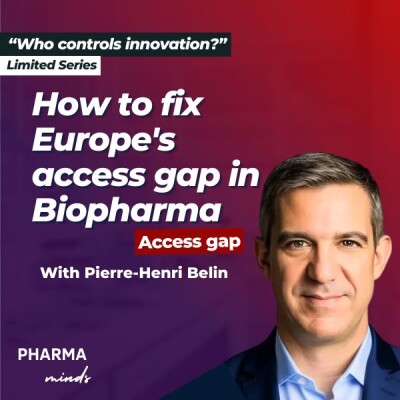
Welcome to Farmer Minds. Today I'm with Pierre-Henri Belin and I just want to say that I'm very happy to be here with you, Pierre-Henri. It's a real pleasure to have you here and thank you so much for joining me today.
- Speaker #1
Yeah, thank you very much for inviting me. Very happy as well. Pleasure to be in this very famous podcast now.
- Speaker #2
Yes. And to share your story.
- Speaker #1
Exactly.
- Speaker #2
In a few words about what you've done, you've worked your whole career at Johnson & Johnson and you decided to become an entrepreneur.
- Speaker #1
Made the jump in 2022, very hands, yes. And with Xcube Bio. And we are a platform that helps big pharma, little pharma, late stage biopharma to really get into Europe in the best possible way. So we are a market entry accelerator.
- Speaker #2
Okay, so the reason I wanted you here today is because you told me and you mentioned before that since, yes, this month and over these past few years, you have met with 100 different biotechs that are currently operating abroad, specifically outside of Europe. Through these meetings, you discovered that maybe 100 different drugs were available outside. Really interesting drugs for patients, but not existing in Europe.
- Speaker #1
When you look at the statistics, and it's not my statistics, it's IQVIA statistics, there are more than 100 drugs. that have been launched in the US in the last five years that are not in Europe, right? And we see this number is very constantly growing, unfortunately. And it means just, it's as simple as that, is that patients in Europe are not treated the same way as in the US and have not access to the same type of drugs, right? And here we're really talking about new molecular entities. So not even, you know, biosimilars or generics or things like that, or MeToo's, yeah.
- Speaker #2
What opened your eyes to this problem? Because you were in a big pharma?
- Speaker #1
Yeah. The reflection we had was that an advisory was nice, was useful, but was not maybe enough. And there was a need for more than that. This was also in the context a couple of years ago, or even more now, maybe five years ago, where you had these very high profile biotechs coming to Europe, like Bluebird Bio, like AGIOS, others, and just running into problems along the way, you know, and sometimes it can be a bit frustrating. And those biotechs were first. Great assets, great teams, very well advised. And so there was really something about the execution, right, that needed to be sorted. And typically Bluebird Bio, for example, or AGIOS, and I mean great companies. I mean, we met with the executive. They are absolutely great. So this is not a competency. This is about making it work and having the right sequence of execution, having the right angle, strategic angles. understanding in a deep way the stakeholders, how payers would work, for example, how a hospital or a KOL would work in a different way than in the US, right? And so this is all these things that need to be there.
- Speaker #2
Okay. Okay. And how did you start?
- Speaker #1
And so we decided and we tested the idea of creating what is called in financial jargon, an SPV, a special purpose vehicle, or a NEWCO. So creating basically a company in Europe that would be a shell in which we would... create and execute the launch and the entry of the partner. So we would offer Biopharma the opportunity to create with us a small company, a different company, an empty shell called Nuco. That would be the nucleus of the entity that you need to deploy across Europe. And we would use this entity as an execution vehicle and we would service and we would, I mean, provide expertise to this entity to grow it step by step. according to a very clean, very sequenced execution plan. We are not doing a licensing because we are just building organization and we are building on behalf of an organization according to a plan that we believe is efficient and is mitigating the risk of getting to Europe. So this is really appreciated. We see a lot of CEOs in particular who are at the beginning of their business, you know, and they have got it. It is really hard for them sometimes to give away to a licensing organization, something that they spent years and years to develop, right?
- Speaker #2
Yes.
- Speaker #1
And so here they stay in control. We are a temporary partnership, so we are vanishing at some point once we have done the job. But we have got skin in the game with them also because we are investing in Europe for them.
- Speaker #2
Yes. Okay. And how is it going today? Have you already?
- Speaker #1
So we've got it. Yeah, we've got it. We progressed a lot of companies. We are closing one, our first one, very soon that I can... I cannot just give all the things.
- Speaker #2
It gets closed?
- Speaker #1
Yeah, out. And we've got three or four that are really on the short term. And it's very exciting because they are very exciting assets in a sense that it's very innovative. We see, I mean, for patients, it's going to be great and so on. So really, really, really good, really good thing.
- Speaker #2
Okay. What I like, yes?
- Speaker #1
Maybe just the most, I mean, just to tell you, the model, I think, is interesting in the sense that it's also... I would say filtering out, it's maybe a bit strong, but incentivizing the type of company with R&D with a second asset or second indication. They like particularly our model because they know they're going to have their own structure for the second asset and so on. And you've got this kind of company with a platform with a lot of science. It's not necessarily the one shot you can find or say that you've got one asset they want to monetize quick and quick. I mean, this can be also great. I mean, this can be also great assets sometimes, but here we've got this kind of very passionate people. And yes, and that's adding the motivation to work along them and, yeah, get their science to the final goal, right? To the patients ultimately, yeah.
- Speaker #2
Yes, and I was wondering, is it useful or can it be useful also for European biotechs who want to address the European markets? And which start with, we start with the science.
- Speaker #1
That's interesting. Yeah, I think our initial assumptions was that's going to be a U.S. play. Yeah, because this is where you've got, of course, a lot of innovation. Well, needless to say, but also you've got a lot of this gap that exists in terms of the cultural gap on the way things should happen. But we realize also that, yeah, European biopharma, we're also potentially interested by this model and actually not just them. And, well, we may talk about this later on. We see more and more innovation and particularly Chinese companies with great potential and that are also interested in this model.
- Speaker #2
You said we are in a moment where innovation is rising a lot, exploding, and we are in a certain world. And we didn't talk about this, but also budget to pay for drugs, for innovative drugs in Europe are limited.
- Speaker #1
Yep, sure.
- Speaker #2
And And then it's, yes, actually the first step in the cold water for you is really, yes, to decide to do something new, to propose something. And I like the idea because, you know, what exists and you have to create. Someone has to create. And yes, just try. And what is maybe the perception of the payers? What could they gain from this? What is the value for them too? Because it's also an end point.
- Speaker #1
Yeah, of course. Well, I mean, I think that the payers are not. You know, they are not evil, right? They want value. And so they want to make sure that what you bring to the market is going to be a real value for the health care system overall, for the patient, of course, but also in general for the health care system. So if you bring an innovation that is a real innovation where you've got the right endpoints and you've got the right demonstration, what we see is that payers are inclined to pay for the right things, right? And of course there are budget constraints and so on, but you can get there. What we also propose on the other side is really to be as lean as possible to make sure that we are not throwing money away that would not be driving more value to patients. And so our model is also very much driven towards this. But we fundamentally believe that, again, if there are good assets, there is a willingness to pay. And when you look at a difficult conversation with payers, it's often because the added value to the existing standard of care is not great or that the data that have been generated to demonstrate it is not a fit. Right. And that's what we try to avoid in our process.
- Speaker #2
To anticipate. Yeah.
- Speaker #1
Yeah, to anticipate. And we like to talk to companies that are, to start talking to companies that are phase two so that we can, we don't do new co at this stage or whatever. It's very light, but we can definitely help them just by reflecting thoughtfully on the last phase of their clinical developments to make sure that they are truly ready and nothing important is missed. They deliver, they produce the right data set that makes the conversation with EMEA in one sense, but also with pairs, a better one. And so, yeah.
- Speaker #2
So you can, yes, nearly assure them they will go somewhere.
- Speaker #1
Yeah, And I put them in, I mean, there are some misconceptions. I mean, the dynamics of pricing in the United States and Europe is so different. And we cannot blame the biotechs for looking first at the U.S. market because this is what makes their investments, you know, viable. Unfortunately, the United States is really so important now in terms of financials. So they have to do that. But Europe is important as well. I mean, it can still be a sizable amount of their business. There are a lot of patients. There are more patients than in the United States. So this is a go-to-market strategy.
- Speaker #2
Yes, but I think it's also, we didn't talk about these sectors, but also for big pharma to understand how a launch can be done.
- Speaker #1
Yeah.
- Speaker #2
Maybe, you know, in a kind of like leaner way and achieve profitability with different expenses.
- Speaker #1
Yeah, absolutely. I mean, I've been in large pharma. And we sometimes turn down assets that could have been interesting to license or acquire because they were just too small. Because the cost of the platform, the operating elements of big pharma is already there. And you just can't make it work for a small patient population most of the time, right? And we see that, for example, big pharma companies now tend to step away from the orphan disease area because it's so difficult to operate in. And they go into GLP and all the things that are fashionable at the moment. But there is, I mean, there's a lot of innovation in smaller spaces, right? In those, I was looking at a statistic, I think. There are more than 9,000 diseases with no treatments. And so 10,000, I think we have 10,000 orphan diseases. And yeah, most of them have no treatment. And the large majority impacts kids as well, right?
- Speaker #2
So they talk about a tsunami of innovation.
- Speaker #1
And so, yes, it's really, yeah. And so how do you get there? I think the biopharma platforms are fantastic for deploying, you know, large-scale, large-scale innovation. I mean, the COVID vaccines or immunologics and things like this. But for smaller things, you probably need something different. And this is what we're trying to crack here.
- Speaker #2
Okay.
- Speaker #1
For very specific precision medicine, you probably need another way to look at things. One that is more flexible, that is more purpose-built and, yeah, leaves options open to make sure you can adapt to the market conditions.
- Speaker #2
Yes, indeed. It's very complex, but that's what makes this interesting. And can you maybe in one sentence explain your mission so we can really understand what…
- Speaker #1
Well, bringing innovations to patients and really doing…
- Speaker #2
Targeted innovation, yeah.
- Speaker #1
And so… It's really helping biopharma go that last mile to their patients. They've done a, many of them have done incredible work, just, you know, deploying from phase one to phase three, or even preclinical to phase three. And so the last piece is very important, and it's often a bit neglected because it's not seen by the R&D organization, or it's not seen as a challenge, right? I, well, you've probably heard this, but you hear a lot of CEOs saying, you know, my product is so good. I don't need a commercial team.
- Speaker #2
Yes, science.
- Speaker #1
It's going to be sold like hotcakes, right? Which never happens, of course, because it's a bit more complex than that. But OK, you can't blame them for being there, right? What we try to do is help them just evolve to the next step and really make sure they don't miss what we call the last mile. So the little piece of work, I mean, it's not so little, actually, but the little piece of work that needs to be done from the end of your data set or the generation of data. to the real patients having real access and being treated in real conditions.
- Speaker #2
Yes. And then it means you do maybe, I don't know if it's a few years, five years with you, partnerships means they would have two years of commercialization with you and you do the good.
- Speaker #1
As well. We go, I mean, typically we go four to six, yeah. An average of five, you're right. And that leaves us time to of course go through this regulatory process and payer and also deploy across the continent. Because I mean, the other thing about Europe is that it's so fragmented that you cannot just do one launch. And this is another concept that is quite difficult from a United States standpoint. It's not one launch. It's just like 27 or more launches that are happening over two or three years. And so, yeah, we have time to do that once we are there. It's time for us to exit.
- Speaker #2
Yes, this is exactly what they are planning to do at this point in time. Okay. Yes. And how is it generally perceived or understood from the financials in the United States as well?
- Speaker #1
Yeah, I mean, it was very interesting. I think the fact that the United States market is now a little bit more uncertain, right? Totally. Of course, it's still the top priority overall. We see more and more investment vehicles or funds, things like this, interested in looking outside, probably just to diversify and make sure they're not just relying on the United States. We had this experience of talking to funds where the partners were telling us, you know, it's the first time I see how business works in Europe. Right. So we never really bet on this. So it means that the investment they've done in some of the biotechs were just against the United States potential. So it's initially they were not interested, but they're starting to be interested.
- Speaker #2
OK, starting to just open their eyes.
- Speaker #1
And because also they realize I mean, they realize that some funds have dozens of those biotechs that are now reaching. you know, phase three. And the question is, what do we do? And so they can't necessarily find a license. They don't want to do a license. They want to go on their own and so on. And so there is this question that is coming and they see that there are more and more of these companies. And this is a step that is important because it's a step of monetization, right? So it's a step where the investments start to return, right? And so they are very interested in our model. We've got a lot of traction on this. which is nice because it helps us just really plan for some fundings and so on. The difficulty that we often have is always to showcase a brand new model, right? And so, as you can imagine, it actually took us a little bit of time to really get everything ready and to get people acquainted with that so they see the benefits and so on.
- Speaker #2
Yes, to trust it also, yeah.
- Speaker #1
But we've got a truly fantastic, absolutely fantastic connection now, you know, with this whole investment world. They really see the value in what we're doing. And they also recognize the need for that kind of thing. It's a big step forward, honestly. And it's something we've been working toward for a long time. When you look at, as we said, something like 2,000 assets, when you look at the number of operators able to bring innovation in Europe as a whole, not just counting some very sub-regional ones, there are less than 100, probably 80. So you've got 2,000 assets, 80 players. There is something wrong, right? You need to have more options. And I think most of the funds understood that and the investors understood that. So, yeah.
- Speaker #2
Yes. And it's also a way to present Europe as an open market with solutions.
- Speaker #1
Yeah, exactly. And it's exactly.
- Speaker #2
Instead of like.
- Speaker #1
Problems.
- Speaker #2
Instead, yes.
- Speaker #1
Yeah. I mean, honestly, the reputation of Europe as a pharmaceutical market, you know, is really not that great, to be perfectly honest. And sometimes, honestly, for the wrong reason, because there are things that are done in the right way as well. Yeah, it's just a different market. And this is what we try to explain. It's not worse or better. It's different.
- Speaker #2
I think it's more complex.
- Speaker #1
Yeah.
- Speaker #2
Then you probably just need a little more time to really come to terms with it.
- Speaker #1
I would almost disagree with that. I think I would agree in a way, but I would almost disagree. I think the entry is more complex. And so getting in there, the market entry, getting into the country, into Europe is complex. And it's much more complex than the US, where you've got a very free market. So the access is very good.
- Speaker #2
But you have, yes, one payer after that, yeah.
- Speaker #1
But then once you convince the payer, you've also got what is called universal coverage in most countries. So you don't have any questions asked. If there is a prescription, there is a fulfillment.
- Speaker #2
Yes.
- Speaker #1
In the US, of course, you can launch and pretend you launch very easily because it's a free market. You set your price, you go, right? And it's there. But you've got so many things to do along the way. Sometimes almost just to convince patient by patient, right? Payer by payer, right? So. There is a lot of complexity that is coming progressively in the US.
- Speaker #2
Okay, it's different.
- Speaker #1
Yeah, and it's what I said. I mean, it's different muscles. And this is where I think... We believe the issue is, right? Capabilities are different. Yeah.
- Speaker #2
Okay. So again, yes, Europe is generally seen, you know, as a much more regulated part of the world, actually.
- Speaker #1
It is. Yeah. Fragmented.
- Speaker #2
Yes. Fragmented and maybe the cultural aspect too, but in the US?
- Speaker #1
Yeah. Culture. Yes.
- Speaker #2
Commercial.
- Speaker #1
Yeah.
- Speaker #2
Okay. What if a launch fails? Who pays?
- Speaker #1
So we do. We take the risks, right? Yeah. Well, financially, we take the risk. of complete failure right that exists the worst case this is the worst case i'm not saying it's never going to happen we've got a lot of control on that and we again the way to do that is really to sequence your investments and this is what we what we do so that if you lose you don't lose too big, right?
- Speaker #2
It means you can stop, you can change your mind in the middle.
- Speaker #1
We can, we've got some, I mean, in cooperation with our biopharma partner, of course, there are ways to step out, right, if we need to. But we fund this launch, right, the market entry and the deployment. So this is our financial risk, right, overall. I mean, again, we try to control that by sequencing our investments, by being, again, lean, flex.
- Speaker #2
Yes, and you will learn on the way and reduce your failure rate.
- Speaker #1
Exactly, exactly. But they are, I mean, the biotechs which went alone and succeeded, they are in Europe, right? There are some of them flourished, right? And they did great. They had all this kind of discipline of sequencing, of getting step by step and, you know, moving from one success to the other and learning from the failures and adjusting afterwards and so on. And this is really the way to go. And again, very different from a US launch where the point is really to go strong, full in a first step, right? So that's what we try to do.
- Speaker #2
Yes, and okay. I mean, yes, I really try to, I start to imagine yourself, you know, as a group with different companies. And then it means you don't have, yes, limitations for competitive risk or anything. Because each one is in silos and each one can operate. Because it's like, I think something really special about this industry. is it means different companies, different business can be into the same house.
- Speaker #1
Yeah, that's true. I mean, what Xscape Bio is, is primarily a platform. So a platform that is creating companies. So you're right. Each of the partners got their own companies and we can operate them separately and so on. But we, the platform is there to be able to scale, right? And to be able to have a lot of these companies. We don't think it's, I mean, we think it's probably... a better approach. In the current world where, you know, we've got precision medicine, you've got very targeted assets. The focus is important and more than the cross.
- Speaker #2
Yes, I would really like to take some time to talk about your 100 interviews that you have conducted and to give a bit of an insight from someone who is actually involved, not just from a position paper or a report about these companies, what's happening with them, where all of this comes from, and what exactly are we talking about here? What is the real story behind all of this?
- Speaker #1
I mean, maybe we can start with what we observed is their problem, basically, which was not necessarily as clear when we started, right? And because you say, okay, maybe they don't have money, maybe they don't have willingness or something like this to go to Europe. What we see are two things, but three things, but two things that are really stringent. First is they don't have the bandwidth. This is as simple as that, is that they are into so many other things that getting five minutes of brain time in Europe is just like a struggle, right? And so this is the primary thing I would say is that they know it's great. They know it's important. They know they should do something, but the organization is not fit. And we see that in small, but also in larger. Biotech is the same, right? Because there are so many other priorities or things that are perceived as other priorities that is there. So that's the first thing. And the second one is not necessarily a matter of money. It's a matter of allocation of resource. And because when you, again, speaking to those CEOs and the CBOs and chief commercial officer, it's so hard to put a dollar in Europe when you've got also an opportunity to put a dollar in the U.S. organization or commercial organization or in R&D. And even if they've got this kind of plans in mind, if we've got the money to do that, theoretically, it's such a difficult thing to say, okay, yes, we're going to put this money into that to launch in Europe. And probably based on the fact that they don't know how Europe works in most of the cases.
- Speaker #2
And what about companies that are based in the East?
- Speaker #1
So, I mean, we had a very interesting conversation, we say, and we hope that we can get a deal with an Asian company, Chinese in particular. I think there is really a big tectonic move at the moment in the biotech area where Chinese organizations are really coming to a point where they do that in a very professional way, very neat, very clean way. We had access to a few data rooms and we had a chance to look at some data and it's very well done, honestly. And they've got a long-term perspective that is interesting. And so they are also very interested in our model for this reason as well, because they see us as a kind of a step-to-step into Europe. And then they've got their own business in Europe, and then they're fine, right? But the conversation will be much more, what's going after that? What is happening after the partnership, rather than what is happening during the partnership, where when do we get the patients? When do we really get a price? And so on forth. And so we've got way more conversation on how to build, what's going to be the impact on the long run and so on and so forth. So this is a really different conversation. But they're going to be there for sure. And they're going to be there for a right reason because they're going to bring, I mean, innovation and really nice assets.
- Speaker #2
Then maybe the political situation is maybe actually having an impact on some biotech strategies.
- Speaker #1
I mean, yes. Yes, of course. I mean. There has been a lot of things happening, particularly since the beginning of the year with the new US administration that are touching us indirectly. And I think tariffs is not touching us directly because for us, it's bringing things into Europe. So it's not selling something to US, but it's creating uncertainty. All the things that are going on with the FDA, all the shakeups in the FDA administration and so on is creating uncertainty. The conversation on what is called most favored nation, which tried to align the prices with Europe and the U.S. or try to get the European paying more for innovation. This is also creating, you know, questions and so on. And it's delaying for us. It's delaying the decision in general. But it's not necessarily, you know, cutting out the discussions, too, and just. you know, cutting out everything out of Europe and say, I mean, we've got some companies telling us, okay, we probably don't go to Europe because it's too complicated now. But it's not too much of that. And then for the Chinese, it's also very interesting because they are the Chinese or Japanese, but the Chinese in particular, they want also to not just invest into the US, but also they understand that they also need to invest into Europe, right?
- Speaker #2
Yes.
- Speaker #1
And so we've got this growing and significant increased interest, I think, from Chinese companies, really. And why did you decide to found the company here to establish the company in Europe here?
- Speaker #0
Well, yeah, it's a good question. I mean...
- Speaker #1
Is there a reason or not?
- Speaker #0
Yeah, yeah, there is. I mean, there is, well, besides the fact that some of our founders are Swiss, and I used to live in Switzerland for a long time, but we believe that Switzerland is really a very good combination of business features. I think it's very stable. I mean, it's business friendly. I mean, these are all the things that are known, right? But what is very important is I think if you think, if you look at Europe, this is the largest hub of talent, period. There is no other competing area from, at least from a commercial talent or, you know, late stage talent, I would say. And so our model is about creating businesses. So it's about hiring people as well. It's about having those competencies to have excellence in-house. And so it's very important that we are in the middle of that, right? And that we can just tap into this fantastic ecosystem of Switzerland. So, yeah, I would say first is probably the talent pool. And second is probably the business friendly elements. And, okay.
- Speaker #1
Okay. And just talking a little bit more about the kinds of talents you need, you know, can you explain a bit?
- Speaker #0
Sure. We've got the way we work is twofold, actually. We've got our own platform. So Xcode.bio, which is providing services. And it's providing also expertise to set up the new companies, to set up the new entities and so on. And for that, we've actually got a really extensive network of talented individuals. We've got at this point probably very close to about 50 different experts in our networks covering all the various functions and areas that you could possibly imagine. And we need to have a very comprehensive and thorough network here because we are dealing with companies with very specific technology.
- Speaker #1
Okay.
- Speaker #0
So when you've got a radiopharmaceutical company, you cannot just get your random CMC or your random regulatory. You need someone who knows this, right?
- Speaker #1
Okay.
- Speaker #0
And so we've got, it's very important for us to have this talent pool. So first thing, the second element is that when we create the new company, we need to populate the new company. We also, in general, we create an entity here in Switzerland that is going to deploy across Europe. But we put the headquarters here. And so this is where we need to have people with the commercial excellence, you know, expertise, again, in various disease areas.
- Speaker #1
So, okay, like...
- Speaker #0
I mean, we go from a, I don't know, neuroscience with something in very specific neuroscience element to rare oncology or rare disease and so on. And you need different profiles and you need to have this kind of diversity around you to be able to ramp up your organization. And I don't see too many other countries with that level of diversity. the breadth of talents that exist in Europe, at least.
- Speaker #1
Yes, to deal with Europe and to really handle everything that comes with it.
- Speaker #0
Yeah, sure.
- Speaker #1
We still have a few minutes. I would like to talk about the future. What do you think is the biggest threat of this system, this European system, in your opinion?
- Speaker #0
That's a broad question. Well, let me see. Well, I struggle to answer to this question, to be honest, because we don't see that as a threat, right? The way we try to think about it is as a given, right? And this is the way it is at the moment. How do we make the best of that? Then how do we, you know, play with the system to be able to reach the patient in a viable, in a financially viable way, right, for biotech? So I would say, I would say, I mean, of course, the main difficulty is definitely going to be the budget and the prioritization of the budget of healthcare systems in Europe, you know, right? Where do you, where do you, you know, you've got a limited budget, where do you put your efforts, right? Do you want to go into very specific diseases that may be a bit more expensive, but very neglected or very difficult to treat things? Or are you going to go into or invest your money into early stage or just primary medicine, all these kind of things? And we see this is not always very good. We see in some countries that there is a lot of money spent on, you know, analgesics and first line things and reimbursed very, very well, right? And then it's putting pressure on, you know, the last cancer treatments that is probably going to save the life of someone, right? But a few, right?
- Speaker #1
Okay, no problem.
- Speaker #0
And so this is probably, this is this unclear prioritization that is probably a threat, I believe. The fit for precision medicine, if you want, at the end. So are we going to get into a world where we take care more of this kind of very difficult things?
- Speaker #1
Okay. Okay. Unclear, you say. Okay.
- Speaker #0
So I would say that.
- Speaker #1
Yeah, the strategy is unclear to what we want to. Okay. But yes, what's interesting is you're in the middle of innovation and science and a product.
- Speaker #0
Yeah.
- Speaker #1
Then it's also maybe a way to invest in science and to push science. For you, it might be a bit challenging, maybe even more so than for others, because you are trying to bring in innovation from abroad. And this means you are introducing new ideas and approaches that people here might not be familiar with, which can make things more complicated.
- Speaker #0
Yeah, I mean, we bring solutions for patients, so we bring solutions for healthcare, right? I mean, I would hope that there is more of European innovations coming, and it seems that the European institutions are getting there slowly, but they probably need to muscle up. of course, the investments in early stage biotech and things like this, where we are focused is really probably a bit more on, again, the delivery to the patients and how we have, at the end of the day, a more healthy population, or at least some people are really treated better, right? And here, yes, there is already a lot to do because there are those late stage assets that are ready. And there is really a tsunami that is coming. So the question of prioritization is going to be very acute at some point. In payers' discussions and also in budget and political discussions in certain countries, this issue arises because either you accept not to fund some medicine or you have to make a difficult choice and lag a little bit behind, which we're already starting to see in some countries, right? Lagging a bit behind in terms of innovation and you leave.
- Speaker #1
Yes, there are ways.
- Speaker #0
And you leave patients without solutions that exist elsewhere in the world. Or you make the decision to really fund that, making sure that access is preserved for assets that are well demonstrated for adding value. And then you do maybe a little bit less on other things, right, that are, it's less life threatening, less serious. I don't really know how to actually qualify that, but there is this shift. And probably flexibility is going to be very important to have. And this is not always the most evident feature of systems that are not that flexible. And so that's where the tension may come. But we are here to, I mean, we see ourselves as being here to help, not just to fight. It's really about how we can do the best with this system and try to make an...
- Speaker #1
Yes, but it's also quite interesting, actually, because right in front of you, what you see is the big pharmaceutical company model, which, as you know, is also not particularly flexible.
- Speaker #0
Yeah, yeah. I mean, they've got their merits and they've got such a... I don't want to blame them because it's not about that.
- Speaker #1
No, no, it's not the point.
- Speaker #0
But they really do have significant advantages when it comes to bringing about this kind of large-scale innovation. And they do that in a great way.
- Speaker #1
And it was a moment to make this happen.
- Speaker #0
But there are actually other things to do, right? And there are really all these smaller disease areas where...
- Speaker #1
Yes. And the point is, in the face of problems, what do you propose? How can you adapt?
- Speaker #0
And so... We see so many drugs that are getting really close to the market. And at the moment, there is no plan to go to Europe. And that's a shame. I mean, among the advanced markets, this is the biggest patient market, if I may say so, or the patient pool, right? There are many more patients than in the US alone. So you cannot just, I mean, in my view, you cannot just go without it, right? You have to be there. You have to be in Europe.
- Speaker #1
Yes. And how do you see your company in five years?
- Speaker #0
So, yeah, good question. With a lot of NUCO, a lot of partners, we are building the platform to be able to scale. So that's really about, it's not just about having one or two. It's really just being able to go big. There are also other geographies that we're interested in. I'm probably biased because I lived in Japan for some time. And I think the Japanese market also, in a way, shares common things with the European one. It's very difficult to get in. But once you're in, it's a fantastic healthcare system.
- Speaker #1
Okay. What advice would you give to a biotech CEO?
- Speaker #0
I would tell them don't neglect Europe. It's a great market. It's a great place to also learn for them. And because there's good science, there are good doctors.
- Speaker #1
Yeah.
- Speaker #0
There are a lot of patients. And so be prepared and grow the right muscle to get there. And we are here to help if need be.
- Speaker #1
Yeah. Okay. Thank you.
- Speaker #0
Thank you very much, Natalie. It was very nice.
- Speaker #1
In the next episode, we'll explore the tension between access, price and collective choices. And in the comments, feel free to tell me, is Europe too fragmented to be competitive or is its diversity a strength? I
![[Insights] Produits frontières : transformer la réglementation en avantage stratégique cover](https://image.ausha.co/DxYZ9g83tTEC6Wr39rcUpzpTWcQsUBjd7hU5AZsG_400x400.jpeg)
![[Insights] Groupements de pharmacies : ce qu’il faut retenir du rapport IGF-IGAS, avec Hugues Villey Desmeserets cover](https://image.ausha.co/UgNUSqEle2cZH1rOVklykwyk35Rz2q4seXKVMgWM_400x400.jpeg)
![[EXTRAIT] Une innovation en prévention qui inspire jusqu'au Danemark... avec Anne Beinier cover](https://image.ausha.co/PuxqczYfLjqCYtMRA0dqMcN77dzaY8CoGDnOnLF2_400x400.jpeg)