- Speaker #0
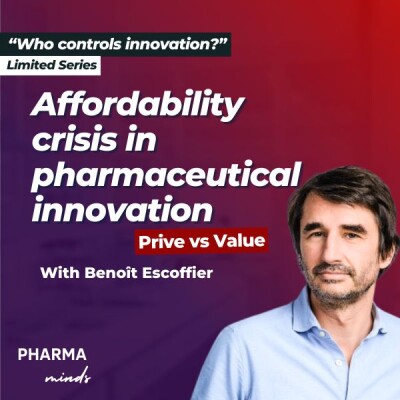
Pharma faces constant pressure, patient access, public system sustainability, and corporate viability. Since this interview, Benoit Escoffier has become Head of Access Europe at Daiichi Sankyo, which makes this conversation even more relevant. The question is no longer theoretical. It's about how to balance societal expectations with the economic reality of innovation. What responsibility do pharmaceutical companies have in maintaining this balance? We discuss this in this video. This episode was recorded with the generous support of Daiichi Sankyo.
- Speaker #1
There's an extremely strong focus on price, not so much on value. We're obsessed with price and we don't work much on value. The business models of pharmaceutical groups will evolve. They must. That means we certainly need to think about other ways of evaluating medications.
- Speaker #0
Today, I have the chance to be with Benoit Escoffier. Hello, Benoit.
- Speaker #1
Hello, Nathalie.
- Speaker #0
Benoit is the head of Daiichi Sankyo in France. I'm delighted to be able to welcome him today because I feel like he has an atypical profile who will talk to us about science, innovation, leadership. And well, how do we go about tackling these subjects that are super cross-functional and still manage to have an impact with perhaps simplicity? In any case, I'm super happy to be able to have this discussion. I think we're going to have a slightly different perspective, someone who has well traveled the world and who can also bring us Well, the mission of Pharma Today. I'm super happy.
- Speaker #1
Well, me too.
- Speaker #0
I really hope so. So to begin with, I would like us to take a moment to talk a little bit about you and your experiences when you first arrived at Daiichi Sankyo. Could you tell me what exactly was it that truly fascinated you at that time? Was it perhaps something along the lines of basically a breakthrough innovation or a revolutionary new approach? specifically in the field of oncology, what was it that really caught your attention? Was there a particular moment or idea that stood out to you?
- Speaker #1
Yes, actually, it was what we might call a kind of second wave of innovation, really.
- Speaker #0
Right, yeah.
- Speaker #1
It was the monoclonal antibody drug conjugates, which had existed for some time, especially in breast cancer, and which had demonstrated extremely positive efficacy. And there, in fact, the Japanese researchers... Because one of the peculiarities of Daiichi Sankyo is that they really have in-house research that is very, very strong. The Japanese researchers, who are actually very strong in technology, more than in chemistry or biology, managed to develop an element which is quite important in ADCs, which is the linker, the one that connects the monoclonal antibody to the chemotherapy, basically, which is an element of stability. We managed to develop a second generation of that specific element, which meant that we managed to develop and offer to healthcare professionals and patients products that are even more effective than those that were on the market. And we are in this dynamic today, very focused on these molecules that we call ADCs. But in the future, we also have research and development on other techniques of production, which... I hope and I am certain will be.
- Speaker #0
Can you explain a bit what does it revolutionize in the field? Why do you actually decide to take on these kinds of fights?
- Speaker #1
Well, what I'd like to answer to your question is what is a revolution actually? I think the interest we have in the pharmaceutical industry is to bring innovations. And besides, I don't know if we all have the same definition of what an innovation is. We talk a lot about innovation. We talk a lot about the values of innovation.
- Speaker #0
Yeah, there's disruptive, there's incremental.
- Speaker #1
But we don't know. In the end, I am quite deeply convinced that whether it's the members of, well, those who work in the pharma industry or even the health authorities, they should always put themselves in the shoes of the citizen, the patient and the citizen, because we are all that first.
- Speaker #0
Yes, that's how we decide.
- Speaker #1
Before being, I am a citizen before being there to decide what needs to be done. For me, well, for me and for my team, because we worked on it, an innovation. Today, it can be characterized by three things. Either it prevents the disease, overall vaccine or other things, or it cures, or it allows one to live longer in better conditions. These are the three elements that could determine an innovation. So you could have a product that technically is not revolutionary, meaning it doesn't have a way of being produced that is absolutely new, but which meets one of these three innovation criteria and which will therefore improve the lives of patients and so on. So for me, it's more that which interests me. It's to say to myself, and what interested me in the portfolio, in development, in research and development at Daiichi Sankyo. What are the molecules that potentially will bring innovations? And it's on the basis of this discussion that I had with people who knew about it at the time, much better than me in oncology, and who told me, yes, there's something very promising in terms of innovation in this lab. So go for it. And so that's what I did.
- Speaker #0
Yeah, yeah. And today then you're in charge of the French subsidiary, but you also have a global role actually managing the upcoming portfolios.
- Speaker #1
Well, I was very interested in getting some R&D experience because overall, we operational structures aren't much without the researchers who find the molecules and bring them to us. And I really wanted to understand how that worked. And so we have a future product that's an ADC as well, but it targets another receptor called MUC1, which it binds to and which is present in many cancers. And there are groups that are very far upstream from the launches working on these molecules. It's early development, early stage, well, which I asked to work in. And so I work as what's called global commercial lead in that group for this molecule, which is a quite promising molecule. And that allowed me personally to learn a lot about all the stages of development, research and development, and also about the decision-making processes used at... that point. And then I think that my experience, which is more operational, more focused on sales elements, finance, and the probabilities of also contributed to helping us make choices, which isn't always easy when you're so, so far along in the development.
- Speaker #0
Yeah, yeah. And is it, do you want to tell us about that? Maybe about basically just the perspective of how a lab thinks five years before a launch, what it looks at? Because later, well, there might be people in administration listening who think, oh. Well, I'm going to have to validate that or not. And so actually, is that taken into account? I mean, on what criteria are these things that you, how do you anticipate them knowing that, well, you have your eye perhaps a bit sharpened on France, but you're not just dealing with France?
- Speaker #1
No, no. And I've worked on many regions, but I think it would actually be interesting. It's a good. It would be interesting, in fact, if perhaps the authorities could, or if there could be exchanges with the authorities upstream, only of phase threes, which are essentially the phases that actually allow for registration. Now, there can be exceptions or whatever, but there could be discussions upstream, particularly on protocol designs. Overall, the authorities on the very upstream part today...
- Speaker #0
Yeah, they're not there.
- Speaker #1
No, it's not. They don't have the time. Yeah,
- Speaker #0
yeah.
- Speaker #1
That's for sure. But the decision-making modes, first, there's a capitalistic decision-making mode, meaning these are huge investments. And so they can, to have, either you have deep enough pockets and you can do it all by yourself, or you decide to go and do it with a partner who can help you. That's what we did with AstraZeneca on one side and then with MSD on the other. So there's a decision already there. Then there's the part, let's say, very scientific and clinical, meaning the efficacy of the drug on various elements very early on to see if there's an activity that works or not. And then after that, we get into the logic of phase one, phase two, with a very strong driver nonetheless, which is scientific. Does it work or does it not work on which we must apply feasibility filters at some point? And that's where I come in is to say, yes, okay, it's scientifically or clinically, we see there's an activity. But overall, the market is already completely saturated, for example. So it will be hard to bring value compared to that where the target is so small that in terms of development costs compared to potentially what we could have in sales, it doesn't work. And so there are many decisions that come into play. based on a clinical activity relative to a feasibility to then move towards phases two, phase three and others. It's quite complex.
- Speaker #0
And it's not the right time to talk about that, because I'm going to ask you to talk about a stable world. But that means there's also, well, looking perhaps at the final market and what there will be in such a country to know how it's going to go. And they're the weight of each country. How do you... Look at it. Because while it's true that often health authorities naturally have a French perspective, they find it hard to consider that there are other countries, or even consider that other countries are there basically to pay. to pay for what happens in Europe?
- Speaker #1
Well, that's somewhat what happens in practice since the United States represents 50% of sales and almost 60% of profits, at least for specialty products, for 2% to 3% of the population. So there is something today, and I think it's one of the reasons, even if it's done in a somewhat brutal way, for which the American president is putting pressure on the pharmaceutical industry. So yes, I... I think we're at an extremely important moment where the business models of pharmaceutical groups will evolve. They will evolve and they must evolve. And that means we certainly need to think about other ways of evaluating medicines.
- Speaker #0
I was talking about innovation.
- Speaker #1
Exactly. First thing is what is an innovation? And then second thing is what value we give to innovation.
- Speaker #0
Yeah.
- Speaker #1
And that today.
- Speaker #0
For society, meaning not just for.
- Speaker #1
Well, exactly. I mean, basically, if our mission is to improve the quality of life for society in general, then our innovation must enable this improvement in quality of life. Today, we're still using the same evaluation criteria that we've had for quite some time, especially in oncology. And there are certainly things to contribute to work on regarding more comprehensive aspects of quality of life, for instance, improving quality of life across many more factors. where we target the populations we want to bring our innovations to, so that the effect is truly positive and not diluted. So there are things that we absolutely need to work on, well, to hope that this industry, which is, in my view, the most essential industry today, because it's the one that brings the most benefits to citizens, not many others do, at least in terms of industry, well, can continue to have a business model that rewards the risk taken. So is the risk today heavily? Those are discussions we can have which need to be refined. But overall, it's a capital intensive industry with significant risk taking, more so than in other industries, and where there must be a suitable return on that risk taking so that people continue to invest in this industry. But there's going to be a rebalancing in the coming years. And yes, does that mean there need to be other sources? of growth than just the United States. I think so. And I think it's a good thing too. Now, well, that's my feeling. I don't know how it will evolve.
- Speaker #0
So do you have, I mean, basically it means it's not necessarily health innovation paths, but basically it's paths for, maybe you can comment on paths for, actually, yeah, what are we not valuing enough today? Paths, you mentioned quality of life, yeah. For patients, You mentioned.
- Speaker #1
I think the feeling I have is that today...
- Speaker #0
What are we not looking at actually? What's in the blind spots that that means we're actually a bit off the mark in the sense of everyone, you know?
- Speaker #1
I have the feeling today that there's an extremely strong focus on price, not so much on value. We're obsessed with price and we don't work much on value. Maybe at one time it suited everyone not to work on it. But again, I think we're at a point where if we... The industry are proud of what we do and we're confident that what we do really brings something. We honestly have no real interest in continuing to let the authorities dictate how things should work, who actually have two main issues. The first issue is that budgets are becoming more and more restricted and it's not going to get any better. That's obvious. And the second is that there's still this old public-private opposition sentiment, unfortunately, which means the industry's image is still... quite negative. So I'm personally quite convinced, and I'm working with my team on this, that we need to work on value. Now, value is once again about the elements I mentioned. Innovation. Now, how do you value them? Well, it's certainly not simple.
- Speaker #0
No, but surely it was simpler to talk about a list price.
- Speaker #1
Exactly. It's certainly not simple. There are surely several criteria to be integrated into it. Of course, quality of life. impact on recovery, for example, in oncology, but also what it creates in terms of dynamism for a country and so on. But I think in any case, it would be interesting for the industry to spend time working on this. Because today I don't see what the solution is other than to keep fighting and fighting, yeah, and fighting without getting the results we want to have.
- Speaker #0
Because on top of that, there's a notion of actually being not disunited. but being opposing forces when in the end we're all looking, whether it's the public or private sector, as you say, or just the average citizen, we're all looking to be well cared for. If there's one thing for sure is that or to have the best care.
- Speaker #1
Yes. That's why I think the priority and main effort we all must make, and especially us in the industry, is to put ourselves in the citizens' shoes. Does the citizen...
- Speaker #0
Do they want this or not, this innovation or not? That's it.
- Speaker #1
Do they want this innovation and are they ready to fund...
- Speaker #0
Yeah, to pay for it.
- Speaker #1
This innovation, which is an investment. Yeah,
- Speaker #0
yeah. Not necessarily out of pocket, but the society...
- Speaker #1
The cost, no. It's an investment. Are they ready to invest in that?
- Speaker #0
Yes.
- Speaker #1
And why? And you know, and I mean, and we really have to put ourselves...
- Speaker #0
It's a very responsible approach you're asking of a citizen to say, actually, it's normal that in certain areas we invest. It's an approach that's a bit new.
- Speaker #1
For me, the point isn't so much asking the citizen to decide, but for us to put ourselves in the...
- Speaker #0
Citizen's shoes.
- Speaker #1
Meaning that I, as the industry, okay, I have financial goals that are obvious. Our mission is to improve quality of life within a sustainable financial framework.
- Speaker #0
Yes. In fact, you're going to look for something else if...
- Speaker #1
The health authorities, their goal today is to ensure that the budget doesn't blow up, doesn't blow up, doesn't blow up. And so we're dealing with two opposing logics. But there comes a point where at least putting ourselves in each other's shoes and saying, yes, on this, it's clear. That there's an innovation because it meets the criteria I mentioned, at least one of the three, and that it's valued in this way. That could be interesting.
- Speaker #0
Right. Thank you very much. I appreciate your willingness to share your experiences. I'd really like to hear you talk a bit more in detail about things that are perhaps a bit more concrete and specific in your daily work today. So as I understand it, you took over an existing subsidiary, but it was one that had to be completely transformed from the ground up. What was going through your mind? At that time, what were you thinking about? What did you want to achieve and what were your goals? What did you want to achieve?
- Speaker #1
I was very lucky because, yes, I took over the Daiichi Sankyo France subsidiary in 2019. There were just under 20 employees who we still had a cardio portfolio, but mainly for export markets. So they still had to maintain a minimum level of activity there. So today we're at over 90, which is absolutely very interesting and remarkable. And for me, well, that was the challenge. It was the challenge of rebuilding a subsidiary with an existing team and a team I was going to build and create. With my own personal ideas and desires that Daiichi Sankyo really allowed me to develop more of a startup mindset with a lot of collective intelligence, with a lot of empowerment, with a lot of decentralized decision making, with a lot of work on oneself. Because once again, I think it's starting to be perfectly understood and known. I mean, a happy employee is an engaged employee. And overall, your mission will be achieved, or at least your goals, your ambition. So for me, all my work, besides defining a vision and a plan, is to recruit people who share this kind of mindset, who are truly committed to building teams that genuinely want to work together, and then to ensure throughout the entire year that overall, as a group, they continue to be fulfilled and satisfied in doing what we do together as a team. Well, I think that perhaps one of my main qualities is quite precisely the ability to simplify complex things and make them easier to understand things. And in any case, to express those thoughts and feelings to my teams in a way that is truly authentic and genuine, but not in a way that comes across as pessimistic or negative, because there are, of course, always things that are complicated. There are things that are, it's certain that Donald Trump's policy today, or at least the threats that he indeed, but I honestly think that there are always opportunities to be found in every threat. I believe there's a significant opportunity for Europe, especially when the United States stops investing in science. And so what I try to do is tell myself, look, what we see as a difficulty, what... opportunity can it create? I don't want to deny the difficulty, but I'm interested in opening up to the opportunity. We had time for decisions. These are long timeframes, the pharmaceutical industry. And now, in fact, it's an industry that's accelerating on many subjects, but which nevertheless remains a long-term industry. So there's a complexity, another one that's being added. I'm quite personally convinced that we'll get something positive out of it too, that we'll manage to evolve our decision-making methods, that we'll manage to evolve our investment methods.
- Speaker #0
What's it due to? Can you give us a bit, explain? What's this acceleration due to?
- Speaker #1
I think it's due to, there are different subjects. There are all the geopolitical elements we talked about, which mean that suddenly we can no longer not have a plan B, C or D in relation to this instability.
- Speaker #0
Yeah, knowing that it'll be plan E.
- Speaker #1
Exactly, which is super important. We can talk about the United States and China, which are still two drivers today of the industry. One that wants to stop everything, that wants to cut prices and then invest much less in science. and the other that wants to take a major hegemony with Europe in the middle, battling a bit over things, it might be time for us to take leadership on other things. So the geopolitical dimension is important. The dimension of artificial intelligence will also come, notably in everything that is the research and development phase, to revolutionize our way of...
- Speaker #0
It gives time, I'd say. It accelerates, but it gives time too.
- Speaker #1
It's going to accelerate. It's certainly going to increase the number of competitors, the number of people who will invest in this industry. So your ability to be on the market as quickly as possible will be an element that will be primordial in the definition of your business model. That's an element that's also extremely important. And then, once again, budgetary crises will require us to be much more agile, much more reactive, and I even think, above all, much more proactive. Because today we're mostly very reactive. And so these are elements that will impose a strong effort on us to redefine a business model that must continue to reward risk-taking, but no longer in the same way.
- Speaker #0
Okay. In any case, it's going to be fascinating. It's going to be great.
- Speaker #1
It can be, yeah, for sure. Absolutely.
- Speaker #0
What would make it not be?
- Speaker #1
That we don't want to go there.
- Speaker #0
We're afraid to go.
- Speaker #1
Yes, of course.
- Speaker #0
But there will be countries that go there.
- Speaker #1
Here, I'm mainly talking about the labs and companies. Basically, today we have a business.
- Speaker #0
They don't want to change their...
- Speaker #1
Well, it's always the same. You've seen it in many sectors, right?
- Speaker #0
Well, giving up on Europe, basically.
- Speaker #1
Yes, but it's... Today, there are pillars of the definition of our business model that have made this industry wealthy and thus innovation for society for X years that are currently, well, shifting. Either we stay saying to ourselves, No, it mustn't stop. It has to stay like this. And I fear that won't work or we manage to anticipate, even if it means anyway to choose is to renounce. Right. Even if it means giving up certain things to continue to flourish in a different way of of seeing our industry. And I think that will work.
- Speaker #0
Don't you have any models in mind of people who who are already doing it in the pharmaceutical industry?
- Speaker #1
Well, I'm not enough, perhaps today. uh aware or really in the inner workings of the the big labs or others to know who already has this well is working on it i imagine everyone is actually it's not so much that i think everyone sees it what's harder is making the decision and it's i think it's a bit like everything the first one who makes the decision we'll have one or we'll have lost that's always the issue it reminds me of the times when we had tons of medical sales networks. And then... As soon as one person put one in, then another would put one in. And then everyone realized that it was ridiculous and that it destroyed the value relationship with the prescriber as well. But everyone said, wait, if I remove one, well, I'm going to lose my share of voice. So there was this...
- Speaker #0
So would it be a new lab that's going to do it?
- Speaker #1
No, I don't think so. No, no, I think that I think there are leaders who are visionary enough and...
- Speaker #0
I don't know how to say it politely, but actually... well, an idea is worth nothing until it's been at least executed. And when it is executed, the execution will be completely different. So then we can play for time. We can wait. But, well, it remains to be invented. It's like there might be several models, actually, even.
- Speaker #1
I'm even convinced there will be several models. That's for sure.
- Speaker #0
Here we're talking about one farmer, but there may be several formats or models to be decided.
- Speaker #1
As I was saying, the... the drugs we're going to put on the market won't more and more and more be on a restricted target for which you'll have a specific contribution. And so that means a different financing logic than what we see today. There are many different things that will continue to evolve. My feeling is that we really need to be more proactive in thoughtfully designing this horizon.
- Speaker #0
Yeah, yeah, I know.
- Speaker #1
But be attentive, just because there are others out there who aren't really waiting.
- Speaker #0
Yeah, yeah.
- Speaker #1
I'm talking about the industry in general.
- Speaker #0
Yeah.
- Speaker #1
I think governments and others at some point face so much pressure from all sides that we have to be a force for proposals. And once again, I am deeply convinced of it. I'm a citizen first before being the GM of Daiichi Sankyo, which I'm extremely happy about and which takes up a lot of my time. I'm a citizen first. I'm first an inhabitant of this world.
- Speaker #0
Thank you very much, Benoit, for this, I think, very open discussion. In any case, it leads us to reflect, to feel concerned already by an era, even if it is, because even if it's complex, we are also, well, you know, perhaps also responsible for it.
- Speaker #1
Absolutely. Absolutely.
- Speaker #0
So it's... Well, learning to appreciate what we like and to defend it perhaps as well. Thank you.
- Speaker #1
Thank you, Natalie.
- Speaker #0
Don't hesitate to share, well, what you thought of it with Benoit. Where can people write to you to tell you what they thought of it?
- Speaker #1
Oh, well, on LinkedIn without any problem. And then later via my email. Well, there's no with pleasure even to discuss it.
- Speaker #0
Thank you very much, Benoit. See you soon.
- Speaker #1
Thank you, Natalie.
- Speaker #0
If price reflects value, who defines value? Is it the national governments, the individual patients, or the healthcare industry? And what happens when innovation is no longer new but essential? In the next episode, we move away from cutting-edge oncology to talk about mature medicines, where access depends less on price than on the viability of production. In the comments section below, I invite you to share your thoughts on who you think should define the criteria for a medicine's value.
![[Insights] Produits frontières : transformer la réglementation en avantage stratégique cover](https://image.ausha.co/DxYZ9g83tTEC6Wr39rcUpzpTWcQsUBjd7hU5AZsG_400x400.jpeg)
![[Insights] Groupements de pharmacies : ce qu’il faut retenir du rapport IGF-IGAS, avec Hugues Villey Desmeserets cover](https://image.ausha.co/UgNUSqEle2cZH1rOVklykwyk35Rz2q4seXKVMgWM_400x400.jpeg)
![[EXTRAIT] Une innovation en prévention qui inspire jusqu'au Danemark... avec Anne Beinier cover](https://image.ausha.co/PuxqczYfLjqCYtMRA0dqMcN77dzaY8CoGDnOnLF2_400x400.jpeg)