- Speaker #0
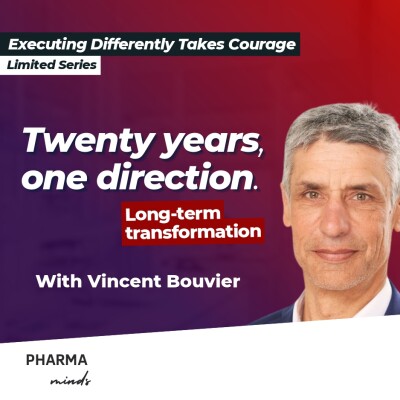
The pharmaceutical industry knows how to plan. It knows how to build detailed roadmaps, define strategies and align its various teams. It knows how to execute, but often it does so within frameworks it is already very familiar with. This series is about something else. About moments when plans have to go beyond the usual framework, when systems are under pressure, when you have to dare to think differently and then have the courage to see execution through to the end. Five conversations with leaders who have had to deliver in these kinds of situations. Five different ways of answering the same question. What does it really take to execute differently? I wanted to start this theory with Vincent Bouvier because Vincent Bouvier from Vidal illustrates something fundamental, which is often very misunderstood, about execution. It's not a question of speed, but a question of duration. Vidal has gone through 20 years of transformation without any sudden or dramatic break. There was no real dramatic pivot and no real pivot following a crisis. Instead, it was just a good direction maintained with the right funding, the right shareholder, and the discipline to invest at the right time. So I don't want to just give you tips out of thin air, but before talking about agility, volatility and shifting markets, I wanted to start with this, because what does it truly take to stick to a difficult plan when absolutely no one around you can yet see why it is absolutely necessary to hold on?
- Speaker #1
The world of healthcare is being overrun by tech topics. Right now, we're only at the beginning. It's extraordinary. We're really just at the start. We were lucky that publishers approached Vidal to collaborate. 100% of the revenue for several years now has been digital. We have stopped all types of paper publications.
- Speaker #0
Vidal book doesn't exist anymore?
- Speaker #1
Not at all. We have created subsidiaries in different European countries, in Germany, in Spain as well. We're not going to spread ourselves into more than 30 countries around the world, but we're quite ahead on the topics we're discussing. We are now in ongoing dialogue with healthcare professionals to improve them. Whereas at the beginning, the most important thing was how we would manage to capture all the patient's data in order to ultimately simplify their work so that they no longer have to retrieve it themselves at every stage of the care pathway. And so they can focus on their diagnostic decisions, their therapeutic decisions regarding patient care. That is the challenge for the next five years.
- Speaker #0
This episode was recorded with the support of Vidal. Hello, everyone, and welcome to this new episode of PharmaMinds. Today, I'm here with Vincent Bouvier, the head of Vidal, who has been leading the company for 20 years. Thank you for being more and more of you listening to PharmaMinds. This is a rather special episode because Vidal is a company that everyone in pharma and healthcare knows. It's the company that published the well-known red book, The Essential Bible of Medication, which comprehensively lists all the medicines available in France. So I feel truly honored. Thank you very much because I think you have rarely... shared in fact this adventure, which is rarely entrusted to someone, especially for such a long period of time. So here we are. What I want to know is what has happened with Vidal over the past 20 years? What transformation has taken place? And above all, what really interests me is to actually understand the leader behind all of this, to understand how you view the long term, how you manage to be visionary, and how you project yourself into today's world. Building a company that stands the test of time, that is sustainable. Does that sound like a good plan to you?
- Speaker #1
Yes, quite a program.
- Speaker #0
Indeed. Well, I'll let you now introduce yourself to start with.
- Speaker #1
Yes, of course. I'm Vincent Bouvier. I'm a trained physician, a gastroenterologist, and so I studied medicine and did my residency. I think that it became clear to me very quickly. The vision, if you will, was that the future ultimately lay in structuring data, in having robust knowledge bases about healthcare products, about therapeutic strategies, and that this needed to be implemented in software. And not in dictionaries, nor even on websites, to be very clear. The future was there. And in fact, that's what we built over the years. It's about how we could offer this to all healthcare applications, whether in hospitals or private practices, so that right away, alerts, suggestions, or recommendations would appear to prevent mistakes with products and avoid putting patients at risk.
- Speaker #0
So how did it come together? So you arrived, there was a website. a book, and then little by little, it's about building these foundations, organizing the data. So did you see that a change in the business model was going to have to happen?
- Speaker #1
Yes, that's right. It was a publishing house.
- Speaker #0
Exactly.
- Speaker #1
Actually, in practice, it was a publishing house undergoing its digital transformation, meaning it was putting its dictionary online. So that was the first step, and it was important. But the steps that followed around structuring the data you were extremely formative. That was the first realization. And by the way, it also corresponds to the idea that, as I was saying, we had to work with new players who were the software publishers. Let me remind you that at the time, doctors only used paper and pencil in practice, whether in private practice or in hospitals. In fact, we were interacting with them directly, meaning they were using the dictionary and we were speaking to them. And at that point, There was still the challenge that we had to communicate at a computer, at a software publisher we had to communicate with as well, which in the end disrupted us a bit, but was a necessary step to bring future knowledge to professionals. So actually, it was the arrival of software publishers, basically, who entered the field and also became part of our business models. because the incredible thing is that If you remember, the dictionary was given to doctors for free because they were funded. The monographs at the time were financed by the pharmaceutical industry. And when I arrived at Vidal, 100% of the revenue was based on that. And actually, not only did we gradually change the products, but we also changed the business model. That is to say,
- Speaker #0
clients,
- Speaker #1
we said to ourselves, no, from now on for this. It's the doctor who should pay. It's their responsibility to ensure the treatment is safe. If they want it to be, they have to pay. And so we started to set up these subscriptions that were paid for by professionals. And I truly believe that's the right path, which we continue to follow. And now you see just for France, this part alone brings in more than 20 million euros in revenue. And then afterwards, we added other countries in Europe. So this story, actually, that's how it started.
- Speaker #0
you When we perhaps return to the context, for those who might not be fully aware of what a publisher does, what you do and how you work together, how do you actually divide up the work?
- Speaker #1
The software publisher, whether it's in a hospital or in private practice, mainly manages all of their patients. So all the data concerning the patient is recorded, organized into workflows, kept consistent, and that's the job of the software publisher. And we bring in extensive knowledge about health products and more generally about various medical treatment strategies, if you will, for effective patient care. Because we don't work on diagnosis, we only focus on supporting therapeutic management so that it can do so. Suggestions and alerts when necessary at the time of prescription, dispensing or administration of the products.
- Speaker #0
And this close collaboration with software publishers, did it start right from the beginning? How did it happen? Was it easy? Was it obvious?
- Speaker #1
No, as a matter of fact, it was actually not a simple process at all. There we were quite lucky that one or two publishers approached Vidal saying, couldn't we do this together? So there really were on their side as well people who were truly forward-thinking and visionary and wanted to introduce a medical service into their products. And that we really did together. Afterwards, it evolved a lot, of course. But I realized a few years later that in the United States, things had started at about the same time. That is to say, the market, which is now the most developed in the world on this subject, medical decision support, and currently the most important market is the United States. It started at the same time as we did, and we, in France. If you look at Germany today, for example, Germany is several years behind. It started this process of integration into software and working with software publishers much later.
- Speaker #0
Yes, but actually it mirrors the whole network aspect that existed even in consumer telephony or consumer internet, which also arrived very early in France.
- Speaker #1
We seized the opportunity immediately. Well, I think the internet arrived at the same time in Germany. However, medical IT developed more slowly in Germany, for example.
- Speaker #0
And do you have an explanation for that?
- Speaker #1
Listen, no, I don't have one. In any case, I don't know it. I'm not going to look for one, but I can see it clearly now.
- Speaker #0
Even now they've...
- Speaker #1
Oh yes, that's still the case. Germany on certain topics is catching up, catching up on their delay. especially when it comes to all the medical decision support. On the other hand, interestingly, they are much stronger when it comes to billing topics, especially hospital billing. It works better than billing in France. It's like a BMW engine, you know.
- Speaker #0
And how did that transition in business model happen? Did it happen gradually? Did you say to yourselves, okay, we're going to, well, how did it actually happen? Just to get a sense.
- Speaker #1
Well, there were some techno tracks and it happened very gradually. So as you said earlier, it is a long-term process. Yes, that is exactly right. And it is still ongoing today. There are still many professions today that write prescriptions without regularly and properly securing their prescriptions. So all of this is happening gradually. Once again, this is true in private practices, but also in hospitals. So things are improving, but there are still huge challenges.
- Speaker #0
Yes, you articulated very effectively the changes that have occurred over time. These are changes in services, shifts in the digital platforms and products you offer, and a notable change in your clientele. And how did that go? Even the acceptance by doctors? Now, is it something that seems to be becoming routine?
- Speaker #1
Yes, absolutely. And actually, what's really great right now is that their expectations are steadily getting higher. As they really start to use it, there is feedback. There are requests for improvements. There are suggestions. So now we're in constant dialogue with the healthcare providers to improve things for them. Whereas at the beginning, that was less the case.
- Speaker #0
Yeah, they're also maybe more used to technology and to the perspective and well, knowing what they can expect or not believe.
- Speaker #1
Yeah, at the same time.
- Speaker #0
And finally see some figures too, maybe to know about the company. I don't know, in 20 years it went from, has its turnover? How has it evolved? Thanks to that, the number of employees, the... Yeah,
- Speaker #1
sure.
- Speaker #0
We'll talk about international just after, but...
- Speaker #1
Right. So, well, as I was saying...
- Speaker #0
What impact did it have developing like that, you know?
- Speaker #1
Well, that completely changed the profile of the people in the company, of course.
- Speaker #0
Okay.
- Speaker #1
There were still mainly reader editors at the start, and then people who were in charge of printing a dictionary, which, by the way, was a real feat because according to what the printer said, it was one of the biggest books printed in the world. and it was printed in 250,000 copies. So it was a huge industrial achievement, right? And I remember that it was still the main subject, yeah, when I arrived. And so, well, of course, the profiles have completely changed. There are...
- Speaker #0
And when they saw you arrive, they thought to themselves, but what is this guy doing who doesn't come from the publishing world?
- Speaker #1
Yes, that may be true, but it was also incredibly fascinating and truly wonderful, every single bit of it.
- Speaker #0
And now it's become a tech company.
- Speaker #1
Well, yes, exactly. So now it has become a tech company, which also includes various medical specialists as well. That's it. And what's really fascinating is that it's actually the services we offer are a comprehensive blend of knowledge and software. So to arrive at a final solution that ends up on the professional's desk, you have to carefully integrate the specialized expertise at every single level. The products are complex because they require dual expertise all the time. So we have teams of pharmacists, pharmacologists, and now more and more people who are specialists in data processing and language processing in AI. And now we also have a lot of people working in software development and technology. So the company has completely changed.
- Speaker #0
And what about in terms of its size?
- Speaker #1
So it has tripled. There are 200 of us at Vidal. The business model has also completely changed since most of the revenue now comes from subscriptions, which are sold to hospitals, doctors and pharmacists to provide these decision support tools. 100% of the revenue, and this has been the case for several years now, is digital, because we stopped all types of print publications.
- Speaker #0
No books left? At all?
- Speaker #1
Not at all anymore. And the last edition of the dictionary was in 2019.
- Speaker #0
All right.
- Speaker #1
everything has completely transitioned. So the products, the teams and the revenue model, so everything. And when you say it like that, it sounds like the journey is complete. But actually the journey, it continues because technologies are further accelerating the changes needed for our products and therefore for our teams. The business model itself is much more stable, but now it's going to be a very stable trajectory. But there you have it. So actually, I feel like the train is still speeding up. Yes.
- Speaker #0
All right.
- Speaker #1
This is because in the meantime, we have also internationalized the company. setting up subsidiaries in different European countries, in Germany, as I mentioned, and also in Spain. We sell our databases in more than 30 countries around the world. And it's interesting because how do we do that? We do it with our partners, publishers, who are present in different countries and who tell us what they want. The same interface, the same knowledge in the different countries where we operate. How do we manage to achieve that? So we've developed the capability. to be able to localize for a given country. The service we provide, for example, which is well known in France, is almost the same as what we can offer in other countries. And we can open a new country if the opportunity arises.
- Speaker #0
All right. By offering a sort of product standardization?
- Speaker #1
Yes, that's it. It's the same alert system. However, you really have to adapt your strategy to the local market. In other words, analyze specific regional products and local data for this to work. If you work in intensive care, you might not know that morphine ampoules are diluted to half the concentration in Argentina compared to Portugal. You could end up killing your patients very quickly. So you absolutely need to know which products are available in the hospital where the databases are operating. All of this requires significant localization efforts, but they're essential.
- Speaker #0
So how many countries are you in now?
- Speaker #1
We sell in about 30 different countries. And that's increasing rapidly. And we're very happy because we've completely overhauled everything in depth. We have redesigned our entire data model so that it is now completely universal and adaptable for everyone. And so that indeed the interface we offer to our partners and software vendors, when they integrate the knowledge, is exactly the same from one country to another. And so the concepts are exactly the same. And we attach local information to these concepts when needed. But that's a big job. And that provides us the opportunity to observe this model develop. And ultimately, this SME, which was founded originally as a French entity, became a mid-sized company first because we've expanded significantly. And now truly, with international and global ambitions now, our goal is, I think we're already the European leader, but our goal is to accelerate. But if you like, that's where the thing is amazing, because we're absolutely... at the beginning of what we can offer, if you will, in terms of decision-making for professionals. We're at the beginning. You see, we already have things in the pipeline that we could do in one or two years that will truly revolutionize the way healthcare professionals can work with medical data.
- Speaker #0
We can see right now there are revolutions happening.
- Speaker #1
Yes.
- Speaker #0
That's it. So it's related to technology.
- Speaker #1
It's deeply connected to technology that allows us to make significantly better use of knowledge. Whether it's knowledge about medical science, which, as you know, presents very significant challenges because it's constantly growing. The amount of knowledge to master is enormous, in fact, for each pathology. And it's accelerating because everyone is working faster and faster. Now the Chinese have joined in. Now they are also conducting a lot of clinical trials. Science is advancing rapidly on the one hand. For a professional, it's a challenge to keep up with it. And then on the other hand, and this is the second revolution, which is extremely important. There's the data about the patient, which is stored in electronic medical record software. The patient I was speaking about just a moment ago, their data is now fully ready for use because it is organized or mapped according to standards that enable the software to accurately interpret the information. I understand, well, the software understands that the doctor is seeing a woman who is 12 weeks pregnant with a comprehensive medical history of congenital heart failure. So that's in the medical record. And what is the actual degree of insufficiency? And if that's in the record, properly entered, and we work with the technologies we have now, well, actually, we have algorithms that understand it and say, all right, you can't prescribe this product to her, so I won't even suggest it to you. There's a good reason for that. It's because it is contraindicated for her. And we provide the right suggestion, the medically relevant proposal to the professional. In the same way, if you see coming in, An additional test, a lab result, for example, that is a contraindication to one of the medications she's taking. Even if it's the next day, it comes into the doctor's system. The doctor will know and will be able to tell his patient, stop taking it. You see, these are things that are possible today, but they're not routine yet, but they will be tomorrow. It's really wonderful.
- Speaker #0
And so you also work in complete harmony with a comprehensive national electronic patient record system that could be created.
- Speaker #1
We use the infrastructures, for example, the DMP and all the efforts made by public authorities. precisely to share this information, to make it accessible and actionable. And so we use this effort specifically to create value for professionals. Everyone has their role, but for that we have to thank everyone, not necessarily aware of the efforts made by public authorities. Over the past few years, notably thanks to European funds, we have finally reached the EDMP. It's a reality. Our software feeds into them, and soon doctors will be able to retrieve them to create the summaries I just mentioned.
- Speaker #0
Very soon. Why? Because it takes time for...
- Speaker #1
Right now, we're in the phase where the software is feeding the data in. They are coming to feed the EDMP. And in the coming months, we will teach them to come and retrieve the data for reuse. So it's a very interesting time.
- Speaker #0
All right. On large volumes.
- Speaker #1
Yes. Not only is our core business decision-making, both in France and in Europe, but we've also diversified. our activities. And now within the group, we have medical software, particularly for the private healthcare market in France. And so we were able to initiate collaborative partnerships between the provision of decisions I've been talking about since the very beginning, and their full integration into medical software. Since ultimately, it's remarkably straightforward, because it's all part of the same group. And so... We can clearly see the potential for positive transformations in practices that this can bring about in the pilot programs we're currently running.
- Speaker #0
Okay, so that means it's worth it?
- Speaker #1
Oh yes, absolutely. And it's certain that it's going to, it's happening right now. It is happening right now. As you can see, our current pilots are showing it to us now.
- Speaker #0
Also in terms of patient knowledge and being able to make suggestions, to ask questions, to actually enrich even the diagnosis or the...
- Speaker #1
Yes, so on those topics, it's clear that generative AI is going to be of great help to us, because it allows beginning with either written language or even voice to thoroughly understand and transform them into organized medical terms. What the patient says or what is written in the various places where they are treated, so that it is understandable by an expert system, by an algorithm. So we are going to collect, we are starting to collect on much more information about the patient. So the records I mentioned are actually much richer regarding the patient's history. And so that's fantastic because for people who are interested in decision making, it's like fuel for an engine. You are fueling with much more information and engine that. As a result, if you give it more fuel, it runs better. That's all.
- Speaker #0
With what more? And here, maybe the next step is to actually suggest things, to make suggestions.
- Speaker #1
Well, yes, absolutely. We already do that and we're going to improve our suggestions. But if you see the system understands that when the patient was a child, they had a certain problem with a particular medication, for example, the system will understand that this medication should be avoided in the future. It will avoid risks and mistakes and certain contraindications if it understands there was a previous illness. And all of these are elements that will be integrated even more easily into the systems because technologies will incorporate them seamlessly for the professional without them having to write it down.
- Speaker #0
It seems smooth. We can see that there may have been some trial and error. But I wonder if you remember, did you think to yourself, this is going to be harder than expected? Or was there also some denial? I can't give up. I absolutely have to be present. Or is it the excitement of the ecosystem that keeps you going? I'd like to understand that a bit more. How do you manage over 20 years to stick to your vision and have a strategic vision and hold on to it?
- Speaker #1
It's true that we were incredibly lucky to witness the remarkable evolution I've been talking about throughout this entire period, to make progress month after month and year after year. We had no doubt that it was being implemented and that it is being implemented. So if you like... We didn't at all.
- Speaker #0
Beyond any doubt. Yes, it was a calculated risk that had to be accepted.
- Speaker #1
Not doubt at all. The complexity perhaps up until now has been more about convincing people that it was necessary to invest in things that would only become apparent a bit later in five years rather than anything else. First of all, we wouldn't be able to put it into production for another two or three years because we work on, I don't know how many... When it comes to services, you have to build an entire back office to manage new types of data. It takes a long time. Then you have to integrate them into the software, as I mentioned earlier. We're dealing with cycles that are quite long.
- Speaker #0
And then number two?
- Speaker #1
Wait, three years? Did you say three years? In general, you have to invest to create these systems even further upstream. It's not always easy to convince shareholders about these kinds of long-term software projects. So there was certainly a challenge in getting returns on investment, which took a bit longer. But as soon as there was a firm conviction that in the end, what was happening would only continue to grow and intensify. And not just in France, but across the entire world, we finally managed to make it happen. But that effort to convince people had to be made. That was a real challenge in supporting this transformation.
- Speaker #0
Investment, yes.
- Speaker #1
Yes, because you need to be supported by shareholders who understand and back you for the long term. It's not the case for all shareholders. Now, that was part of my job, and I quickly realized that it was really key to do it. During that period... Vidal changed shareholders. At one point, we worked with an investment fund that was the main shareholder. And there, it's a challenge because those are people who are often interested in the short term, you know, but it went well. And so that was a necessary condition for success.
- Speaker #0
So are you still with that fund?
- Speaker #1
No, no, no. Let me explain. Since as far back as 2016, we have been working together with a well-established Japanese company in the digital health industry. Over the years, This collaboration has given us valuable experience and helped us understand the market better. Our Japanese partner has always shown an extremely positive and forward-looking perspective on the future of this market, consistently expressing strong optimism about the opportunities and growth that lie ahead. And who helps us to continue developing it? In Europe and throughout the whole world. So that's going very well. But it's precisely no longer a fund. It's a real industrial player who has a long-term vision. Plus the Japanese, you know, they have very long-term visions. They are...
- Speaker #0
Here for millennia. But as a result, it's interesting because this notion of the long term, you can't really play that game with someone who only sees the short term. Or have you managed to do that as well at certain times? Can we talk a bit about that? It was really deep down, you were able to give them the results they wanted. But at the same time, you had to make compromises.
- Speaker #1
It's always a balance, actually, that you have to find, just like in everything we do. And we were lucky enough at a certain point when there were investments that we knew wouldn't pay off for quite a while. At that moment, we raised our prices. So we were able to get quicker returns, which helped to compensate, which helped us manage. In the short term, we had some good news. Or actually, when there was good news, that's also when I took the opportunity to invest even more. And the luck we also had during this transition was that we were never in economic difficulty. And it's definitely much harder to invest when you're struggling than when you're not. On the other hand, it's sometimes also difficult to invest when everything is going well, because you don't understand why you need to invest so much. But that's exactly when you need to do it. So we were lucky in that regard. And that really helped support this transition. We never make it otherwise.
- Speaker #0
Yes, of course. But then. What made the difference in all that? Was it your ability, precisely, to formulate a project that was concrete enough in order for one to possess?
- Speaker #1
Those are certainly very compelling and valid arguments, yes. So it's true that the clinical decision support market has several key advantages. First of all, it requires deep integration, a truly deep partnership with CEL partners, as you explained. So actually, it doesn't fall apart in five minutes. It doesn't fall apart in minutes. It's not fragile. Well, it is over the medium term, but for that, you always have to show that you're improving. But in any case, the risks are not immediate. That's the first thing. Second, they yield predictable revenue as subscriptions remain quite stable from that point of view. You don't put your head on the block every morning. You know you're going to have so predictable and fairly secure revenue in the medium term. That's really very helpful to be able to reassure our investors.
- Speaker #0
You are talking about 12 million people who visit per month on the site. What did that change actually? The fact that there are no more books on the relationship, in fact, that you have even with the doctors. You were saying that, yeah, they contribute more now because they also feel perhaps more comfortable with the tech. But what did that change? Do you know them better too?
- Speaker #2
Yes, absolutely. Absolutely. Well, we're in all the current digital topics.
- Speaker #0
That is to say, we work, if you will, as closely as possible to their needs. We have permanent panels with them on different subjects all the time. We build, in fact, the services with them, the interfaces with them. Right. So there are certain interfaces that belong to our software publisher partners. Right. So we have to manage a three-way relationship. It's not always simple, but anyway, it's a complexity of our profession.
- Speaker #1
Yeah.
- Speaker #0
But, well, we build with them. You see, there's something I'm using too, which is also a major evolution, is that medical decision-making has become medical devices, meaning the software we make to secure a prescription, well, it's treated like a pacemaker. We consider that if there's ever an error in our software, well, we can kill the patient, which is absolutely true, right? So that brought us into a quality management system of exactly as if we were making an artificial heart.
- Speaker #1
And how did you do it? I'm coming back a bit again to the strategy stories to do that. You got there by moving forward, building. But how do you do it when you build a strategy, when there's a plan A, a plan B, a plan C?
- Speaker #0
I understand your question as a question for all the business leaders, actually, right? That is to say, well, I don't see it from a medical angle or specifically from a product one.
- Speaker #1
What interests me is to know how you do it.
- Speaker #0
Well, it's true that when we lead a trajectory like that, We always need to anticipate a possible failure. And so the plan, as you say, we always have plan Bs, actually.
- Speaker #1
There often are, yeah.
- Speaker #0
Well, at least most of the time. And well, it's part of my role, actually my own role to make sure that if, well, it doesn't work, we fall back on another vision. And we've progressed, but I think all companies, for that matter, have progressed in that area.
- Speaker #1
Yes, in today's world.
- Speaker #0
Yeah, when we make budgets, we make these three-year strategic plans. And they're obviously never followed because you never know what's going to happen. But it lets us think through where our risks might be and what we do if those risks occur.
- Speaker #1
Yeah. This is a case where in the end, plan B actually turned out to be better than plan A. That sort of thing does happen from time to time, you know? Yes, it really does.
- Speaker #0
Of course it happens. Yes. Sometimes it happens in life, you know, very often. I do a lot of sailing and it's something that happens all the time. That is to say, you set a plan for your regatta before you leave. If you know you're going to, you want to do this. For whatever reason, you can't implement it because you're blocked. There's the boat in your way. So you're on to something else. And in fact, it was the best solution.
- Speaker #1
It's fascinating. Well done. Well, for all that, for everything you've done. I don't know if there's anything you'd like to add to round things off that you'd like to say.
- Speaker #0
I just say that I regret not being 30 years. younger, because I think those who are coming next are really, really going to be interested and have a lot of fun.
- Speaker #1
You surely have 30 years ahead of you.
- Speaker #0
Thank you. Thank you.
- Speaker #1
A big thank you, Vincent, for this conversation. Well, it was fascinating. Thank you.
- Speaker #0
Thank you very much.
- Speaker #1
What Vincent teaches us is that long-term execution relies on three things, an unwavering conviction, a shareholder whose horizon is aligned with yours, and the discipline to invest precisely when the pressure is at its lowest. It's the foundation that for me is the most decisive, and I encourage all of you to, well, reconsider it. In the next episode, we take complexity up a notch, moving beyond the company to see what execution becomes when it is driven by a state, an ecosystem of actors, and 31 local markets simultaneously. Guillaume Delmotte takes us to China.
![[Insights] Produits frontières : transformer la réglementation en avantage stratégique cover](https://image.ausha.co/DxYZ9g83tTEC6Wr39rcUpzpTWcQsUBjd7hU5AZsG_400x400.jpeg)
![[Insights] Groupements de pharmacies : ce qu’il faut retenir du rapport IGF-IGAS, avec Hugues Villey Desmeserets cover](https://image.ausha.co/UgNUSqEle2cZH1rOVklykwyk35Rz2q4seXKVMgWM_400x400.jpeg)
![[EXTRAIT] Une innovation en prévention qui inspire jusqu'au Danemark... avec Anne Beinier cover](https://image.ausha.co/PuxqczYfLjqCYtMRA0dqMcN77dzaY8CoGDnOnLF2_400x400.jpeg)