- Speaker #0
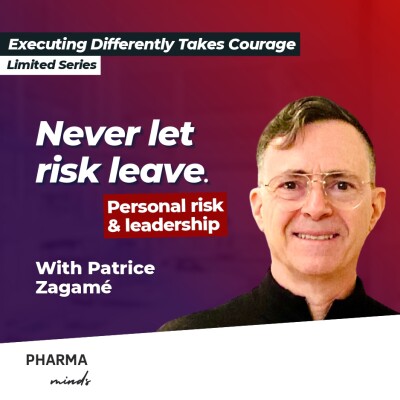
I wanted to end this mini-series on execution with Patrice Zagamay, because his episode is ultimately the one that goes perhaps the furthest on this personal notion, not necessarily in terms of numbers or scale, but in terms of what execution reveals about oneself. At some point in a career, execution ceases to be a professional skill. It becomes a personal question. Do we really commit or do we just manage? Do we take the risk of leaving the mark we want to leave with no guarantee of success? Or do we stay in the comfort of an organization? Welcome to PharmaMinds. I'm Nathalie Lahit, the host of this podcast, and I'm bringing you closer to the people who shaped the pharma industry. My goal is to understand how they've evolved within this sector, what led them to progress and to fight to build a society that is healthier. Ethics, personal development, ambition through their advice, I want to give you the keys to imagine tomorrow's pharma together. Today for this episode, I'm with Patrice Zagami. We'll keep it simple. I'm impressed because he's truly a leading figure in the pharma industry that I have here with me. His new challenge, entrepreneurship. He's the founder and CEO of Eolius Health, an OTC lab for plant-based products aimed He's at the Brazilian market where he's lived for about 10 years. Without further ado, I'll let the conversation begin. Hello, Patrice.
- Speaker #1
Hello, Nathalie.
- Speaker #0
I'm delighted to be with you today. Welcome to Paris. Thank you. We're lucky to be meeting. To start, I'd like you to give an update to all the French pharma industry people who'll be listening. I think with great pleasure. How are you doing?
- Speaker #1
Very well, very well. Thank you. And hello to everyone. The whole industry is listening, but I think maybe a first message. When you spend 35 years in an industry, you end up meeting many people, clients, colleagues, government, civil servants, and so on. And yet, over the years, you create relationships, perhaps more than professional, I think, human relationships. So I'm delighted to be with you today and to be able to exchange once again with all these people.
- Speaker #0
And you're doing well?
- Speaker #1
I'm doing very well, absolutely. As you briefly described my new projects. It's quite stimulating indeed.
- Speaker #0
Now let's turn to your career. I'd like to understand what makes a doctor find themselves in the industry so early to build a career.
- Speaker #1
I had a career start. Throughout my career, I've been under pressure regarding these balances. But that's also what makes these leadership positions enjoyable, having to manage this concept.
- Speaker #0
You've experienced many complex situations, I imagine, in a career. What moment would you describe as the most difficult for you?
- Speaker #1
I'll say, without giving names. none of the difficult moments well i'm going through one right now starting a business on your own funds is a real challenge but anyway apart from that one which is also a bit obvious i think there are missions that they're not impossible missions but there are missions or battles that are hard to win when you build a career it would be nice to have a little crystal ball and not to get involved in missions that you cannot win out of a taste for personal challenge I've often taken on battles that I couldn't win, but it's not necessarily good for one's career. Just an anecdote, after many years working internationally and being quite well regarded by my organization, I was appointed in France, and France is a rather complex country to manage. You have the labor union dimension, you have the regulatory dimension, which is quite significant, you have the dimension of the talent capital of the French, which is quite sophisticated on a global level. I've worked with many different nationalities. The French critical spirit is very much present. You don't really realize it when you're in France. But when you leave France, you realize to what extent we have a critical spirit. And so I came back as the leader of a French subsidiary. And there I really felt the difficulty. Same thing trying to change an organization, to make it run at a much faster pace, to create growth in a country where I had 150 million in price cuts every year. to gain market share while at the same time applying a sales force reduction that came from my group. So you reach a point where it's a bit like squaring the circle and there you are in the middle of the crossroads between missions that are irreconcilable. So this notion of taking on battles where you cannot win.
- Speaker #0
You often can't know that as you go along.
- Speaker #1
I think you can if you think about it a bit.
- Speaker #0
If you come to France, you know there are battles.
- Speaker #1
I often don't think enough, so I've taken on a few.
- Speaker #0
So how do you make your choices then?
- Speaker #1
That's a very good question. I once had training on learning how to make choices. Yes, no, on... No, simply. Make choices. It's whether you make choices because they arise. So one day they call you, they say, do you want to go to Spain and hop? Oh, well, yes, Spain is nice. Let's go. Or do you really make choices? Do you say to yourself, well, my career, I want it to be like this. And so I'm only going to go there or I won't leave my country or I will move or I'll go to the United States and so on. So this notion of choice.
- Speaker #0
I'm staying in my job right now because I really want to be calm and at peace.
- Speaker #1
Choice or chance. I've worked a lot by chance, but it's not necessarily good. So I recommend working by choice.
- Speaker #0
At the same time, you've had a lot of fun. You've done the jobs you had with passion.
- Speaker #1
Yes, yes, yes. But once again, here, I think that it's important in our discussion, but in a general way, for those listening to us, you have to know yourself. You have to know yourself. You have to know yourself. Know what you love in life. Early on, we change. We have the right to change. But you must define a bit what you want to be, what you want. Otherwise, yes, you just drift along a bit. For me, it wasn't necessarily bad because I'm rather by nature impulsive and I'm rather by nature curious and changing. So for me, everything new, everything that's a challenge is rather stimulating, but that's not necessarily the case for everyone. So for people who might need a bit more certainty, getting into paths that lead them to a lot of change, fluctuations, uncertainties is not necessarily a good emotional choice. Not necessarily a good career choice because they won't be in their comfort zone. And then... we're not alone in life. So we have spouses, we have families sometimes, we have parents who are in a country. And so all these decisions have a considerable impact on other people.
- Speaker #0
You've been abroad a lot afterwards.
- Speaker #1
Yes, perhaps. Among the choices I made, well, I think that having already oriented myself towards the pharmaceutical industry was a pretty good idea. Because I repeat, I found an energy there that I wouldn't necessarily have found in a hospital setting, particularly. So that was a pretty good decision. And once again, these are involving decisions because there we were talking about two very different careers. Not necessarily easy to make that decision at that time with so little visibility on what was going to happen. So that was a first choice. The second is that by heading straight for foreign countries, I stepped into a logic that I was right to follow, I think. So the fact of going, I could have done my military service quietly in Paris, staying close to my friends and my family. I decided to let myself be parachuted into the heart of Latin America. I didn't even speak Spanish at the time. But it was a good choice because in the end I traveled a lot. I spent a part of my life and then finally I land today in Brazil. It's not by chance. It's the last of the dominoes. Maybe not the last actually. But it's one more domino that followed the others. But I don't regret it at all. It's good. It opened me up. First it opened me up to a different culture. It opened me up to a different energy, different experiences. I enjoyed it. It's very good. And on a professional level, finally, it allowed me to reach increasing levels of responsibility. I think it was the right choice.
- Speaker #0
And among the choices that should have been made?
- Speaker #1
That's interesting, I think. Besides, as they often say, it's what we shouldn't do that's more important than what we should. But among the choices I didn't make, it's not that I decided not to do them, but I was already somewhat aware of the stakes. So it was a bit either out of stubbornness or out of pride or that I just didn't make those choices. That is to say, I was in an organization that, like all organizations in the pharma industry, began to evolve from the mass market towards specialties. So it started with oncology in the 2000s. And so you have to put yourself back into the context where all these specialties were small. So they were a bit like the second or the third or the fifth wheel on the wagon.
- Speaker #0
You told me that there were actually two important turns that I missed, and those were the things that ended up keeping me from becoming the CEO.
- Speaker #1
Those are the two important and significant aspects of the executive curriculum, which, as we have seen, were truly decisive and crucial for shaping and influencing professional careers. Today, there are others that are currently happening, and that's why I think that the people listening to us should start thinking, what is going to define the higher level needs that will mean I have to acquire? I need to be in such a place or have such a skill.
- Speaker #0
Those two things, oncology and the US, were things you knew.
- Speaker #1
I sensed it. Honestly, I do have a fairly reliable and certain competence when it comes to analyzing things. Really, I can usually pick up on these situations quite well, the future, and I sensed that it was obviously going to happen. All the signs were there, but it was only confirmed later. So oncology was already, as I say, a smaller part of the organization. But it was a high attractor of people because they were in full growth and full structuring. And so it was the time to enter this field since it then became extremely decisive. And for some companies it became the portfolio, meaning they eliminated all other products and they became oncology companies. So for me, no, I didn't make that choice. I could have. And at the same time, I found a job. I was doing more interesting and then I didn't push to do it firstly. And secondly, the United States, well, there it's more because it wasn't offered to me that I didn't do it. On the other hand, I could have actively sought to go to the United States at all costs. I could have done it and it's probably what I should have done. But there I think it's more out of pride that I didn't seek to do that. Absolutely. And the organization, it didn't come up. I think there's a point in organizations. When you start providing an important service to organizations, they still have, and this is a message for all our friends, they still have a tendency to leave you where you are. You hold the line, you fly the plane, and there aren't necessarily 50 people to fly the plane. So organizations are a little bit conservative in maintaining the status quo. They develop people, they make the effort to develop people, but I think it's something you have to keep control over. Because otherwise you might end up staying at the pace of your organization. And five years can make all the difference. You've stayed five years too long in a country or in a role and you didn't make the transition. There are certain ages and moments in life to move on. Unfortunately, it shouldn't be that way, but it is.
- Speaker #0
Thank you so much for sharing that. Because it's very inspiring to know that everyone makes mistakes. Mistakes or choices that have consequences, but which can turn out to be good choices for you and for your life. In this last part, which is a bit more personal. I'd like to try to understand the pressure a manager like you faced, having had so much responsibility, always caught between local teams and management above.
- Speaker #1
Yes, there we come back to it. You're right to say that it's very personal. I think everyone will have a very different experience of it. It depends on your personal involvement in the work, in your mission. It depends on your personal sense of the collective mission, as I was alluding to at the beginning.
- Speaker #0
You spoke of the balancing acts to be done between the trade-offs.
- Speaker #1
Do you feel a responsibility towards people or not? There are many people who don't necessarily, then again...
- Speaker #0
I think when you're in the healthcare field everywhere, maybe even more so, it's hard to let go, to stop.
- Speaker #1
Yes, that's quite possible. It's a background, medical training, pharmaceutical training. These are service-oriented fields for humans. You certainly keep some psychological traces of it, that's clear. It's very personal. I think the organizational experience depends a lot on your personality. I probably had a personality with a sense of... responsibility towards others that sometimes put me at odds with the choices of the organizations. As I was saying, organizations have economic imperatives, stock market imperatives. The stock market is an extremely cruel world that requires organizations to have permanent profit growth. It's not just that you're asked to have 20% EBIT, you're asked to have growth in your EBIT. Not only is it 20%, but it's annual growth. and the economic world of healthcare isn't infinitely expansive, so that translates into tensions. The good news is that when there's competition, we manage to gain market share, so we hold on. But there comes a point, and when sometimes you're in areas where there's little competition, when you have a generic, when you finish the product cycle, you find yourself with extremely significant economic stakes. So balancing the well-being of the teams you lead with economic well-being isn't necessarily easy. One could argue you shouldn't have gone for it. That's the manager's job.
- Speaker #0
I think there's also a need for people like you who are capable of taking on riskier missions, which aren't easy. The question is, at what personal human cost can we do it?
- Speaker #1
To be perfectly honest, I had a burnout at one point in my career. So you shouldn't be ashamed to cry. It's very trendy to express these feelings. I think that, yes, at some point, there are missions that tear you apart. And so you hold on, you hold on, but you can break. It shouldn't be underestimated. So it's clear and I think everyone knows it, being a manager and a manager of executives means it's on the same level as a high-level athlete. You have to be in good health. You have to be able to have psychological distancing mechanisms. You must always be able to gain some perspective. You can do it through meditation, through psychology, through psychotherapy. You have to be able to distance yourself from the professional content. When you start mixing things up, the emotional side, your personal values, the economic imperatives of organizations, there comes a point where you are really at odds and you break down psychologically. That happened to me. I mismanaged my energy. As I was saying, it was a battle I couldn't win, really in a very rational way. Rational why? Because at the time, our team managed to take France from sixth position to almost first position in the French market. So you'd say that's actually quite good. But conversely, we barely had zero or one or two percent annual growth. in organizations that were asking for 10 it was the era of china the era of india all that was growing at 15 to 25 percent and so the shareholders were demanding growth So when you were in markets like Europe, it was very difficult to deliver economic growth, even if you were extremely high performing because market shares and all that, while reducing and increasing productivity. So at some point, you just can't win. So for me, yes, I held on, I hid it. I did the balancing act for a few years. And then at one point, I broke.
- Speaker #0
You didn't see it coming?
- Speaker #1
No, not really.
- Speaker #0
It builds up gradually.
- Speaker #1
It's like frogs. When you put them in cold water, as soon as you heat it up, they hold on for quite a long time. So I didn't jump out of the pot of boiling water.
- Speaker #0
How do you recover from that?
- Speaker #1
How do you recover? Well, you have to be very careful. Burnout is a very serious illness. But in my case, I walked away from it all I know. I left my company and went to take refuge in Latin America.
- Speaker #0
And you protect yourself.
- Speaker #1
So yes, I simply... Was it radical? I changed the equation. Since I couldn't solve it, I simply turned the page and moved on to another equation. And that was good.
- Speaker #0
Yes, because you're talking about protection mechanisms that are already difficult to put in place, the ones that suit us and... than keeping them during moments that are complex.
- Speaker #1
But when you have some distance, the problem with burnout and people who don't understand that at some point they can refuse their context. We can always step out of context. There's a cost, there are consequences, but most of our misfortunes, we create them ourselves. So if we accept staying in an equation that has no solution, we are ultimately responsible for that. So we have a choice, we have to leave. I was in a company where I stayed for 17 years. I was quite well regarded. Yes, it was a difficult choice. It wasn't even a promotion. It was lateral.
- Speaker #0
Especially since there's always the fear of what we'll do next. Life is never written in stone.
- Speaker #1
That I can reassure everyone listening to you. It's part of life. You never know what's going to happen next.
- Speaker #0
Whatever happens.
- Speaker #1
The important thing is to go with desire and faith.
- Speaker #0
Thank you so much for sharing this experience, because I think it really does good to hear this from a leader like you, honestly, because... These are behavioral topics and they're often hidden, so we also need examples to not only prevent it if it happens around us, but also to be able to talk about it. You exude a lot of charisma, of strength, but there's also a very strong sensitivity and sincerity. How did you go about learning to know yourself better?
- Speaker #1
Maybe you need to be lucky, maybe you had to be lucky in your upbringing to have faced trials or challenges early on. I think people who build themselves in a secure environment who enter a system. early, they do have moments of questioning, but generally it's much later. I perhaps had the luck to have them very early in my life for personal reasons. So maybe it's a stroke of luck in the end. Your upbringing leads you to be under pressure a bit earlier. And so you ask yourself questions sooner. You have uncertainties earlier. So that's the first part. The second part is gradually through training, understanding that there's a hidden dimension. It's not just the hard, there's the soft. And when you start pulling that thread, you realize you have to go a bit into introspection. I did a few years of psychotherapy. I've read quite a few personal development books. And I've also spent time with coaching. I've had mentors. My organization and Novartis had supported us with high-level mentoring, outstanding coaches, comprehensive training, and so on. But you really do have to take an interest.
- Speaker #0
In the end, That was the strength of your career, I think.
- Speaker #1
Yes, yes. I think that gave it its foundation. How do you manage people? I think if you don't work on yourself a bit, it's tricky because you have an egocentric approach. So you manage people, but you don't necessarily engage them. And as I say, everything comes together in life, in my opinion. And economic performance, you can only have it through people. I understood that very, very, very early on. We'd already talked about imposter syndrome. In our discussions, it's that at some point, we all know we can't do everything and we can't do everything all the time. And so it's necessarily others who find the solutions and do it. And I understood that very, very, very early on. I quickly realized I wasn't the smartest person in the room. I quickly understood and I told my teams as well, I'll never be the best financier. I'll never be the best at marketing. I'll never be the best in medical affairs, nor the best responsible pharmacist. But I'll probably always be the best across all the skills the team has because I've covered enough fields where I wasn't the best exactly. So I learned to know what needed to be known and to manage people who knew much more than I did. You still have far too many CEOs or leaders who think they know much better than everyone else. That's a gross strategic error, by the way. It's the people who know. It's the clients who know. It's the governments who know. It's your teams who know. It's not us. And me right now. I'm in a new field where I understand nothing and know nothing, which is digital.
- Speaker #0
Could you perhaps, just to finish up, tell us about this new approach, a project for a young retiree who ultimately is taking on the biggest challenge of his life?
- Speaker #1
Absolutely. That's good. I've always been sensitive in my career to what the English say, which I like. It's a short phrase, but it summarizes much better than anything else, which is walk the talk. So do what you say. And since I've preached a lot, unfortunately too much, I've preached too much in my career, do this, do that. And I've often said, oh yes, be entrepreneurs of your organization. So I preached entrepreneurship to people. So autonomy, all the glamour of being an entrepreneur. And so it's good now. Now I have the chance to walk the talk and see if I have the, and I wanted to test myself. I found a bit of this, this fascination for entrepreneurs. And so I wanted to test myself. And here, once again, I'm testing myself. We'll see. We'll see. But it's very, very fun. It's very, it's very stimulating. It's a big challenge. It's a lot of financial commitment. It's very risky. Yes, it's true that it would be more logical to, to go to the beach in Brazil. But I think that having challenges like that. projects. It's the spice of life. So it's good. Let's go.
- Speaker #0
Well done anyway. Congratulations. Is there one last question that you would like me to ask you?
- Speaker #1
There's always this question in personal development courses. And one of the methods to know what you want in life is to ask yourself what you want people to say when you're dead on your tombstone.
- Speaker #0
Indeed, I wouldn't have asked you that question.
- Speaker #1
At your funeral speech, I've often asked myself the question. I think I always come back to what makes me tick. What makes me tick? ultimately is having led teams somewhere. Having led them in joy, good humor, enthusiasm and success, it's something that's always made me feel alive. So if they say that when I die, that's just fine.
- Speaker #0
Thank you. One last thing. What is the advice you could give to young people who want to embrace a career as challenging and fulfilling as yours?
- Speaker #1
First of all, it's that they won't have my career. It will be another era, another reality, another economic system. other products. It won't be the same thing at all. And that's important. I practice it a bit in my daily life as an entrepreneur. I started with one idea, but I'm already on another idea. I thought I'd do digital. And then finally I launched a sales force and that in the space of three months. So I think this notion, and we are too educated in our, in the first third of our lives in certainty, we are created on models. We think that because we studied pharmacy or medicine it's going to be good for the rest of our career and No, everything changes all the time. So you have to educate yourself on fundamental principles. And we come back more to values. We come back more to behaviors because everything else follows. It's rarely technical. It's rarely, you have to go to the United States. Yes. At one point in my career, it was the United States, but maybe tomorrow it will be China. Maybe tomorrow it will be India. Maybe tomorrow it will be France. It's hard to know. It's doable. If we read a bit, if we search, if we connect, we manage to see where it's going to go. Obviously, if we don't dig deeper, it's going to be hard to know. So what I recommend to someone starting a career, one, it's what I was telling you. There's career, there's what I want to learn. So that's really understanding the difference.
- Speaker #0
A career depends on others. What I want to learn depends on me.
- Speaker #1
And the second is to have some fundamental principles of success, success alone and success with others. And for everything else, it's being flexible and seeing where the wind blows. Those are the three pieces of advice I'd give.
- Speaker #0
Thank you very much. It's time to wrap up this conversation. A huge thank you to you for this fascinating discussion. I was very touched by your sincerity and the accuracy of your approaches. I'm extremely grateful that you were willing to share these insights. I think it will help listeners better live out the career of their dreams. A big thank you, Patrice, and enjoy the rest of your stay in Paris.
- Speaker #1
See you soon. Thank you very much, Nathalie, and well done on your admirable project. Thank you.
- Speaker #0
I found this question interesting to ask because we're all at some point led to ask it of ourselves. And the question is, how far can we go and what do we have to gain from it? Patrice spent 16 years managing subsidiaries on several continents. And today he's starting over, but with his own personal funds in Brazil. In a business, in an entrepreneurial approach, it's not a career conclusion. It's really an act of commitment, of leadership. And what Patrice says is that commitment isn't a posture. In fact, it's a decision that's renewed. with every single mission, with each and every team, and with every seemingly impossible context. And at some point, this decision becomes so deeply personal that it leads to putting skin in the game without a safety net, but with intention. And to be surrounded by people who genuinely understand this thoughtful approach, it really means a lot. That's what I wanted to end this series on. Not on a method, not on a choice, but on a personal decision. Thank you for following me this summer. If this series spoke to you, Share it with someone who is executing right now because, well, they are the ones who need it most.
![[Insights] Produits frontières : transformer la réglementation en avantage stratégique cover](https://image.ausha.co/DxYZ9g83tTEC6Wr39rcUpzpTWcQsUBjd7hU5AZsG_400x400.jpeg)
![[Insights] Groupements de pharmacies : ce qu’il faut retenir du rapport IGF-IGAS, avec Hugues Villey Desmeserets cover](https://image.ausha.co/UgNUSqEle2cZH1rOVklykwyk35Rz2q4seXKVMgWM_400x400.jpeg)
![[EXTRAIT] Une innovation en prévention qui inspire jusqu'au Danemark... avec Anne Beinier cover](https://image.ausha.co/PuxqczYfLjqCYtMRA0dqMcN77dzaY8CoGDnOnLF2_400x400.jpeg)