- Speaker #0
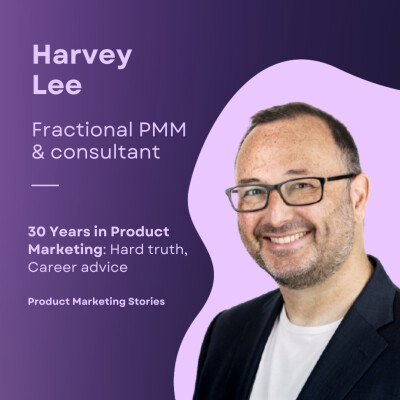
Today's episode is with Harvey Leaves, a very long-standing product marketing leader with plus 30 years of experience in many different organizations such as Microsoft and Product Marketing Alliance. From individual contributor to VP, Harvey is now a consultant and number one ranked product marketing creator on LinkedIn by Facebook. So this episode is for every product marketer who's ever been misunderstood, undervalued or asked to judge different slides. In this conversation, Harvey challenges the most common misconceptions about product marketing, he unpacks the real scope of PMMs, why the role is still unclear for many companies, and how to change that. Harvey also shares sharp career advice, strong opinions, and lessons that will stick, and even some reveal of his new book coming out next year. If you want clarity, confidence, and a bit of tough love about your PMM journey, This one is for you. Hi, Harvey. How are you?
- Speaker #1
Hi, I'm fine. How are you? Nice to see you.
- Speaker #0
Yes, I'm really happy to have you on the podcast today. We are here to talk about career, to talk about the PMR truth. So I'm very happy to have you today.
- Speaker #1
My pleasure. My pleasure. Let's go.
- Speaker #0
I'd like to start by getting to know you better for the audience and for me. Can you present yourself? Tell me, tell us who you are. What are you doing today?
- Speaker #1
Yeah, sure. Hello, my name is Harvey Lee. I am a very long-standing product marketing leader. If it doesn't sound too fancy, ranked top 10 product marketing consultant and number one ranked product marketing creator on LinkedIn by Fabricant. I have spent more years than I care to mention in product marketing. We can start at 30 and go up, but I've been doing it since the mid-90s in various different guises. in various different organizations, such as Microsoft, Kaspersky Lab, Seiko Epson. And of course, many people will remember me for my recent work at the Product Marketing Alliance.
- Speaker #0
And that's why I'm very happy to have you today, because we are going to be able to know how the product marketing has evolved and how you see also the new reality of product marketing. And I would like to focus on your career. Because as you mentioned, you went from working in company to go independent. Why did you decide it?
- Speaker #1
Yeah, there's a lot to unpack there, isn't there? The short story, I mean, it's a multi-layered answer, right? So I'll try and keep it simple. But I think the first part of unpacking that question is I've taken product marketing as far as I could. I mean, I took it from being a product marketing manager all the way to vice president. Then you ask yourself, where do I go from here, right? So it's either... stay static and move sideways, which is, you know, it's a valid option for some and take it to different categories and just reinvent the same thing over and over. And like I said, completely valid option. I tried to be the CMO, you know, only 20% of product marketing leaders want to be the CMO. I wasn't one of them. So I didn't want to take it there. So I kind of felt like after 30 odd years, I've taken it as far as I really could. And it's like, I'm not the kind of person to just Rinson repeat the same thing over and over once i've done something achieve something been there it's like it's okay for a while but i want to keep not climbing but i want to keep growing and that's really what it's about for me i want to keep growing you know after learning all about my own positioning and what motivates me and what excites me um the idea of staying on the same business and doing the same things day in day out was not attractive to me at all. I mean, I'd spent my whole career doing that, right? And a great case point for that is when my 12 years at Microsoft, I was on the Xbox team and some people, if you've read my first book, Backstage Passion, I launched the first Xbox. I was employee number 12 in Europe. And for the first six years of those 12 years, it was wonderful. Business growth, challenging, personal growth, professional growth. amazing and the two directly correlated but once we'd actually hit our targets you know we'd become the number one video games console in europe northern europe especially after about six or seven years it became okay rinse and repeat let's do it again uh and it became about not just business growth but business consistency and sustaining the business and growing share and that's perfectly valid but it wasn't nowhere near as exciting as the previous six years which was Grow and launch a business from zero to what is now $16 billion business. Grow a brand against all the odds and pull it off. right and it's like those are the kind of challenges that i like to be involved with and i like to lead and i like to be you know challenged by uh turning up and turning up and wondering what the category management looks like for the holiday season is a perfectly valid challenge but it's not big enough for me funnily enough it's not big enough for me it's like it's almost like the bigger the challenge the more i get excited about it the more complicated it is the more i can get my head wrapped around it because one of my skills is being able to simplify complexity and so the next six years were about asking myself all the questions it was like well okay well we we reached our objective now what and the company was like profit profit profit profit profit and i was just like stagnant stagnant stagnant i'm not growing i'm not growing i'm not growing and you know i i tried to get promoted and didn't and i tried to grow in my role and I did a bit off and on, but. Long story short, I just came to the conclusion I just could not grow in that role any longer. And I tried for six years extra. So I ended up leaving. And so every role that I ever went to after that, it was like, it's all about personal growth, right? Does the opportunity excite me? So every opportunity I went to, it was like an insurmountable task. Perfect. Right. Let's go. So I'd stay there for a few years, achieve it, move on. But it got to a point where it was just like, okay, this is really tiring. And I started burning out. And then the business growth story started to become a personal story of I'm burning out. I have new responsibilities. I'm married with children, young kids. I was traveling a lot. This is just before lockdown. And I've been made redundant a couple of times. So that'll be a familiar story for most people listening as well. So I was out of work twice in five years for six months at a time. It happens to everyone. I had not stopped working for 20 years at that. point. I'd literally not had a day off. So it was a huge voyage of discovery. And I came to the conclusion after being made redundant twice, after working in different organizations outside of Microsoft, this was not how I wanted to sort of end my career or finish the next 10 years of my career. It was really about what's going to excite me further, what's going to make me grow further, but also what's the trade-off for my lifestyle going to be, right? So I wanted to be... really focused on how can I make my career grow whilst my family's growing up, right? And, you know, traveling, as it was at the time, 93,000 miles in economy every year to visit customers, wasn't it? So I decided, and it was a gradual process. It was from one redundancy to another. One redundancy, oh, should I go freelance? It was like, maybe, maybe not. And then a role would come up and I'd do the role. And then a few years later, it would happen again. Should I go freelance and then Every time I answered the question, it was like call and response. So that was my call. The response got stronger every single time until the response was overwhelming in 2020. But I already knew the response at the end of 2019. It was like, you have no other option but to do it now. And it was like, if you keep going back to corporate and you keep burning out, the periods of time between layoffs and burnout was getting shorter and shorter and shorter and shorter to the point where it was like, I'd start a job and I'd burn out the next day. But I didn't want that to happen. I just thought, you know, this is it. This is like now or never. I'd already met the guys at the PMA in 2019, in the early guys. And I'd started very seriously thinking about building my own personal brand, building my visibility, being more active in the community around 2019, towards the end of 2019. And literally 16 weeks later, I'd been made redundant. I left my job. I went freelance. And I started consulting for the PMA in the very, very early days, right? And they had one European summit under their belt at that point. And it went from there. Then I got another client. And then I got another client. And it all started coming through LinkedIn. And I was like, it can't be this easy. And I was right. It wasn't that easy. But it started off kindly for me. So I suppose it's a long-winded answer. But there's no way to sort of summarize that one into bullet points. because It was a gradual process over time. It will be for most other people if people are thinking about how and where their career is heading now. For me, there's no epiphany moment where you wake up one day and go, oh, today I'm going to be a consultant. It just doesn't happen that way, right? It's a measured, gradual reveal. And that was my room.
- Speaker #0
It's super interesting because, as you say, it's also all the experience that you had during all these years in corporate that made you also be more.
- Speaker #1
sure and more confident and so it's also as you said gradual you know that you want to do it but maybe it's not the right moment now but you start building the path to be able to do it right yeah i mean in my i've got a new book coming out next year it's called the anti-resume uh how to turn a messy career into a future-proof career and it's great for product marketers it's great for everyone actually but it's especially resonant for marketers and b2b tech professionals and product marketers right? The answer resume is a... It's a method. It's a way of thinking about the constraints and, to be perfectly clear, the lies we're told about what a career should look like and how to counter them, right? How to counter the world that we're thrust into. And there's a phrase early in the book where I say it's about the not this moment. You know, it's like not this in quote marks, the not this moment. And for me, going back into corporate over and over again, the signal got stronger and stronger around the not to this moment. It's like, this is not for me. I might not know exactly what I do want, but I know exactly what I don't want. And that is a great place to start. But most people start in the opposite. They start with, I want to do this. But if you work it the opposite way around, it's far more revealing. And it'll reveal what's left that might excite you rather than you. doing it the other way around. So everyone gets signals. It's like, I want to do this. I don't want to. This excites me. This puts the fear of God into me. And those negative ones, I call them the not this moments. And when you get the signals, most people ignore them. And in the book, I said, well, actually, you need to listen to them. And those signals can be rational, logical, emotional. It can even be a feeling, right? A feeling in your gut. you've got that sunday night feeling about going to the office on monday morning it's a signal you should not ignore it it's telling you something you're either excited to be going in or you're not it actually has meaning and i spent those five years across those two redundancies ignoring the signals and i paid a heavy price for it right and that brought that and it brought me to the not this moment and then it brought me to i know exactly what i'm going to do now to take action but it was five years later than i probably should have done it That was my lesson. I didn't listen to the signals.
- Speaker #0
Do you have any other advice for PMMs or even marketers, product managers who are thinking about becoming consultants or freelancers?
- Speaker #1
Yeah, you know what? It's a really hot topic right now. And I get two calls today from product marketers going, I want to be a consultant. You're the only person I know doing it. And in Europe, I probably am one of the very few. You can probably count the amount of product marketing consultants in Europe. UK and Europe on one hand and still have some fingers left as change. You won't need all your fingers. The first thing I'll say to you, it's not the grass is not greener on the other side. So if you're sick of your job or you're sick of being in-house and you think the grass is green on the other side, I'm just going to go work for myself. I can do what I want. Everything's just going to be a fairy tale. Unfortunately, I'm here to tell you it's not. It's not better. It's not worse it's just different right and it's different in ways that you may partially be expecting and different in ways that you're not. And it's really hard work. It's really hard work. The irony of it is, it's not really the work that's the hardest part, right? The hardest part is getting the work. And that's the hardest part. And the challenge for anybody thinking about going freelance or being a consultant is this, nobody's looking for a product marketing consultant. That's the hard part. there's no demand for it. There is a demand for it. Sorry, I'll rephrase that. There is a demand for it, but nobody recognizes it as a demand. So buyers, other product marketers, founders, CMOs, CMOs are generally my buyer and senior product marketers are generally my champion. Nobody wakes up one morning and goes, I need a product marketing consultant today. It just doesn't happen, right? But they feel the pain of not having that help, which is I can't find anybody to hire. The work's not getting done because we don't have capacity or I don't have budget or whatever it is or a mixture of all of these things. So they feel the pain of not having it, but they don't consider it as an option because they didn't realize it was an option. I did a survey when I was fractional VP at the PMA with product marketing leaders. I did it in London and I did it in San Francisco when I was doing talks there. literally 90% of people in the room, and they're all VPs and directors of product marketing, didn't realize a product marketing consult was an option. But when we told them it was and what it entailed, 70% of them said that they would consider it. So it's pretty staggering statistics. I mean, it's not even close. It's a wide chasm, right? So that's a challenge because there's no like marketplace or huge amounts of inbound where people are just looking for product marketing. It just doesn't exist, right? So that's one challenge. And to overcome that challenge, certainly the way that I've done it, and it's the only way I know how to do it really, is I've built a brand. And I built an inbound engine. Engine's probably more scientific than it actually is. I built a very, very visible brand with a target ICP. And I have a flywheel of content, newsletters, LinkedIn, talks, books. I publish like crazy. And I'm planning on publishing even more. I'm becoming Simon & Schuster on two feet. And that is the law of attraction. Like attracts like. So if people read it and I ask people, look, if... If you're reading this and it resonates, just think of me when the need comes up. So that works. But I will say one other thing on the topic before we move to the next question is you need to diversify, right? So if you think you're going to be a full-time product marketing consultant and only be doing positioning and messaging, I've got a shock for you. You probably won't. There isn't enough of that kind of work to go around. And it's probably being done by the in-house team anyway. You'll be brought in for exceptional projects, more than likely. So there's some research we can't get. done because we don't have the expertise in the team or there's an inside word that's missing because uh we have two people off sick long term or we're not we can't hire right now but the work's not getting done so you usually get hired for exceptional projects or we need enablement materials or whatever it is or case studies written so it's largely certainly in europe project work um there is some fractional stuff going on in there but it's mostly in the us and that's it and it's hard work the hardest work is the flywheel is the creating enough noise creating enough publishing opportunities whether that's talks podcasts here we are um newsletters and creating all of that to attract enough inquiries and i do know of a couple of people in europe who started doing it recently and they get that they started newsletters around product marketing and the newsletters are great they're not sales pitches at all it's just all you have to lead everything with value and hope it people make the connection. How long did it takes you more or less to build this flywheel as you as you were probably say two years which doesn't sound a lot but when you gotta eat and pay the bills every month the expenses come in is another month you're thinking when am I gonna get a phone call that's not sad I think it can be done quicker and I think it's very personal right so I think that it took me a long time for people to realize I'm not at the PMA anymore so that took me and And actually, a lot of people still think I'm there. Huge newsflash announcement. at the PMO a year and a half ago. I think you can do it quicker. I think you can do it in a year. And that's with a massive caveat that you already have a pretty good standing in the community, fairly senior. People already respect you. And maybe you work two, three very senior director roles in pretty good companies. You've got a good track record, great portfolio. You're comfortable with speaking. You're comfortable with writing and publishing and this, that, and the other. And you've got great connections. Then I think it takes a year. If you don't have any of those things, it's yay longer. And there's two types of consultant, right? And I'm not dissing either of them, but there are two types. And I would say that if you're listening to this and you're a CMO or you're thinking about hiring a consultant, think about the type of consultant you want to hire. So there's people like me who are few and far between and less than 1% of all product marketers around the world. And we do it full time. It is our job. We live it, we breathe it, and we don't do anything else. We're here to serve our clients. And then there are people who call themselves product marketing consultants who are freelancers in between jobs. They don't live it. They don't breathe it. You know, without being disingenuous, they're moonlighting. Right. And that's completely valid. It's completely valid, but they don't live it. So they want to do a bit of messaging where pick up a bit of a bit of part time freelance work, but they're still looking for a full time job. That's not my type of consulting. My type of consulting is I'm all in. So I'm available in six months if you want to bring me back. You know, I haven't gone to another job somewhere. So there's two types. And what I found is that since the layoff era, most product marketing consultants are the second type. Yeah, they're the moonlighting type, especially in the US, I would say. Not so much in Europe, but especially in the US. And I get a lot of inquiries. Oh, can I have some of your time to talk? I'm thinking about doing this while I'm looking for a job. And I give them the same advice. And I'll give them the same advice here. It's like, do one or the other. Because you'll do both badly.
- Speaker #0
As everything. We can't target everyone. We have to choose. I would like to deep dive also on a topic that you like a lot about talking on why product marketing is so misunderstood and what people think about product marketing versus what it is in reality, because there is a lot of misconception even within the product marketing community. So I would like to have your opinion on that. What? What is for you the biggest misconception that you've seen about this role?
- Speaker #1
Well, I mean, there's so many misconceptions out there. It's just like, oh, we're here to do pretty slides. We're here to tidy up everybody else's garbage. We can do everything and everyone and be everything and everything. everything to everybody. And of course, that's absolutely not true. The reason why product marketing is misunderstood, actually, is quite straightforward, but people don't think about it in these terms. And that is that in any organization, you have tangible roles, right? Tangible, they feel very real, you can almost touch them. So sales is the most tangible role. The sales team sell, and they produce their outcome is money, right? It's not very hard to understand, right? It's like, I get it. And the leadership gets it. It's like, we have to have a sales team. They do their thing. We get to eat tomorrow and pay the electricity bill, right? It's very, very tangible. Marketing is more or less the same, more or less the same. And product marketing is completely the opposite. It's a bit like it's closer to brand in terms of perception. And what I mean by that, not in the work. scope of work but what i mean is in its intangible perception inside an organization so brand is a great case in point before we get to us and that is nobody understands what brand is in most organizations it's always fluffy it's always a logo or it's a color that's true for like five percent of brand work right that's just brand assets or brand codes but brand is you know real brand managers and people who really understand brand and how to create and maintain brands Managed brands are brilliant at it. And, you know, there's no better brand manager than a brand manager at P&G or Unilever or any of these huge, enormous corporations where, you know, their brand managers are basically category managers. And they live and breathe the brand. And they also do some of the product marketing work within that role as well. A typical kind of quote unquote fluffy brand manager is largely misunderstood. And brand is on the books of any company as an intangible asset. because it's hard to measure, right? You see where I'm going with this. So product marketing is also hard to measure, right? But it's even harder than brand. At least there are some methodologies officially to measure the value of brand. However, and there is science behind it. The problem for product marketing, there's no science behind it that people understand. It's totally intangible. And there's a reason for that. But I'll just give you a friend of mine, Jonathan Memel has this wonderful musical analogy for it. So if you think about all the roles in a company as a band, as a rock and roll band, right? Sales are the lead singer. Everybody knows who they are, what they do, and what you're going to get. Marketing's the lead guitar player. A lot of people know what they do, have got a pretty decent idea, know what they sound like, know what they look like. Maybe not quite so familiar with them, but know that they're essential, right? And then you've got the drummer. The drummer's like customer, customer. service or customer success you know they keep the beat going they keep the customers happy it's just like just keep the lights on keep it going great fantastic don't stop and product marketing of the bass player every band needs a bass player you have no idea who they are what their name is what they look like what they do what they sound like but bloody hell you miss them when they're gone i love it i've got to credit jonathan maymond for that um is a great and he is a bass playing product markets. I use that analogy a lot because of my music background, of course, as well. And of course, the bass player is the ultimate intangible in any band, right? You can change your bass player for every album and nobody would know. You change the lead singer, everybody would know, right? So we're the intangible, the ultimate intangible function inside any organization. So back to one of your previous questions, the reason it's misunderstood is because it's intangible. And the reason it's intangible... is that we don't speak in revenue language.
- Speaker #0
And so do you mean that we should speak in revenue language?
- Speaker #1
We have to. If you want to become tangible in your organization, we have to stop talking in measuring the things that we do and start talking in the language of revenue about the outcomes we helped achieve, right? That's the pivot. So it's not, oh, we changed the messaging and people loved it. It's we changed the messaging and here's what the revenue results were. right? And here are the steps that we did to change the messaging. And this is the before, and this was the revenue from, let's say, the conversion rate on a website. And then we changed the messaging, and this is the after, and this is the increase, and we did that. And that's a conversation you can have with the CFO. So when the CFO is thinking about headcount cards, he thinks, or she thinks, in revenue terms, it's just like, who's the best value to the organization? Who's most tangible, who can we not live without? And if you're intangible, you're vulnerable because they think you can live without you, right? I'm not saying that's right or not, but that's how people think. So you protect your assets. So your assets are measured in revenue language. So we have to start talking in revenue language. If I was in customer success, I would say in dollars or euros or in pounds, I would say, this is how much money we saved the company from stopping 15 customers churning last quarter. We didn't make $15 million. We saved it. And here's how. If we weren't here, you'd be $15 million less. profitable or let you know of your gross margin so we have to sort revenue language and by showing how we got that revenue is how we start making the intangible tangible and that is a step towards making product marketing's contribution more
- Speaker #0
understood do you have on other examples of how we can really show the value in a revenue business term i have a process called show me the money,
- Speaker #1
right? So I don't know if you're familiar with the film Jerry Maguire, but there's a scene in Jerry Maguire where he's trying to sign a player and the player just says, show me the money. And it's a really, really famous scene. I can't talk about it too much because there's a lot of swearing in it. If we take the analogy of, okay, we have to show the organization the money rather than just the outcome, what we can do is we can show the steps that we got there. So they get an appreciation for all the work that went behind that number. So let's say the number is... We converted 20% higher before product marketing got involved. That was worth $2 million, incremental revenue. Then show the work that you did. Let's say it's five steps, customer research, insight, validation, testing, reiteration. Show all the steps and all the incremental gains or losses that led up to that. It's like opening the door to the sweatshop. It's like, this is all the work that's going on. This is the engine behind it. Show the steps in vertical steps. It's like step one, step two, step three. This is all the work that we did that might have been considered intangible in these people's eyes. But you're showing actually not just the thought process, you know, the actual work that was done, the time it took, the measurement, the iteration, reiteration to get to that outcome that you're talking about. And for me, it's enough. It's already a lot of work to do that. But it's enough to convince senior leaders at an organization that actually what our contribution is, is worth keeping hold of. And think about what it would be like if we weren't here. What happens when the bass player stops playing?
- Speaker #0
I like the way you frame it, because I think that when we are product marketers, we do really well at the fact of explaining what we are doing and all the stuff that we've done.
- Speaker #1
No one cares. Exactly.
- Speaker #0
The second part is missing about. How do we link it to the company strategy, company OKRs, company... Yeah,
- Speaker #1
exactly. Well, we spoke to this amount of customers. We did this. We tested this messaging and the CFO is falling asleep behind his computer. You know, the CEO, she's like, she's gone to lunch. It's like, no one cares. It's like, it's just a harsh, it's a hard reality. And, you know, when 65% of product marketers have been doing the role for less than three years, there's a lot to learn, you know. And I don't mean that in a disingenuous way. There's just... Just a lot to learn. So the sooner, whether you've been doing it for one year or whether you've been doing it for 10 years, the sooner you start connecting your work to revenue outcomes, the sooner you'll find that's an insurance policy for your job security. Not perfect, but it'll increase it. The sooner the organization will understand your value and the sooner you'll start being invited to other more exciting projects, right? Hey, we need to get product marketing involved in this project or we've got this launch that, you know, let's bring Carlos to this, you know. And that will just start happening automatically, whether you stick your hand up for it or not. And that's a great place to be.
- Speaker #0
How do you think the PMM product marketing career is evolving today? You mentioned that 20%, I think, of PMMs want to become a CMO.
- Speaker #1
Only, yeah, which means 80% don't.
- Speaker #0
To become a PMM, there is a lot of ways to become a PMM.
- Speaker #1
Yeah, there is.
- Speaker #0
Is there also a lot of different ways to end up? Yeah, there is.
- Speaker #1
I actually think it's diversifying a lot right now. It's not necessarily a bad thing, but I think a lot of product marketers didn't get the memo yet. So here's the memo, right? Old world. Old world was I became a product marketer and I stayed a product marketer and my title has been product marketing something for however long. That's the old world. That world's dead.
- Speaker #0
right? Or he's dying. And it's not necessarily a bad thing, right? People listening to this is going, what's he doing? He's killing us. I'm not, no, actually, I'm trying to open your eyes to new opportunity, right? Those roles still exist, right? But if you look at segmentation, I run proprietary segmentation data on the total addressable market of product markets. Nobody else has that data. I'm the only person in the world who does it, right? it's not really growing so um and what i mean by that is that you know everyone's always the hottest role ever it's been the hottest role ever forever right for 30 years it's been the hottest growing role it's like when's it actually going to combust right not quite yet um so prior to uh just after lockdown i did the first set of numbers got three years of data there was a hundred and 16,000 product marketers in the world. Is that a big number? Well, if you think there's 6 million marketers, that's 2%. It's like, we're nothing really. It's like half the time we spend ourselves talking to ourselves in a paper cup, 2% of all marketers. And all the layoff era happened, right? So a bunch of people got laid off. What happened? Negative 2.6% retraction on total global numbers. the more interesting story is where it happened, right? So there was a few thousand single digits, which actually is not as high as people think it is. What happened is product marketing grew in the US by 5%, but it went down 10% everywhere else. So UK lost 10%, France lost 10%, Germany lost 10%, more or less Africa, Southeast Asia. Everywhere outside the US lost about 8% to 10% of their product marketers. in the layoffs and the US gained 5%, which of course is not equal because of the scale. It's not a weighted number. Why was that? Right. So the number only went down, you know, a few thousand, like 2 point something percent, but the US went up. Why is that? It was because the decision-making bases moved, the teutonic plates, if you will, moved from global to the US, right? So what was happening is that the US-based organizations were building a moat in the US, hiring more product marketers, bolstering and scaling down their regional operations. That was fundamentally what was happening at the top level, right? So that's why we felt the pain in Europe and in the UK. The 6,000 product marketers in the UK, 600 people lost their jobs. And that directly correlates right across outside the US to most regions. there's only 2,000 product marketers. What was it? 2,000 in Australia and New Zealand. They lost 200. For them, that was even a bigger hit because they've got such a smaller number, right? So the smaller the number, that 10% is the pain is even felt even more so, right?
- Speaker #1
Exactly.
- Speaker #0
So 10% in the US where there's like 50,000 product marketers isn't felt so greatly. So it's not equal. And then what happened is it came back. And it came back and hit about 130. So it was bigger than it was ever been before, but it hasn't moved since, right? For two years, it's not moved. It's been about 130,000 product marketers. And they're all nearly new. You know, they've been doing it for less than a year or two. They're all really green, lots to learn. It's exciting, but they're not moving the function forward in terms of seniority, changing perceptions. Yeah, we're not growing at vice president level. We're growing at junior product marketer level, right? That's very important. So where's it going, right? I don't think it's going to grow much more, right? If it does, maybe it hit 150 or this or the other, but it's all relative to how everything else grows. You know, because we're only about 2% of marketing. If marketing grows at 2%, it's meaningless. It's really meaningless. So what do I think the impact of this is? Well, I can tell you that product marketers who are feeling stuck, stayed, frustrated, maybe laid off, I'm seeing more and more of them moving into broader defined roles that aren't product marketing, but use product marketing skills. It's not a bad thing. I say to people when I'm coaching and teaching and talking, don't get married to the title. It's just words. Get married to the outcome. Get married to what the role actually is. There is now about 30 different titles for product marketers. product marketing and brand manager, product marketing, you go to market executive, I mean, you name it. There's a marriage of titles, there's product marketing and insert something else to reflect the fragmented landscape. So don't get too attached to the title. But there are a number of roles now that are outnumbering product marketing roles approximately of a ratio of three to one. So for every product marketing role that's called product marketing, there's three of these. And these roles you'll know, right? Because you've seen the titles on LinkedIn and in the job classifies, growth manager, portfolio manager, go-to-market manager, all of these kind of roles, value propositions manager. These are basically product marketing roles, but just more tightly defined around one area of product marketing, right? So they're specialisms. But there's three times more of these jobs available than there are actual product marketing title jobs. So I say to people, don't get married on the title. Look at the opportunity, right? So if you're struggling within product marketing title roles, because the competition is high, right? because people look like this they're just going after the same roles think a little bit more broadly and open up the blinkers a little bit and think okay well portfolio propositions go to market growth whatever whatever it could be don't discount it because the opportunity there's way
- Speaker #1
more opportunity playing in that field than there is in our field and our field is not growing do you think that product marketers should specialize in a specific field of the product marketing like we talked about go to market positioning
- Speaker #0
I think that's the million dollar question. I think the short answer to that is it depends. And what it depends on is your experience and tenure, right? So if you've been doing product marketing for 10 years, you're well established, you've got a really good track record, you've got great connections, then I think probably it is time to specialize, right? And be a specialist generalist, right? So you're able to do all the general stuff, but you can specialize in one specific area. I know some product marketing leaders who are very, very good at that. You know them. them as well you know household names uh in the product marketing world um and i'm and i've done it on on the career side right so i've specialized on the career side uh but i still do product marketing consultancy i still do all the other stuff too if you're thinking about specializing and you've been in your role for less than five years i don't think you've earned the right and i don't mean that in a bad way it's just like you've just just got so much more to learn and achieve before you think about specializing. If you specialize too soon, what you'll find is that you won't have the generalist background, that solid rock to fall back on that will allow you to move. Now, if you specialize in a niche, there's two types of niches. I write about this in my new book, The Anti-Resume. There's two types of niches. There's good niche and bad niche. Bad niche is, you know, I specialize so specifically in such a tight market. that actually in movie terms, I've typecast myself and I can't do another type of role. So like, I do email, blah, blah, blah, in Scandinavia for companies up to 100 employees. Well, unless your future employer fits those criteria, you're kind of screwed. Because one day the demand for that will just not exist anymore. But if you're a specialist generalist and your specialism can span different categories, different industries. this is a good niche you can take that specialism to other places when the opportunity arises for example if you're a specialist in messaging in b2b you will always be a specialist in messaging and you can take it from telco to cyber security no problem right so it's it's portable so that's a good niche right so you have to be you have to be really thoughtful and intentional about all of these things around your whole career your specialisms you know where to play how to play because you could and i learned the hard way over a long period of time it's why one of the reasons i left microsoft after 12 years is that i didn't want to be typecast to the point where i couldn't do anything else and i've got friends there dear friends that have been there 20 years and they'd be the first person people to admit to me or to you that they couldn't work anywhere else anymore they've been institutionalized thankfully they're of an age where they wouldn't need to but uh that's by the by you know it's my Okay. But when you're thinking about specialisms and niches, you have to be really careful and just be really choiceful and make sure that you can always move it because whatever a hot category is today, I mean, AI is on fire, has been for ages and will be for the future, there will be something else that's on fire in two years from now and everybody will run towards that. So you could specialize in a certain type of AI right now, I can tell you in two years from now it'll be obsolete. So was that a good niche to specialize in or not? But whatever you do, make it portable.
- Speaker #1
This will be my last question about the career. What's the best way at the end to approach the career growth? Like, even if we want to get a promotion or if we need to take a step back, as you did also, to say, OK, maybe I don't want to be in the corporate world anymore. On the contrary, I want to. The not-mish moment. Exactly. How do you approach it?
- Speaker #0
Yeah, I think in the interest of time, I think the best way to approach the future is to start doing it before you need it. And build, here's a piece of actionable evidence. Build bridges to the destination that you set yourself before you need them, right? Before you need to cross them. When I get career coaching clients or I'm teaching or doing talks or webinars, I always get a huge cohort of people say to me, oh, I've been laid off or I'm stuck and I want to do this. And they didn't build bridges and they didn't start doing what they, to get to their desired state, even if they know what it is, they're starting from almost a negative position. It's like, I've got to start over. And I give them the harsh truth. It's like, start doing this, start doing that. And then they start getting this sort of feeling of dread. The signals saying, you should have started this two years ago. You should have started this two years ago, you know, in your own ear. And that's the right, that's correct. So build it before you need it is a piece of golden advice. And along the same thread, one of the other very common ones that I get in the product marketing world is I want to be strategic. But, you know, my boss won't let me, or they just want me to do pretty slides, or I'm stuck in the go-to-market motion, but I want to be strategic. I think it's especially important to recognize that people who are stuck or people who have been doing product marketing for a while, I would say nine out of 10 of them still want to, that's the move that they want to make. Even if it doesn't mean being serious, I just wanted to do more strategic work. I want to do inbound over outbound. But there's no opportunity at my role. And then I challenge them and I say, are you sure about that? And they're like. What do you mean? So we have a, we put the kettle on and make some espresso. And it's like, okay, well, let's have a chat. And I said, you can be strategic tomorrow before 10 o'clock in the morning if you choose to be. I'm going to say, I don't understand you. I said, strategy is just about asking better questions. Right. So this is about positioning as well. So if you're an executor, that means you're a doer. You are somebody who... does something and execute. And it means that actually you're in a support role. I talk about this in my new book. You're in a support role. You're in go-to-market. You're there to execute. The expectation of the organization is that, oh, don't worry. Harvey's got this. He's going to deliver it. Everything's going to be fine. Even if you're in that role, what you say is not, okay, I'm going to go and do it. Have we thought about doing it this way because it might yield a better result and I've done some work to demonstrate it. All of a sudden, you're having a different conversation. You've moved from a support role to a strategic role just by asking one question. It's challenging them in the most professional way, but not disrespecting them or not saying you're not going to do the support work. But what you're doing is you're showing that you're a strategic thinker. Don't wait for permission. The best piece of advice that I can finish this on is don't wait for permission. You've got everything you need already. You just don't realize it.
- Speaker #1
Thank you, Harvey, for all these super useful insights. I think that product marketers in France, at least, will have a lot of questions for them to think about the career, how to be more effective or to have more impact also in the organization. So thank you very much.
- Speaker #0
My pleasure.
- Speaker #1
I would like to finish the conversation with three questions that I used to ask to everyone. The first one being, what's the next subject or guest that you would like to hear in the podcast?
- Speaker #0
You should get Tamara Grominski and get her to talk about product marketing leadership.
- Speaker #1
And the second question is, do you recommend any book or resource in particular? It can be professional or personal.
- Speaker #0
I recommend all the books I've written, obviously. So they've got the new one coming out next week. Books not written by me. Okay, so seriously, professionally, if you're thinking about being a consultant, right, there is one book I actually recommend everybody reads and it's called The Million Dollar Consultant by Alan Weiss, right? It was recommended to me by a product marketing leader, actually, in the US. I read it and it changed my life. Literally, it sounds cheesy, I know, but it's like it actually changes the way I think about how to do consulting. and how to think about clients and how to do proposals and invoicing and The whole thing and the whole value chain of consulting. So Million Dollar Consulting, Alan Weiss. I should be on commission, but I'm not. So if you're going to do consulting, read that book before you do anything.
- Speaker #1
Thanks for the advice. And the last question, the easy one, where can we reach you?
- Speaker #0
Well, you'd be unsurprised to hear LinkedIn probably is where it's happening the most. So yeah, come out, meet me on LinkedIn, send me a connection request. Tell me that you listen to this podcast. That'd be nice. I'll write back you. And a really good way to carry on learning for free is to sign up for my newsletter, which you can do at my website, harvey-lee.com. And you'll get a free PDF copy of my book and all my infographics and a great product marketing segment report for free just by signing up.
- Speaker #1
I will put all the information in the description of the episode.
- Speaker #0
Super. Thank you.
- Speaker #1
Thank you again, Harvey, for your time. Have a great end of the day.
- Speaker #0
My pleasure. Thank you so much for having me on. Merci d'avoir écouté cet épisode jusqu'au bout.
- Speaker #1
Si l'épisode t'a plu, n'hésite pas à le partager sur LinkedIn en me taguant. Tu peux aussi me soutenir en laissant un avis 5 étoiles sur Apple Podcasts et me laisser un commentaire. Ton aide est précieuse pour m'aider à faire connaître Product Marketing Stories et aussi m'encourager à créer davantage de contenu. Alors merci.