- Speaker #0
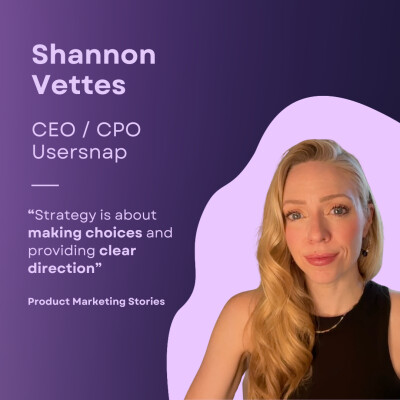
Today, I'm joined by Shannon, an American expat who's been living in France for almost 20 years. She spent her entire career in product and tech, building, leading, consulting and strategy, and she's now both CEO and CPO at UserSnap, where her team helps product managers collect, analyze and take action on user feedback. We talked about what it really means to wear both hats, CEO and CPO, and how Shannon ended up stepping into this dual role. She shares why it's perfectly fine not to have a linear career, how she builds strategy and keeps it aligned with the company's value delivery, and why creating a safe space for disagreement is essential for getting it right. You will also hear her hot takes on product marketing, why she calls herself a PMM fangirl, how PMM and PM collaboration works at UserSnap, and what most teams get wrong about it. Finally, Shannon shares her three tests to check if your strategy is good enough and her three pieces of advice to make PNPMM collaboration truly work. Hello, Shannon. I'm very happy to have you on the podcast today. How are you?
- Speaker #1
I'm doing well, thanks. I'm really excited to be here. Thank you for having me.
- Speaker #0
To start the conversation, can you present yourself, tell who you are, where you're working today, what do you do?
- Speaker #1
I am an American expat living in France for almost 20 years now working in product and tech. And that's how I identify in addition to being like a mom and all these other things. When it comes to work, I've been working in the product fields forever. It feels like I started building in like 2000, my first sites. I started consulting a few years after that. And I've been in the business of creating products for as long as I can remember, either on the engineering or the product side, working in transformation, consulting or building myself. Right now, I'm CEO, CPO of UserSnap. We build tools that help product managers collect, analyze, and take action on feedback. And that's what we do. And I love it.
- Speaker #0
This is one of the first questions that I have about exploring your career evolution and what you do today as a CEO and CPO. What does that mean exactly to have like this double hat?
- Speaker #1
First of all, I think it means like a lot of different roles are being played. And what can be... tricky about this sometimes is that it's always leadership, which I always liked, but I have to sometimes be playing a role of business strategy, organization, health, and looking at the numbers is a big part of that task. And then there's another part of me that has to be extremely creative and curious and looking at the market and listening to our customers and trying to understand their pain points. So this EO part of me is like, you know, cash and, and viability and all things sort of collaboration and, and setting up my team for success. And the CPO side of me is like market trends, opportunities, how do we position ourselves for the most valuable proposition that we can make with the best package and price associated? So I'm sort of feeling like the leadership questions that I ask myself on a day-to-day basis are, How do I find the right opportunity for the company that also is the right opportunity for the product? And how do we balance these two aspects of this is good for our growth, but it's also the right strategic play for us right now. And the challenge is always going to be focus. As a CEO, I want to solve all these problems. I want to solve internal data problems. I want to solve team growth problems. I want to solve other things. But as CPO, I have to just focus and buckle down on the product itself. So there's that like dichotomy and the friction. But what makes it easier for me is that I'm just one person. And so I can sort of see the whole landscape. And that actually makes it sometimes easier.
- Speaker #0
Looking back, as you said, you always worked in the tech world, the product ecosystem. What are the main qualities of being a CPO, having a product background to be a CEO today?
- Speaker #1
So how does one move from CPO to CEO?
- Speaker #0
Yeah. And what are the advantages that you see? Maybe having this product visibility, knowing what, listening to the customers, to the clients, what do you see as being your superpower? Because you have the background that you have today.
- Speaker #1
Yeah. So I think the superpower that helps me the most is having worked in multiple fields, actually. And I find this interesting. In France, it's a handicap. They don't like it in recruiting conversations when you say, I've been an engineer. I've been in design. I've been working in multiple fields. I've worked in program. Like I've not just been a product manager. And they really feel this deep discomfort. Like, oh, why did she move around so much? Why couldn't she settle? And this is an absolute superpower for me today. And so anyone who's listening to this podcast who doesn't have a very direct career trajectory, or if you switched, if you were a product and now you want to move to PMM or vice versa, my advice would be, Don't be scared off by anyone who says, hey, this is not good that you did this. It's great that you did that. So in the role today, in the growth opportunity, had I not experienced like in program and transformation and consulting roles, I would not be a good CEO today. I understand a lot about marketing teams. I understand a lot about product teams, engineering teams, CS teams. I was also a director of support for a little while. Like all these other aspects of roles that I've played bring to me a level of understanding and empathy. And it's really allowed me to coordinate the team and their capabilities and their talents with a lot more thoughtfulness. And even though I still challenge some things and wonder about some things, I don't know everything. I have to trust the team and their expertise. But having some breadth of understanding makes me able. to challenge and makes me able to coach in ways that I think someone who's a CEO who has never been an engineering leader or who has never been a product leader or a support leader, they can't have that same perspective. So I think that this superpower of I didn't land in one role and stay the course and the growth trajectory of that role has brought me a level of empathy and ability to coach that I could never have done. So if you want to move... from CPO to CEO, I would say get to know the other areas of the business, specifically finance, managing P&L, managing support is something that maybe a lot of product leaders haven't considered. Support is a very complex and difficult job that we undervalue, in my opinion. And I think also understanding marketing and engineering, like try and get with those people, understand their day today, but more importantly, understand their challenges, that will help prepare you for a growth trajectory, in my opinion.
- Speaker #0
So when we look back at your career, how did you end up becoming the CPU and CEO? Is it like it was an opportunity that you saw? It was someone calling you? You were expecting to do this move?
- Speaker #1
So it's a bit of a funny situation. I was really trying to get into leadership roles that were much more product oriented. I haven't yet run a business end to end. This is my first time. So I'm going to allow myself some grace. I will make some mistakes along the way and learn from them, as all leaders do, whether they admit it or not. And in this case, I was applying for a CPO role within the SaaS group family of products. It just wasn't quite the right fit. There wasn't any people management. And I really love people management. It's one of my favorite parts of the job is seeing people and helping them craft career and growth opportunity. So We talked about it. The recruiter's like, we really love your profile, loves your interview. This role doesn't sound like what you're looking for. And I was like, yes, I agree. And he said, okay, we're going to keep you in mind though. And he called me like a week later, like it was really soon. And he said, there's this other role. It's not what you wanted as a CEO, but would you still be interested? And I said, I don't, I don't think I can do that role. I'm not qualified. I've never done it. And I honestly feel like I wouldn't know how to do some aspects. And so he said, well, which aspects? I said, specifically like the financial ones. I haven't that breadth of experience. I'm not even really certain that I could do it. And he said, well, why don't you go through the interview process and let's just like, see how it goes. And I said, okay, like I'm willing to try. And the only reservation I have is, is there a product team or, you know, product marketing team or how does it work? in the setup today? Am I going to get to like have that leadership aspect that I'm really looking for? And he said, oh, totally. This is a product that wants growth, that wants change. They're really looking for someone who's a product leader in addition to a business leader. And I'm super business minded and I'm super product minded. So I said, yes, let's try it. And I kind of had these low expectations. I just didn't really think I was going to get it, to be honest. And It happened that it worked out. They said, okay, your profile is definitely the best. Because I'm in France, there was some salary negotiation that had to happen. I'm more expensive as a resource because of the cost of being on a French contract. So I did have to accept that. If I want this role, it's not going to be at the salary that I was at. And for me, that was a trade-off that I was really willing to make. So that's how I got here. It's like, I'll try for it. They say that they'll help me with the financial aspects. I'll take a small pay cut because this is definitely an experience that I don't want to miss. Pivoting a company and leading the product sounded so cool. So I absolutely went for it. And no regrets. Really happy with how it's turning out.
- Speaker #0
What an adventure also to go for a role where you initially think that maybe I'm not the right fit or I don't have the skills to do it. And at the end, I think that it's also having the courage to go beyond what you think you can do. I assume that you are learning a lot along the way. Maybe you can share learning that you have or the big questions that you have having in mind, mainly about the shift in strategy or the organization, maybe.
- Speaker #1
So I've been consulting on strategy for a while now, and I've been in a few companies. I worked in multiple sectors in both B2B and B2C. So I feel like I had this underlying experience that really helped me a lot. But this is maybe the first time that I've gone through a full end-to-end strategy pivot, like new ICP, new value proposition, market is shifting so rapidly. No one can predict what month to month things are going to look like. So it's quite a interesting challenge. At first, I was very much like, I know how to do strategy. And I think Stephanie explained it really well in her presentation that she gave at Product at Heart. The way that she said it, I'm just going to echo how she talked about it because it really resonated with me so much. She said, you kind of go into these situations feeling like, I got this. Like I'm... I might have things I'm going to learn, but I'm going to figure it out. And I know enough about product strategy that I'm going to be able to ride the wave of my knowledge. And then at some point in your journey, you realize, my God, there's this big knowledge gap that I don't have. I'm not going to be able to just go on what I know. I have to go do some deep dive. I have to go learn again. And luckily for me, I love that. It's so much fun. I would do it all day if I could. So you have to go and dive. deep. And so we did this big research project. I talked to hundreds of product managers and product leaders over the course of like a month. It was like every day, four or five conversations, just immersing myself in this group and trying to understand where was the market headed, what were the pain points and where was our opportunity. So you have to do that. And at some point you kind of come back up and you say, okay, I feel like I've seen enough and heard enough that I have confidence. in the direction that I want to go. And now it's time to test. And that's also a challenge for product leaders to know when is enough knowledge. And so we think this is actually a crux. And one of the reasons why we love our products so much is because we help illuminate that question of, do I have enough confidence? And I think that this is why we use our products so much during that phase of exploring the strategy and exploring the problems. We explored markets. and capabilities and people using our products. And it really brought me that ability to question my own certainty several times. I still use it today. Every customer conversation is an opportunity to learn and grow your assumption base. That was the journey that we took in this strategy approach. And for me, it was good to be reminded that even if you have experience doing something, every new business. is going to challenge your knowledge. And it's going to make you feel like a novice again for a little while until you do that research and you educate yourself again. So anyone who's thinking about becoming a product leader, keep your humility on check and be ready to question yourself. Don't assume that you know anything. Go talk to people and always try and understand deeply in order to feel confident. And maybe the second thing that was a big lift for me was like learning how to build budgets and do FP&A and making the tough decisions around staffing. Like, do we have the right people and do we have the right capabilities in the team in order to push ourselves forward in the direction that we want to go? So those are tough decisions. Is it the right strategy? Is this the right investment amount? And do we have the right people? Those are the three big things that I think about in this role.
- Speaker #0
I would like to focus on the right strategy for you. How do you define a strategy and you told us about talking to customers, benchmarking, seeing what is going on on the market, but how do you perceive what is a good strategy and how do you test it? on the market and do you implement it?
- Speaker #1
I want to tell you that I had a really clear plan and we executed that plan and it went so easily. Here's how it really went. I had an idea of what I thought the market problems were and their priority. Because I'm a good PM, like we challenged it. Let's go talk to some people. Let's see if this hypothesis is true. So my underlying assumption was actually that Um, product managers really cared about product market fit. And I was like, there's an opportunity here. There's not a lot of tools out there that are doing PMF assessment and evaluation and really helping PMs understand that. I was like, this is the thing. They're all going to care about it. We're going to sell like hotcakes. Off to the first 10 PMs. It was like the lowest rank thing. I just was in this moment of panic. I was like, oh my God, my entire premise of strategy was built on this shit. What do I do? Like a good scientific person, you go back to the drawing board and you explore the problem spaces instead. So we started exploring different markets. What if we went into more of a CS market? What if we went into more of a developer and bug tracking market? What if we went into a product like discovery market? And we explored four or five markets just talking to people in those groups about how they prioritize their tools. what problems we're trying to solve, how often those problems come up. So for me, strategy is first and foremost, when you have a product like ours, that is a workflow tool, you want to make sure you're in the right market for focus. Because the way that the product was designed before was really for everybody and all things. If there's one thing I've learned about strategy, trying to be for everybody is a losing strategy. You will build a general solution that everyone is kind of lukewarm about. So maybe that's the first takeaway for me from this experience is don't try to build something for everyone. Don't go horizontal immediately. Be niche. Try to pick one market and one clear ideal customer profile and really focus on them. So the first step in our strategy was all about like eliminating markets and then eliminating potential customer profiles. And so we did a lot of interviewing about that to try and find out what was the total addressable market that we were interested in. It was products that had the most breadth and opportunity and also the biggest group of people experiencing the pain. And then we tried to look at ideal customer profiles and different types of product managers and what type of pain points were they feeling and where did we want to play to win? And we started looking at five or six different problem spaces. and trying to get priority and insight around those through the interviews. And we landed on people really lack confidence. It's a universal problem. They're making bets, which is great, but bets without any research or insight is, in my opinion, kind of stupid. I hate to say it. Okay, product managers, don't get mad at me. But when you are making a large bet without any insight or research, it's dumb. Someone has to say the harsh truth. I'm comfortable being that person. So strategy is about helping you make choices and it's about helping you give clear direction to the team members so that they're all rowing the boat in the same direction. So for us, that was, you know, going into user snap, which had a very broad audience, very broad markets, very broad application. And it was only a collector of insight and didn't really do anything with that insight. We made the hard decision of like, okay. we're going to stop caring about all these other potential ICPs. And we're just going to double down on these product managers who are trying to collect insight first to really validate their assumptions and validate their solutions. And this is the most important thing that we can do to help product managers right now. So this has driven our entire strategy for the first half of the year. The second big takeaway around strategy is that it's not going to remain static. If you set a strategy and you keep it for five years, you have a very long-term vision. But in the world that we're living in right now, where our entire market has become commoditized, anyone can create a form. It's no longer a unique value proposition. The breadth of capability is literally changing every single week. So. In the space that we are in, where people are looking to build themselves instead of buy, the real data challenge for us is trying to figure out how do we create a capability that cannot just be vibe coded? So keeping a constant finger on the pulse of what's going on in tech and where are the leaders in our space? starting to go and where do we want to go in order to remain differentiated and keep providing a unique value proposition is a second big challenge and strategy. So first, narrow your focus. And second, be ready to pivot or change that approach when you see that the market is changing, especially right now more than ever. I think this is a really key thing that wasn't a part of strategy before the last. you know, six months. Now it definitely is. You have to constantly be monitoring.
- Speaker #0
And how do you test the strategy once you have it?
- Speaker #1
Well, first you have to see who talks to you. That's a good test of your strategy. Like when I started doing research and I said, okay, I think we want to focus on product managers who are struggling with confidence and not having enough information to like really validate their bets. That was a bet. So part of the first step was like, If we do outreach to this group, do they even resonate with the problem space enough to want to talk to me? So I've utilized my network on LinkedIn. We utilized the actual customers that we had and the role that they had defined and tried to target them directly in the app and say like, hey, you're this role. You're doing this thing. Would you like to talk to us about your problem space? And so we had the customer conversations targeted directly through that, also my network. And that group resoundingly wanted to talk to us about the problem space that we were interested in. So that was like a first validation. Like, yeah, we like struck something here. When we said, is this one of your biggest problems? And they all said like, yes. That came through really loudly. So we felt really good about that assumption. And then when we went to market, like testing again, we had all these roadmap ideas. So many different things that we could prove. So we went first to like the problem space hypotheses. Like we think this is a problem and this is a problem and this is a problem. We sort of matched them to some of the features that would solve those problems in our mapping. And we did like a feature prioritization survey. Hey, audience who said that you're this role in this problem space, what if we gave you this list of opportunities? Like, can you tell us which one's like the top three that you want? And we got that information and it disproved a lot of my assumptions, actually. And so that to me is also really reassuring when I think I'm right. I found out I was wrong. Then I actually feel more secure. I do find again, like asking people directly, is this your problem? What is the underlying reason why? And tell me more about these potential solutions and which ones you would prefer. Those two bits of information together taught us quite a lot about the strategy and if it was viable. Now, the last thing is like, always go look because What you don't want to do is constantly be playing catch up. So we utilized our growth team and looked at the market opportunities. And even though we had validation on some of those problems that needed to be solved, I was like, everyone is doing this right now. What if we did it later? What if we first found a unique value proposition and did that? And then we added the stuff that everyone else was doing later. Because when we were making our strategy, it was really important that we be able to say we're the best at something. So I do think that we are one of the best at analysis, at deeply understanding the hypothesis. We have AI features around this. I think that we are the best at solutioning that because we have problem, like identification, hypothesis generation that is feeding the problem solution. So I do think that those things together have made our... space stronger for that. And instead of just going and building like a consolidation tool that collects insights from everywhere, I was like, I want the quality of our analysis to be better. Maybe later we'll do consolidation, but first, at least we know that our analysis is on point. And I think that is a decision that you make as a product leader that requires testing and learning too. So going and looking at the market and finding your differentiated offering is a third test that you need to do. So who is the right people? Are they even responding to me? Second, are these the right problems? Are my solutions hitting or not? Are the things that we think we should prioritize really what we should prioritize? And third, understanding deeply that aspect of, is this differentiating our market? Three tests that you can do right away to figure out if our strategy is good enough.
- Speaker #0
And there is also the big challenge of having... everyone in your team that is believing also in you and that's why also having interviews and backup is really important to not just say it's my intuition and we should go there do you make sure that all the company is going on this same direction well first of all i use
- Speaker #1
I used to just have to do a monthly health check survey to the team. And one of the questions that I asked them is like, how well do you understand our strategy and how aligned are you with the strategy? And I asked them also a secondary question, which is, do you feel that we're delivering the right amount of value to our users? Because they may say, yeah, yeah, yeah, we get the strategy. But if they don't agree that the value... that should be delivered as being delivered. I almost feel like that's the proof point. So I like to ask both questions. Do you feel like you understand it? And do you think we're delivering good value in order to truly understand if the team is aligned and if they're not? And this is an anonymous survey, by the way. So there's no retaliation for someone disagreeing with me. And I was really clear about that from the start. And that's the purpose of these questions is to give the team a voice and an opportunity. They are in corners and in conversations that I cannot be in. And so a part of my job as a leader who's trying to build the right strategy is giving them the opportunity to have a voice. And not everyone is comfortable speaking up. No matter how safe an environment you try to create, there's always this underlying fear of like, is this going to haunt me? Right? And so in making an anonymous question, I find it's the best way to give people a safe space to disagree. And when we are in meetings together, I also encourage people to disagree. I say like, does anybody disagree with this? Please tell me because I would hate for us to move forward and have someone like wrenching their guts going, this is not the right decision. So you can do it anonymously. That's the best way. And I do it monthly. Because we make decisions about our roadmap monthly. I have a long-term vision for the main pillars of capability that we want to do and why we want to do it. And we have a clear, you know, mission and strategy statements that are shared regularly on our monthly updates. Like I quiz them regularly on this stuff. So they're kind of sick of hearing about it. That's okay. But I would rather repeat myself too many times than not enough. So I have recently surveyed and everyone was like, great. So I'd do like a bad to great, you know, and they were all great on the strategy. So I know that I've got that on value. There was one person, if I'm being honest, who said it was just okay. So I'm going to have to like find out if I can encourage this person to speak up more about why they think it's just okay. But other than that, the rest of the team said good and great. So I do feel comfortable with it. And that's how I feel certain. I always feel this comfort when I can get validation on those things. just going like with my gut. I don't feel certain enough. So I like to do a small micro survey to de-risk all sorts of decisions, whether that be internal or external. I just feel information is the best way forward and it costs me so little because I can target them so specifically and I can put the... opportunity there. So it just makes it easier for me that way to always try and collect data first before making those decisions.
- Speaker #0
Thanks for these insights. I would like also to get your take on product marketing and how product and product marketing can really work together to deliver the most value. What's your take on product marketing and its collaboration with product?
- Speaker #1
I will be a self-proclaimed fangirl of product marketing. I have worked with product marketers before, and I find there's two flavors that I've worked with. The first flavor is where they're sort of underutilized and underappreciated. This is the situation where it's like, I've got a product, it's done. Go write me the contents to, you know, promote it. And I find this so reductive on the skill set. The way that we work with our growth team, which plays a product marketing role for us. They help us conceive which markets we're exploring and how we should explore them. They help us bench competition and emerging opportunity. They help us explore the strategy quite deeply. They were an integral part of our strategy development. I feel genuinely I couldn't have done it without our head of growth, who is by my side this whole time, playing the PMM role for me. And.
- Speaker #0
She and I together were, you know, looking at the market and what was going on, looking at the potential, exploring the value propositions that we could be interested by. And I feel like this is a seriously underutilized capability that product marketers provide. And that's the second flavor. I prefer that drastically to say to a product marketer, your value to me is to write this blurb for LinkedIn is to not recognize the talent. that they can bring to the table. And I prefer to say, hey, product marketer, or in our case, growth, playing the role of product marketing, help me explore and bench the competitors, their pricing, packaging, help us evaluate where we are strong, where we are weak, where we need to develop battle cards or objection statements. Help us think about how to craft messaging and positioning for the product that differentiates us. Help us find the right way to reach our audience and the right channels. I think it was Maya Boj who gave a really great explanation for how PM and PMM can work well together. So I'm going to, again, augment and echo the words of another woman in product that I really love. So she said that you can be very like a product manager is a chef in the kitchen. We can cook up some magic with the right team. But we may not be super strong at writing the menu or promoting the restaurant. And this is where a PMM can be very strong. They can influence you and tell you, hey, that restaurant over here, it's similar to ours, is doing these recipes. And they're really getting a lot of great reviews for it. Maybe you want to think about positioning us this way. And they can bring you that external eye. And they can say, when you talk about your dish, you can try this wording that seems to work really well with the audience, really resonate with them. And maybe you want to market it in this space. Maybe. in this particular location, because there's great foot traffic or something. So they can help you to utilize the magic that you've cooked up, and they can help you understand how the market will perceive it, talk about it in the right way, in the right places to the right people. And I think that that is a deeply undervalued talent, one that I really enjoy exploiting in our growth team.
- Speaker #1
So what would be your advice for PMs, product people? to better leverage the collaboration with product marketing managers.
- Speaker #0
All right, three pieces of advice. Number one, include your PMM at the very start. When you are thinking about the customer or the problem space or whatever you're trying to decide, grab your PMM and pull them into the brainstorming session or whatever it is, because not only does it really help you to have a sparring partner to think these things through, but they will bring this really intelligent and global perspective that I think a lot of... PMs have a tendency to just rely on their product sense and just feel really comfortable in their assumptions. So having product marketing in the room for me is an extra challenge point. And it's a brain expander for me. So when I'm looking to make a decision, I love to spar with my product marketer. A second piece of advice, when you make that decision, ensure that they are involved in the planning and the coordination. orchestrating how you want to bring this solution about include the product marketer. They can not only anticipate the right channels, the right audiences, the right words, as you would expect them to be able to do, but they can also help you think about price package position in addition to just the product. So they do bring a global perspective of how you should test and bring to market certain things. And I am a big fan of A-B testing price and package. And so they can sometimes have a great opinion informed by the market and your products on that type of validation. So don't just craft your solution and say, we'll put it in this package at this price. Include your product team, including PMM on that type of decision making. And the last thing that I would say is if you have questions. Don't forget that they are an amazing research tool. A lot of product teams don't necessarily do the deep dive and go out and look. Product marketers are really good at that. And so when you are trying to make these decisions, if you don't have the research, sometimes it's a great mission to give to your product marketer and say, I would love for you to bench the price points of similar products for this feature set. And they can bring you this amazing research, in my experience, on what is out there. And a lot of product managers are like, well, I can do that too. Of course you can. You can do the research. If you want to, you don't have to always delegate it. But I find that there's, as a product person, so much to orchestrate already that it's really great to just have someone I can trust and delegate that research mission to. And I find that they like it generally. So they feel well utilized and well valued. And you get to focus on coordinating CS support, documentation, sales. and all the other business lines that need to be involved without also having to do every single deep dive yourself. So the underlying advice that applies to all of those things, trust your product marketing team with things that you don't know and be ready to let go a little bit and let them do some of that work. And you will benefit for it and they will get better utilization. You'll get better value out of that role.
- Speaker #1
You just say a key word, which is partners. and it's really C. the PM and the PMM collaboration as partners and working together. And it's not the PM that is taking the job of the PMM or the opposite. It's more about how do we put together our brains. And when we look at one thing, we won't look at it in the same way. And I think this is where there is this added value and that we can really have great conversations because we each add a different ingredient and this makes the conversation level up. and also see things that I couldn't see as a PMM with my way of thinking and the same for the PMs.
- Speaker #0
I think of it so much, the relationship PM and PMM is so much like relationship product design or product engineer or, you know, product support. Like when you are partnering with a discipline, you don't assume that you know everything about their work and they don't assume to understand fully the breadth that you're dealing with across all those teams. So Like when you are partnering with an engineering leader or manager on a opportunity, you trust them when they say, hey, this is an XL effort that you're putting to us here. And this is why they can explain the complexity, usually, why that would be so. And this is the same type of conversation that we should be having with PMMs. We need to be a little humbler and stop assuming that we know everything about product marketing just because we know products. I do believe that product marketing is a different type of discipline, very aligned with growth. And it is something that you have to be willing to delegate. Sometimes delegate and trust are things that I think a lot of product people are uncomfortable with when it comes to product marketing tasks. And it's because we think that we know everything about it, but I do think it's a whole other, you know, line of business. how to make the cake and write the recipe and put the cake in the right window with the right price and the right sign and all that stuff. It's a pretty talented person and someone with a lot of time and no pressure who can do all of those jobs simultaneously. And if you don't have to, if you can work with someone on it, just like I wouldn't want to estimate every single mission that we're trying to do, I like to delegate that to the engineers and let them speak for their voice of what they think the complexity is. So I would say the same thing about product people and partnering with product marketing. Trust that they are able, willing, and should be allowed to do some of this strategic and alignment research with you because they do have expertise that you can leverage and you don't have to do it all by yourself. And they're not taking away from you. They're adding to you. They're augmenting your knowledge and ability.
- Speaker #1
Do you have other common ideas about product marketing that also you disagree? that we say on the market and that you have already listened and you say, okay, no, I really disagree with that.
- Speaker #0
I think I only disagree with people who want to relegate you to blurb writers. I don't agree with that.
- Speaker #1
And how do you explain the fact that you were saying that it's almost natural to work like the duo between product and design, product and engineering, etc. How can we explain that it's more difficult to create this kind of partnership with? product marketing?
- Speaker #0
I think it's because a lot of product people think that they can do the job. I think it's because they're like, why do I need someone else to do this? Like, you can also estimate stories if you want to. Every product person should have some level of technical understanding that you could make assumptions. The question is, should you? A lot of product people do it without. Thinking like, should I be doing this? So I do think that there's like the disagreement that I have with people in the product space who don't believe in the PMM role and who think it's BS. I would say you have a high opinion of yourself and your ability to know all things about the market and to know all things about, because it has the word market in the job, let's remember, please. And marketing actually preceded products. I don't know if everybody remembers the history of how this role even came about. It was marketing first before it was product or before it became product marketing as a subset of the product role. Marketing was actually there in Mad Men days and all this stuff. Like they were there before us thinking about problems and channels and all this stuff. So I do think that there's, you know, a need to remind people your job isn't just to be a coordinator and executor. Your job isn't just to be a problem finder and a solution explorer. Your job is to be a collaborator. More importantly, you should be listening to the right voices. If you have access to a product, person outside of your domain who can focus on the market, why wouldn't you listen to that level of expertise and depth? It just seems silly to me. So if you have access to that, if you're lucky enough, and I count them very lucky, you should definitely be using it and stop trying to be challenged by it. They're there to enlighten. So like utilize it.
- Speaker #1
A great way to finish the interview, Shannon. Thank you very much for all the insights that you shared. Maybe we can finish with the three end questions that are usually the easiest ones. What is the next subject or the next guest that you would like to hear on the podcast?
- Speaker #0
I really like Andrea Sayes. I think she's written a really good book or two. She's a smart lady. She's vocal. She says a lot of things that I agree with. She does have some perspectives on PMM that I think are really interesting and worth exploring. Not only that, she's just a delightful person and super articulate and super experienced. So I think she's a great one to have on your podcast. If you can get her on, just talk about her experiences in PMM and her experiences working with products and how she, ask her about her book. She's got a lot of great things to say about her book too. And I think she's just a smart lady with lots of great advice.
- Speaker #1
Great. Thank you. Do you recommend any books or resources?
- Speaker #0
There's actually a book that's coming out and it's on pre-order. I'll talk about two books that I recently read and enjoyed. So I really liked Matt LeMay's Impact First Teams. He just published it a couple of months ago and it's fantastic because it's super to the point. He cuts through a lot of crap and calls out things that I'm just like, yes, this is a problem. People need to deal with this. And I love that about him. He's hilarious too. So it's a fun read. It's a good read. And I think it's something that every PM should pick up. Second book is by Nazreen Changel and it's coming out in September. It's open for pre-order now. It's called Product Delight. I'm a big fan of Kano as a means of validation for your assumptions. And she talks about product delight. I think this is really near and dear to product marketing as well. So I think product marketers especially will enjoy how she talks about the emotional connection that is critical when we're thinking about building products. She has a three-step framework. We just did an interview and we're launching her as an expert. Matt is also one of our experts. I love those two. They're great. In her interview, she goes through this process. So stay tuned. We're launching her soon. And go sign up on Pre-Order for her book. She's going to be launching it in just a month and a half. And it's fantastic.
- Speaker #1
And finally, where can people, listeners reach to you?
- Speaker #0
So I'm super active. on LinkedIn and starting to get into Reddit. I'm trying to put myself in that space. Also, just reach out to me on LinkedIn to have a chat. I talk to people all the time. Product people, talk to me. I love you. I love talking to you so much. It's my biggest joy when a product person reaches out to me and is like, hey, what are you doing in product right now? Let's talk shop. It's like I get goosebumps. I get chills when I get to have this conversation. So please do reach out to me on LinkedIn. Just say hi. Just connect to me. I'm super approachable and I always make time for coffees. It helps me stay in touch with you. So that's a great opportunity for you to chat me up or ask me about whatever you want to talk about. Lots of people ask me about career and lots of people ask me about like problem spaces. I do quite a lot of mentoring as well. And that's another thing that I'm always willing, especially for the women in product. I'm here for you. Like you can ask me your questions. I have coffees with people all the time. And even just on Tuesday. had another Women in Product event where it's just three hours of like CV reviews and stuff like that. So I'm here for this community. I love when you are able to use whatever I can give you. So don't hesitate and find me on LinkedIn. I think it was the best way to find me.
- Speaker #1
Thank you very much, Shannon. It was great to have you.
- Speaker #0
Thank you so much for letting me come on here. It's been a joy talking to you. And you're just awesome in general. It's a podcast. And thanks for the hard work you do and for helping PMs and PMMs work more closely together.
- Speaker #1
Yes, thank you, Shannon. Have a great day.
- Speaker #0
Okay, you too.
- Speaker #1
Merci d'avoir écouté cet épisode jusqu'au bout. Si l'épisode t'a plu, n'hésite pas à le partager sur LinkedIn en me taguant. Tu peux aussi me soutenir en laissant un avis 5 étoiles sur Apple Podcasts et me laisser un commentaire. Your help is precious to help me make product marketing stories known and also encourage me to create more content. So thank you!