
Description
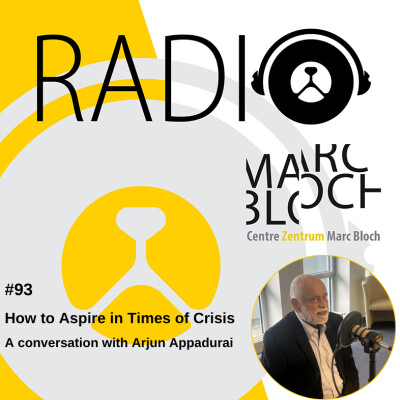
In this new episode of Radio Marc Bloch, we welcome Arjun Appadurai, who recently visited the Centre Marc Bloch to deliver the keynote lecture at the Centre's Séminaire central.
Interviewed by Sanja Beronja, sociologist and postdoctoral researcher at the Centre Marc Bloch, Arjun Appadurai, one of the most influential anthropologists and social theorists of our time, reflects on some of the central ideas that have shaped his intellectual journey, from globalization and financialization to imagination, the future, and the capacity to aspire.
At a moment marked by geopolitical tensions, economic uncertainty, democratic challenges, and growing inequalities, what can Appadurai's work still teach us about the world we live in? How should we think about globalization more than thirty years after Modernity at Large? Has the world become more fragmented than interconnected? How do finance, social media, and new forms of communication reshape our social and political lives? What does it mean to aspire when the future itself seems increasingly uncertain? And finally, might imagination itself be one of the most important political resources we have?
The conversation explores some of Appadurai's most influential concepts, from global cultural flows and predatory dividuation to the capacity to aspire as a profoundly human capacity that is nevertheless cultivated unequally across societies. We discuss why mismatches between aspirations and opportunities are no longer confined to marginalized populations, but increasingly characterize broader middle classes confronted with economic insecurity and uncertain futures.
Drawing on a lifetime of thinking across India, the United States, and Europe, Arjun Appadurai offers a uniquely comparative perspective on globalization and the futures that societies can imagine. Rather than stopping at a diagnosis of contemporary crises, the conversation gradually turns toward the possibilities that remain open to us. Together, we reflect on how globalization, finance, social media, and inequality shape not only the world we inhabit but also the futures we can imagine. Ultimately, this conversation invites us to rethink hope—not as passive optimism, but as a practice of imagining, negotiating, and patiently building futures that are still worth striving for.
To go further:
Appadurai, A. (Ed.). (1986). The Social Life of Things: Commodities in Cultural Perspective. Cambridge University Press.
Appadurai, A. (1996). Modernity at Large: Cultural Dimensions of Globalization. University of Minnesota Press.
Appadurai, A. (2004). The Capacity to Aspire: Culture and the Terms of Recognition. In V. Rao & M. Walton (Eds.), Culture and Public Action (pp. 59–84). Stanford University Press.
Appadurai, A. (2006). Fear of Small Numbers: An Essay on the Geography of Anger. Duke University Press.
Appadurai, A. (2013). The Future as Cultural Fact: Essays on the Global Condition. Verso.
Appadurai, A. (2015). Banking on Words: The Failure of Language in the Age of Derivative Finance. University of Chicago Press.
Hébergé par Ausha. Visitez ausha.co/politique-de-confidentialite pour plus d'informations.