- Speaker #0
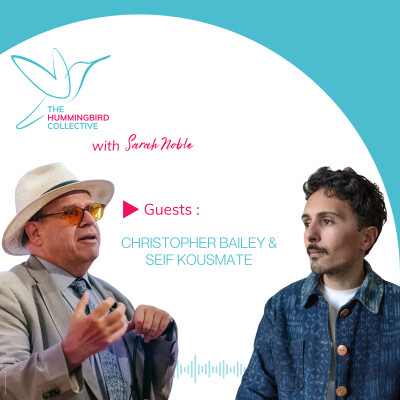
Welcome to the Hummingbird Collective podcast. I'm your host, Sarah Noble, head of global engagement, inner development, and creative peace building at the Co-Initiatives of Change Foundation. Today, we're recording in front of a live studio audience here in Geneva during the Geneva Peace Forum. So to everyone in the room and watching online, thank you for being part of this conversation today. The world feels heavy right now. But here we're inspired by the legend of the tiny hummingbird who kept carrying single drops of water to the flames in the forest while the larger other animals froze in fear. When the bigger animal asked what difference she thought she could make, she said, I'm doing the best that I can. This podcast shares the stories of people who are bringing their drops of water to the fires of our world today. We're living in times of deep rupture. Conflicts are multiplying. Institutions are under strain. And the distance between us seems to grow every day. So how do we create when everything around us feels like it's breaking apart? And what is the role of arts and the creative process itself in moments like this? The scholar John Paul Lederach reminds us that building peace isn't merely technical. It's imaginative, deeply human and creative. He speaks of the moral imagination. the capacity to imagine a shared future even in the midst of violence and division, and to build relationships across the lines that divide us. Here in Geneva, a global hub for peace, that idea is gaining traction. Initiatives like the Co-Arts and Peace Encounters and the Geneva Peace Forum point to a growing recognition that the artistic process belongs at the heart of building peace, not at its periphery. Today I'm joined by two guests who are working right at that intersection. Christopher Bailey began his life on stage as an actor and a playwright. Then he took a turn few would expect into global health, first at the Rockefeller Foundation and then at the World Health Organization. There he founded Arts and Health Program, and today he co-directs the Jamil Arts and Health Lab. And still he performs, bringing illness and the loss of sight onto stage to remind us that health is so much more than the absence of disease. And we also have Saif Kousman, who was an engineer in Morocco. And at 26, he quit his job and bought his first camera. Self-taught, he went looking for people the world tends to overlook. And today his work has grown into installation and video and his latest project, Men vs. Fathers, that was nominated for the Pré-Élysée 2025. Christopher Saif, we're so happy to have both of you here today in the Hummingbird Collective.
- Speaker #1
Thank you. Happy to be with us.
- Speaker #0
So Christopher, I'd like to begin with you. You started out on the stage as an actor and a playwright, and that path led you. to the World Health Organization. Can you take us back to the moment where your path changed?
- Speaker #1
From acting to global health?
- Speaker #0
To global health.
- Speaker #1
Well, the moment actually happened when I had a day job working at a market research company, believe it or not, in between acting engagements. I had been more and more focused on it. And one night, it was a Wednesday night at about three in the morning, I woke up shivering with anxiety, bathed in a cold sweat because of a market research report that was due out the next day that I was responsible for on the U.S. market for dog food. And I thought, oh my God, what has my life become? A few years ago, I was literally playing Shakespearean Kings on Broadway, and now I'm losing sleep over selling more dog food. So that Sunday, I went to the New York Times, and I found a little want ad that said, research professional wanted global philanthropy, and it turned out to be the Rockefeller Foundation, and my life changed.
- Speaker #0
Wow. Well, thank you.
- Speaker #1
So a little bit like dropping the engineering. Finding a camera.
- Speaker #0
Yes. That's great. Why don't you tell us a little bit about you left engineering and bought your first camera and what was happening and what called you to do that?
- Speaker #2
At that time, I was working as project manager and I studied engineering for many years. I had a stable job, but something was feeling wrong about this life. I felt I was in the wrong place. I was always being interested in people and the world around me, But I never... I could imagine that there is an opportunity to become an artist, especially growing up in Morocco. So artist is not a job, especially for my parents. So at 26, I decided to drop this job and I bought a camera. I wasn't sure about the future. I didn't have any clear plan. I didn't want to photograph in school. The only thing I was sure about, so I want to. see the world differently. So I want to meet new people, to travel, to understand stories that they were not always being told. And photography gave me that opportunity somehow. Looking back to this decision, I don't think I was only choosing photography, but I was more choosing a new way of living. And I think this decision changed everything for me until now.
- Speaker #0
Thank you. And when you look at, Christopher, the role in the WHO, we think of the WHO as very focused on evidence and measurements and policy. And when you started talking about art there, how did people interact with that? Were there misunderstandings? Can you tell us a little bit about that? And then maybe also what the peace sector can learn from that experience?
- Speaker #1
Well, first of all, there was no misunderstanding with Dr. Tedros when he was first elected. He put out his famous call to staff for crazy ideas. And starting an arts and health program was my crazy idea. And he immediately got it, hence the program. But I did spend an awful lot of time in the first year or so convincing my colleagues that WHO should be involved in it at all. And I remember one particular conversation where a senior member of the administration said this arts work is merely recreational. And I said, listen to that word, recreation, that's healing. Now, of course, playing word games is not going to supply the evidence base needed for WHO to embrace this. That was the next step, was to collate the evidence base out there. And that resulted in the 2019. WHO report on the evidence base for the health benefits of the arts, which became the most downloaded report on the Copenhagen website.
- Speaker #0
Wow. And what were the misunderstandings about arts? So you mentioned that it was recreation, or did people not take it seriously or not see the link?
- Speaker #1
I think that, for one thing, many of the public health professionals at WHO often practiced arts in their spare time. I had a colleague who was a great Spanish guitarist. Another one was an actor. Another one was a painter. So it's not that they didn't experience arts themselves, but they had it siloed in their head because of their training and professional experience. So I actually found that the real turning point happened with COVID-19. And suddenly, when you had the television filled with images of Italians singing to each other across streets from their balconies, people began to intuitively understand the power of the arts. And it was a great relief to me because I spent far less time trying to justify what I was doing and more time doing it.
- Speaker #0
And what, in your experience, do you feel has been the most rewarding?
- Speaker #1
There are so many. But if I had to pick a moment, just randomly, I'm thinking about in the first weeks of the full-scale invasion of Ukraine, being in Moldova and working with displaced children who had... dark circles under their eyes, who had hair loss, who were experiencing the visible physical signs of trauma. And seeing a group of healthcare clowns parade in on their toy instruments, flat and out of tune, and the moment when one of them accidentally tripped and knocked over the entire train of clowns behind like a row of dominoes. And hearing that first child laugh. And I gave permission to all the other children laughing. And that sound was like a rain coming down on an arid desert. And the smiles bloomed on their faces like desert flowers. And then the mothers began to cry because they hadn't heard that sound in weeks. And seeing how that intervention not only gave relief to them, a moment of safety and magic, But the... actual measurable symptoms of trauma began to alleviate over time. It had a lasting effect. It was not just a moment's diversion.
- Speaker #0
Yeah. Wow. And in this report that you said was one of the most downloaded, there is that evidence base of the link between artistic process and healing?
- Speaker #1
Yeah. It's more on the clinical side. So for instance, just to take one of the hundreds of studies looked at. You're in hospital. There was one randomized controlled trial that showed how if you are recovering from an injury or a surgery, if you add music to physical therapy, it can reduce the hospital stay by 50%, just to give one random example. But most of the examples are rather clinical. So our next follow-up report that's going to come out in a couple of years. is going to take a more population, public health, community health point of view, which I'm really looking forward to.
- Speaker #0
Great. Thank you. So Saif, I wanted to ask you more about your work and your journey. So you photograph people whose lives are often reduced to statistics or migration routes. What does having the camera allow you to do that writing a report can't?
- Speaker #2
So a report can tell us a lot. It can tell you how many people crossed the border, how many people were displaced by. an event, how many families were impacted by a war or conflict. But the photograph has the power to take you more closer to one person. And in my practice, I developed this long-term approach. So I never land somewhere and take a photograph and leave. So I need to build trust, know about the person I'm photographing, share things about myself. And photography for me, it's kind of a result of relationships. It begins with the relationship at least. And from there, like the person in a struggling situation, they are never that moment. So they're beyond that moment. So I try to give the complexity of the person in my photograph and leave the space for what they can be through this photograph. And I think also this... as an African photographer knowing all the history of how Africa have been photographed in the past so it gives me this responsibility to protect the person I'm photographing and be aware of their dignity so I think this is something that you never get from statistics or from a report because it's a result of my encounter with people yeah and how did you
- Speaker #0
developed this approach? Because as you said, some people just come in, take pictures and leave. And how did you get the sense of you needed to build trust, you needed to change a bit the power dynamics?
- Speaker #2
Because I'm an African, I have seen this in the past, and I was not happy with this representation. At some point, I said, this is one of the first questions I asked myself, how I should represent communities, my people, am I legitimate to do this job or not? And the only way to do this is to build trust and to spend time with people, come back again and again and again until there is a real relationship that can allow you to get the complexity of the subjects.
- Speaker #0
And when you take photographs, how do you build that trust? Because it seems like trust in our world is something that is very lacking at the moment. So we might have something to learn.
- Speaker #2
As I said, I spend time with people. Only time. You build trust through time. I'm deeply, genuinely interested in their story. And they feel that my job is to create this bridge between their story and the outside world. It may help them to get a better life. So that's how I deeply believe that the time I'm spending on a place, meeting people, coming back, connecting, doing also the follow-up through the years, through the months. that gives you this multi-layered approach to the story or a complex reading to a story. Because a story is never just one situation, one dramatic situation that you capture and you leave.
- Speaker #0
And what in your experience has been... a photographic journey that you're the most proud of?
- Speaker #2
I'm proud of all of them, but one that's really, like the one I can share is back in 2018, I was interested in the reconciliation process in Rwanda. And they decided to move there for three months to understand how this concept of forgiveness that happens like. few years after the genocide at the institutes for people coexist in the same society they they're working together and they're living together i want to understand this concept so at the beginning i was really interested in survivals and the people who have been taking part of the genocide to understand like the history and and and their present how they they're coexisting and at some point i met with theophile who was 22 years old through his mother, who was raped during the genocide and lost many family members. And I asked him, with this heavy family history, what he thinks about forgiveness and about the reconciliation. And he said, my mother teach us how to forgive to stop the circle of hate. Otherwise, we never build a better future for us. And it was super strong. and it's made me switch my focus on that story i was i was focusing on the old generation so i spent three months working with the young generation and to see how beside their differences and the family history they they have how they build a rwandan identity okay great because one of the photos that is exhibited can you describe it a little bit also for the listeners online so basically like i i I tried to... create a positive narrative about Rwanda. Because before going to Rwanda, I did some research on the internet, and the only thing, like even 25 years after the genocide, I'm still getting images from the genocide. So there's no new narrative, even 25 years after. So one of the ideas, like focus on something positive, that brings people together and shows resilience in their buildings. So basically, I did a story about many young people. who are trying to work together, build their future, and embody this reconciliation and forgiveness.
- Speaker #0
And so you have this process that you use to decide where you want to photograph and to meet people and to take their pictures. And then when you come to a place like Geneva and you have the pictures that are hanging and you see people go walk by them and interact with them, how is that for you?
- Speaker #2
For me, this is part of my responsibility as a photographer, as an artist. It's like people give me access to their privacy. They share their stories. And my job is to distribute those stories worldwide. So to create this connection between an audience and the subject.
- Speaker #0
Great. And how do you decide where you go?
- Speaker #2
This is very personal. It's like my... These are personal questions that I have. through the years. I can never say what I'm going to work next. At some day I wake up, I said, I'm interested in that subject and I can go there for three, four months and then find like the foundation of the story. And then I can go for three years on the same subject.
- Speaker #0
Right. So I have a question for both of you, because we're here at the Geneva Peace Forums, surrounded by people who have been working on peace and peace and building peace in itself as an active... of creation um and i think one of the the challenges we face is is uh perhaps less than in the the art and health realm is there's still a lot of silos between arts artistic process and and peace so i'd be interested to hear from you um how do you think these two worlds can better come together or through some of the experiences that you may have had maybe chris if you want to yeah well i think one of the things that safe was describing uh Um,
- Speaker #1
when we talk about the cycles of violence and how to break them, is also the issue of transgenerational violence. And one of the things that the science is telling us right now, for instance, is that collective trauma can actually get written into the DNA. And so the hyper-independence, the hyper-vigilance, the lack of trust can actually be...
- Speaker #2
It was the case in Rwanda.
- Speaker #1
It was the case in Rwanda. the case in Palestine, it's the case in Israel, it's the case in Ukraine. And you can see the palpable symptoms of that. So the question becomes, if trauma can actually rewrite the DNA, Is there such a thing as trauma-informed growth? Can you rewrite the DNA in a healing way as well? And can art play a role in that? And one of the things that we found, for instance, working with, I was sent by the Irish government to the Western counties of Ireland to work with people who were second and third generation and descendants of people who had experienced the troubles, the conflict between the Protestants and the Catholics in the North, but by extension, going all the way back to the Irish Civil War in the 20s. And one of the most effective ways of having people break this cycle, where they were reacting. with the same symptoms of trauma without ever having experienced trauma themselves, because it was epigenetic. One of the treatments they used was the exposure to beautiful landscapes, to art and music and dance. And what they found is that when you are in the presence of something incredibly beautiful and larger than yourself, instead of feeling further diminished, you feel like you are a small but essential part of a larger whole. Dissociation becomes association. And neurologically, what's happening is you are reinforcing that feeling with oxytocin, the bonding hormone. So literally, you begin to reconnect to yourselves, to your past, and that healing happens at a at a deep neurological level. And potentially, and the science has not been established yet, but my hypothesis is that you can use these techniques to interrupt the cycle of transgenerational trauma. You can literally rewrite the DNA.
- Speaker #0
Wow. That's incredible. And Saif, in your experience, how have you seen art transform?
- Speaker #2
I don't think art can solve a conflict. But I think the art can bring people together and give them the opportunity to see each other. So, for example, photography can give a moment of attention when you see a photograph of a person. So you spend time with their face, their body, their story. So you connect to the person somehow. And maybe that helps to see a person rather than a category. So at least it's a first step to build that connection. And it's the beginning of trust. And once we are somewhere there where we can see each other, we can listen to each other, from that we can build something together. And maybe this is the beginning of empathy to solve problems.
- Speaker #0
And when you're taking pictures of people who are vulnerable in terms of... whose photos get taken, who's being looked at, and who gets to tell their story. There's a power dynamic there. And so how do you personally navigate that?
- Speaker #2
This is one of the first questions I ask myself when I begin being like a serious photographer and have access to those kinds of stories. And I think the first thing is to admit that there's a power relationship. And as photographer, we have a responsibility to manage this. So I'm the one making the decision. So I'm the one framing the picture. I decide what's going to be inside, what's going to be outside the image. So I'm the one doing the editing. So I can build a narrative. So for me, photography can never be neutral. And when we see a series of photograph or a photograph, we should always stay with those questions as a viewer. See, okay, who is taking this picture? Is it delivering a complex narrative? It's just like a shortcut to what we are looking for. And as I said before, as an African, African people have been represented through the same lens by outsiders. Like conflict, misery, war. And my responsibility as an African photographer and artist is to build a new narrative, including the dignity of people, protecting their person and their stories. So when I'm doing a story, I know it's my perspective. And it's my responsibility to give an audience a complex, multilayered story, not like a single image. of a shortcut of how Africa should look like.
- Speaker #0
Okay. So art cannot solve conflict, but it can help create craft narrative and art can potentially help break trauma bonds. What is it, do you think, that people here at the Geneva Peace Forum should take away about what art can do? Because it can do many things and maybe other things that it can't do. Because I keep coming back to this point, but I feel that there's something around bringing the peace building, mediation, and artistic world together that
- Speaker #1
still hasn't gelled and and well i i think you put your finger on it uh at the beginning of this podcast when you talked about how we're living in a heavy time and uh and this concept of hope um hope particularly when there's very little reason to be hopeful um hope is essentially a creative act without the magic what if. There is no pathway to peace, to innovation, to a transformative state, which is one of the reasons why I think instead of only having experts around the table, we need a different kind of expert, the expert in questioning. We need the artists around the table who can ask the what-if question, the naive question, the observed and experiential question, because the reality is... Evidence and data are absolutely essential for identifying objective scientific truth. But that doesn't mean people will believe it. Data may make things true, but art makes it real.
- Speaker #0
Do you want to add anything to that?
- Speaker #2
No, for me, just art can create this space where people can be together without feeling. judge or whatever so they they they open the opportunity to meet so that's for me that it's very important to stay around table and be open-minded about each other it's it boils down to storytelling and who's telling the story for
- Speaker #1
what purpose and one of my go-to quotes is from a swiss psychologist carl jung who said loneliness is not the absence of people. Loneliness is the inability to express what matters to you most. And there are many reasons why we can't express it. It could be a disability. It could be an unequal power relationship. It could be that there are no words. And in which case, you have to find an image, a sound, a movement through space. something that can get you to find that expression that releases you of the burden of inexpression.
- Speaker #0
And how about for both of you in this world where everything feels like it's breaking apart, what keeps you creating? What keeps you going?
- Speaker #2
For me, curiosity. I'm so curious about the people, about the world. And I just want to know more. I want to grow with this world. what also like very what i like about art it's when i have questions i can stay with them very long time so it gives me this space to see the evolution of my questions and the answer i'm getting through the the years of the months that that's i found this idea very amazing like you can keep working on the same question again and again and again and the results you get it's you're growing.
- Speaker #1
I think having the privilege to be witness to these transformations is a great blessing. And that's what keeps me going from day to day is it's not a question of should I be hopeful? I see the evidence every day with the people in the communities I work with of people finding a way. And finding that expression in the most difficult circumstances. And I'm in awe of them.
- Speaker #0
And how do you think some of these stories can be more widely known about the role of art and creativity in healing? Because it seems like there's a lot of airtime given in our media ecosystem to negative news. I mean, the idea that art can help heal an intergenerational trauma is quite amazing. So how can we get... that better known or or more researched um i think it's happening uh but i also think um that the incentives of our current media environment go against it uh where everything is geared on the internet to the clickbait and that's fueled by outrage regardless of where you're starting from politically and outrage shuts off That empathic part of the brain, it puts you into a danger mode where you do not consider the complexity of a situation. You don't empathize. You don't make the connection. You go into fight or flight mode, essentially. And parts of the brain that we normally associate with compassion shut off. You go into rage. Your executive functions begin to go down. The stories we need to tell require a space with patience and attention. And I think they are happening. They're just not necessarily happening in the social media outlets that we are increasingly exposed to. But I'll also say in terms of the evidence that is happening, I can tell you, because I've been out there proselytizing and helping institutions generate the funding to create it. I don't necessarily think we need more evidence to prove the health benefits of the arts. I think we need more evidence to better understand the basic science of why it has a health benefit. and how to scale it to reach the most number of people, particularly the most vulnerable.
- Speaker #1
Saif, do you have any thoughts on this?
- Speaker #2
I think we are living in a different era. So the mainstream media are not the power anymore. So each one of us have the power to look out for your media. I have my own media. So we have to put like a personal effort to find those platforms. So as Christopher said, they already exist. There is like many... ways of sharing the the art the this podcast there's like instagram social media all all of this like many artists are they are already they're using them but they don't have the spotlights to shine and to share like their stories in a deep way to a larger audience so each one of us have the responsibility to find their sources and keep looking for a positive
- Speaker #0
stories that they feed them instead of fear as it was said i think the other thing that we can do as a society is invest in the arts in for young people uh and that's something that i had some conversations with in the mayor's office in levive in ukraine how to take these ideas and not see the arts as some sort of vocational opportunity or a luxury to have when the budget's balanced, but to see it as an essential part of building your ability to problem solve, to work together, to find meaning, to build resiliency for whatever life brings your way. At the end of the day, and this is what the next WHO report on arts and health is going to show, we believe from the evidence that we're looking at, creative expression is not a luxury or a means to an end. Creative expression is a health behavior, just like good nutrition and regular exercise and good sleep. It's something that we must practice every day in order to be a complete person.
- Speaker #1
It's interesting that you say that also in our coming age of AI and what that means and what that means for young children when they're at school and how they're learning, because it seems like in many ways, When I have two small kids and they like to play and they like to create and that's who they are. And then somehow in our education process, there's a bifurcation and art is something that you need to do or be good at as opposed to something that you do because you enjoy that.
- Speaker #0
That's exactly the issue. There's a lot of debate on whether AI is a danger or a benefit and all that. From an arts and health point of view, my concern is simply this, that too receive the benefits of creativity, you have to do it repeatedly. You have to fail. You have to experiment. You have to engage. And if AI is doing all our creating for us, not only will it create bad art, but we don't get the actual neurological and physiological and emotional benefits of it. where it just becomes a commodity and not something that we practice. And art, as much as anything, is a physical activity. You have to do it. I had an acting teacher at the American Academy of Dramatic Arts, and first day of class she said to all these young kids, what does it mean to act? And one person said, it means... to feel the part another person said it's to interpret the intentions of the playwright it's uh you know and on and on um she said those are all great answers they're all wrong and she took out a dictionary and she said to act verb transitive to do to make happen it doesn't mean to feel it doesn't mean to think it doesn't mean to interpret it means make something happen And giving it to AI isn't going to do it.
- Speaker #1
Saif, how do you feel in your work in photography that AI is making a difference? Or does that change how you function?
- Speaker #2
Actually, there's like a generation of artists who are using AI to create art and they believe in, because they think they control the AI, they guide the AI to give them the result they're looking for. But personally, for the kind of stories I'm looking for, I'm not interested in the AI. I'm basing my approach about the human connection. So I don't believe that AI can replace this human connection because you need to be out there to see people, to build trust and create.
- Speaker #0
It may do the opposite. It may create more distance.
- Speaker #2
Yeah, definitely. And basically the AI right now, they are using what we already created before. to build something new. So we were the one creating at the beginning. So they will never replace the human brain and the emotional we get from creation.
- Speaker #1
Definitely. So we like to close every episode of our podcast with what we call a Be the Change moment. So it's a small, real thing that somebody in this room or somebody listening today could try in their own life to make a difference to all the challenges that we're facing. It doesn't need to be a big gesture, just a small drop of water. Saif and Christopher, what would yours be?
- Speaker #2
For me, I would say pay attention and take your time. Sometimes just you need to see someone, listen or watch the situation and give time to do like a deep understanding of what's happening before like changing the thing. And time for me reveals a lot just by watching. And you see, like, through time, like, you will get a lot of information without talking or asking.
- Speaker #1
Thank you. So take time.
- Speaker #0
My colleague, Daisy Van Court at University College London, was looking at some cohort data and saw this persistent pattern in this large cohort over decades that people who practice some form of creative expression or just participate in the arts as an audience member two to three times a week. Statistics are showing that can reduce the likelihood of clinical depression by 50% in a population. So I would encourage one simple thing that anyone can do is actually consciously make the time to express, to listen, to engage. in a creative way two to three times a week minimum.
- Speaker #1
Right, thank you. These are great be the change moments. Thank you for reminding us that creation is not a retreat from a broken world, but it is one of the ways that we begin to repair it. And thank you to all of those here in the room who have made this live recording possible and those of you online and also to the Geneva Peace Forum for the invitation. The forest is large and... We are not alone in our work and the world needs more hummingbirds. So if you want to continue the conversation, you can visit our website where you'll find more of our episodes and ideas on how you can be the change you want to see in the world. And remember to share your drop of water using hashtag Hummingbird Collective. Christopher and Saif, thank you so much for being with us today. And thank you to our audience. Thank you.