- Speaker #0
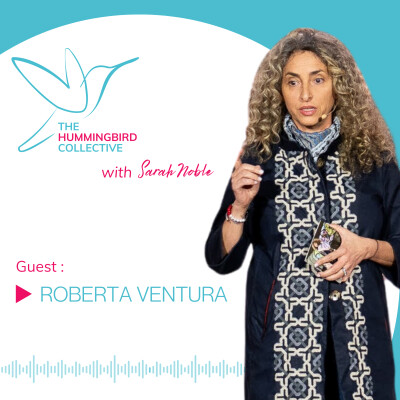
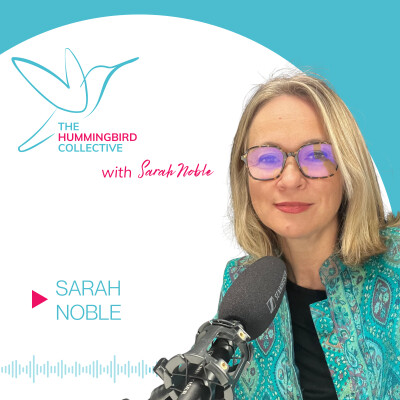
Welcome to the Hummingbird Collective podcast. My name is Sarah Noble and I'm your host. I am the head of global engagement, creative peace building and inner development at the Co-Initiatives of Change Foundation. The world feels really heavy right now and it's tempting to look away. But here we're inspired by the legend of the tiny hummingbird that went to get a drop of water from the stream when its forest was on fire and all of the other animals stood frozen in fear. When the bigger animals asked what Thanks. the hummingbird thought it could do, she turned to them and said, I'm doing the best that I can. I'm doing the best that I can. This podcast series are the stories of people carrying their drops of water to the forest fires of our world today. Our method is intercultural dialogue, the art of listening and speaking across our differences. And we're here to lift the illusion of insignificance one conversation at a time. Right now, around the world, over 100 million people have been forced to leave their homes. They didn't choose to go. A war came, a disaster, and suddenly everything they knew was gone. And then they wait. The United Nations estimates that most displaced people will remain refugees for at least 17 years. Many wait longer. While they wait, the world tends to define them one way, as people who need help, who have their hands out. We seem to see them for their deficits and not their dreams. What the world misses is everything else they have. Their knowledge, their heritage, their skills, passed down through generation. Skills that nobody can take away from you, no matter what else is lost. Today's guest saw that skill, saw the gap, and instead of looking away, she built a company. One where the people the world had labeled as helpless turned out to be the experts. Roberta Ventura is Italian and has a life... passion for the Middle East. She worked for more than 20 years in asset management in Geneva and London. And for those same 20 years, she and her husband donated to organizations supporting refugees and watched conditions deteriorate. In 2013, she went to Jirash refugee camp in Jordan and started listening. And she decided to build SEP, a company that works with artisans who happen to be refugees, to create beautiful hand embroidered pieces sold all around the world. Not charity, not aid, a business. with artists or colleagues. Roberta, we are so happy to have you with us here today.
- Speaker #1
Thank you for having me.
- Speaker #0
So you have cared about refugees ever since you were a student. Can you tell us about the moment where you realized that you needed to make a change? There have been a couple of special moments, moments where time stops and you will never forget. And I would say
- Speaker #1
I've had two occasions. Both those occasions contributed to leading me to starting CEP 13 years ago. The first one was 1997. I was in Lebanon, an intern at Reuters, the press agency. And a colleague at the press agency came from a refugee camp in Lebanon called Ain el Helwe. He was Palestinian. I begged him to take me to see the camp where he was coming from. because again And since I was a child, I wanted to, I felt that there was so much we don't know and we don't understand about life in a refugee camp. So I visited Annenheil with him in April of 97. And that stayed with me forever because it was, it was something that all the photos and the videos of the world cannot describe. I came out thinking that I could not accept. that human beings wait for a political solution in such a state of poverty and stripped of their dignity, because that's what I saw there. So that was definitely one key moment. Then I went on after my internship at Reuters and I moved to London, where, as you said, I worked for 20 years in investment banking and asset management. And there was a point. It was 2004. I was in Trieste, in Italy, visiting one of my customers, the biggest insurance company at the time in Italy. And I have a meeting with a customer who is a fund manager there. And she says, I don't have time for the meeting. I have my Zumba class. She said, you come with me. I'm like, yeah, OK. So we go to this gym and I sit on the floor and all these ladies are jumping up and down and there's, you know, the screen is on. And I look at the screen, I'm sitting on the floor all dressed for a meeting and these girls are jumping up and down. And on the screen I see Arafat is dead in Ramallah. I was like, what am I doing here? I broke down. That was actually even more emotional or different from the camp moment. The come moment in 1997, I was more angry than sad. I was angry and I thought, that's it, I can't just assume this is normal. In 2004, I felt so helpless and that's when I really broke down. And then it was not the time for me to start something else yet because, well, I had to make a living, really. And so I stayed on until 2016 when I finally then dedicated all of my time. to the social enterprise. But yeah, I would say these two moments.
- Speaker #0
Amazing. Thank you, Roberta. So often in the news today, we see people that are defined through a simple label in terms of what refugees and what they've lost and not by who they are. And SEP essentially flips this around because the artisans are the experts. And I'm curious how that affects this us and them feeling when that dynamic is completely flipped.
- Speaker #1
Yeah. First of all, I am so touched that you asked that question because most people never actually stop and think about this. Most people just assume refugee is who you are and that someone is designated to take care of you. The UN, NGOs, whoever. Most people don't really stop and consider them as human beings. And I know because I've watched this for many, many years. What is also interesting is how, if you are a refugee, and again, I mean, let's be very specific, which refugees am I talking about? The people I've been working with every day for the past 13 years are Gaza refugees. So they came from Gaza after the 1967 Six-Day War to Jordan to seek refuge. And they've been refugees ever since. So we're talking about four generations of refugees. And these four generations of refugees are supposed to be... invisible or were supposed to be invisible. Even within the country that hosts them, when I first went to Jordan in 2013, I was talking to people in Amman who are maybe Jordanians of Palestinian origin. And I would tell them I was going to go to the Gaza camp. And I was surprised that most people didn't even know it existed. And we're talking 50,000 people, 45 minutes drive from our mind. So, So first of all, the first part of my answer to your question is, let's not make no mistake. We collectively assume that either they don't exist or they are what the label says they are and that someone is going to take care of them. But what I found very interesting is when I went to the camp also to see how they see us. It's fascinating because... Well, first of all, again, I find it very interesting to try and put myself in their shoes. I don't know how I would feel about, you know, I was a privileged white person showing up at the camp, yet another one, saying that I wanted to organize after-school programs because that's how it all started. And I appreciate, first of all, the sincerity. They were very sincere and they all told me, frankly, we have enough of NGOs and after-school programs. Honestly, if you're here for more of the same, we have enough of this. If you really want to help us, you need to listen to us. And what we want is work. Nothing else. Dignity and work. Now, at that point, first of all, I realized that they saw us with a huge deal of skepticism and cynicism. It's like, oh, yet another one of those do-gooders who just wants to feel good because they tick the box. deliver some teachers and some classes. But also, honestly, I never felt any tension, but I know that they have long ago lost hope that somebody on the other side cares. And of course, the war in Gaza since the genocide, sorry, in Gaza since October 7, has kind of proven them right. because again collectively Nobody seems to care. For sure, nobody's coming to help. So when I arrived in 2013 in the Gaza camp, the assumption was no one is coming to help. It took a couple of years of working together to get to the point of mutual trust where when we go to the camp, we're family and I feel at home at the camp as much as I feel at home here in Geneva. And I think it might also have to do with the fact that they are Palestinian refugees. There's a cultural element that the Palestinians are so welcoming and warm and warm hearted that no matter how much trauma they live through, once they know they can trust you, they're going to be just the most welcoming people on the planet.
- Speaker #0
So yeah, it's both ways. Both ways. And then, so for each set product that is produced, because you talked about this notion of people feeling invisible, each product that's produced has the name of the artisan on it. So what is that like for the women to know that their product is out somewhere else in the world with their name on it?
- Speaker #1
Yeah. So first of all, we call them artists. rather than artisans. I always keep pointing because, but it's interesting, because they themselves, we brainstormed about this name thing. We brainstormed about artisan versus artist. We brainstormed about business versus charity as well. Because, of course, we chose the difficult way, which is the business way, which means that we can't rely on donations. We can only rely on producing things that people want to buy. And if enough people buy, then we survive. and we grow and hopefully they will go above the poverty line sustainably waiting for a political solution um but we could have gone the easier way we could have gone the charity way and still produce and sold items while also asking for donations the ladies were adamant they wanted to work for a company okay so that was one thing um artists versus artisans they explained to me When they do embroidery, when they produce a... a piece of embroidery work. It doesn't matter if it's a pattern that you've seen before, which they are reproducing, they will put all of their emotions and a lot of creativity. Some of them even go as far as to say that they can actually recognize their own hand when they see the pattern. For us, it's just crazy. But now, like again, 13 years on, I can see what they say. For them, it's really each creation is a creation of art. And we come to the name. In the beginning, because I wanted to make a statement and I wanted to change our perception of refugees and the refugees' perception of the people who have a passport and a country that they live and belong in, I suggested, how about signing every piece? And in the beginning, they were not sure it was a good idea. What is very interesting is that a few months into what started as a project, they would not allow anything to leave the atelier, the workshop, without the signature. Because they developed a self-confidence and they developed a pride in what they were doing, whereby they thought, oh,
- Speaker #0
I made this and it's going to carry my name all the way to the Hamptons, to Geneva, to Hong Kong or wherever it may go. Amazing. And so what have you learned in your experience for what it takes for people to genuinely collaborate that may have completely different world visions or world experiences? What are your key learnings over the years from all of your experiences in the banking and also in working with CEP? Look, the hardest thing to do is to build trust, of course, right?
- Speaker #1
And frankly, you're right to ask. irrespective whether it's the banking or it's the social enterprise because at the end of the day it's human beings working with other human beings so it is the same thing and simply in banking there are different backgrounds for the people and the actors involved in our social enterprise fine yeah the founders are italian the artists are palestinian The people who sell and who collaborate with us are from all sorts of other nationalities and origins. I think the fact that transparency and respect are at the center of it all, the fact that it's clear to them and to us what we're all doing, and the fact that we're all driving in the same direction with mutual respect. Again, there have been occasions where the lack of respect could have gone both ways. And we've clarified, you know, it doesn't always, it's not, the world is not perfect. Nothing is always perfect. But whenever we've had... tensions, all we needed to do is clarify that anything that had been done or said was coming from a point of respect where we are on the same side and we're here to celebrate an heritage and to celebrate talent. And once this is clear, then of course there is collaboration and of course we work together and of course nobody watches the clock anymore.
- Speaker #0
And so this notion of of of artists and embroidery and that being cultural heritage being passed down. Was that when you met with these women and originally they said, you know, we don't want to have an after school care, we want jobs. Was it apparent from the beginning that that's what it was going to be? It was not.
- Speaker #1
The only thing that was apparent is that I had to identify something that was monetizable, something that could be turned into an actual business. It could have been food because food is also central to the... Palestinian family, history, heritage. I don't think I've ever met one of the same artists who is not also an amazing cook, for example. But then obviously food came with a lot of complications, mainly due date, assumption, hygiene standards, and so on. And obviously different countries with different standards. So it had to be something else. But to be honest, it was between food and... Now, why embroidering? Because whenever you visit a camp, you do see that there have been some heritage projects at some point or other. Very sadly, most of those heritage projects, because they don't have this mentality of trying to build a business that's there to stay, turn out to create what? Products which are sitting at the camp, and when somebody visits, you get to see them. I came from a completely different background. I knew nothing about embroidery, but you just can't help but go, wow. When you see the work, you don't have to be an expert either in fashion or in embroidery. There's something special there. So I identified that which anyone who goes to a Palestinian refugee camp will have felt. I also noticed that I was falling in the trap of the so-called pity purchase. I was because... buying the things which they had made knowing full well I wasn't going to wear them or even gift to them because the quality of the fabric was just not up to standard but then that's what like kind of on the plane back thinking about what I bought which I was never going to wear or use thinking though about the magic of the embroidery work that's when I kind of put two and two together only much later on 2021, only a couple of years ago, did UNESCO recognize the Palestinian pattern as heritage of humanity. So it's kind of obvious, right? Now it's even more obvious. And that's really how it became clear that that had to be the core of the business idea. And then since you've been working with these artists,
- Speaker #0
what... what has happened with their lives.
- Speaker #1
That's really what I wanted to prove. The reason why we're called SEP, Social Enterprise Project, is that intellectually, I had a feeling, well, from the heart, I had the feeling and in my mind, intellectually, I had the theory, which I had developed, which needed to be proven. My theory was you can... be dropped by a helicopter in a refugee camp where four generations of people have lived off aid, who are dependent on aid, and who have never worked in four generations. And you can actually treat them like normal human beings and work with them. And my instinct was that everything was going to be suddenly very normal. They were just going to turn into active economic agents. like you and I. But it hadn't been done. Frankly, I researched right, left and center, and there was no proof of that. So I wanted to, first of all, just prove. And I did ask fashion designers what they thought about my idea. And most feedback was, if I can simplify it in one sentence, hopeless because having never worked. there's going to be problems of quality and deadlines. They're not going to keep to the deadline. All those preconceptions. I show up, we discuss, we start with 20 ladies. We have no... been late on a delivery in 20 years ever the quality of the work is outstanding there are mistakes minor we've never had to kind of wonder what to do with something because of mistakes so the quality of the work and the time frame and the delivery um so from that point of view that was very quickly evident but what about the artist what was the impact of working within CEP for the artists. They told me that. I didn't ask. Because again, it was... I wasn't an institution trying to kind of fill in a form with feedback, you know? But they would come to see me and they would say, I'm not sure if you fully understand what's going on here. But I'm like, I'm smiling, I'm happy again. And I was diagnosed with clinical depression beforehand. I was crying all the time. I was like, okay, that's interesting. So it's kind of, and when they hear one lady come over and tell me this, then everybody's saying the same thing. Basically, what they explained to me is, first of all, embroidering is akin to meditation. So embroidering itself, in and of itself, by itself, is like meditating. They sit there, they do their work, they count their crosses, they finish their work, and they feel light. empty their head is empty so it takes the mind off of the problems that is again irrespective of set what they've explained to me is that the fact that you don't just embroider because you like it but you embroider because there are people on the other side of the planet who appreciate your work love your work who suddenly think oh my god like you said earlier you become a master as opposed to a person in need of help, said it just makes you feel different. And diagnosis of clinical depression, you will find it in every single refugee camp that you go to. And so, yeah, I was actually positively surprised that besides proving that you can work as a business in a refugee camp and the quality of the work would be up to the highest international standards, You also, incidentally, are providing an alternative to clinical depression, which is mental health.
- Speaker #0
So, yeah, I was like from the very, very outset surprised, even though my expectations were high. So at CEP, you are working with people, these artists who often are invisible to the rest of the world. And how, because it's incredible what you've been able to do and the change that it has made. But It also has brought challenges and there are also challenges in terms of the political context. Where do you draw your strength? What gives you motivation to just keep on going? First of all, the challenge,
- Speaker #1
the main challenge is not what you would expect. The main challenge is not working within a very difficult context, navigating between one war and another. the poverty situation, the fact that the couriers don't deliver to a refugee camp because they don't consider it as an official address. But these are little things, almost irrelevant. The main challenge is that when we started, I thought that like me, most people were just waiting to finally buy cool accessories which were actually making a difference. And that was a miscalculation. Why? Our customer is what I call the conscious consumer. And in 2013, the concept of conscious consumer was non-existent. It was just something inside some people. But I felt that I was an average consumer who just felt the need to be conscious. And by that I mean, I know the power of each time I spend my money to help. or to destroy lives, the planet, but also lives. And so I assumed that over time, the conscious consumer, every consumer would become conscious. Okay, it's taking longer than I expected. I would say that a minority of consumer worldwide is conscious. And I would say that the other consumers that we observe fall in three categories. Skeptics, snob, lazy. That's vis-a-vis what we do. Skeptics. Oh, you're a private company working with refugees. Surely you're abusing them. Surely. Now, some of the skeptics will give us a chance to explain how we operate. And then they understand and they just kind of open up. But many of the skeptics, they just judge in advance and are not interested in a debate. The snob. Oh, made by a refugee? Then surely it must be cheap. Why? If we pay what we believe is fair to all of the suppliers, included the artist at the center of the model, sorry, it's not going to be cheap, but the snom, what we call the snom, thinks that way. The biggest, biggest category is the lazy consumer. This is a consumer, because, you know, with the snob and with the skeptic, you can discuss. The lazy customer, and unfortunately, this is the vast majority of all consumers across all countries today, does not care who made what they buy and what the impact of how they spend their money is. They just don't. And you know what? They don't want to hear it. We see them in the shops. We see them on our chats. The lazy consumer. gets nervous when you mention that it was made in a refugee camp. They just need to go away because they don't want to be involved. It's not just the politics. It's really a lot of consumers, they don't want to have any responsibility. Unfortunately, we all have a responsibility when we spend our money. But yeah, that would be the biggest challenge that we collectively are facing at the moment.
- Speaker #0
Interesting. And what keeps you going?
- Speaker #1
You're right. That was your question. I wanted to first of all tell you what the challenge was, because it's probably not intuitive. I mean, a lot of people who just look at a business working in a camp, they would expect the challenges to be on the supply side, not on the demand side. The only thing that keeps me going is that today the artists are a thousand. There's a thousand ladies who ask for more work because the more they work, the more they earn. The happier they are, the more they start planning and they can't stop. And so, yeah, that is kind of a bit of a curse as well, because that gives you the energy and this huge weight on your shoulders as well.
- Speaker #0
Amazing that there are a thousand artists these days. A thousand. Wow, that's great. And in all of your experience of crossing borders, be it from, you know, the asset management world to working in refugee camps, what is it that you've taken to be one of the key lessons? Frankly,
- Speaker #1
for me, the key lesson is that we should try and think out of the box. By that, what do I mean? Private sector, humanitarian sector, government. We grow up, in the last few decades, we grew up culturally thinking that they were separate boxes. And in my experience, across... all the jobs and projects that I worked on, is that whenever these boxes come together, the most wonderful things happen.
- Speaker #0
So we have to kind of have the guts to think a little bit out of the box. It doesn't have to be completely crazy. Yeah. Thinking out of the box, I love that. So we're getting to the end of our episode, and each episode ends with a Be the Change moment. So it's the time where I ask you, What is something that you want to share with our listeners that they can do in their lives every day starting today that might make a little change in the world? The idea is not that this is life-changing, but through these conversations, we are lifting our illusion of insignificance to show that we actually can, each and every one of us, make a difference and to bring all of our little drops of water to the collectifiers of our world. So what would be your drop-off question?
- Speaker #1
Look, there's something that I am forcing myself to do. I noticed that when I'm on the tram, even in the street walking, I tend to be on my phone. It's because I'm working, but still, I tend not to see people around me anymore. I used to, before the phones and before it got very busy, I used to love looking at the other people on the tram and kind of appreciate the diversity. So what I'm kind of forcing myself to do is force myself to... Smile, even though the news is awful and the world is ending. And by smiling, I feel like whenever I force myself to try and kind of stay positive, smile and look around rather than on my phone, I notice that there's a lot of positive energy going around. So hopefully that could be a small thing that...
- Speaker #0
We can all try. Thank you. So to smile, to be present, to look up and to make human connection. Yeah, that's great, Roberta. Well, thank you so much, Roberta, for everything that you've shared today.
- Speaker #1
Thank you so much.
- Speaker #0
And thank you so much to our listeners for spending time with us at the Hummingbird Collective today. Remember, the forest is large and you are not alone. The world needs more hummingbirds. If you're interested to hear more or learn more about being the change, you can go to our website that's in the show notes and also information. About SEP, the brand is also there. So please follow them and learn more. And remember to share your drops of water with hashtag Hummingbird Collective. Thank you.