- Speaker #0
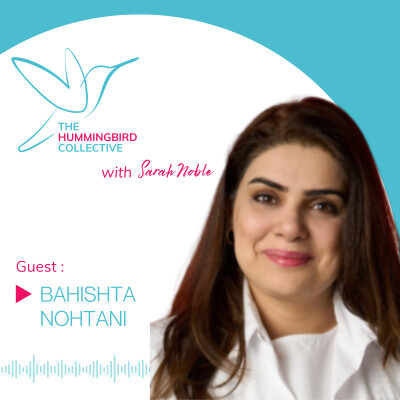
Welcome to the Hummingbird Collective podcast. My name is Sarah Noble and I'm your host. I'm the head of global engagements, creative peace building, and inner development at the Co-Initiatives of Change Foundation. The world feels really heavy right now and it's tempting to look away, but here we're inspired by the legend of the hummingbird that brought each drop of water to the forest fires while all the other bigger animals froze in fear. Here, we recognize that the fires in our world exist and instead of Turning away, we choose to do something about them. When the bigger animals asked the little hummingbird what it was doing, she turned around and said, I'm doing the best that I can. I'm doing the best that I can. And this podcast series are the stories of people who are carrying their drops. Our method is intercultural dialogue, the art of listening and speaking across our differences. And we're here to lift the illusion of insignificance, one conversation at a time. Have you ever been told that you aren't allowed to do something because of who you are? Today's guest grew up in Afghanistan under the Taliban, a group that seized power of the country and banned girls from going to school, from working, and having a voice in public life. As a child, she went to school in secret because girls were forbidden to learn. She went into exile, and then the Taliban fell. And for 20 years, Afghanistan slowly built something new. Girls went to school, women went to work. and democracy began to take root. And then in 2021, the Taliban returned and erased it all. No school for girls or women, no work, no voice. Afghan women are at the forefront of one of the most important fights of our time. Across Afghanistan and in the diaspora, communities around the world, there are extraordinary women who are organizing, building, and refusing to disappear and be erased. These women are not giving up, and they're fighting every single day. Today, we're pleased to be joined by Bahishtan Notani, who grew up in Afghanistan at a time when girls were not allowed to go to learn. She went to school anyways, in secret and a great risk. That act of refusal is the thread that runs through everything she has done since. Today, she lives in Switzerland and is a dentist in Geneva. She also is the co-founder of the Afghanistan Women's Rights Association, ARA, which supports underground schools, health clinics, and shelters. for thousands of women and children inside of Afghanistan today. Bahishto, we're so happy to have you here today.
- Speaker #1
Thank you, Sarah. Thanks for inviting me to your program, and I'm so glad to be here. Maybe people know or don't know, but you're doing a lot for Afghan women, and I'm here. First of all, I would like to thank you for all what you're doing for Afghan women. period of history for Afghanistan, Afghanistan people, and especially for Afghan women.
- Speaker #0
Thank you, Bahishtah. And it's great. And we all need to do more to support the women and girls of Afghanistan, because what happens to them happens to all of us. And I think today, to better understand what the situation is, maybe you could take us back and tell us a little bit your story. So you come from the south of Afghanistan. And what was the world like when you were growing up as a little girl? What did it feel? to be in a place where you couldn't learn and you went to school anyways. So how did you do that?
- Speaker #1
You used the sentence that have we ever heard that you cannot do this because you are, because who you are. I have heard it every day during my childhood that I cannot go to school because I'm a girl, I'm a woman. I cannot walk in the street because I'm a girl, I'm a woman. I cannot laugh loudly. I'm only allowed to smile because I'm a girl. So I have heard that every day, this is the story of every Afghan woman on that period of the time during first Taliban regime, that we were hearing these sentences and what has started now also. So every day was a fight for me. Every day was a fight for me to be able to go to the school. The schools were not open, so it was the secret schools, underground schools. Every day it was a fight to be able to go out of home, to learn, and just to fight to be able to breathe, to breathe and to do the basic. everyday work. And as most of Afghan women and girls and Afghan families, my parents were also obliged to move us to the neighboring countries in Iran and Pakistan to be able to get to go in the school and get education in those countries. But it was very hard as well because Afghans were not allowed to go to school in those countries. And we had to... to hide our nationalities from very childhood. We were forced to say that we were not Afghan, we were Iranian, or we were from Pakistan to be able to go to school. And learning of every word to learn how to read, to write, was a fight for it. And even inside the society, even inside... the people, inside the families, you had to start fighting and negotiating for your very basic right, which is education, which was the possibility to go to the school. However, it was forbidden from the Taliban. So at that time, I remember my mother, she had a school, a hidden school. In Nimros province, the Taliban, they come, they attack the school and they beat my mother, they beat all the children inside the school and we had to close the school. But a week after, we had to reopen the school and go back and change the location of the school. So it was a fight of every day.
- Speaker #0
Wow. And you, so after you had said you... were living in the neighboring countries. And then you came back to Afghanistan when you were a teenager, if I understand correctly, and you were translating between Afghan communities and international organizations. What was that experience like for you in terms of getting people to understand who come from very different worlds or cultural backgrounds or experiences?
- Speaker #1
That years for me, for my age, I call it the 20 years from 2001 to 2021. It was the golden years for Afghan women because we started from very little and we achieved a lot. And we were in a good route to achieve more and more and more. But unfortunately, it had stopped very rudely. When the regime changed, um Everyone was very motivated. The women were motivated. And they showed that it was not the Afghan people's culture that they don't want their girls and their wife and women to go out and work and participate in social life and be free. So because when the regime changed, within 24 hours, every woman was out of home. the woman they went to to the school. schools and they broke the locks of their schools and they opened the school and everyone was the school. I remember in my province, even during the evening, the women, they sleep in the school because that much the school were missing them. So they showed that it was not their culture. And little by little, there was a development. So I got the opportunity because I was very young, but I was speaking English and yeah, a little English as I'm speaking. speaking what today are so little English. So I got the opportunity to get to be hired in delivery room with MSF, Médecins Sans Frontières. And from that time, my journey has started to be to work with international community and Afghans. And what I learned was that humans are here to help each other. I saw the beauty of helping each other. I saw the beauty of people they leave their country their comfort I worked a lot with France and MSF France and Indian Canada so I work a lot with Canadians and French people and I saw humans that they leave their comforts their security their life behind and they come to help people and they come to to to be there and I saw a very good energy and I saw the power of this energy when we give it together from people of different cultures, different languages, but when these barriers disappear, how strong we become and how strong we can help each other.
- Speaker #0
Amazing. And so then how did you go from being in the delivery room with MSF to becoming a dentist in Switzerland?
- Speaker #1
Yeah. Besides that, I mean, when I start working with MSF, then I work with MDM, then I work with the National Solidarity Program in Afghanistan, and then I work with UNAMA, United Nations Mission in Afghanistan, and then I work with UNODC. I, besides that, I founded an organization for women supporting in Afghanistan. And that put me in some security problems and I had to leave the country. So I was evacuated from Afghanistan by UN and I come to, I find myself in Geneva. So I was here and I, I asked asylum and I got a refugee statue in Switzerland. So yeah, that's how I come to Switzerland.
- Speaker #0
And why become a dentist? Well,
- Speaker #1
I love to take care of people. I love the connection between humans, to be able to help people. And I love the health section. And I never had this opportunity in Afghanistan, because if I wanted to study, then I had to... to not work and I was I'm a mother of two child and when I arrived in Switzerland I I learned I I learned French the the the point which was amazing being in Switzerland was that I had the equal right with Swiss people and all European people to go and sit in a class and do my exam and see if I will pass or not And that was the most amazing point and beautiful thing that I found it. And then I tried to study, learn French and enter in the university. So, yeah, why I choose dentistry was really to be in contact with human and help human.
- Speaker #0
Amazing. So you said something, Bishra, about when you were sitting for your exams and this idea that you... equal with everybody. And I think for our listeners, many who have never had any of their rights taken away, so they don't know what that feels like. Can you describe a little bit more what that feeling was like for you? Or what does it feel like when you have rights taken away from you and then granted to you? What does that feel like in your body?
- Speaker #1
No, it's like a feeling of blessings, feeling of justice, feeling of like, oh my God, what? can be more better than that. I'm allowed to go to school. I'm allowed to go and sit and give exam. It just makes you feel the justice and the equality. And it's so amazing when you have this right. And I wish it for the woman inside Afghanistan today. And that's why I'm fighting for it.
- Speaker #0
Great. So could you tell us a little bit more about the work that your organization is supporting on in Afghanistan today in terms of shelters and underground schools? Because I think for somebody who is listening, who isn't necessarily following the situation in Afghanistan, or Afghanistan is not so much, unfortunately, in the news today, what does that actually look like?
- Speaker #1
Yeah, first of all, I would like to start with the point how the idea come that I should fund this organization. It was an evening when I was coming from the university and Mmm. has medical studies, they ask a lot of studying. So I was in the library until midnight. And at midnight, I took the bus, the tram, and I wanted to go to home. And I just thought with myself that it's midnight. I have two daughters. They're at home, safe and security. And I'm not worried about their famine. I'm not worried about their school. I'm not worried about their... I mean, yeah, honey mother is worried about the future, but I'm not worried about their future, that they won't be able to go to school or they won't be able to develop. And I am in all security and I'm taking the bus and I'm going to home. And for just for a minute, I thought, what is the paradise that people are talking to us about? This is the paradise. I mean, you are safe, you are in security, you are. Yeah. We are always hearing about paradise. This is the paradise. And just a while after, I become very... I felt myself very guilty. And I thought that, OK, you come here, you are here, but you left more than 20 million women behind you, and they are in this situation, and you are not doing anything. So therefore, I, with a very nice colleague of mine, Gabriela Morello, we co-founded an organization which is called Afghanistan Women's Rights Organization. time we founded our organization, the motive was to work on civic education and public awareness. Public awareness about women's rights, human rights in Afghanistan and at that time Afghan constitution and international constitution and in Islam because Afghanistan is an Islamic country people are following Islam rule so we we thought we were doing this. And it was doing great. We were doing a great job. As a result, in the region we were working, the number of women who were working on the offices were higher than men. The number of girls who were going to school was much more higher than men because the boys in that region, they were working, they were doing business. And the girls were driving. We were in a very good way. I mean, very slowly with a lot of problems because the Afghan ex-government had a lot of problems as well. But we were in a good way and what we needed was time. And we were the result. As a result, I mean, this was the only region in Afghanistan that we sent only women in parliament, not men. So this awareness was giving its result. But little by little, we discovered, we realized that... um, Awareness without giving possibility will not work neither. So we give literacy classes to the women, we give health services to the women, we help street children until the collapse of Afghanistan and taking power by Taliban, by force. From that time, the situation has become, I mean, horrible to the women, to the people, for the people of Afghanistan. So then we, from our activities, has stopped for the women's rights promotion, human rights promotion. And we give the accent to the education, underground schools, health services and shelters for the children and women.
- Speaker #0
Okay. Okay. So you're a part of a community of women who are refusing to give up because of the situation that... and you're fighting for women in a situation that the world is starting to look away from. So how do you keep going? How do you find, despite the horrific situation of women and girls in Afghanistan, what keeps you going and keeps you willing to continue to do this work?
- Speaker #1
My own life history, the woman inside Afghanistan. They give us courage. Their work, they give us courage. Their resistance give us courage. And the way they're continuing to resist and to fight without being tired, that gave me this courage.
- Speaker #0
So you work with a lot of people who have different cultural backgrounds and who are different than you. What is something that you've learned from all of this journey? about how you can work with people who are different than you?
- Speaker #1
What I have learned is humanity, is that people can be different. They can talk a different language. They can have a different culture. Something can be funny in my culture and can be very rude in their culture. But every human being has a positive intention in our energies together. can be the strongest energy in the world that no bomb atomic can make face on. When we put our energies together, and I think I believe in it,
- Speaker #0
and it has proven. So I think when we are together from different culture, from different ways, that makes us the most strong possible. And if somebody is listening today and they feel completely overwhelmed about the situation in the world, and if they're hearing and learning more about the situation, in Afghanistan, what would you say to them?
- Speaker #1
I would like to tell them that for just a... As again, they realize that today in Afghanistan, the women are obliged to sell their children to be able to survive. And what would that feel that in a family we choose one member to sell so the others survive? This is the situation of Afghanistan. This is the situation of Afghan women. They need you to talk about them. They need you to not forget them. They need you to not... forget their situation and they need your support.
- Speaker #0
So you are one of many women, Afghan women in the diaspora, who are working really hard to keep international attention and focus on the situation in Afghanistan. And you've talked a little bit today about how we can continue to do that. From your life experience, at the end of each episode, we have what we call... a Be the Change section. So it's something that we close with that our listeners could do based on our conversation. So it's not necessarily going to change the world, but we have this belief that all of our different drops of water, if we're all making small changes, that that can add up to something. So what would your Be the Change practice be about what we can do about the situation for women and girls in Afghanistan?
- Speaker #1
We need is the sensibilization. I would like to ask everyone, all listeners, to talk about women of Afghanistan, to talk about the situation of Afghanistan. Wherever they go, even if they're in a small meeting, if they're in a small gathering, to talk about the situation of women in Afghanistan and to not forget.
- Speaker #0
Okay. So keep... the focus on the situation, talk about it, talk about it even if it's in small gatherings, continue the conversation and keep it going.
- Speaker #1
Because I believe that the energy and the power which human being has, we cannot find it in any world.
- Speaker #0
Thank you. Thank you so much, Bahista, for being with us today and for sharing your story and for continuing to talk about and for and speak on behalf of the women of Afghanistan. And so many of the other women from Afghanistan were also speaking about these issues. And we'd really like to thank you for being here and sharing your story and the continued importance of talking about this situation, because it can't remain like this. So thank you for spending time with us here at the Hummingbird Collective. Remember, the forest is large, and you're not alone in your work. The world needs more hummingbirds. And if you want to continue the conversation and be the change, if you want to learn more about the situation in Afghanistan and also about Bahishtah's work, you can look at the show notes and the link is in the bio. And you'll find more ideas about how together we can reinforce this common humanity and how together we can be the change we want to see in the world. Thank you.