- Speaker #0
Voice of Industries.
- Speaker #1
Hi Thomas, really happy to have you today on Voice of Industries. Could you take a few minutes to present yourself and the activity of ARC Advisory Group?
- Speaker #2
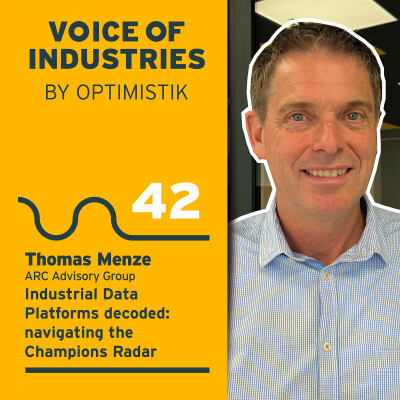
Yes, sure. Mathieu, thank you for the invitation. It's really nice to be here and I'm really proud to discuss with you. So let me summarize. ARC Advisory is a market research organization. Our core competence is market research on automation trends and if I understand you correct today our focus will be on industrial data platforms. That is one area we are researching beside control equipment, interface technology and other software related topics like HMIs and this kind of stuff. So I'm a consultant with ASC. I'm based in Europe, in Germany and yeah I I think we can... can deliver some insights regarding latest trends and technology what goes on in the OT environment in the operational technology environment.
- Speaker #1
Perfect because today we will discuss about as you mentioned industrial data platform and you recently published what you call a champions radar for industrial data platforms could you explain what is the intention of this ARC insight?
- Speaker #2
Yes, sure, I can. So this, we call that Champions Radar and this Champions Radar comes from a classical radar screen used in the marines or in the airspace. So we want to give guidance, guidance to the user because these technologies, these use cases are very fragmented right now and some people have really lost focus. So one important topic for us was really to clarify the situation regarding industrial data platforms. And we compressed everything into this radar. That means you can see in one look which supplier is positioned where and where are the different core competences of the suppliers. And you can select what you need. And that is important. The radar is not regarding good or bad solution. It is regarding on what's my use case, what do I expect from the technology, and where should I look to the appropriate supplier to select best of brief solution for my application.
- Speaker #1
And particularly this industrial data platforms, it's a space where things are moving very quickly in the past 10 years. So I think the exercise to do this radar is not so easy as you have to capture the current trend. And talking about that, in this radar, you make the choice to compare what you call global solution versus specialist solution providers. Why did you make that difference? And what do you have behind this concept?
- Speaker #2
Yes, let me answer. That is really a complex question. So let's start simply. So why did we separate the different supplier groups? And I would call it we have one, the global suppliers, suppliers who deliver, let's say, MES or data historians for decades. And on the other thing, we see a rising niche. These are the cloud native suppliers. You called it special suppliers. I think it is more precise to to call them cloud native. So that is my first clarification. Second, I disagree a little bit with your statement because these trends are not easy. Because we have two completely different trends. On the one hand side, we have these traditional suppliers. They are not really fast in development according to end users needs because they have to have upwards compatibility to their systems. On the other side, they have end-user demands they need to fulfill. And it's always something complex to handle this both ways. On the other way, the cloud native suppliers, they have an easier approach because everything is normally hosted in the cloud. It is much more agile and flexible. So that means you can get access to the system from everywhere in the world. cloud native, and it is relatively easy to adapt it to the end user demand because in many cases these software tools are based on low-code, no-code approaches. So that means it is not necessary to use external service providers or it can be an internal IT expert to create, for example, a dashboard or access to certain data streams. With the help of external resources, you can do it on your own based on low code, no code. So complex question, sorry, complex answer.
- Speaker #1
Thank you. I think it is perfect. The trend you mentioned is a rise of user accessibility, self-service analytics, all this concept, in fact, of... Letting people build their use case by themselves together also with one of the consequences, a rapid deployment that a specialist platform can offer. Could you precise a bit more and deep dive into this aspect of the trends you observe?
- Speaker #2
Yes, I can. First of all, you have to question yourself why exist both concepts. global supplier approach and the cloud native supplier approach. I think the answer to this is relatively simple. This goes back to the digital transformation in the industry. Because with the global suppliers, with the MES systems, with the SCADA systems, with the data historians and with all the databases in IT, a lot of, let's say, company-related data was already available. but and that's a big but in different silos. They were not connected to each other. That means only a few people had access to these data silos and it was hard to interpret this data because sometimes they were not contextualized and because of that the data handling was difficult. And I think that was the main trigger for these cloud native platforms because The operators on site, they realized to be more efficient, and that is really the main objective, or that was the main objective on the digital transformation, to increase the process efficiency, they need more access to this data in the silos. And then the cloud-native approaches arises on the horizons. They had methodology to really get access to data in the data silos. They had methodologies to contextualize all this data that is really meaningful for the operators. And last but not least, they replaced some manual data entries, the good old spreadsheet tables or shift books or whatever. They consolidated everything. And now a new era began because you had all process-related data in one place, contextualized. And you can start analyzing these data to look into more, to achieve more efficient processes and this kind of stuff.
- Speaker #1
Perfect. And I would say to capture all that, how did you build your champion radar? What was the process to be able to build this champion radar in order to position all these players?
- Speaker #2
Yeah, that was a real difficulty. I agree with you. You're spot on. So... We discussed internally how we can manage that. And more or less, we defined four areas where we really measure the performance of these different concepts. So we said, first of all, what kind of data models are available and handled, how transparent they are. That was one aspect. Then, of course, what is the traceability concept? So how can we really... understand and trace data regarding events, whatever. The next one was really regarding the ease of use. What kind of ready-to-use applications are available, for example, to create dashboards, to achieve OEE or really replace this manual data entry. And last but not least, what was the coverage of of these suppliers. regarding industry and regions because not every software is everywhere in the world available. Let's say these global suppliers with MES, Historian and SCADA systems, they have built up their sales and support teams for decades. They are more or less everywhere available. The cloud native suppliers, they start small. They had a very focused look on certain industries in certain regions. and they started from there onwards.
- Speaker #1
Great. And how many companies did you assess in this study and which kind of companies?
- Speaker #2
Good, good question. So I think we had 11 companies, if I remember right, assessed and we had really some of the classical traditional companies like Aspen Tech and Aweber, former OZPI. So from a cloud native one, we have companies like Cognite, Sight Machine, and of course, last but not least, Optimist. Okay,
- Speaker #1
great. Having said all of that, what are the recommendations for industrial buyers for their... The choice of the industrial data platform. And as you mentioned, it's not necessarily a question that there is a good or best or whatsoever industrial data platform. But what are the criteria they should consider based on their specificity?
- Speaker #2
Okay, that is a really complex question. Let me try to simplify my answer. So the main recommendation for the end user, they really need to know what they expect from their software. So are they looking into process optimization? Are they looking into tracking and tracing? Are they looking into measure asset reliability or whatever? So that's the first thing. They need exactly to know what they expect from their software solution.
- Speaker #1
What are the use cases?
- Speaker #2
What are the use cases? Exactly. What are the use cases and what kind of competencies are in the company available? because normally if you buy software You try to handle this software without external services because the investment is sometimes limited. And if you plan for new investments in software, then you see only the software cost. But the total cost of ownership is something different because if you need a lot of third-party services, this may increase your price. So coming back to that scan, what is the application? do you really need from the software? What are the internal competences of your company? So, what kind of competences are available to maintain this kind of software? And then, last but not least, so what are the legacy systems you already built in? Because you have to establish interfaces to get access to the data in the data silos we discussed in the beginning. So, If this is clear and if you have a clear overview, so what is your strategy, then you can use our radar to look which company is really prepared to fulfill your needs. And that is the main objective of the radar. If you know what you want, you can refer to our radar and you can really select the position companies and you get some insight what are really the core competences. of the suppliers analyzed in our Champion radar. I hope that clarifies a little bit the radar use.
- Speaker #1
Great. And to conclude, where can your ARC insights be found?
- Speaker #2
Okay, all these ARC insights are on our ARC websites. So some of them are really public available. Some others are only available if you have a subscription with ARC advisory group. So that's up to you. So my recommendation is maybe check first the public available information on the ARC advisory website. And if you have further interest, contact one of the local ARC advisory offices to negotiate how to get best access to this kind of data.
- Speaker #1
Perfect. Thank you very much, Thomas.
- Speaker #2
Mathieu, thank you very much for your time. And again, thank you for being here.
- Speaker #1
Thanks.