- Gary
Welcome to Episode 10 of Searching for the Brighter Pod. I'm Gary Little, and with me is North Carolina Peanut Extension Specialist David Jordan. Episode 10. We didn't think we'd get here, did we?
- David
No, and many things, if you can get the double digits, you've... You've either done well or you've kind of really surpassed what you needed to do. But we're going to we're going to look at it on the positive side and hope that we can get some information out. And it's it is good to for me, it's good to sit around and talk about peanuts. Now, that's a whole another story whether other people enjoy it or not. But hopefully we're getting some information out.
- Gary
We're just getting started. So it's October 27th. as we record this is how is harvest? Is it about over?
- David
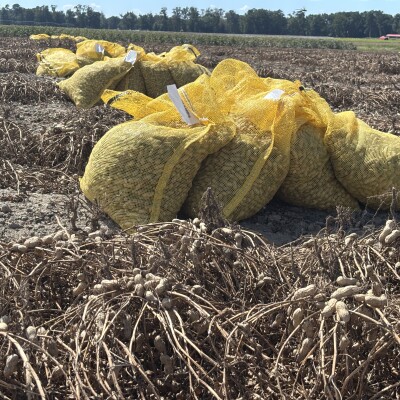
Yeah, Gary, I would say that it's about over. There are still some peanuts out, but we're way down in the short rows now. So as I ride across the countryside, I'll occasionally see a combine running, but I see a lot of fields that have been harvested. Some of those fields, the hay has been baled. Other fields have had some small grain or wheat planted into them. So we're moving, getting pretty close to November. We had a really good weather to get the crop harvested. The crop was about a week earlier than most years. And so folks got started. And when you combine an early start with good weather, that really helped us get the crop out. I will say, though, there was today was the last day of the peanut section of one of the classes. I'm involved with teaching along with tobacco and cotton. And I was talking to a student after class and we were talking about a problem they had in a field. And I asked, well, how how did the how did they yield? And he said, well, we we haven't gotten to those yet. So there are still a few peanuts out in the field as well, but not not many. But every every now and then I'm running across folks with a few peanuts left.
- Gary
Yes. Yes. Have there been any surprises this year in the harvest or the crop?
- David
Yeah, so Gary, I'd say for the last couple of years, I don't know what it'll be this year, but I'm often surprised in a positive way with what the yields are just based on some of the stresses we've seen. Maybe we're a bit more calibrated now where I am, and I think our yields are going to be below average. But I'm hopeful that I'll be surprised by higher yields and maybe some better market grades. I think if I look at the crop and if I were to look back at surprises, I would not have anticipated the challenges that we've seen with tomato spotted wilt this year. That would have not been on my radar. Although we've talked about this before in great detail, there probably are some reasons why it's caught up with us at this point. In some ways, I think we're going to have more Seg 2 peanuts with burrow bug damage this year than we have in the last couple of years. I'm surprised at that, I think, because last year I felt like our weather patterns were just about like this year in terms of having a lot of dry fields and dry conditions. And we just didn't have the big issues last year that I'm aware of. But this year, it seems like we're, you know, the big surprise is more. more burrow bug damage than I would have anticipated based on history. So those were two surprises, spotted wilt being more prominent and some burrow bug damage being more prominent as well. And I think if you look at both of those, there's not a silver bullet or a quick fix once the cropping cycle starts. I mean, you can't, once you've planted a peanut field, your tomato spotted wilt program is in place. Because we don't have an insecticide that's effective on burrow bug, once you have planted and your major cultural practices, deep tillage or moldboard plow, you're really at the mercy of what's going to happen in that particular field. And you can't really correct that. So those were some surprises that I saw this year.
- Gary
How can we use these surprises to help us in the future?
- David
Well, those are, you know, so as we've talked a little bit about those two pests, we need to be proactive up front before we plant and try to minimize that risk. And that leads to an even kind of a bigger reminder for me, but for everyone else is, so we're winding down the harvest now. And hopefully people have survived that fairly well. And, you know, one of our challenges this year is our price was lower than it's been in a while. And if we have some low yields, that just puts a lot of pressure in that respect. So people are thinking about that, having gotten the crop pretty much out. But it's a very good time now to think about the things that surprised you as a grower or a consultant or a county agent or ag business, whomever it happens to be. Think about things that you saw. Try to make notes of those and take notes so that the next time you have peanuts in that field, you'll have a sense of the problems you might have had this year and you could put some management in place. So that's sort of the longer term. Very good approach to pest and production management is to see what happened in a given year. Go ahead and make some notes of that so that you can come back to it. I know I'm over 60 now, so I don't remember things quite as well as I used to. So it does pay to write a few things down. And I think for a lot of farmers and people that are advising farmers, that would be good too. In the short term, so we often think about peanuts. We want to have long rotations. So the particular field you might be in this year, it could be two or three or four years before you go back to that field. So a lot's going to happen in two or three or four years. So writing some things down and taking good notes on what the major issues were, I think can help you then. For next year, it's very unlikely you would be planting peanuts in those fields, but you might be planting peanuts in that area. And so for some things like we were talking about spotted wilt and burrow bug, we don't know all the ins and outs of those pests. We know that both can be mobile moving into peanut fields. So if you're planting peanuts in the general area that you were in this year, some of the problems you saw this year could also be a problem next year. Even though... you're not in the same field, you might be in nearby fields for that. So taking good notes, trying to get something down on paper before you move into November, December, and get sidetracked with so many other really important things could be important for you to make sure you know what you got. The other thing is we have a number of pests and problems that can look the same as another one. So as you see things, hopefully during the year, you maybe have taken some photos or images and recorded those. Reach out to your county agent, to a consultant that you work with. You could certainly send some things to me as well. And I would talk to my colleagues in other departments about it. But we want to make sure we're IDing the problems we have now accurately so that when we put something in place in the future, we're addressing the right thing. And we can develop a good strategy around that.
- Gary
Okay. Anything to think about for the coming week if you're still trying to harvest or?
- David
Yeah. So I think that for the folks that have a few peanuts left in the field, I think our weather conditions look pretty good. I think there's a chances of rain maybe over the weekend. We still, from a frost standpoint, we. To my knowledge, I'm not seeing anything on the radar as freeze or frost damage. In fact, I've got a few peanuts left in the field that I really want to see if my 96 hours holds in terms of drying down and not having freeze damage. But I don't know that I'm going to catch the cold weather for that. But that's a positive for folks that still have some peanuts out, is I don't think that freeze damage is going to be an issue for us, at least as we move into that. almost into November timeframe.
- Gary
Okay. End of episode 10. Anything you'd like to add?
- David
One thing I'd like to add is if you've listened to all these, we really appreciate it. We would encourage any feedback you want to give. And just to give you a little bit of note about where we're going to go, maybe as we move into post-harvest. is we're going to talk to some of the other specialists on the show. And maybe Ashley Collins will get Ashley to talk about the North Carolina Peanut Growers Association and maybe have some guests as we move forward just to... move along from me every time. But I enjoy talking about peanuts, and a lot of people know that. So if our guests can't show up, we're going to have a show. And thanks, Gary, for getting us to episode 10.
- Gary
You're welcome. This has been Searching for the Brighter Pod. You can contact us at brighterpod@gmail.com, on the web at go.ncsu.edu/brighterpod. Thank you for listening.