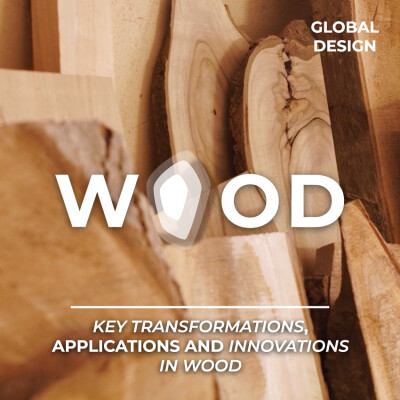
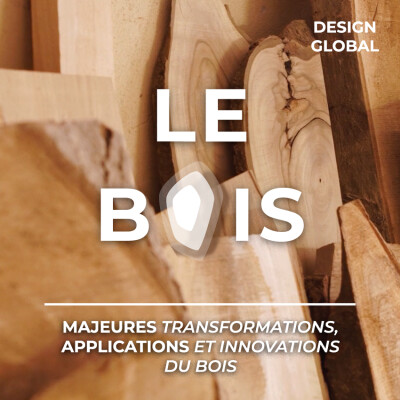
Speaker #0Welcome to Design, Material and Meaning, the podcast that explores the unique aura of design, fascinating materials and the senses that elevate them. My name is Claire Chinellato, Industrial and Luxury Product Designer and Creative Director based in Corsica. Through this podcast, I invite businesses, entrepreneurs. creative souls and designers to awaken your curiosity and discover exciting creations and topics. Together, let's look at the world through a new lens, the lens of global design. Let's get started. Now that you have sharpened your eye on this remarkable material, it is time to explore its major stages of transformations. its applications and finally its innovations through the centuries. To understand the different applications and innovations of wood, we must return to the heart of the forest and follow its entire journey. Transforming a living material requires many steps and a clear understanding of the challenges involved, especially if after listening to this episode, you are considering creating or selecting wooden pieces yourself. Your choices can only become more informed, stronger and richer. Well, since in the first episode we explored forests and the way trees communicate, it is now time to take out the chainsaw and the pruning saw. We are going to cut wood. once felled, the tree is stripped on its branches and changes status to become a log. It is then segmented into several parts for different uses. The largest section of the trunk is called the butt log, also known as the base log. It is the part closest to the ground and contains no branch junctions. This section is attended for structural timber or furniture and is clearly the most thought after. Just above comes the upper log, the intermediate part, often used for smaller pieces where the first branch starts beginning to appear. Finally, the top log, the shorter section in the highest number of visible knots, meaning branch junctions. This part is generally used for everyday objects. and is considered the lowest quality portion of the log. These sections, considered semi-finished products, continue their journey to sow miles where they are cut according to their final use and required volume. This is often the stage where visitors can sometimes be welcomed. Particularly interesting for designers and for those seeking unique wood. pieces, the sawing stage can be carried out using several methods. First, there is plain sawing, also called flat sawing, a tangential cut targeting the outer parts of the loke. It creates beautiful flame-like grain pattern but offers lower dimensional stability. There is a higher risk of swelling and deformation during drying. The second layer involves you rift sawing, an intermediate cut between flat-sown boards and the hut of the tree. These boards offer better stability and a more even grain. Finally, there is a quarter sowing which cuts through the hut of the tree. The resulting grain is the most regular with straight fibers. This is the section with the fewest defects and the least risk of deformation during drying. In sawmills, other cutting methods exist depending on the desired effects and applications, but they are more expensive because they require additional handling. This includes marrow sawing, dutch cutting, mesh cutting, as well as peeling and slicing techniques. Peeling, as its name suggests, literally rolls the log against a blade, much like a giant pencil sharpener producing large sheets of wood using for plywood manufacturing or packaging. The process is truly fascinating to watch. I highly recommend looking it up on YouTube. To facilitate this process, lighter and less dense pieces are generally selected, such as Poplar, Douglas, Beech, and many others. Under certain conditions, veneer sheets between 0.5 and 10 mm thick can be obtained. Slicing, on the other hand, cuts. the wood sheets by sheets along the longitudinal plane. It is particularly interesting because it allows decoration or refined patterns and venues for high-end furniture and decorative applications. This technique projects stunning visual results but requires very regular logs with straight grain. To give you a sense of scale, one cubic meter of raw wood yields about you 50 square meters of broads compared to up to 2,000 square meters in veneer. You choose the technique ! With these elements, you should now be able to select wood species more precisely and begin imagining new applications. As mentioned in the previous episode, wood has an average moisture content of around 12%. Depending on the species and the technique used, Broads may require anywhere from a few days to several years before being ready. This brings us to the drying stage. Why am I talking about drying in this podcast? Because it is a fundamental step in wood transformation and one whose environmental impact is often underestimated. Natural drying is, of course, slower. Roughly one year of drying per centimeter of thickness. The final moisture level remains slightly higher than with machine drying, but the process is far less energy intensive for the planet. High-end corporate steel largely relies on this method. Artificial drying methods require significantly higher financial, technical and energy resources. Results are achieved in days or weeks. The species used and the volume proceeds vary according to the technique. The main advantage is clearly the saving of time and storage spaces. However, these techniques do not allow for aromating development, meaning the wood cannot be used to import aromas to beverages such as wine. The most common method is kiln drying. Wood is placed in a heated chamber with controlled humidity and airflow, where moisture is removed using steam. Other methods also exist, such as vacuum drying or ventilated drying, but with hot air flows, including solar drying. Solar drying is more ecological, but much slower. There are also chemical salt drying, infrared drying and oven drying methods, though this remains rare. When we speak about impacts, there are of course many other factors beyond drying. This is why it is essential to understand the full journey of wood, its certifications, its grades and its transformation stages. At our own scale, we must become more conscious of what we buy, consume and select every day. Wood is a common and widely used material in our life. Yet, it deserves genuine considerations. The first major transformation of wood, as you understood, is solid wood. But then what comes next? Next, next come engineered woods, which are omnipresent in contemporary interiors. Plywood, for example, is made of thin layers of wood crossed and glued together. This structure gives it excellent stability. It is commonly used in furniture, partitions, custom fittings and even visible interior architectures. So-called engineered products such as particle boards emit on average nearly twice as much CO2 as an equivalent solid wood due to their manufacturing processes, not to mention the toxicity of certain adhesives. You probably also know OSB, which has a much rougher visual appearance. It is composed of large oriented wood stands and it's commonly used for floor and transport crates, secondary structure or partitions or intentionally left visible in project with a more industrial aesthetic. Fiberboards such as MDF allow for high precisions and are widely used for furniture fronts, doors, moldings, painted or lacquered components. They also can be dyed in the mass and used as partitions in interior spaces. I even use them for presentation support for my master's exhibition. However, these materials require more processing, more glue. and more energy, which increases their environmental impact. I will take the time in a future episode to explain each product in more detail, I promise. Wood transformation also includes more hybrid processes such as glulam, glued laminated timber. It assembles multiple solid wood laminas along the grain direction to create longer, stronger and more stable elements. Today... This technique is essential for the large architectural spans, contemporary chamber structures, certain structural furniture pieces. It allows wood to compete with concrete or steel while preserving a warmer and more living perception of the material. Finally, the top log, the shorter section with the highest number of visible knots. Veneer consists of applying thin shifts of natural wood onto a stable substrates. It allows the volarization of rare species, the creation of precise and controlled patterns, a reduction in material conceptions, while preserving the aesthetic of solid wood. Veneer is widely used in bespoke furniture, interior fittings, contemporary marquetry, and the luxury sector. These transformations show that wood is never a fixed material. It adapts, transforms, assembles, and composes itself, always according to usage, technical constraints, and design intentions. And it is precisely the adaptability that has opened the door to more spectacular techniques and true innovation. Let's begin with a historical icon, chair number 14 by Michael Thonet. An emblematic creation of the 19th century, it was the first mass-produced industrial model using the steam bending process. These techniques consist of heating and humidifying wood to make it malleable and shaping it on molds. The results? Curved wood with organic and hypnotic forms. Naturally, I must also mention the remarkable craftsmanship of marquetry and cabinets making. Marquetry consists of assembling thin layers of different wood species to create decorative patterns, a know-how transmitted since the Renaissance. The Jean Brieuc studio is a perfect example of its creation, 1000 Fleurs, 1000 Flowers, exhibited at Musée des Arts et Métiers in Paris and awards last year by... Prix de l'intelligence de la main, talent d'exception by the Bétancourt-Schuller Foundation, a folding screen inspired by medieval tapestries exceptional in marquetry and pearl embroidery. As an aside, straw marquetry also exists and can be found in some of the world's most prestigious luxury boutiques. Staying with the Prix de l'intelligence de la main, I strongly encourage you to discover the cabinet making work of Steven Lebrizé. Steven, if you're listening, I hope we can record another episode together soon. Cabinet making focuses on the crafting and ornamentation of fine wooden furniture. Steven and his teams explore unusual woods such as tear wood using biomass or even flexible inflatable wood. Yes, inflatable. I will leave all the references and links in this episode notes. If you think innovation in wood stops here, these final examples may truly surprise you. Yakizugi, translucent wood, and wood residues. Yakizugi, also known as shusugiban, is a traditional Japanese method used to protect solid wood. This technique, both beautiful and effective, consists of sharing the surface of wood, to make it more resistant to fire, fungi and insects. A yakizugi pieces can reach up to 80 years of lifespan. Looking for something almost futuristic? Discover translucent wood. Developed in architecture by Timothée Boitouzet, this innovative material is obtained by replacing linen with a specific polymer-based resin, making the wood translucent while preserving its mechanical strength. Some claim that the final result can make translucent wood up to six times stronger than conventional wood. Today, translucent wood is used in automotive design, product design, and even special design. Before concluding, I would like to address you one last topic that is still too rarely discussed. Wood dust. In so mild carpentry and cabinet making workshops, wood never truly disappears. Each fragment transforms, but it remains. a resource. This ultra-fine residue, long-considerated waste, is now being revalorized in many ways. Mixed with natural and bio-based binders, wood dust can be used to create molded panels, everyday objects, surface coatings, and even 3D-printable composite materials. Some designers go even further and treat dust as a raw material on its own right, capable of being pressed, injected and molted, giving rise to new forms that are sometimes surprising but always meaningful. A particularly striking example is the work of the designer Roc H Biel. Using beech wood dust from workshops, he developed a dense cultural material transformed into furniture. His pieces inspired by classic architecture and ancient columns, appear carved from stone, yet are in fact made from compressed wood residues. This work questions our relationship with material, with waste value, and with the memory of forms. These debts are also integrated into wood concrete, insulating materials, composite bricks, low-carbon objects for architecture and project design. This approaches... reveal something essential. Wood is no longer valued only for what it is as a wall, but for everything it generates. Nothing is insignificant, not the plank, not the offcut, not even the dust. This invites us to adopt a different perspective of materials, more attentive, more responsible, and also more creative. To conclude, wood is a timeless material in constant evolution, a remarkable resource between nature, craftsmanship and innovation. From the underground communication of forests to new technology applications, it continues to reinvent itself and to inspire wonder. This episode is already coming to an end. I hope it inspires you to integrate this incredible material into your project and see it from a new perspective. Thank you so much for listening to Design, Material and Meaning. If you enjoyed this episode, feel free to share it, leave a rating or comment. Every gesture means a great deal and helps this podcast grow. I'll see you very soon for another episode exploring new facets of design, materials and meaning. Until then, take care and stay curious.