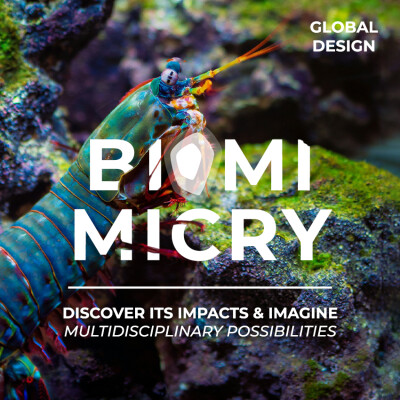
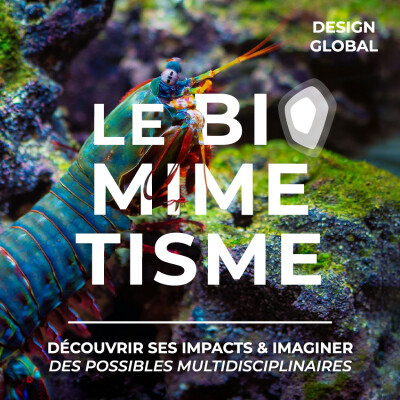
Speaker #0Welcome to Design, Material and Meaning, the podcast that explores the unique aura of design, fascinating materials and the senses that elevate them. My name is Claire Chinellato, Industrial and Luxury Product Designer and Creative Director based in Corsica. Through this podcast, I invite businesses, entrepreneurs, creative souls and designers, to awaken your curiosity and discover exciting creations and topics. Together, let's look at the world through a new lens, the lens of global design. Let's get started. Today, I invite you to dive into an approach that transforms the way we design products, spaces, services and materials around us. Biomimicry. In this episode, I invite you to explore what biomimicry truly is, its definition, its essence and the emblematic examples that have popularized it. We will also look at more discrete, sometimes lesser-known innovation that nonetheless transform construction health care, technology and prevention. We will see how biomimicry also feels forward-looking approaches, particularly through the work of a major creator based in Massachusetts. Finally, you will discover in six key steps a concrete method to initiate a bio-inspired approach in your own projects. Let's start with the basics. What is biomimicry? Biomimicry or bioinspiration refers to the act of drawing inspirations from the forms, processes and functions of living organisms, plants, animals, ecosystems, to create innovations suited to our needs. It brings together scientific and engineering solutions inspired by the living world that respond to human or environmental challenges. The idea is simple yet radical. Rather than imposing purely industrial or artificial logic onto our design, we observe what nature, shaped by billions of years of evolution, has already optimized and we translate these lessons into design, architecture, materials, services and beyond. Biomicry can be applied in a multidisciplinary way at micro scales, materials, surfaces, nanostructures, as well as macroscales, buildings, infrastructure, urban services, ecosystems. Biomimicry offers several powerful benefits which can be summarized in four main points. First, sustainability and energy efficiency. Nature-inspired solutions tend to be resource-efficient, energy-efficient, and often biodegradable or less polluting. Second, structural optimization. Nature offers highly efficient structures. Think of bones, shells, spider webs, forms, and materials optimized for strength, lightness, and flexibility. Third, integration within the environment. Rather than building against nature, we built with it, creating buildings, objects, and services that integrate harmoniously. into ecosystems, sometimes in participatory or regenerative ways. And finally, cross-disciplinary innovation. By combining biology, engineering, design, and computation, biomimicry opens up new, unexpected, often hybrid pathways for innovation. I'm sure you will quickly recognize these categories throughout this episode. Today, there are indeed frameworks to structure this approach, including international and French standards that establish clear methodologies. They are not mandatory, of course, but they allow you to formalize the design approach in a more rigorous and committed way. If you're interested, I've listed references in this episode's description so you can explore further. What are its applications? Biomimicry is not just theoretical. As you've understood, it has a multitude of applications across many fields. Let's begin with three major references. In terms of structural optimization, I'm sure you know Velcro. This fastening system is inspired by the hooks of burdock fruits which cling to loops in fur and textiles. Today, Velcro is an extremely effective contact-based fastening system used in many garments, especially for children, as well as in medical equipment. In terms of environmental integration, you may know aircraft winglets, those slightly upward curved tips at the end of airplane wings, inspired by the flight of birds such as storks or birds of prey. This design improves lift, reduces turbulence and can reduce fuel consumption by up to 7%. Finally, when it comes to sustainability and energy efficiency, you have probably heard of the famous nose of the Japanese high-speed train from the 1990s, inspired by the beak of a kingfisher. This but, known for slicing through water with minimal splash, inspired a design that significantly improved air penetration, increasing speed from 210 to 320 km per hour, reduced electricity consumption by 15% and lowered noise pollution by 25 dB compared to the previous model. In this episode... I wanted to broaden the scope of innovation, hoping you will discover new examples to show you the richness and transversal nature of biomimicry. You will see that some examples are already part of everyday products and solutions, while others, more forward-looking, could significantly improve our lives and environments. Wow, I won't beat around the bush. When I imagined this episode, it was impossible for me to not to talk about one of my role models, Neri Oxman. She's, for me, a leading figurine design, an immense source of inspiration that I have followed closely for years. And she embodies the most radical, visionary and transversal aspects of biomimicry. To me, she truly represents the pinnacle. of sustainable global design. Neri Oxman can be described as a true multidisciplinary figure, architect, designer, researcher. She leads the Mediated Mater Research Group at MIT in Massachusetts and has developed a philosophy she calls material ecology, an approach that reconciles art, science, design and engineering. She and her team designed with, for, and through nature. The Netflix series "Abstracts" presents their work brilliantly. I highly recommend watching it. So how does their work take shape in practice? Through projects that combine biology, 3D printing, technical systems, artificial intelligence and computational architecture. An incredible body of laboratory work with living potential which I can illustrate with two of their projects. The Synthetic Apiary is a project focused on creating and controlled indoor environment for bees, capable of simulating ideal living conditions, light, humidity, temperature, with the goal of supporting biodiversity and addressing the collapse of bees colonies. Here, I want to show that biomimicry is not necessarily human-centered. it can also be applied to other species. In the same vision, the EDEN Project proposes a living regenerative architectural tower, an experimental structure combining among other things, through artificial intelligence, the characteristics of both human and non-human environments within a single system. The ambition is clear, to create a space that actively participates in its environment. Thermal regulation carbon capture, resource production and biodiversity support, Aden stands in contrast to so-called carbon neutral buildings and instead aims to generate biodiversity. What we should take away here is that biomimicry is not just about form or function. It is a bridge between nature, technology and society. A way to rethink our relationship with the world, no longer as dominators but as co- inhabitants. This systemic approach invites us to move beyond the fragmented view of our objects, spaces, and services. Like global design, every material, every structure, every function becomes part of an ecological cycle, an ecosystem, a symbiosis. We could say the introductions are done right. Of course, I've listed many other projects around the world to show you the power of systemic nature of this practice. Have you ever wondered how we rethink the organization of large cities today? Well, here's a clue by drawing inspiration from living systems. Japanese researcher Toshiyuki Nakagaki studied blobs. Blob is a single-celled yellow organism with no brain which appeared about 1 billion years ago and is neither a plant or animal. Researchers studied it closely to improve public planning systems such as railways, networks, and the results are astonishing. Slime mould can generate solutions that are faster and more cost-effective than those designed by engineers. We know that light is a precious source of life. Did you know that the resolution and color performance of our screens are literally competing with cuttlefish? These animals are studied for the ability to change color and create extraordinary patterns. Considering that 76% of marine species are bioluminescents, there is a immense potential for inspiration in digital displays. Staying underwater, few creators are as fascinating as the Mantis shrimp. This small, colorful shrimp may seem harmless at first glance, but it holds remarkable capabilities. It possesses one of the most advanced visual systems in the animal kingdom. It can detect colors invisible to humans, including ultraviolet wavelengths and perceived light polarization. These abilities are now studied in fields such as automotive design, where cameras inspired by this system can detect objects up to three times farther than conventional optical cameras. We also know that concert cells can be detected through light polarization, meaning the mantis shrimp is contributing to advancements in early concert detection. In recent years, more and more projects using natural material wastes have emerged. For example, in construction, a Japanese company developed safety helmets made from calcium carbonate derived from crushed sea shells. Combined with ripped surface, these helmets are 30% more resistant than traditional ones. Another example comes from the universities of Stuttgart and Fribourg inspired by pine cones. Pine cones open and close depending on humidity. Based on this principle, researchers developed an agromorphic material printed in 4D using cellulose. These led to soligate an intelligent shading system that adapts to weather conditions without requiring energy. Biomimicry opens up an extraordinary field of possibilities. Even in everyday material, self-cleaning glass inspired by lotus leaves, hydrophobic coatings inspired by animal skins such as seals, sharks or camels. Beyond surfaces, studying internal structures of living organisms allows us to optimize materials, for example, mimicking bones or coral structures to increase strength while reducing material usage. Biomimicry is also a driver of inclusive design. For example, tulip-shaped wind turbines designed by Dr. Daniel Fabre resist bird mortality by making structures more visible and better adapted to wildlife. Through all these examples, I want to show you that biomimicry is a truly transversal lever. Product design, architecture, spaces, services, materials, ecology, technology, everything can become a field of application. The potential is immense and it is waiting to be explored. Have these innovations inspired you but you're not sure how to adapt this approach to your own projects? I've outlined this overall method for you through six concrete steps. First, observe nature. Look around you. Walk through a forest, look at a plant, an animal, observe an insect, a nest, a shell, and ask yourself, what has nature already done here? What challenges or need has it responded to? And above all, how did it do it? Second, identify a problem or a need. Insulation, recyclability, climate adaptation, comfort, mobility, then identify natural models. that respond to similar issues. How could this principle inform your own projects? Bone structures, textures, spider webs, animal habitats, plant systems, species cohabitation, and so on. Sometimes, sketching out your thought on paper can help. No need to be an expert at drawing. Third, analyze in depth. Once the idea has been identified, break it down as much as possible in order to understand it better. How does this species adapt to its environment? How does this structure repair itself? How does this principle adapt, deteriorate, or renew itself? How does it interact with the changing seasons? Fourth, translate the functions. Define the constraints of your project. Use, scale, durability, materials, manufacturing, then imagine how to apply these principles at the human scale through design methods, materials, and production processes. Think big and think freely before sorting through your ideas in light of your design brief. Fifth, prototype and experiment. Testing sketches, materials, and forms is a fundamental step in both design and biomimicry. Whenever possible, make use of hybrid techniques, 3D printing, biomaterials, robotics, digital fabrications, mock-ups, prototypes, because succeeding on the first try is extremely rare and would almost be suspicious. Observe performance, ecological impact, functionality, comfort, ergonomics, and the durability of your solutions. Adjust, rework, improve. Refine your concept in order to achieve a strong and lasting result. Sixth, integrate and think in contexts. Consider the life cycle, the context of use, the environment and compatibility with other systems. What is the overall impact of your solution from an ecological, social and economic point of view? What is its lifespan? What are its limits? This methodology will give you a concrete approach by turning nature into a library of living solutions through responsible and resilient creations. I would be delighted to discover your ideas and the parallels you came up with by applying these principles. To contact me, check this episode caption for my email address on my Instagram account. Talking about biomimicry is one thing. Seeing it is even better. So where can we discover this practice around us? In our regions and local territories, in cultural venues, museums, design centers or temporary exhibitions that help raise awareness of these approaches. In Corsica, for example, in Bastia, there is the Science Center Casa di E Scenze, which regularly addresses this field through some truly inspiring terms. In Paris, I can also introduce you to Biomim Expo. It is the national event dedicated to biomimicry. Every year, Biomim Expo brings together researchers, designers, companies, schools, creative studios, urban planners and institutions working on living system and bio-inspired solutions. A wide range of terms can be found there. living architecture, fire-inspired materials, design, health, agriculture, energy, robotics and sustainable cities. It would be also impossible not to mention France's national biomimicry hub, Ceebios. It organizes visits, workshops, conferences and demonstrations of bio-inspired materials. Ceebios is the European Centre of Excellence in Biomimicry based in Senlis. Ceebios is one of the key players in France, working closely with industries, schools and designers. Internationally, several institutions also play an important role in spreading biomimicry. In Barcelona, the Museum del Disseny regularly explores living materials and biofabrication. In the United States, the Biomimicry Institute leads educational programs and exhibitions around the world. There is also a biomimicry institute in Japan, for example, working on smart cities alongside startups and public authorities. These initiatives help make biomimetic thinking more accessible, open new paths to the public and nourish the collective imagination, which is essential if we want these ideas to truly infuse everyday practices, urban projects and production systems. To conclude, biomimicry reminds us that nature is not merely a backdrop or a resource to exploit. It is a library of knowledge, forms, functions and strategies that have been refined over billions of years. By drawing inspiration from this profound winsome, designers, architects, engineers and entrepreneurs can invent a different relationship with the world, one that is more respectful, more intelligent and more sustainable. projects our spaces and our services can become an extension of nature, bridges between the living and the built, objects of meaning and responsibility. This episode is already coming to an end. Thank you for listening to this podcast. If a biomimicry speaks to you, share it, discuss it, experiment with it. If you enjoyed this episode, feel free to share it, leave a rating. or a comment. Every small gesture is a huge support for this channel and it always makes me happy to read your feedbacks. See you very soon for the next episode where we'll explore other beautiful facets of design. Until then, take care and stay curious.