- FRICTIONS
Frictions.
- Walid Hajar Rachedi
When I started junior high, my biggest disappointment was stupidly simple. We didn't get lockers. No shiny hallway, no slamming doors, just every 37 kilometers south of Paris and backpacks that felt too heavy. I got the best grades in math, but the subject I loved, without really realizing it, was history. Because it didn't just give you dates, it gave you explanations. And the first time America got explained to me wasn't on TV. It was in a classroom. Seventh grade, Collège Montesquieu. Madame Chassagne said it like it was a fact. The United States is a melting pot. There's no other country that has as many people from all over the world as we do. We have 46 million people in this country who are immigrants and 40 million who are children of immigrants in this country, a higher percentage than any other country in the world. Back then, in a French banlieue in the mid-90s, that idea was irresistible. I didn't have big words yet, but I could tell. Over there, being from elsewhere was fine, better. It was cool. Not merely tolerated, but something to be proud of. Celebrated. And for a long time, I believed one rule made it real. Birthright citizenship. Born there, raised there. American. Period. Belonging, though, is something else. Your voice counts. You get to shape the we. And in Atlanta, that we. is still often written in black and white, even though across the metro area, from Beaufort Highway out to the suburbs of Marietta, about 15% of residents were born abroad. And for many families, immigration is already one or two generations back. There I spoke with two women whose families chose America. Both grew up with mixed messages about what that choice was supposed to mean. Both are professionals navigating a political climate that shapes their work. and sometimes pushes against it. And their mothers too, deciding what to carry forward and what to let go.
- Gyun Hur
My name is Gyun Hur. I'm a Korean-American artist, educator.
- Amenah Arman
My name is Amenah Arman, and my occupation is a trauma therapist.
- Walid Hajar Rachedi
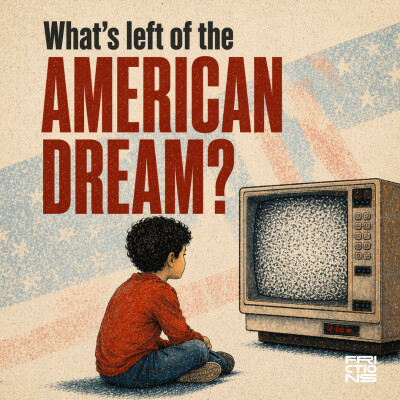
The bell rings again. New room, new faces. But the same old question, who holds the license to belong? What's Left of the American Dream, an audio documentary by Walid Hajar Rachedi. Episode 2, License to Belong.
- Gyun Hur
My very first contact with America, it's land itself. I was in sixth grade in elementary school and my... oldest uncle, who was known to be the brilliant, decided to become a pastor and study the seminary. So he landed in Rome, Georgia. So my parents took some courage to get some money together, and we spent a few weeks in Rome, Georgia. And I think my parents were seduced by this idea of a Second Chance by the idea of American Dream and also My mother, she thought that she was going to have a pool and green lawn. She really wanted it to have that.
- Amenah Arman
My grandfather was born in 1948 when the state of Israel was created. They were living in an area in which they weren't going to be expelled, but they were going to be occupied. And so with occupation comes lack of resources, lack of job opportunities. So it wasn't like... oh, yeah, I want to make money for my family. And I'm just going to go ahead. No, what ended up happening was they were giving Palestinian men who were under occupation, opportunities to travel super cheap, you know, and some of them obviously were expelled. When he was in his 20s, he was an artist. And so he wanted to join a traveling group of musicians. But with his story, it was more so like, oh, we're framing this as... You have an opportunity here. It's free and you get to go. And so he left to South America. This was my grandfather on my mother's side. My mom was born in Chicago.
- Gyun Hur
I think the way that we got exposed to America and South Korea growing up was really through post-Korean War. I grew up learning that North Korea, the communist country, they are the evil ones. I literally had books. with these figures with red face. And that America came to basically save us, meaning that the psyche of a lot of South Koreans is that US government gave us the democracy. Every man in South Korea has to go to military for two, three years. And during his time, my father got to learn how to speak English by just meeting a lot of American soldiers based in South Korea in 70s. My father took a lot of pride in developing friendships with them and learning their cultures. He loved Frank Sinatra and all the movies from 1940s and 50s. And also in 90s, TV shows like X-File. Bob Ross. These were all dubbed, but I grew up also seeing some of these American shows. I was 13 when I moved here. So in 90s, New Kids?
- Walid Hajar Rachedi
New Kids on the Block.
- Gyun Hur
Yes, it was huge. During my elementary school years, we were just obsessed with all these blonde boys.
- Amenah Arman
They were plastered all over our notebooks. So I was in Chicago. Chicago as a child. We were there till I was like eight or nine. Back in the 90s, people were allowing their kids to play in alleyways and stuff. My childhood was really kind of free. It was filled with family. Like there's a large Arab community there. There's always weddings. There's always something happening. Always movement. One of the key moments of my childhood, yeah, Michael Jordan, the Bulls. We all got together. There was pizza. Well, Chicago's really diverse. There were so many different ethnicities. I don't know that I ever was like, oh my God, I'm like different here. It just felt like everyone was different there. Before we moved to the West Bank, my dad moved to Georgia. Moving to the South as a kid was like a stark wake-up call for me. It was just a year, but it was just such a pivotal time for me in terms of identity. That was the key turning point where I'm like, oh wow, we're really different. Like my nose is different. My skin tone is different. Our food is different. So it wasn't until I left the Midwest that I was like, hmm, oh, so this is America, you know?
- Gyun Hur
We decided to come in 1996. My uncle's family was in Roswell, Georgia, which is this upper middle class suburban neighborhood northwest of Atlanta. I didn't speak English. We were not prepared. My family didn't really come from any sort of literacy or wealth. I literally started with elementary ESL level, meaning that I went to public library and rented baby books to learn phonics. As a person, even though I was only 13 back in Korea, I think I had a deep interior life. So I missed home. I missed my language. I missed my way of externalizing what I was feeling. I always been a very verbal person. I thought I was going to be a writer in Korea. But that being taken away, I think I was kind of trying to find ways to find myself again. And it was in art classes where I didn't need language to sort of like channel that, you know. And then it was also through church that my uncle led and... That's when I got to see my people, meaning Korean immigrants, recovering myself from Monday through Friday of trauma of not being able to find myself at all.
- Walid Hajar Rachedi
When Gyun talks about losing her language after arriving in Roswell, and with it, the feeling of losing herself, I understand. I went through something similar. After a year in Algeria, between the ages of three and four, I had completely forgotten French. I remember that first day of school reduced to a single sensation, a carton of cold milk placed in my hands, and the strangeness of wearing warm clothes while my body still carried the memory of Algiers heat. Today, even though I speak three foreign languages fluently, it's Arabic that resists me. Words I understand. but that remain blocked, sounds I can no longer pronounce. Language is a second skin. We think it's impermeable, indestructible. But really, it's just a way of inhabiting the world. And for Amina, it wasn't only about language. When you grow up elsewhere, what does return even mean? Where do you go back to? And what do you find waiting, especially when the chaos of the world and of history gets in the way?
- Amenah Arman
And then 1993 with the Oslo Accord, right? I'm like seven or eight, you know? We all got together. My mom made cake and oh my God, he asked for all the facts, signing a paper and there goes Bill Clinton.
- Archives / news
Today with all our hearts and all our souls, we bid them shalom, salaam,
- Amenah Arman
And I'm like, what's happening? They're like, oh, it's gonna allow us to go back to full esteem, you know? And then when I was 10, we moved to the West Bank. First thing I remember was when we got to the airport, my parents sternly looked at us and they were like, you're gonna lie about how long we're here. You have to tell the story of we're here for a wedding. Because if you tell them that we're here to stay, they're not gonna let us stay. And instantly I'm like, oh my God, my parents are telling me to lie. Like, that's weird, weird. It went from I've never seen a gun to suddenly I'm at this airport in which. My very existence is a nuisance, basically. They don't want me to exist. And they're carrying around rifles. Everyone. If you're telling me as a kid that this is where I belong, but my nervous system isn't safe here, how am I supposed to make sense of that?
- Gyun Hur
I was going to upper middle, very white high school. It's part of the Fulton County system where the North is very white, the South is very black, because it included Atlanta. And I think ESL classes provided for me to be a part of this kind of larger kids who were still learning English, all the kids of immigrants, basically. And all of us kind of stuck together at the cafeteria. Once I was able to speak the language a little bit more comfortably, I started to notice there was actually a program in which they Thank you. bused some of the black kids to our school. The black students were attending our school, obviously didn't live in our neighborhoods, but they're coming up from the South. And a lot of them actually played in our football team. And this Americana, like with the cheerleaders and football players and basketball teams and all these rallies were unfolding in front of me. And I just could not understand any of it. During those times, I'll just do anything just to stay in the art classroom. So I'll always go to my art teacher and say, can I just paint here when everybody's out? Because I really did not, my body didn't feel comfortable with that whole spectacle around sports. And yeah, I felt very uncomfortable for a long time. At school, through art classes, I found my folks. and you Because I was excelling there, I felt that my voice and my talents were valued. As the president of the art club, I was finding some agency in that space. And then outside of school, you know, my family, we didn't do any of the after school activities or anything like that. But it was through church and it was through like Korean community. I was part of a theater club. That's when I got to do act. acting in Korean and got to be really embraced by elders of the community.
- Amenah Arman
We were Western, born and raised for 10 years in the West. So we hardly spoke Arabic. To go there, it's a completely different culture. You're with people who have been living under occupation, born under occupation, and also with Palestinians because we were under colonization throughout history, God knows how many times, right? We are like the United Colors there. You have people with stray hair, people who are blonde, people who are brown, people who look black. My grandfather on my mom's side looked like he was African American. For me, I look Afro-Palestinian. The mindset was, oh my God, I'm going to go to where my people are, where people look like me, right? When I went there, it was like they identify you by your physical attributes. So they won't remember your name, but they'll be like, oh. is that the light sister or is that the black sister? And so my introduction to my people was physical, but not physical, like, oh, she's so beautiful and exotic and brown. Oh, that's the black one, like the slave, the Abde. It was almost like someone had dumped cold water on me. Because what I was being told was, but this is where you belong. But this is where you belong. And I'm like, oh my God, like, shouldn't I like where I belong? Because I hate this place. I mean, things like running. Oh, you can't run. You're a woman. God forbid anything shows or anything shakes. Going out for a walk was like such a big deal. And it's beautiful scenery. So it doesn't make sense to not walk. And my brothers, if you talk to them, their experience was like, we made friends there. We found our people there. Like they had such a strong connection and sense of finding themselves there and creating lasting friendships. That was not a part of my experience. When we left... It was a lot of family turmoil. So my mom and dad were at a turning point in their relationship. And my mom felt like she was basically a single mother because what my dad ended up doing was sent us there, was working here, kind of coming back and forth. But during that time, he just wasn't sending money. My mom just had her moment where she's like, I'm taking these kids and I'm running back to America without telling him. On a political level, it was like a year or two into the second intifada.
- Archives / news
In 2000, then-Israeli Prime Minister Aryeh Sharon made a visit to a holy site of Islam and it provided the trigger for the second intifada uprising. The first had been before Oslo. Violence bred violence and hope seeped away. The Israelis began building what critics called a wall of shame, meant to separate Palestinians from Jewish settlers in their midst, illegally under international law. The Palestinians also divided... deeper into their factions, which tore at each other.
- Amenah Arman
There was always some type of clashing happening or school being closed or a riot. So there was a sense of like, okay, we get to exhale now, we'll leave and you know.
- Gyun Hur
I didn't go to schools in California or New York and some of these metropolitan cities where all the spirits come together, right? I spent most of my young adulthood in Atlanta, Georgia. I grew up in church. Those are two facts that I felt incredibly ashamed about sharing as a part of my narrative until very recently. It wasn't cool. I was at margins. I always perceived that center was whiteness. And I think if I was exposed to literature and reference points during my under and grad school in Georgia, that those marginalized folks and voices kind of came into the center as a way of creating canons and movements, I think that have really encouraged me. So now I can confidently and joyfully say Atlanta raised me, formed me, and that my spiritual background, although I have a very different and complicated relationship to it, has also informed me very deeply.
- Amenah Arman
When I was in the West Bank, I kept envisioning my life in America because that's all I knew. But now that I'm in America, I'm like, wait, but this isn't what I knew when I was 10. Here I am, 16, and trying to assimilate or trying to, yeah, be a part of popular culture. I don't know that I would say I liked it. I was happy to not be in the West Bank, that's for sure. But now I'm 16, I'm wearing hijab. Everyone, they have like slang language, there's gangs, they wear certain colors. Everything was just so unknown to me that it was like this sense of maybe you just don't belong anywhere. That's where it started. That's when I developed like this chameleon-like quality. And technically my outer appearance, you could drop me with Latinos and they would think I'm either Puerto Rican, Dominican, whatever. Or you drop me amongst African-Americans and they're like, oh, you're just a mixed girl. It's not so much like people pleasing, but more like. Learning how to work a room, how to talk to different types of people, just adapt basically to whoever. When the anniversary of 9-11 happened in September, school started. I remember thinking, oh my God, we're walking to school. It's in the city. Like, should we be scared? At the time, there weren't a lot of hate crimes towards Muslims or Arab in Chicago, at least where we were. My concern right now... is how do I fit in? I had an uncle who was really a part of a certain mosque that had a bunch of Palestinian Americans. That's where I found, ooh, there are people who are like me, actually. I made a lot of friends there. I was comfortable with this identity of being Arab American. Got used to Chicago. And then my dad's like, let's go to Atlanta. And that was just devastating again. It was back to the drawing board of like, oh my God, all they have here is black and white. Hardly any diversity. There is no in-between. They thought I was just a mixed kid. Atlanta is the city that I've spent the most amount of time in, in my life. And it's also like the city that has seen me crumble, but then has also seen me build myself up. I credit Atlanta for like raising me as an adult. But... When I was a teenager, seeing racism, seeing the way white people interact with black people here, was so shocking to me. Or even hearing the way teachers talk, or white men talk to black females. Like, what did he just call her? What did he just say? I couldn't compare it to Israelis and Palestinians because you hardly have any interactions with Israelis there unless it's a soldier who demeans you. In my mind, I was like, man. This is their occupier, basically. It just feels like the blacks are occupied by the whites. racism here is a different type of beast you could feel it in people's bones when you walk past let's say a white woman right and she turns her head back to look at a black couple and looks them up and down there is this like i don't even know how to describe it i saw what you did what you stole that from the shop this
- Archives / news
Thanks. I just bought this at Christine's down the street.
- Amenah Arman
You stole it and I am not going to let you get away with it. Because I'm black and you think I can't pay for it?
- Archives / news
Lady, I think you made a mistake. Call the police.
- Amenah Arman
In the back of my mind, I'm like, bro, your lineage, we're slave owners and it shows. Like, it's like seeing generational trauma in motion here in Atlanta. It's not a theory. It's literally walking past you on the beltline in ponds. Like you see it everywhere here. And that's part of the pain. too. Atlanta is beautiful and it has a lot of life. But like if you were really and I have goosebumps just talking about it, like if you actually sat back and took some time out, really, and you didn't think of like, oh, look at how beautiful it is. Look at all the things they're building. But like if you actually took a step back and sat with the grief, you could feel it. It's in the pavement.
- Walid Hajar Rachedi
Amena says something that catches me off guard. It's like the blacks are occupied by the whites. She doesn't say it like a slogan. She says it like someone who has known both forms of power, the soldier with a rifle and the administrator with a smile. The way a teacher looks at a girl she thinks doesn't belong. The way a stranger stares a second too long before deciding if you're safe. It's not written anywhere, but you feel it. It's in the air. You can't see it, but it enters your lungs. For a long time. Many of us imagined the United States as a new kind of country, one that had somehow moved past all that. And then there was a moment, a brief moment, when it all felt real. Gion remembers.
- Gyun Hur
After I graduated from grad school, Obama was transitioning. That felt so powerful. In the midst of recession, it's Atlanta, Georgia. So historically, they... deeply rooted for President Bush and kind of this conservative conversion around Christianity, which I also grew up learning and believing in my late high school, college years. The rise of Obama and its democratic liberal standpoints were refreshing and affirming, especially as I was coming out of grad school. Him being a child of immigrant, yes, but in certain sense, I couldn't quite relate. deeply, and this is an issue that I have with some of the artist friends that I have too, I come from a literal family. I'm not a daughter or a granddaughter of a scholar. So in that way, Michelle Obama and her story of coming out of working class family resonated so much more. What I remember really distinctively is actually Michelle Obama's speech during the Democratic Convention prior to the election, I think as a young person. The minority woman who's been on the fringe, seeing her speak with so much power and conviction, I just remember being deeply inspired by her story.
- Amenah Arman
When Barack Obama became president, there was a sense of, oh my God, wow, black president, like there's no way, ooh, look, and his name is Barack. He may be Muslim and like... okay, sure, we are people of color and we identify with the black community and people mislabel me all the time and that's fine. And at the same time, as an Arab American woman, during that age, I was like, it's really not my win. I'm about to be 40 soon and it still remains this way. I don't really connect to the politics here. My core, my soul is like, this is not yours. It feels like I'm renting space here and I know that this isn't. forever, ever for me.
- Gyun Hur
In 2013, I left Atlanta to Hong Kong to take up a teaching job at a university. Because I went in there as an American, like Asian American, I was part of that expat group. I was kind of coming in and out of that group. The kind of privilege that's very historical under the colonization, I experienced many different kind of racial microaggressions and like discrimination that whenever I would go out in the evening events with my other mostly white faculty, everybody will pass out business cards, which is a very Asian introductory custom, then it will stop right before me because you Usually there's an assumption that I was just a girlfriend of one of the faculty members. I had also incredible, beautiful experiences living in Hong Kong, seeing its landscape. The Umbrella Movement was happening in 2014, and many of my students were out in the street in protests. I got to travel a lot all over Asia with my partner. You see the traces of colonialism, colonial power, and its impact.
- Amenah Arman
My relationship with American-ness is very complex. It feels like a toxic relationship you have with a lover. Because a part of me knows that the West is so seeped into my identity. despite knowing that, despite that my people still call me an American, I don't identify with it. And specifically with everything that's happening in Gaza, I think that cemented this idea of like, you have spent so much time, mental energy, money in their institutions, getting their degrees, speaking their language and making sure that I do it properly, networking and building a profession, like helping their people basically, right? Mental health wise. But for what? Like the end goal is they're killing me over there and somehow keeping me alive here. But this is not life to me. If my parents just decided to have kids there and stay there, okay, I would have lived under occupation. It would have sucked. I wouldn't have had this privilege. God knows if I'd even still be alive, but at least I'd have a cohesive sense of self. There's nothing to resist, nothing to fight against, nothing to prove. But like, as a kid being raised here, I had to somehow swallow a pill that I didn't consent to. I didn't consent to this. Like, this was forced upon me, you know?
- Gyun Hur
The fact that I grew up in America and how I see myself as an Asian American person got magnified in a way when I was living in Hong Kong. because I couldn't really understand the psyche of the locals, right? I knew that I wasn't that anymore. My thinking, my thoughts, my way of viewing myself and the world was very different. And from the distance, I was continuing to be extremely interested in the politics of America. Towards the end of Obama's second presidency, due to the camera availability from the police, black men who were getting killed were being captured. And it was part of the media at the time. And this racial reckoning also was happening, while this transition was also happening. I felt that there's something that I needed to do. And living abroad was hard. And I didn't find a sense of home there. It was difficult. And ultimately, what I realized is that I'm not going to go back to Korea as my home either so I want to go back home that meant America. And I really yearned for her, despite of what was happening in front of me. I was teaching a drawing class when they made an announcement that Trump is surely the president. It was like 2am in US time. I remember seeing it and then streaming it in my class. Okay, guys,
- FRICTIONS
this is happening. crying while Hillary Clinton has called Donald Trump to concede the race.
- Gyun Hur
Like, I just couldn't believe it. I knew that many folks didn't feel comfortable of how things were unfolding because it challenged the norms, the historical continuation of this fabric of and belief around American dreams.
- FRICTIONS
The people rising up saying it's time to listen to us. It's time to listen to us in Michigan and Wisconsin and work for the people.
- Gyun Hur
But we didn't know that it was going to be that extreme, right?
- FRICTIONS
This was a white lash against a changing country. It was a white lash against a Black president.
- Gyun Hur
When that happened, my husband and I both felt that we got to go back. When I came back from Hong Kong, because of my experience being in Asia as an Asian American woman, and its complicated relation to that, coming back, I actually picked a few books to read, and one of it was called literally The Yellow. And it was a book that my professor gave me when I was much younger then. And I was like, why is he giving it to me? Is it because I'm Asian American? The subtitle was Asian American Experience Beyond Black and White. Frank Wu wrote that book in 70s, I believe. And I just discarded it because I felt offended. Anyways, I picked that book again and decided to read and open myself to dive into this conversation to confront the context in which how I grew up. So in 2017 to 2018, I started to read that and investigate that for myself. And the color yellow started to appear in my work in a very committed way. Growing up in Atlanta, Georgia, I really admired for a long time and still now do the Black writers and musicians and artists who took up the generational burdens and trauma and then transfer that into this reframing of Black is beautiful. coming out of 60s and 70s. And I felt that we needed to do that more.
- Amenah Arman
Trump getting elected and I hate it. I think it's crazy. I think it's terrible. But then I'm like, oh my God, Harris, like genocide support it, you know? So a lot of Palestinian Americans, a lot of Arabs, a lot of Muslims have extracted themselves from this system because that was never, ever designed for them to have a say. So for them to even elect. anyone. At the end of the day, for me, it feels light to know that, okay, so back home, my kind is being eradicated, occupied. I've seen it. I've lived it. I have that heaviness. This shit here in America with Trump, they can have it. That was never mine. The war in Gaza basically felt like there was a veil placed upon us as Palestinian Americans, where we just got comfortable with capitalism. Build your businesses. Make sure you send your kids to good schools. You can visit Palestine every now and then. Maybe you can build a home there or buy yourself a condo there. It was almost like I was in a coma for all these years in the West. And then suddenly someone's like, oh, wait, wake up. And then going outside, seeing people, being in restaurants, eating amongst them. Drinking coffee, hearing their conversations, I'm like, wait, what is happening? Do you realize that, like, my DNA over there is being wiped out? It's like Calvino's The Flash. This is a short story where he suddenly is walking down the street and, like, nothing makes sense to him. Like, out of nowhere.
- Walid Hajar Rachedi
What happened in Gaza felt not only like a tragedy, but like an absurdity. The same screens were used for work, for messages, for distractions. Suddenly carrying images of dead bodies. A genocide unfolding in plain sight, live-streamed on our phones. And the words had been raised on, human rights, international law, never again, didn't mean anything anymore. The good guys weren't showing up. Superman was on paid leave. And whatever little credibility the Western democracies still had was gone. What do you hold on to after that? A kind of numbness follows. And yet someone still has to look at what seems impossible to face and try to give it a shape. That's a question artists have always carried. How do you keep working when reality itself starts to collapse? Guillaume would run into a version of that too, when Covid made it harder to ignore the hatred that had always been there just beneath the surface. She began looking for answers and found an echo in the words of a painter who had wrestled with the same question decades earlier. Jack Whitten.
- Gyun Hur
There was one part of his journal. This is never meant to be published, so it's extremely private. So it's the page 18 to 19. He says, The 1963 bombing of the 16th Street Baptist Church in Birmingham with the death of four little girls pushed me over the edge. Those little girls were from my hometown. For the first time in my life, I experienced the absence of hope. My grandmother Etta used to say about white people, their children will be better. Their children had become monsters. My paintings became violent. It became harder to control my emotions. Even hate had entered my vocabulary. Honestly, I was ready to acquire guns and explosives, go back to Alabama, and encourage rebellion at any cost necessary. Ellen Stone, my art dealer, shouted and screamed at me. You're an artist, and you better make up your mind. He insisted that my job was in the studio. How can anyone justify staying in the studio when people are dying? What is the artist supposed to do? What justifies killing for any cause? These were and remain the most difficult questions for me considering the politics of race in America. As yellow was entering, I was already thinking about this larger conversation around race as a construct. COVID happened, 2021, and Trump spoke of this Chinese virus, right? Like this continuing sort of belief of Asians as foreigners and the causes of illness, basically. And I think with that occurred a series of... complicated unfoldings of anti-Asian hate crimes. In 2021, in Atlanta, there was a white man who used to frequent some of these spas because he felt so ashamed for not being able to stop himself from going to these spas, decided to visit back to these three spas. One in Marietta, Georgia, nearby my parents' home, and then in Atlanta, and the shootings occurred. A man's been arrested after eight people were shot dead in the U.S. city of Atlanta. Six of them are understood to have been Asian women. The shootings happened at two spas and a massage parlor in the city, and police are trying to determine if all those killings are connected. That was a very particular moment that... a lot of Asians felt like we could no longer ignore what's been happening. And I think also these are our mother figures and auntie figures. And spas also, it's a behind-the-door kind of business, right? Because spas also dealt around bodies and intimacy. It really shook us hard. And that invisible... narrative around their labor, their presence, their voice in the American South in the thick of, you know, James Baldwin talks about like, when I landed in Atlanta, Georgia, no wonder there are secrets, because there's a thickness of the woods.
- Amenah Arman
I was giving Palestinian Americans therapy. I'm like, I know what we need. We need spaces, we need to talk about this. Meanwhile, I was literally abandoning the way I was feeling. So I would literally just threw myself in the work. And then because you my background before therapy is I am a writer. And so when the images were coming out and the gruesome reality of it, that's when the two identities of writer and therapist came together. I started describing because the therapy that I do is narrative exposure, like massaging the trauma through narrative. I created a whole freaking mental health fund and started giving people free therapy and went broke doing it. I got to a point where Really, I questioned existence. I'm like, do you even want to live anymore? And it wasn't until a friend of mine that sat me down and he said, okay, two things, this Palestinian mental health fund, you've got to put an end to it. You just cannot sustain this. I was burnt out financially. And as a therapist, the second thing that he said was, there are no amount of sessions that you can give to Palestinian Americans that's going to bring anyone back. Your people are resilient and they don't need you to sit around and massage the trauma. They need you to do and to act and to be. And rebuilding sense of purpose started with Checking my ego, just taking a step back, asking myself in this moment, in my reality, what are my responsibilities here? What do I even enjoy my people? Checking me, checking up on me, telling me, you know, things about myself that I completely forsaken was a way in which I don't want to say found myself, but created a new norm.
- Gyun Hur
When I thought about the Atlanta spa shootings, I didn't know what to do. These mothers and aunties who migrated to American South and whose lives, they all passed here, but completely invisible. And I just wanted them to be visible. During the time of 2021, both personal and collective griefs really pushed me to think about different materials in my practice, which ended up becoming that I wanted the presence of river water. and some sort of container they'll hold. And this two-year project titled Our Mothers, Our Water, Our Peace, we decided to make about 100 teardrop-shaped glass vessels and distribute that amongst Asian American families and Asian American advocacy and cultural centers. Throughout that first year per site, we did intergenerational visual storytelling workshop. panel discussions on mental health amongst Asian Americans. The mothers of my generation, they also held their own rituals and facilitated meals and conversations. And then in the second year, we brought all of those vessels back in addition to larger vessels. And we brought all of these tiers basically together as a landscape so that you we could communally reckon with what has been taking place in our respective lives around griefs.
- Amenah Arman
When I think of the American dream, one, it doesn't belong to you because you don't belong here. So the American dream for me is like someone else's dream. It's like Hollywood. You're $100,000 in debt because you got two fucking degrees and you're building. a business that God knows how much taxes you have to pay to the government. You're unable to afford health care. And you don't know how effed up it is until you visit different countries. Like when I went to France, I was like, people are out on a Monday. They're living life and happy making whatever they're making. There is no sense of like, my self-worth is rooted in the fact that I you could afford the Range Rover, and I send my kids to private school or whatever. So to me, the American dream, to be honest with you, I think it's an illusion. I think it's bullshit. The American dream is anti-human, and I want nothing to do with it, even though I'm immersed in it. And again, inshallah, I will not die with my suit and laws.
- Gyun Hur
What broke my parents' American dream was their fixation on the materiality, and towards the end of their bankruptcy, And that eventually pushed them to return back to South Korea. My parents, especially my mother, could not let go of her Lexus car. Holy shit. I just couldn't understand why she wouldn't let go of that. They insisted holding on to a house that they couldn't afford. They really believed in it in a certain way, but it broke them apart. That's something I needed to reckon with and let go. That's their own sort of narratives. and something that I don't want to be a part of. My own imagination and hopes and aspirations on Americana is not the material.
- Walid Hajar Rachedi
If you really just sat me down, you're like, okay, come on, let's come up with a vision. Specifically now in Georgia and in the metro Atlanta area, what's coming up recently are, and this is going to sound small, but it's actually really big, Third spaces for young Muslims. Coffee shops that are popping up. Hubs where they have meetings and young professional stuff and mixers and coffee nights and working out together. And so there's a lot of space that's being created for us, by us, so we can feel safe. So there's a lot of like curiosity about Islam. Even the turban has suddenly become a fashion statement. Modesty, oversized clothing, it's hitting the runway. I have a 13-year-old. My 13-year-old goes to a public school. To see my kid grow up in this time is actually a lot lighter and a lot less worrisome. Embrace LGBTQIA, embrace the Muslims, and BLM for life. So I think we've been, whether we like it or not, whether the community has their judgments of how we've been lumped in with these marginalized communities, whatever, it is what it is. If that means that we aren't threatening and our kids aren't going to be threatened, then so be it. Like, that's fine. You can necessarily blame America for the character traits that now our communities have that we don't actually like. Yes, you have more choice here. To choose either well or terribly. Yeah, like you said, it's an experiment. And I think that's something that I value. Oh, wow, I value something here. And I see this in just the way I parent. Like, I'll tell my kid, hey, I'm noticing something is up. But I'm not going to force you to tell me. I'm going to wait till you find it within yourself to build the courage up to tell me about the thing that I know is.
- Gyun Hur
Let's say that with my daughter entering into my life, I... think that it's necessary for me to work my shit out for my daughter to feel a little lighter. The best thing I feel that I could transfer and gift her is a sense of lightness and joy so that she can enter into imagination in which past doesn't hold her. I think me becoming a mother has given that urgency. And I feel that if I'm healthy and lucky enough, I got 40 to 50 more years left and I'll try my best. But it's complicated because I don't have my mother. She went back to South Korea. We are somewhat estranged and I don't have folks in my life in which my culture is present at the moment in Brooklyn, New York as an artist and as a faculty. I'm losing my own interest or capacity or willfulness to transfer what I know to her. So some of the reckoning that I have and grief that I'm going through is, how am I going to possibly transfer this memory of my own grandmother and her skin and me going to places in South Korea in the neighborhood that I grew up with my grandmother and the kind of soup that she cooked? I have no way of transferring that for my daughter. I'm not even doing a job of transferring language to her because I mostly speak English. The past that I remember doesn't exist anymore in South Korea either. I went back to South Korea one more time and the place that I used to live isn't there anymore. It's been cemented over and there's a new building. So it only exists in my imagination. And perhaps not everything can be transferred and it's an impossible task. There's this virtuosity, like there's a thickness of the spirit that really exists amongst our people. I would love for her to somehow know that. We call it Han, which is like the unreconciled spirit that we linger on because there's a deep spirit that's been wounded and is yearning for something. beyond its woundedness and damage. And she's got her own life and new trajectory for her life that I will also want to give her that permission. But she's going to have that unknown desire wanting to know and I can offer that perhaps that leaves a little bit of room for her to figure stuff out for her own. That journey, the openness to that journey is something that I will love for her to understand that that's very specific to America, that things are not set. and she's going to be part of the narrative making and that she can fully consider herself and her attempts and whatever she chooses to do and however she chooses to live that itself also can be one of many centers. And I think that's something that's been incredibly powerful for me to experience. I didn't understand that that was the part of what America offers until recently.
- Amenah Arman
I think people are being pulled to rally behind the truth and to just embrace the different identities, right? And so, yes, you're still going to have the grief of racism and the generational trauma and all that. And at the same time, the majority now is pro-marginalized identities. They're just curious about different ways of living.
- Walid Hajar Rachedi
What's Left of the American Dream, an audio documentary by Walid Hajar Rachedi.
- FRICTIONS
You've been listening to All Identities Combined, the podcast that explores our singular stories produced by Frictions. Find all our stories on our website, frictions.co.