- Speaker #0
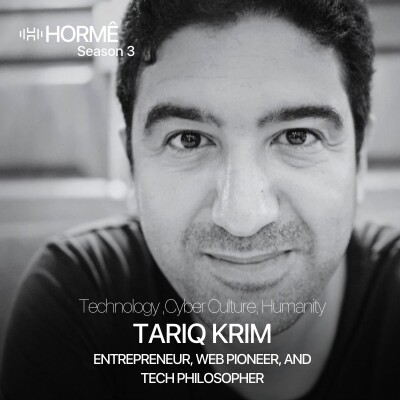
In Greek mythology, Orme is a goddess of drive, impulse and the energy that sets things in motion. It is that inner force that arises when an idea takes shape in your mind. An idea you choose to turn into a business, a project, a reality. In this third season, Orme goes international. New voices, new journeys and new passionate minds from around the world join the conversation. Across every file, every background, and every culture, Orme brings together the minds that think, build, and create. This podcast is powered by Orme Agency, dedicated to independent workers. There are people who do not simply anticipate the future, they help shape the way we imagine it. Tariq Krim is one of them. Entrepreneur, technologist, and keen observer of society. He has spent more than two decades exploring the relationship between technology, culture, and human behavior. From the early days of the French internet to the creation of pioneering digital platforms, his journey has always been guided by the same curiosity, understanding how new technologies transform the way we communicate, create, and live. Behind the entrepreneur lies a broader reflection on our time, on attention, creativity, artificial intelligence, freedom, and what it means to remain human in a world increasingly shaped by machines. For Orme, we wanted to look beyond the technology itself and explore the man behind the ideas, his relationship with the future, with creation, with failure, and with the questions that remain when innovation is no longer an end itself. Tariq, welcome to Orme.
- Speaker #1
Thank you for having me.
- Speaker #0
If you put your CV aside for a moment, who is Tariq Krim?
- Speaker #1
Oh, I've been many things, but I was thinking about it and I think I'm a nostalgic of a future that never existed. But I believe we could build, still build. I was born in the 70s at the time where the future was moving from being very optimistic to very... pessimistic. It was the era of the dystopia and science fiction. And instead of looking forward with a very bright and optimist vision, things seemed to be a little more complicated. It was the first real understanding of climate change, of AI as a potential risk for humanity, as a... Most of the problems that we have today have been shaped by the sci-fi movies of that era. But I'm also someone who's always been between different worlds. I grew up believing I would become a historian, then a pianist. And then I switched keyboard from the piano keyboard to a computer keyboard. And I always, I fell in love with the idea of what a computer could be. And since then, it's always... followed me.
- Speaker #0
What were you fascinated by when you were younger? Was technology already part of your world?
- Speaker #1
No, I was fascinated by, as I said, music. And it's funny because I am one of the most analog person. Even if I always talk about technology, I love books. I love writing on paper. I actually love AI today because you can actually write and read books and you just use AI as a complement to your analog lifestyle. But I would say everything happened when I was in school and we were invited to go to this big exhibition on the technology. I was like maybe eight and there was a booth and someone had a computer. And it was unbelievable because you could type things and press, and the machine would speak with these robotic voices, the early days of voice. And everybody had already moved to the next shiny thing, and I couldn't leave that. So when nobody was there, I started typing. my name with the keyboard because I understood you type and you press enter and the voice would happen and before I was about to press the button I was someone was pitching my ear and I looked it was my mistress was literally telling me don't touch anything you're gonna break everything and the the scientists because they were all have like they were dressed like scientists it was the 70s it was very serious thing looked at what I was doing and instead of looking me with like a mean Luke made a big smile and I took it like, welcome to the club. And therefore, I kind of started playing with computers. I had one a couple of years later and then I never stopped.
- Speaker #0
So there was this particular encounter that changed the way you saw your own future?
- Speaker #1
Yes, it's kind of funny. I knew instantly that was the future and I knew instantly that... If I knew how to use this, I would be fine for the rest of my life. But very early on, it's funny because in France, we had this program from the government called the Minitel, and they gave a free terminal to everyone. And one of the tricks was to actually connect the Minitel to a computer so you could connect to the rest of the world. And I was at school, it's like 1984, and... This guy that I met through a program, exchange program, I think it was coming from actually from Romania. And he had a Minitel as well. And he said, you know what? If you call me tonight, you will be able to connect to my computer. And I did that. I was astonished. I was in shock. I couldn't sleep. And the day after I came with like five pieces of paper. I said, so we have to change everything. That's how. The first screen should look like we should have a messaging system. So I basically, without knowing it, working on designing an online service, what we would call later a webmaster or web designer. And I was fascinated by the interaction between the user and the product. And that became the thing I wanted to be part of.
- Speaker #0
You have moved between technology, entrepreneurship, media, culture and creative industries. What connects all these worlds for you?
- Speaker #1
I think it's always the same thing. I found fascinating about, I evolve in different world and I'm always interested. I'm mostly from the tech. First of all, I personally believe the technology that I grew up with was a counterculture. So was music. It was a system against the... the monopole of big corporation. It was a system against the world where, you know, people can prevent you from communicating with the rest of the world. And until the internet was becoming a big thing, it was difficult to connect. And a lot of hackers at the time said, we will make the connection possible so people on the East and on the West could talk together. That was the Cold War, but also... The idea that information should be free and communication is what brings the world together. And so for me, everything was always about against the system. So when I see now today, you know, the concentration of power, the big tech, it is the exact opposite of what we fought for for years. It's kind of a paradox, right?
- Speaker #0
Yeah. Through your career, you have worked with and supported many entrepreneurs, creators and people building new things. What do you look for in someone when you decide to support them?
- Speaker #1
So I've been unofficially, officially involved in a lot of projects, just giving ideas. I think there's a few things that I found fascinating. First, when you do a personal creative journey, whatever it is, it is so hard because you're you. You have to convince yourself, then you have to convince the first people around you, and then you try to convince a bigger, wider group eventually one day. When you're dead, you're famous. Sometimes people achieve that before, but it's... And I always found it so hard, so I'm always trying to get a distance, you know, it's not my project. Because I hate it when people came within my project telling me what to do. But I also believe, because I've been also lucky to recruit incredible people to work with, that...
- Speaker #0
Do you have something to share? Or projects?
- Speaker #1
Hey,
- Speaker #0
anecdotes?
- Speaker #1
Anecdotes? I don't know.
- Speaker #0
Pick one. Only one.
- Speaker #1
I don't know. It sounds weird, but 2008... I wrote a blog post about like how France should be leading in technology much more and more being more entrepreneurial. And then I got a message from someone who said, oh, we've we convinced the president we we should do something. And then I we suggested we should do like there was the G8 before it was the now it's a G7 before it was a G8. Why don't we have a great conference with like all the tech people coming in? And they found it. The idea was fascinating. So we spent time with the Elysee to call people, do you want to call? It was kind of funny. And then we ended up having this EG8. I was an initiator, but I knew also my role. I tried to make sure we have the right people, but then it become a big thing. Publicis was involved. Maurice Lévy, the CEO, organized a big, I don't know, he got a big tent out of nowhere in the Tuileries, and we invited some of the top people. And then I had to... I was asked to invite Mark Zuckerberg because it was like the president at the time I wanted to see. So I said, OK, I'll see what I can do because I knew him at the time, but I didn't want to come because he didn't see the point. So and the funny thing is, it's that this thing out of nowhere was it was very interesting because it was the first time that the world of politics and technology met in France. And I think because I had a little pull on the organization. And for me, the important thing is that we had to invite everybody because I also believe in serendipity. You have people who don't know each other, who would have never meet if this thing had never been happening. And if I meet in Paris at a party, maybe something would happen. And one of my, the reward I had is years ago, this guy who's got a famous podcast on AI. And we were talking because, you know, France has a big... had a big AI event a few, a couple years ago, but instead of making it like open, they made it a little bit more exclusive, so it was kind of empty. Honestly, it was not the good vibe. And I told the organizer, invite everybody. And one of the guys who was in the room, he said, I remember, it's because you invited me. I didn't know him, but he said, do I want to come? I said, sure, everybody should be, that he met his partners for a, so I believe also in. in Serendipity. So it was kind of an idea where I knew that I was an initiator but I was not the final... but things like stories like that I think we all have stories where you kind of connect people and things happen or like an idea or nurture you. Sometimes it's just that someone is looking for making sure that idea is actually you know valid And you tell them, you know what, I don't know that. You know that. You're the only person who knows that because I support you because you're spending time and work on something. So there's a lot of ideas that should exist, even if anyone around you tells you not. But sometimes you just play that role, you know?
- Speaker #0
So you have been thinking about technology and artificial intelligence long before AI. became a mainstream conversation. What do you think people are still fundamentally misunderstanding about AI? First,
- Speaker #1
there's no... I think AI has been in the... First, I think everything we know about AI, I did actually a conference on that specific topic at the HED in Geneva, is we learn from movies. So every time someone tells me, so who are the most important people in movies, I sometimes say... Kubrick, maybe James Cameron, Spielberg, you know. But one of the things I think is interesting is that AI has, first of all, there's a different type of AI. There's a form of intelligence where we teach the machine what it should, we tell the machine how to think. It's called symbolic. you know, we use symbols and we organize it. That was the early version of AI and it didn't work because the machine was not able to, we didn't know how to explain everything to a machine. And then there's a new era, I mean new since the 80s of what we call neural networks, connectionist AI where instead of telling the machine, we let her learn. So you show, instead of telling this is a cat, a cat has ears, has a... A fur has these kind of eyes. You show the machine cats until it actually learns by itself what a cat is, and then you show the machine a dog photo and say, no, that's not a cat. And then you're like, ooh, that's how... That's the basic technology behind what we have with ChatGPT. But the interesting thing is that when a machine learns, it basically... It depends a lot of... how you teach that machine, what kind of content and when it self-learned, because now we have a system where the machine learn by itself. The real question is, does the system has the same values or set of values that we do? In reality, it doesn't. So the biggest challenge that we have now with AI is that there's places where it makes total sense for the machine to be... to be connected, but there are systems and places where it shouldn't have any role. I'll give you an example in the army right now. The AI decides what kind of target you should use. And of course, when it makes mistakes, it means that you can bomb, like what happened in Iran, like a school of women's, sorry, girls' school, or it can invent targets. So there's still a question about the fact that AI is non-deterministic. You know, when we used to do computer stuff, software, a question has the same answer, the problem is solved the same way. The program is doing the same thing. So if there's a mistake, it means that either the program has a bug or we gave him wrong data. Now with AI... We don't know because the machine kind of invents the answer itself. Sometimes it's better than what we would have thought, and sometimes it doesn't work, and sometimes we don't even know it doesn't work. So we're also in a new territory, and that's something that I think most people, they still believe AI is like the computer that knows everything. No, AI is kind of the computer that guesses everything and eventually figures it out.
- Speaker #0
To your mind, what is genuinely revolutionary about the current AI moment and what is simply hype?
- Speaker #1
It's not hype because we figured out a way, especially with ChatGPT. My last startup is now running one of the big programs, is working on a big program at OpenAI for developers. And we talked a lot about it. And I think that today the machine can code better. than humans in most cases. For writing it kind of works, I still believe it's not good enough, but the real chat GPT moment is that suddenly we discover that we can ask the machine something and the response actually makes sense and it evolves into something better over time. But the problem is always the same, is that if it becomes really good And that's the vision I have currently for my new project. I believe that we're going to live in a world where the two important skills are how to ask the AI what the work you want to do and how to evaluate. And to evaluate, you need something that I don't think enough people have inherently, that is taste.
- Speaker #0
So do you think some areas are perhaps overestimating?
- Speaker #1
I think so. I mean, I don't, I have a... movie studio where we use AI for the pre-production. I don't believe an AI can do an entire movie. I don't believe as well that an AI can do an entire book. I mean, technically it can. I'm talking about something that has taste, that feels interesting, that feels genuine. Don't forget that AI is trained on the past and therefore whatever they do is always a version of the past. I still believe that The humans are the only ones that truly invent the future.
- Speaker #0
Okay. And so what worries you the most about the way we are currently developing and deploying AI?
- Speaker #1
I think it's the problem of speed. We're going too fast. It's the same way, you know, when you do recipes like fast food. At some point, you decide to go so fast that you invent processed food. It means that you... You invent like, you know, if you go to a fast food, I'm not going to give name, but you know, the usual one. You can put the meat or the bread or the fries on the shelf for like a whole day. It doesn't matter. Everything has been designed to go too fast. And I think we are in the eye of as a race to dominate. And I don't think the one who dominates will be the one who goes the fastest, but I believe that it's the people who will be the wisest. It takes time to do something good, even in the age of AI. And I think a lot of companies and a lot of people who implement AI in their product don't understand that.
- Speaker #0
So we spoke before that technology meets culture in your path. You have always moved between these two in cinema. particularly. Why do you think these two words need each other?
- Speaker #1
I think for the moment, AI is a tool and is becoming a collaborator. It's a very interesting thing. So I use it for two things, mostly for not for writing. I write. I always make a joke, but I believe it. I don't delegate to the machine what I love. I love writing, so why delegate? As an assistant or a secretary, you know, like in the general, you know, the way we used to have secretary, I mean, it's not someone who's like, oh, looking at the bus and someone actually knows the stuff, can do the proper research, can prepare this. This is a fantastic tool to support you in your writing. Sometimes I bike and I use a mic and I talk about my newsletter. And in my newsletter I say, don't forget to find me the right date of this thing, find me the proper name of that, I forgot this but remind me this. So it becomes a connection. In the movie we use it for the pre-production, so we've worked on a project on Jules Verne and we have created an extended universe, what we call in the movie a lore. I saw the Bible of all the characters, and I always talk about how when I was at the LACMA Museum in Las Vegas, sorry, in Los Angeles, different city, there was a Stanley Kubrick exhibition, and there was a whole room dedicated to Napoleon, a movie that he never made, and Ridley Scott took over, and he had done thousands of research. Every, the thousand people around Napoleon, all the documentation, all the costumes, all the places, all the barrels, etc. We are not able today, especially with the smaller budget, have the ability to go deeper and having a whole team doing this. But now with AI, you can actually do a more profound job. So I believe in the technology to help you do a better job. Not faster, not cheaper, better. It's very different, you know, from... And also more profound, meaning that you have watched through several possibilities. Some of them you didn't think of, and I was, oh, by the way, there's something like that. And you're like, oh, wow. And then you go back. But for me, even if I use these tools, I always use paper as my base because we also live in a world where... Things go so fast and our brain is not designed to, you know, do 10 tasks at the same time. So the paper is like my bookmark, my cognitive bookmark, where I can keep ideas and then go back and forth between all the different projects.
- Speaker #0
Do you think technology is a form of culture rather than simply a tool used by culture?
- Speaker #1
It is completely a culture. The hackers' culture was a culture. The counterculture of the 70s and the 60s. was also the 90s even now you know we're talking about gen x subgenre soft uh you know a soft um there's a whole style of movies were made in the 90s uh just before 2000 but have a like run lola run like uh fight club uh hackers i mean there's a list there's a whole list and and and you can feel like there was a whole you A vision of how the future was going to be just before 2000. Matrix is also part of this, you could say. And I think it's culturally very strong, but like many things, you know, hip-hop was the most underground music until it became the official music for like luxury. Now it's all about hip-hop and you have advertising for like a car and they use hip-hop. Same happened with technology. The underground has been used and used by the large corporation. Now you're not a developer at Facebook, you're a hacker. There's always been a usage of the culture against the... And that's the proof that there is a real culture. But I think it's one of the most powerful cultures. But a lot of people who come now to technology don't really know about it, unfortunately.
- Speaker #0
So what happens when technology becomes part of the creative process itself?
- Speaker #1
That's very interesting because creativity has always been a part of the creative process. It's just that now we have... We used to have passive technology, just tools we use, from the pen, from the typewriter, even the computer. It's funny because I read a long article on the life of Stanley Kubrick and he was absolutely crazy about computers. He was one of the very first to use the word processor back in the 70s when it was not the obvious. Same with a lot of musicians that I've met, from Brian Eno to Peter Gabriel. Even David Bowie, I was lucky to interview once when he had a CD-ROM. So we only talk unfortunately about the internet. And he told me they were so much into technology as a tool. So I think technology has always been part of the creative process. The question is, is it technology that leaves you in control of the process? Or is it technology that either distracts you or takes control of the creative process? That's what I'm afraid with. AI, it's that sometimes the products are so good that you derivate from your initial idea and you're not strong enough to fight for your ideas.
- Speaker #0
So you have also explored the world of cinema, as you said, and audiovisual creation. What brought you into that universe?
- Speaker #1
So it's very interesting. I met two people. DJ Luc Fer was the former CEO of Studio Canal and Edouard Boconjibo was a longtime TV executive for TF1, but also for Luc Besson's studio, and we're not going to have any bodies. And first, I love movies. I've always been interested in that space. And we came along to the idea that today we're in a very interesting moment. You have on one side a machine that is producing big movies, and they're milking, you know, franchises like Star Wars, Marvel, and to the point that the special effects companies have no time to rest. They work nonstop. And you can see that there's a problem of quality. certain movies all look the same you're like you don't know if you're a star movie in a marvel movie or like a other superhero they're like kind of always the same because the technology yeah because the technology at the time the fact they're working non-stop and they're moving working on multiple uh project at the same time so i wouldn't be surprised that something that was rejected from studio a has been sold when for me it's horrendous because the entire idea of making a movie is that you create your own universe And it's like the same way you would do for any brand. Imagine you have a watch brand or a luxury brand. You say, you know what? I'm giving you this concept because it was rejected. It shouldn't work like that. So we thought there was an opportunity to create a smaller, mid-sized, independent studio, but focus on real stories with great actors. So the model we structured is mostly European actors, European stories. and european funding and so we've been studying and now it's uh we have a a few projects in the in the but our shaping uh but we will announce soon but it's for me it's fascinating because i discovered that the cinema in a way has the same problem that music had in the past and that technology has is that uh you're either super big and you're pushing only for like financial results or you're super poor and you only push for artistic you know to a tough movie and i think there's an in-between where you can actually have a movie that is that makes financially make sense because you can't do a genre movie with a shoe string widget you can but it's better if you have some comfort into it and that's where i think the magic would happen so that's what we're trying to do.
- Speaker #0
What have you learned from filmmakers, actors or other creative people? that has influenced the way you think about entrepreneurship today?
- Speaker #1
So the movies have discovered something very simple. If the movie comes on time with the original scriptwriter, with the original actors attached to it, director of photography, etc., that's a miracle. Because I discovered that most of the movies are stuck on agendas.
- Speaker #0
and how to get people to work together and complexity that are beyond our scope of understanding. You have the best team and then there's a strike, so the movie can't be made. Or you wait for three months and your lead actor has to be contractually finished the third version of a movie, the number three of a movie that he doesn't want to do but he's obligatorily contracted to do. So I found that it's... A lot of the things happen through how you handle this. And I think in cinema, it's also the same thing in startups, is that you have to fight to keep the whole thing together. And this is an incredible, something that I didn't see as much in technology, because in technology you can always pivot, you know, you can change. you say i'm gonna do this now i'm gonna focus on that but in movies you don't have that because you sold an initial project and then you're fighting for that thing to be done the best of your possibilities and i i found it remarkable to be honest so your past is uh
- Speaker #1
surrounded by many people what is the most unexpected person you have met through your work so many so many of them it's kind of funny because i was uh
- Speaker #0
I was very young and I knew that I was at this Apple conference and I knew that Steve Jobs was going to do a conference in the top floor of the same venue where the Apple conference was happening in the Knit La Défense. And I said, you know what, I'll try to see if I can sneak in. I get in and for some reason there was, I was very early on, like an hour in advance, and I was not sure I was going to come, but I saw there were things, so I got in. And I ran into someone and that was Steve Jobs and I was super shy and very... And he knew I was kind of early and I was like, oh, I heard this and next. I heard so much at that computer and then he looked at me with a smile and he said, oh, let me do your tour. So for like 10 maybe, for me, it felt like an eternity with like 5-10 minutes. He showed me around the computers and the stuff and I was stunned and I discovered what I didn't fully... that a lot of people miss about him is that first he knew technology so well and that's why he could explain in a very simple way and he had this kind of contaminating optimism so you he's excited and everybody's excited and I think this is something that I go back to because I really enjoyed that person in the 70s and 80s when he was like fighting against IBM and the big guys A little bit less later, I met him once later, and he was very mean to us because he destroyed us because we were trying to do a partnership with Apple. It didn't go the right way. But that was very interesting because, you know, there's people you see and what you admire, and you see them in real, and you don't know if you're going to like them or not.
- Speaker #1
Definitely.
- Speaker #0
Yeah.
- Speaker #1
Have you ever walked into a meeting thinking that you knew exactly what was going to happen and left with a completely different perspective?
- Speaker #0
So many times. I mean, my second company, I was in Monaco for a conference and I met someone I really admire, who was the founder of Skype, who I had met many times before. And I came and I was supposed to, I told him, I'm going to do a new project. I don't know exactly. And I came, I thought we were having dinner, and then he said, oh, I'm funding your company. Okay. So I was thinking, how can I? And then that was out of the way, so we had a great dinner. But it happened that you always have to also provoke the unexpected. Because sometimes you go in a conference where you know you're going to be destroyed as well because it's a board meeting or it's something and things are late, things are not good. And then you come and you read the room and you see that people are not, especially when people support you or like funded you or believe in you, sometimes you can turn things around. Sometimes you have to explain to them your perspective, because this is something that I've also learned is that we, something that I learned also from Steve Jobs, listening to him is, is very clear about the. He's very open and very, but open is one thing, very clear about what and how he wants to do things. It is so clear, but it sounds, when you're very clear, people start to make the whole idea in their head. And they tend to agree with you on the feasibility. Then you have to... So many times I came thinking I was going to be yelled at. And then I told them, you know what? We failed. But I had another idea. And I think if you give me some time, I'll explain to you why it's the right way to do things. And you leave and people are like, okay, we'll support you. So it's kind of funny.
- Speaker #1
Okay. With all the people you have met, what kind of people do you enjoy being around? Like, really enjoy?
- Speaker #0
Well, of course, you want to be next to real people, people who are the way they are in private and in public. I mean, I think role-playing is something you believe can help you. And in fact, it just doesn't work. But the one thing I've learned is the only thing I live for is any person. Especially older people. Anyone has something to teach you about life that you don't know about. Because everyone has a different life from you, different experience, different things. And the beauty of life sometimes is to be or letting that person teach you that.
- Speaker #1
Looking back at all these different chapters, technology, entrepreneurship, media, cinema, and the people you have accompanied, what is the common thread?
- Speaker #0
I believe only in people who are passionate about what they do. I think, it's funny because I've been in many AI conferences these days and I feel people are not, are lost. They don't know why they're here. They're here because, of course, there's a lot of money in tech and they think that they can have a part of this.
- Speaker #1
But they have lost it.
- Speaker #0
They don't know. They're not passionate about it. It's a day job. And don't get me wrong. Some people are designed to be entrepreneurs and some people are designed to be craft makers in companies or incredible at marketing, et cetera. But you need to be passionate about your skills. And by passionate, because I also, I believe in the idea that if you're good at something and if you become really good by spending enough time into it, you can make a living in your life. Because if you're a reliable expert in your field, you won't have a hard time finding jobs. And of course, you also have to learn how to sell yourself without overselling yourself. I think when you come to a certain level, and someone told me that once, he said, you don't need to say you're an expert. You're an expert. What you're here to talk about is how you can help people or being more specific on the field. And I think the... All the people I've been seeing and all of these different things are passionate, work really hard and also are very humble especially in the fields they don't know and they're eager to learn and I always feel that it's something that differentiates when you stop learning when you think you know everything you're cooked and so that's the I think is the most important thing.
- Speaker #1
Perhaps what remains after all this year spent imagining what comes next is not the technology itself, but the human question it leaves behind. Tariq Krim's journey reminds us that innovation is never only about building what did not exist before. It is also about observing our time, questioning its direction, and choosing what deserves to be carried forward. Between entrepreneurship, technology, culture and ideas, His past reflects a certain way of moving through the world, with curiosity, independence, and the freedom to look beyond what already exists. Because perhaps the future is not something we simply discover, it's something we choose to imagine. So thank you, Tariq, for sharing your story with all of me today.
- Speaker #0
Thank you for having me.
- Speaker #1
If you enjoyed this episode, follow the podcast and share it with those around you. And if you know someone with an aspiring journey, that deserve to be told, do not hesitate to reach out to us. We will be happy to hear about it and perhaps feature this story in a future episode. Because every story matters and every story has the power to inspire others.