- Speaker #0
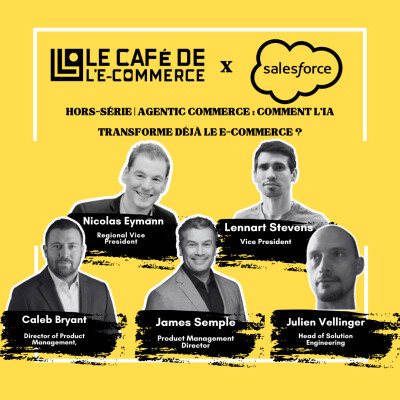
Hello à toutes et à tous et bienvenue ! Vous écoutez le Café de l'e-commerce, c'est la saison 7 et vous êtes dans un épisode hors-série. Je suis Laetitia et je suis sa compagnie d'Adrien.
- Speaker #1
Bonjour Laetitia, bonjour tout le monde. Ravi de faire cet épisode hors-série, ça faisait quelques mois je crois qu'on n'avait pas fait l'épisode hors-série. Et justement Laetitia, vous l'avez vu dans le titre du podcast, de l'épisode, de quoi va-t-on parler dans cet épisode spécial ?
- Speaker #0
Depuis deux ans, on parle énormément d'intelligence artificielle dans le retail et dans le commerce en général. Mais aujourd'hui, nous ne parlons plus simplement de génération de contenu, de recommandations ou de chatbots. Nous parlons d'agents capables de comprendre une intention, d'exécuter des actions et d'intervenir directement dans le parcours d'achat comme dans les opérations des équipes.
- Speaker #1
Et pour comprendre ce qui est réellement en train de changer, on a eu la chance d'aller rencontrer 5 experts. expertes de Salesforce avec cinq points de vue différents. On va parler du marché français, des attentes des marques, des nouveaux storefronts, de la data, de merchandising, de recherche conversationnelle, de productivité des équipes et bien sûr des impacts business.
- Speaker #0
L'objectif de cet épisode hors série n'est donc pas de vous vendre un futur hypothétique. Nous allons essayer de comprendre ce qui existe déjà, ce que les entreprises peuvent réellement tester aujourd'hui et surtout par où elles doivent commencer.
- Speaker #1
Et justement, par où commencer ? Nous, on va commencer avec Nicolas qui dirige l'activité de commerce cloud de Salesforce en France. Et il se trouve en plus que Nicolas est un auditeur depuis de longues années dans le podcast du Média, le Café de l'e-commerce. Et on va l'écouter dans une seconde et son point de départ, il est intéressant. Le véritable sujet, ce n'est plus de savoir si le commerce agentique va arriver, mais de savoir à quel rythme les entreprises doivent avancer. Bonjour Nicolas.
- Speaker #2
Bonjour Adrien.
- Speaker #1
Au-delà du fait que tu as le plus beau prénom du monde, qui est le prénom de mon fils, il faut que je le rappelle à chaque fois. Nicolas, est-ce que tu peux te présenter ? Qu'est-ce que tu fais chez Salesforce ?
- Speaker #2
Bonjour à tous, Nicolas. Moi, je suis en charge de l'équipe agent de force commerce, donc Commerce Cloud sur la France et chez Salesforce depuis bientôt huit ans.
- Speaker #1
Et puis, tu es auditeur du podcast Le Café de l'e-commerce. On se connaît, on se suit depuis quelques années. Toi, tu as un avis un peu particulier sur tous ces buzzwords, IA, gentil, etc. par rapport à ce qui est en train de se passer sur le marché, n'est-ce pas ?
- Speaker #2
Alors c'est particulier, c'est plus que des buzzwords, là c'est une réalité, c'est concret. Par contre j'essaie un peu de m'en détacher, je t'écoute, je sais aussi que les buzzwords, il y a un peu les marronniers.
- Speaker #1
On est pas là-dessus.
- Speaker #2
Mais moi, tout ça, ça m'inspire un autre mot qui est le mot tempo ou rythme. Finalement quand on prend un petit peu de recul sur l'évolution du e-commerce, Il y a 25 ans, c'était est-ce qu'il faut que je fasse du e-commerce ? Ensuite, il y a eu une autre disruption technologique, le mobile. Comment est-ce que je fais du mobile e-commerce ? Ensuite, on a eu quelques années plus tard les marketplaces. Comment je fais le social commerce ? Comment je fais ? Mais on était sur un temps plutôt long. Les disruptions technologiques arrivaient. Et là, effectivement, on a un tempo, on a un rythme qui s'accélère et qui s'accélère à un rythme étourdissant. parfois même un peu effrayant. Et ce que je perçois dans les nombreux contacts qu'on peut avoir en France, c'est effectivement, on ne sait pas comment réagir face à cette accélération du tempo. Et moi, je suis plutôt du genre à me dire, restons concrets, restons pragmatiques. Une disruption technologique, ça arrive tous les jours. Le décideur final, c'est le consommateur et c'est le consommateur qui va l'adopter et qui va changer son comportement. Et la première réponse, c'est que concernant l'argentique commerce, ça y est, c'est fait. Les comportements sont adoptés. On fait tous des recherches pour demander des comparaisons de produits, des recommandations sur les LLM. On a envie de discuter avec les agents. Les chiffres montent. on a annoncé un chiffre il n'y a pas longtemps, on a quasiment 20% des ventes mondiales qui sont impactées ou assisté de près ou de loin par des IA. C'est des milliards de dollars. Donc finalement, il ne faut plus se poser la question. Le comportement du consommateur, il est là. Le consommateur, il a choisi. Et l'agent de commerce, il est bon. Nos clients se posent la question d'être dans le bon rythme finalement. Soit je suis trop en avance et finalement, je vais cramer du budget sur des choses qui ne vont pas être utilisées par mes consommateurs. Soit je suis en retard et finalement, j'aurais perdu des parts de marché. Et donc... L'idée aujourd'hui, et ce que j'aime bien, c'est qu'on ait... On ne met pas nos clients face à une décision compliquée, irréversible ou qui coûte de l'argent. C'est-à-dire que finalement, aujourd'hui, on a les technologies pour tester, poker. On a le droit à l'erreur, on a le droit de se tromper. Personne ne sait où ça va aller, la gentille commerce. On sait que maintenant, le commerce assisté, c'est dans les usages. Est-ce que demain, nos clients vont arrêter de vendre à des personnes physiques, mais vont vendre à des agents ? on aura tous un agent qui va faire les courses à notre place, on peut imaginer plein de choses plus ou moins dystopiques, mais par contre l'idée c'est de surtout ne pas fermer des portes aujourd'hui, d'être rationnel, de se donner le droit à l'erreur, et la bonne nouvelle c'est que les technologies aujourd'hui, le vibe coding, cloud, les approches très ouvertes de Salesforce, nous autorisent et autorisent nos clients à faire des tests, à se tromper à changer de trajectoire. Et ça, je trouve que c'est génial. Parce qu'en fait, on ne met plus nos clients face à une décision qui va impacter le P&L des prochains semestres, des prochaines années. Là, ça va beaucoup plus rapidement. Donc ce tempo, c'est à la fois effrayant, mais c'est aussi une bonne nouvelle parce que ce tempo, en tout cas chez Salesforce, on met à disposition de nos clients, les capacités de le tester en cohérence avec leur business. Et ce que j'aime bien aussi, c'est que ces tests peuvent être très facilement mesurables. Est-ce que j'ai un taux de conversion qui est meilleur ? Est-ce que vraiment j'ai baissé mon TCO ? Est-ce que vraiment j'ai pu avoir un time to market qui est plus rapide ? Et ça, chez Salesforce, on aime bien quand il y a des vrais impacts business sur des disruptions technologiques.
- Speaker #1
Justement, j'aimerais bien rebondir sur ce que tu viens de dire à la fin, sur le ROI. Parce que tu peux tester, tu peux poker dans tous les sens. C'est quand même dur, parfois, slash souvent, de mesurer le ROI. Là où je te rejoins, c'est que je l'ai vu ces dernières années, Salesforce qui s'est beaucoup plus ouvert à l'écosystème, qui était déjà très, très ouvert. Une des forces de Salesforce, c'était l'écosystème, mais encore plus dans le cadre de l'intégration technique, de la data, etc. Et deuxième chose... la capacité à tester de manière beaucoup plus simple, sans entrer dans des projets qui peuvent être longs ou complexes. Le ROI, comment tu le vois ? La discussion que tu as avec tes clients, elle se fait comment ?
- Speaker #2
Déjà, le ROI, c'est vraiment... On retrouve dans le e-commerce des discussions qu'on avait peut-être pu perdre ces quelques dernières années où il y avait des discussions headless, pas headless. C'était des choses où finalement, on était plus sur des approches un peu technologiques. Là, ce que j'aime beaucoup, c'est qu'on est sur des approches très business. Et là, finalement, le ROI, c'est finalement comment est-ce que je vais vous aider à avoir un meilleur taux de conversion. C'est un vrai sujet. Et là, le taux de conversion, il n'y a rien de plus facile à mesurer. Finalement, je mets à disposition mon agent, je mets à disposition mes innovations technologiques. Et finalement, quelques jours après, je peux voir quel impact j'ai eu. La capacité, la rapidité à mettre sur le marché une innovation, pareil. Le vibe coding, Claude, tout ça et ses approches ouvertes de Salesforce aujourd'hui permettent une accélération. Et je peux voir très, très vite si je suis en capacité de tenir ce rythme. Et puis ensuite, on le voit, les coûts, on est sur des magnitudes beaucoup plus mesurées. Et finalement, je trouve ça très sain qu'en fait, on mette le ROI au centre de cette... de cette disruption argentique parce qu'il y a quelque chose de très rationnel. Dans cet irrationnel, on entend parler des LLM, des valorisations de plusieurs milliards. Non, non. Nos clients sont là pour faire du business. Nos clients sont là pour s'adapter aux nouveaux usages et aux nouveaux comportements de leurs clients. Client avec un S et un client-client multiple. Et donc la bonne nouvelle, c'est qu'aujourd'hui, la techno le permet. Et l'approche de Salesforce, finalement, c'est la même qu'on fait depuis 25 ans. C'est-à-dire qu'on aide nos clients à se rapprocher de nos clients. en leur offrant une plateforme technologique la plus robuste, la plus sécurisée et qui intègre les dernières innovations pour que chacun, à son rythme, puisse les mettre en cohérence avec son contexte et ses objectifs business.
- Speaker #1
C'est toi qui vois passer la grande majorité des projets de commerce il y a en France, chez Salesforce. Tu es vraiment au cœur du réacteur là-dessus. C'est quoi, tu dirais, les plus grands freins que tu observes dans l'adoption ? du commerce argentique parce que tout le monde n'y va pas encore on est encore sur quelque chose où on se regarde et on parlait de ROI il y a deux secondes parfois on est en recherche du ROI tu vois un peu des
- Speaker #2
soit de la maturité ou en tout cas des choses qui te disent ceux-là ils ne sont pas prêts il y a forcément un frein qui est le premier c'est le par où je commence il y a toujours cette notion de rythme cet emballement où finalement ce faux mot je ne sais pas si je vais aller trop vite ou si je ne suis pas assez vite mais finalement ça se gère assez facilement le deuxième frein qui peut arriver très vite c'est la notion de budget et cette maîtrise des tokens on en a parlé, les lames ça maîtrise des choses La maîtrise de ce nouveau business model qu'impose l'agent TIC Commerce et puis ses conversations et dans l'approche de Salesforce, on s'est aussi adapté à ces nouveaux usages et on a aussi un nouveau business model. Donc nous, on a un travail de réassurance sur la capacité à donner à nos clients à maîtriser ce budget. On leur donne des tableaux de bord, on a un digital wallet pour qu'ils puissent... Vraiment embrasser cette disruption technologique en étant en contrôle et en maîtrise de leur budget et des KPIs qu'ils en retirent. Donc vraiment une approche très business case.
- Speaker #1
Nicolas, tu me disais tout à l'heure en off que c'est des choses qu'on ne voit pas chez Salesforce dans l'organisation. Depuis 24-18 mois, il y a eu une vraie transformation très profonde. Alors pour les clients sur la tech, il y a des choses, mais surtout en interne, vous avez vraiment eu des bouleversements ces dernières années. et particulièrement depuis deux ans, c'est ça ?
- Speaker #2
Oui, depuis deux ans, ce qui se passe est assez incroyable. D'abord, pour CommerceLod, pour un joint de force commerce, il y a eu un réinvestissement massif sur la roadmap. Tout ça couplé avec ce que permet l'IA aujourd'hui. Finalement, ça nous permet de proposer aujourd'hui une roadmap qui est la plus ambitieuse depuis ces cinq dernières années. Et je le dis avec beaucoup d'humilité, mais elle est vraiment disruptive. mes petits camarades, on en parlait à un store Frontnext, les agents back office, front office, on retravaille le search, on est sur le conversationnel, il se passe vraiment des choses incroyables, et en fait, on capitalise aussi sur l'investissement plus global de Salesforce sur l'agent TK, depuis ces 18 et 24 mois, et finalement, on voit que tout se rejoint, et que... finalement, on capitalise sur des investissements globaux qui se retrouvent dans la partie e-commerce. Et tout ça a une cohérence et un sens parce qu'en fait, on est juste là pour aider nos clients à faire du business et à mieux servir leurs clients. Et je trouve que ça, c'est la magie de Salesforce. C'est de garder dans cette folie d'innovation, de disruption technologique. Ce cap, ce phare dans la nuit qui est qu'il faut qu'on serve nos clients avec une plateforme robuste, sécurisée, innovante, en apportant tout ce que l'IA peut apporter aujourd'hui, c'est-à-dire de la rapidité, de la simplicité, aller plus pour moins cher et avec toujours la capacité de s'adapter et de personnaliser un maximum d'interactions.
- Speaker #1
Nicolas ? c'est quoi le conseil que tu donnerais s'il y avait un conseil que tu donnerais à une enseigne qui veut se lancer, qui n'ose pas trop encore se lancer sur l'agentique ?
- Speaker #2
Le conseil c'est d'abord il faut se lancer il ne faut pas avoir peur, aujourd'hui on a le droit de se tromper on est en capacité de faire des tests, on est en capacité de très vite corriger, adapter améliorer On est dans une période qui permet une agilité comme jamais elle a permis. Donc j'ai un seul conseil, c'est de dire ne pas avoir peur, ne pas avoir peur de faire des choix en absence de visibilité sur ce que sera le commerce ou l'argentique commerce dans les mois et les années à venir. Ce n'est pas très grave. L'important, c'est de s'adosser aux bons partenaires technologiques. et de se lancer parce que c'est la meilleure façon de se lancer, tout en restant en cohérence avec l'ADN de la marque et la façon dont la marque veut communiquer.
- Speaker #1
Nicolas, c'est ce qu'on voit tous les jours. L'inaction, surtout dans un truc qui va très vite, c'est la pire des décisions. C'est pire que de se dire, je vais faire un choix, mais dans six mois, ça sera peut-être plus valide. Au moins, tu testes, tu apprends. Et il y a beaucoup de chaines, ce n'est pas que technologique, mais c'est en interne, sur les people, les connaissances, les formations, etc. Donc, c'est hyper important.
- Speaker #2
Oui, c'est clair. Et puis, de toute façon, on vit tous la même disruption. Donc, on ne peut pas ne pas se lancer. Merci beaucoup, Nicolas. Merci à toi.
- Speaker #0
Alors, si on a bien écouté Nicolas, eh bien, ce qu'il nous dit, c'est que les usages commencent déjà à évoluer. Les consommateurs utilisent les IA pour rechercher, comparer et sélectionner des produits, peut-être un jour complètement déléguer l'acte d'achat. Les marques doivent donc avancer, mais sans céder à la panique, sans multiplier les expérimentations inutiles et sans perdre de vue le retour sur investissement.
- Speaker #1
Oui, complètement. Et finalement, il pose la question centrale de cet épisode, c'est comment avancer assez vite pour ne pas se faire dépasser, ne pas avoir ce faux mot et sans aller tellement vite non plus qu'on brûle le budget des usages qui ne sont pas encore mûrs. Mais une fois qu'on a posé cette question, il faut regarder qu'est-ce que ça veut dire concrètement.
- Speaker #0
Et c'est là qu'intervient Julien. Son travail consiste précisément à montrer aux marques ce que ces technologies permettent déjà de faire. Alors avec Julien... nous allons parler de démonstration, la fameuse démo, de storefront, de vibe coding, de personnalisation et de l'accélération très concrète des projets e-commerce.
- Speaker #1
Et je suis avec Julien. Bonjour Julien.
- Speaker #3
Hello, hello. Adrien, comment vas-tu ?
- Speaker #1
Très, très bien. Ravi de te voir ici. Long time no see. Exactement. Et c'est pour ceux qui ont la ref, on a eu la chance de bosser ensemble il y a quelques années. Julien, est-ce que tu peux te présenter justement qui tu es et qu'est-ce que tu fais chez Salesforce ?
- Speaker #3
Rapidement, je suis chez Salesforce depuis une dizaine d'années et j'officie en tant que solution engineer, c'est-à-dire nous sommes les technico-commerciaux qui accompagnent la force sales chez Salesforce sur les aspects technico-fonctionnels. et j'ai la chance depuis maintenant 5 ans d'animer l'équipe. Je suis le leader de l'équipe commerce ainsi que l'équipe... revenus cloud qui sont des solutions qui ont tendance à se rapprocher sur l'aspect B2B notamment.
- Speaker #1
Tu fais beaucoup de choses Julien mais une des choses que tu fais toi et via ton équipe également ce sont les démonstrations de la plateforme Salesforce et particulièrement de tous les aspects agentiques, on est d'accord ? Tu parles avec tous les prospects et les clients et tu leur montres ce que vous faites et comment ça pourrait répondre à leurs besoins.
- Speaker #3
Exactement, on est vraiment les mains dedans l'équipe avant-vente l'équipe solution engineer et il y a... complètement en prise avec la technologie et avec la révolution agentique. Et effectivement, il y a beaucoup de nouveaux cas d'usage qui se présentent et il y a une véritable métamorphose de ce domaine technologique via l'intelligence artificielle et via l'intelligence artificielle, notamment générative.
- Speaker #1
Alors, on va parler justement du marché et ce que fait Salesforce. Mais avant de parler de Salesforce, sur le marché... Tous les jours, tu rencontres des marques, des enseignes, B2C, B2B, dans tous les sens. C'est quoi un peu ce que tu vois, la trajectoire que tu vois, on va dire, des 18 derniers mois ? Les grosses tendances, c'est quoi ?
- Speaker #3
Alors, il y a une tendance à demander plus de personnalisation. Il y a une tendance aussi à resserrer un petit peu les rangs et à resserrer les budgets. Donc, on a un besoin de productivité qui est vraiment accru. Et il y a aussi un peu une peur de la désintermédiation via les IA, une peur de rater le coche sur l'IA. Ça, c'est ce qu'on voit un petit peu chez les retailers.
- Speaker #1
Donc, il y a ce faux mot avec l'idée de « on ne sait pas ce qui va se passer demain, mais montrez-moi ce que vous faites » . J'ai l'impression, dis-moi si je me trompe, mais cette force est leader sur le sujet. Ils s'attendent à ce que tu leur dises dans quelle direction il faut aller, non ? Il y a un peu ça ?
- Speaker #3
Exactement, il y a exactement ça. Et c'est un peu la proposition de valeur de Salesforce, c'est que personne ne sait en gros où ça va, mais en tout cas, on adresse toutes les directions de manière optimale. On a des réponses à toutes les questions. C'est ça qu'il faut bien comprendre.
- Speaker #1
Pour les e-commerçants, c'est quoi les 2-3 use cases que tu vois le plus ? C'est du chatbot et du service client ? J'en sais rien, ou c'est des choses un peu plus avancées peut-être ?
- Speaker #3
C'est en fonction de la maturité des retailers. Ça change un petit peu, mais ce qu'on voit, en tout cas, ce qui résonne, c'est avant toute chose, il y a trois, quatre grands domaines sur lesquels ils ont des attentes. Les premières attentes, c'est comment l'IA va pouvoir accélérer, changer la donne sur le time to value en termes de front-end. Aujourd'hui, il y a une attente avec tout ce qui est vibe coding. que la génération de contenu et grosso modo les opérations sur le front-end soient accélérées de manière significative par l'IA. Donc ça c'est une première chose. Ensuite il y a une attente sur l'intelligence, c'est-à-dire qu'on attend que l'IA amène de la conversion, amène de la pertinence sur le front-end mais aussi dans ses rapports avec les LLM. Il y a une attente sur la recommandation des produits, sur la personnalisation des parcours, qui est très importante. Il y a aussi une attente d'accélération des opérations dans le back-office. Aujourd'hui, il y a une vraie attente d'accompagner par l'IA les merchandisers au sein des back-office commerce, voire même pour certains, aller jusqu'à une opération qui soit totalement... totalement gérée depuis les applications d'Elarge Your Language Model.
- Speaker #1
Alors justement, tu parles de Salesforce qui a une vision complète. Quand tu fais des démonstrations des solutions Salesforce, c'est quoi les deux, trois trucs où tu sens que ça impressionne, il y a le wow effect ? Il y a des choses comme ça quand tu les présentes, ça a son effet ?
- Speaker #3
Alors indiscutablement, Salesforce Commerce a sorti un nouveau framework de front-end. qui s'appelle Storefront Next, qui est entièrement en React, donc qui utilise toutes les dernières technologies, toutes les dernières versions des librairies de React, et qui a été pensée... pour lire. Donc il a été pensé pour être recherchable par les LLM, pour être crawlable facilement par les LLM avec tous les tags qui sont attendus. Et surtout il a été créé pour être vibecodé en fait. Aujourd'hui c'est probablement la solution la plus, enfin la solution front-end la plus vibecodable sur l'e-commerce du marché.
- Speaker #1
Es-tu le vibecode dans Salesforce ou dans Cloud, GPT,
- Speaker #3
etc ? On peut utiliser tout les id, tous les CI du marché, Cursor, Cloud. Nous côté solution engineering, on utilise beaucoup Cloud, Cloud Code, mais en fait c'est très agnostique. On a des dizaines de skills qui ont été publiés justement pour Vipoder et là où on génère du wow effect, c'est quand on arrive avec avec des sites de démo qui reprennent au pixel près le site du client. mais avec une expérience totalement agentisée qui se personnalise à la volée en fonction du parcours. Et ça, les clients s'en voient quand on démontre ça.
- Speaker #1
Et du coup, il n'a pas l'impression de se dire non, le projet n'est pas duré six mois, il va durer six jours parce que j'ai presque déjà tout. Et il y a une perception que tout est déjà presque prêt.
- Speaker #3
Ça masque le back-office sur toutes les intégrations. Exactement. Alors, on apporte aussi des nouveautés sur les intégrations back-office puisqu'on a un On apporte une technologie en mode app préintégrée. On va beaucoup plus loin que la technologie cartridge qu'on avait, qui était une préintégration. Là, on arrive sur des intégrations quasiment en click and drop sur le back office. Mais bon, là, ce n'est pas la question. Là, on est vraiment sur le front end. Oui, on prévoit une accélération drastique des projets. Après, il ne faut pas oublier que ce n'est pas parce qu'on crée un site de démo On le crée sur une locale, on le crée avec des use cases précis en tête. Après, effectivement, il y a beaucoup d'autres choses à voir. Mais le vibe coding est une vraie révolution de ce côté-là. Et je répète, on a probablement la solution front-end la plus vibe codable du marché à l'heure actuelle.
- Speaker #1
Julien, on a beaucoup parlé d'expérience client, de front, et c'est hyper important. C'est un impact direct sur la conversion. Est-ce qu'il y a d'autres endroits où l'IA, l'agentique, peut aider également ?
- Speaker #3
Oui, en réalité, il y a trop de domaines pour en parler. On est un petit peu contraints par le temps. Mais oui, dans le back-office, l'accompagnement des utilisateurs en langage naturel, passer de manipulations qui prenaient des dizaines de clics à quelques mots en langage naturel, et tout cela, que ce soit dans les opérations e-commerce, mais aussi dans tout ce qui est OMS, et notamment... La capacité de créer à la volée des règles de routing, de commandes, lorsqu'on a un souci. Quelque chose qui pouvait prendre plusieurs minutes à des opérateurs logistiques. Aujourd'hui, on a un problème dans un entrepôt, on a une collection qui a été dégradée. Eh bien, les opérations peuvent, en quelques mots, changer des règles de routing et détourner des stocks depuis des magasins ou un autre entrepôt. Donc ça, c'est aussi assez magique. ça se voit pas, mais... Ça fait partie de tout ce qu'on peut améliorer dans le quotidien des opérations.
- Speaker #1
C'est ce qui fait toute la différence. L'adoption et tu as rattrapé également peut-être les erreurs humaines, etc. C'est tous ces trucs où il y a à redresser les choses ou faciliter l'engagement avec toutes les interfaces qui ne sont pas sexy, qui sont compliquées, tu es toujours en train de courir, etc. Donc, l'impact est monstrueux là-dessus, on est d'accord. Merci beaucoup, Julien. J'aurais dit merci beaucoup à Jean-Julien presque. Avec Julien, on commence à voir que le commerce agentique, C'est pas... uniquement une nouvelle interface visible par le consommateur. Ça transforme aussi la manière dont on construit un site, dont on construit une expérience client et dont les équipes internes interviennent dans le back-office.
- Speaker #0
Et ces opérations qui auparavant nécessitaient des dizaines de clics, aujourd'hui, progressivement, elles peuvent être pilotées en langage naturel. La promesse est importante, des projets plus rapides, des équipes plus autonomes et une expérience capable de s'adapter beaucoup plus facilement au compte. contexte du client.
- Speaker #1
Du coup, il y a une autre question qu'on peut se poser. Si demain, le parcours commence dans ChatGPT, Google, etc., ou dans une messagerie, est-ce que le site e-commerce reste encore le centre de l'expérience ?
- Speaker #0
Et c'est justement l'un des sujets que nous avons abordé avec Leonard Stevens, qui est VP, vice-président P2C Commerce, chez Salesforce. Avec lui, nous avons parlé, en anglais, de commerces connectés, de nouveaux canaux, de contrôle de la marque, et de la place du storefront dans ce nouvel épisode.
- Speaker #4
Je suis très heureuse d'être ici à Paris avec toi. Comment vas-tu, Linette ?
- Speaker #5
Je vais bien. Tu vas bien ? Oui, c'est toujours magnifique d'être à Paris. C'est une ville si belle. Et merci de m'avoir mis sur ton podcast.
- Speaker #4
Merci de m'avoir mis ici dans ta maison. Linette, peux-tu me dire plus de toi ? Qui es-tu ? Qu'est-ce que tu fais à Salesforce ? Et quel est ton passion pour le commerce et le commerce d'agence ?
- Speaker #5
Oui, absolument. À Salesforce, je suis le vice-président du commerce B2C. J'ai une longue histoire dans le commerce, 18 ans ou plus dans le côté partenaire de l'agence. J'ai passé la plupart de ma carrière devant les clients, devant les marques, pour les aider à résoudre de vrais problèmes. J'ai eu l'occasion de rejoindre Salesforce et de prendre des réponses sur le problème de résolution avec les clients directement dans le produit. J'ai eu l'occasion de travailler avec les marques et de voir qu'ils ont pu résoudre leurs problèmes de business grâce à la technologie.
- Speaker #4
Donc vous aidez toujours les marques et les marchands ?
- Speaker #5
Très bien, je les parle quotidiennement, aussi que je parle au produit et aux équipes techniques.
- Speaker #4
Salesforce a introduit des mouvements importants sur le commerce et l'expérience de connexion. D'une perspective de votre point de vue, en tant que personne qui construit ce travail quotidien, quels problèmes êtes-vous pratiquement en train de résoudre pour les marques actuellement ?
- Speaker #5
Oui, c'est une bonne question. Je pense que le problème principal est de aider nos marques à entrer dans le futur très rapidement, à avoir un chemin facile dans le futur. Et un autre point d'interrogation est vraiment comment on augmente le temps de valeur et la tâche de tâche. Nous voulons réduire le coût total de l'entreprise, la difficulté de gérer une plateforme d'e-commerce et permettre à nos marques de se concentrer sur certains de ces différenciateurs. Nous sommes dans un monde d'agentique commerce. Les choses se passent si vite. Nous devons permettre à nos clients de se mettre sur une plateforme qui peut les amener et faire ça efficacement.
- Speaker #4
Salesforce a souvent parlé beaucoup de commerce connecté. Quelle est votre définition de commerce connecté ?
- Speaker #5
Je pense que ce terme est utilisé de nombreuses façons. Je veux dire, pour moi, c'est en train de se connecter avec le client où ils sont. Vous pouvez le voir comme une définition technique de dire que nous connectons différents systèmes derrière les scénarios, mais c'est vraiment en train de se connecter avec notre client. Que ce soit en se connectant avec eux par un voyage qui commence dans leur inbox ou par un voyage qui commence dans la boutique ou un voyage qui commence en ligne ou maintenant par les canaux agentiques. C'est à dire trouver une façon de se connecter avec leur client. Et nous faisons cela en prenant notre technologie et en la mettant plus près ensemble et en la faisant se connecter.
- Speaker #4
Alors comment vous vous connectez avec les gens et avec les marques par l'AI ?
- Speaker #0
Yeah. I mean, there's, there's, you know, it's an evolving space that's happening so quickly. You know, one of the things that we've, we really invested in is, is doing syndicated commerce feeds for, um, like Google UCP, open AI, as well as making our storefront, uh, easily accessible through agentic LLM crawlers. You know, we, it, it kind of reminds me of like 15 years ago when, uh, when the market was looking at marketplace selling and we were like, where are the customer going to be? Right. And brands were a little bit scared by it. And... How is it going to impact them?
- Speaker #1
I remember that time too.
- Speaker #0
Exactly. And it's another one of those. It's another channel. So, you know, we're making sure that we're there where those channels are going as those channels evolve.
- Speaker #1
A lot of brands and merchants are talking about agentic AI, but they are also a bit stressed, nervous about losing control in their misconception of AI and agentic commerce. How do you reassure them that agent won't actually create? the chaos or any chaotic situation or off-brand experiences.
- Speaker #0
Yeah.
- Speaker #1
That's the worst scenario, but I'm telling you that's...
- Speaker #0
Yeah. You know, there's a lot of apprehension to stuff that's new. Like we were talking about earlier with the marketplaces and people felt like they were maybe losing some control of their brand. And we found out that's not necessarily always true. And in many cases, you know, because with Salesforce, you have the entire commerce experience within your control. You've got the e-commerce experience, you have the search. You have the agentic shopper capabilities. So you have the control over all the data that you are presenting to an agentic experience. So if it were like a third party involved and it's maybe making choices around what's being shown, you know, you don't know what you're necessarily going to get by working within the Salesforce platform entirely. You can control that from the way you set up the products to the way you make these experiences available to your customer. So it's not taking away from the merchant's brand experience. It's really enhancing it with... all of the information that you've set up within your Salesforce ecosystem.
- Speaker #1
You spoke earlier about data. I want to ask you one question about data. Data is the foundation of commerce, personalization, inventory, pricing. How does an agent stay grounded in real trusted data rather than drifting?
- Speaker #0
Yeah, that's right. It's all about data. Everybody knows that. When you're dealing with an LLM, the more context you can provide, the better results you get. And really one of the ways we do that, again, is because you're working within the platform, you have access to data cloud, you get that 360 view of a customer that is truly your customer. You know, you understand their orders, you understand which products they were looking at, what they placed, you know, what they were looking for previously. And you can use that all to help build out what that customer's experience is really for them because you have that 360 view. And that's really, really key to it. It's hard to understand the customer. without having access to all of the data that's necessary to make those decisions.
- Speaker #1
One of the biggest conversations also in Chicago at Connection was around the future of storefronts. So first, my question is, what is the future of storefronts according to you?
- Speaker #0
I think the future of storefront is very important. You know, there's the question of what does a storefront mean? And I think it means even more than it probably did before. But it has to be... has to be stood up in a much more dynamic way that's flexible, extendable. One of the things that we've been talking a lot on, of course, is our storefront next that we've been developing. And it's now in the marketplace. And we're seeing a lot of feedback and results from our customers that are going live with it around how quickly they can roll out experiences, change those experiences, connect with content in ways that are being driven by this agentic world where we have to move really quickly. So that's the real value, I think, behind a store fund is it's still the grounding and connecting place to your customers. And it's still your place to represent your brand. You're just now reaching out to customers through different channels, right? Whether it's them doing their own exploration through one of the LLM search or chat GPT, but you're still bringing those customers back to you and having that control of that in-house experience and being able to quickly change that and make updates is, I think, even more critical than it was before.
- Speaker #1
Lina, that's a very personal question, but also professional. What is your best experience in this agentic world in commerce? Do you have one with one brand in particular in mind?
- Speaker #0
Oh, with a particular brand? I think just seeing customers realize how quickly they can react now for the first time. is it is it's just just awesome to see you know just earlier a couple hours ago i had a you know meeting with a you know very large customer as well and they had got a chance to to try to play with some of the new technology on their own i didn't even realize that they had started doing that and they were just surprised by how quickly they can move you know in in a in a world where It's not just a race towards velocity, but it's a race towards meeting customers where they need to have been met for some time. And so now being able to do that and do that at an individual segment level and do that so much more quickly, it's just cool to see how excited they are about what they can unlock.
- Speaker #1
Yeah, that's the wow effect. Because when you understand that your brands, there are no more skeptical about agenting, but say, yeah, that's it.
- Speaker #0
That's exactly right. And I, you know, it's... All the skepticism fades away when they start unlocking these capabilities and see it come to light right before their eyes.
- Speaker #1
Linard, can you tell us more about Connection? I mean, the kind of brands, the kind of topics and all the exciting topics that you talked.
- Speaker #0
For sure. Connections is always an exciting place. You know, you're getting to connect with brands in the midst of their journey. You know, fortunately, this year we got to announce some new things. We got to talk. to some of the brands and talk with them on stage about the journey they've been having with, uh, with our, with our products and with the new storefront, uh, and just seeing the excitement all come to light as everybody gets into one place and shares ideas. It's, it's, um, you know, it's one of these forums where no one feels like they're competing. They're really just sharing what's working, what isn't working and, and how they can improve and how we can help them on that journey. So, um, you know, it's always an exciting time. If you haven't had a chance to experience it, you know, you should go.
- Speaker #1
So, Leonard, thank you very much for everything. And if the audience wants to know more about you or maybe to reach to you directly, what's the best option?
- Speaker #0
Yeah, first of all, thank you for taking the time to chat with me. And you can always find me on LinkedIn. You've got my name, Leonard Stevens. Look me up. Send me a message. I'm happy to talk. I'm very, you know, very enthused about this particular space. And, you know, reach out. We'll have a conversation. I'll show you what's working on. I, I, I emphasize transparency. So it's all about sharing what I think is coming and listening to where you think things are going.
- Speaker #1
Thank you, Lénart.
- Speaker #0
Thank you.
- Speaker #2
So Lénart reminds us of an essential point in his speech, which is that ancient commerce does not necessarily mean that brands will lose control of their customer relations. On the other hand, they will have to be present on more contact points, these famous touchpoints, and give their data, their products and the entire experience accessible to new customers.
- Speaker #3
It's rather positive because the storefront doesn't disappear. It becomes a point of anchorage for the brand while the discovery and the conversation are moving and starting elsewhere. But for it to work, all this, the agents need to have access to reliable, complete and really exploitable data.
- Speaker #2
And it's often there that the difficulties begin. Incomplete product data, isolated system, responsibility shared between several teams and the accumulation of punctual solutions. Léa, ici. it quickly reveals the weaknesses of the organization.
- Speaker #3
It's exactly what we talked about with James, our next guest. How to prepare your data, how to make your teams evolve, what are the gains, you were talking about ROI, what are the gains we can hope for, and what are the first use cases we can generate?
- Speaker #1
We are now recording this just after Connections Chicago. And we are here in Paris. Honestly, one to pick was everywhere in Chicago. agents in commerce, not just AI assistants, not just chatbots, but autonomous agents becoming part of the buying journey, the customer experience, and even storefront separation. And today I'm sitting here with James at Salesforce Paris to dig into what this actually means for commerce teams in practice. Hi, James.
- Speaker #4
Hi, great to be here.
- Speaker #1
I'm very happy to be here because you're from London and you are here in Paris and you were in Chicago. You're a big traveler.
- Speaker #4
Yeah, I'm a huge traveler, unfortunately. My brother says I fly more than birds do.
- Speaker #1
And I'm very happy that today you are a bird here with me. So James, you're not a bird, actually. You're working here at Salesforce. What's your job? What is your background? And what do you do here today?
- Speaker #4
Yeah, no, that's a great question. Thanks. I'm a product management director here at Salesforce. I'm part of the go-to-market team. So I don't know. The way I describe it is obviously part of product, but much more the part of product that works with the customers, the partners and our internal sales teams to help really understand what the product is doing and to help get things like messaging. So we also work closely with product marketing. market fit, and also get feedback from the customers. I don't have a team of people building things for me. I'm not that part of product. I came across as part of an acquisition of Mobify, a company building front end specifically for mobile originally, and then kind of front end as a service approach. And their technology became Salesforce's composable storefront. So that was about five and a half years ago I came in. While I was at Mobify, by complete chance, I ended up being one of the five people at the table when the Mac Alliance was first mooted, brought Mobify into the Mac Alliance. So a lot of my role at Salesforce has been very much around the composable space.
- Speaker #1
Okay. So you evolved in the industry, in the e-commerce industry forever. We can say that.
- Speaker #4
Something like that. Yeah. Way too long.
- Speaker #1
Way too long. So you see the evolution and the revolution of AI.
- Speaker #4
Yeah, absolutely. Very much so. Yeah, yeah. This is a huge game changer right now. What's happening with AI. Incredible. Yeah.
- Speaker #1
So when you woke up in the morning and you realized that you were in an agency world, what is your reaction? You say, wow, this is it.
- Speaker #4
Yeah. Okay. That's a really great question. I like the way you... You're phrasing that. Yeah, absolutely. I think what I love about what we're doing at Salesforce is, you know what technology is like. Sometimes it's a solution in search of a problem. And I think we've all probably seen quite a few examples of that, even with AI, as good as it is, even with agents. I love the way that the stuff that we're doing at Salesforce is very, very practical. Okay. I don't want to kind of go off on a tangent, but if you think about the whole Headless 360 stuff we've been doing, if you think about training people to work consider website. I'm not sure I like the way that... your back office technology, the whole kind of management, merchandising stuff. I don't like that. Don't use it. Don't use it at all. Just go into Cloud, go into whatever your favorite tool is and just do all of that stuff by writing prompts. I mean, that is an incredible change, right? Absolutely change. Obviously changes things around in terms of like, oh, well, I don't have to train people on this and all of those kinds of value propositions. So there's a lot of that. One of my favorite uses of a GenTik at the moment is our internal Slackbot. which can basically summarize and do all of this kind of stuff. So, you know, you've interviewed Caleb, my colleague, he's like, James, this is how you do all your reporting from now on. And it just goes, you know, summarize the last couple of weeks, put it in this format, and it does all those kinds of things. So we can focus on the stuff that we love, the creative stuff, the inspiring things, connecting with people, and let Slackbot actually do all that work. And it's the same thing with all of the agentic stuff. And I think the merchandising side of it is quite quickly proving to be the low hanging fruit in terms of, you know, just immediate cash returns for... for retailers like that. So yeah, it's exciting. It's exciting right now.
- Speaker #1
James, here in this podcast, we talk a lot about vision, technology, but from an operational standpoint, what changes first inside an organization when it starts adopting a giant e-commerce?
- Speaker #4
Well, that's a huge question. Yeah. Okay. That's a huge question.
- Speaker #1
Maybe data? Would you say data? Yeah.
- Speaker #4
Yeah. Yeah. I mean, That's definitely where I was going to go. And okay. So one of the things I spend a lot of time, I get a lot of people with, you know, sort of anxiety FOMO, I guess, about what's happening with UCP and what's happening with all of these kind of genetic streams, you know, product streams for a genetic AI systems that, you know, external AI based shopping. And as you say, yeah, exactly. It's data. It's like first thing you have to have your product data strategy sorted out. Typically companies like, you know, Google, stuff like that are looking for quite a lot of. new attributes you typically wouldn't have on your product. So where are you allocating that? Are you doing that inside something like Salesforce? Are you doing that below Salesforce in a PIM already? Because you want to have those augmented product attributes exposed to other systems that may eventually get put into these UCP feeds. So for instance, UCP is literally becoming universal. We're already seeing this starting to power things like social, which is getting social shopping getting even bigger and bigger now. So just a data strategy around product is a really good starting point right there. And then, yeah, absolutely. Moving forward. Let's put it like this. Maybe one of the frustrations, and I totally understand why this happens. One of the frustrations when you're trying to come in and sort of put together really good value is too many people thinking in isolation, too many point solutions. And then they're like, oh, we tried this thing out and we were surprised it didn't do as much good. And it's like, well, of course it didn't. It doesn't know what's going on. It only knows this little tiny part of your world. And so, yeah, once people get connected, they get the data all in one place, then it's incredibly powerful, obviously. And that's when it can start to draw these... pull these things out for you. And we've seen tons and tons of huge, really, really valuable business cases as a result of that. But absolutely, it's the first place to start, I think.
- Speaker #1
Does agency commerce require brands to fundamentally rethink their teams and their workflow? I mean, their organization, infrastructure?
- Speaker #4
Well, I mean, absolutely. Infrastructure is an interesting point. Just even on internal teams, I feel yes, except it's not like, I don't think it's like... Okay, well, can we go back to something like the Mac Alliance and those kind of Mac architects? There's a lot of things where suddenly you're having to... bringing in a lot of infrastructure experts, bringing in a lot of technical guys. I'm not so sure it's going to be that. I just think that bit by bit, it's going to be a smooth, slow transition where it's like, oh, this thing that used to take me ages, now I can do really, really quickly. So just thinking of like agentic merchandising, just that ability to do something with a prompt rather than having to go through a bunch of clicks and stuff like that. So maybe I think what you're going to find is companies are able to do more with the same teams. I would... I would say that's the main thing I'm seeing. So I'm not sure I'm seeing from a merchandiser point of view, a big change, except that they're all much more powerful. They're all doing a lot more, much more productive. So from that point of view, and then, yeah, if you start to look at things like the data side of things, then it's breaking down silos. That's the big thing I think is going to have to happen. Just that sense of, yeah, just breaking down silos between departments. It's often not even a technical thing. It's just an organizational thing that's just been around forever. Yeah, but making sure the data is... you know, visible to all parts of the business is the big thing.
- Speaker #1
Visible, clean.
- Speaker #4
I'm not asking for miracles, but yes, yeah, we can start with that. I mean, okay, you actually hit on a really good point there, which is we've started to add things, started to add internal tools to allow you to do a lot more product readiness checks, specifically because you are now exposing that to external systems, right? And so again, just raising that higher level of like cleanliness of data and ensure, you know, this product doesn't have this, you know, it's a... This is missing from this product. This is missing from that product. So not allowing them to go into production until they're actually fully completed in that area. Clean data would be great.
- Speaker #1
Would be great. And you said it, that's a miracle in some kinds of organization. What are the first measurable business impacts that brands are actually seeing or facing? Yeah.
- Speaker #4
So, okay, let's go with the positive ones. So the first positive one, I think, is... It goes back to merchandiser productivity. You know, to just look at the sort of changes in the marketplace five years ago, sort of post-COVID or during COVID and just after, everything was flexibility, ability to differentiate, best in class. Now, generally, the top three things I hear from retailers as a priority are TCO and then two other items that are typically TCO in disguise. You know, just things that when you can boil down to it, it's still really TCO. And so... The most measurable benefit, I think, are either direct or indirect merchandiser productivity. So if you look at one of our customers announced that since putting on a service agent to deal with post-order fulfillment details, things like, where's my order? Very, very common request. Yeah, where is my order? Change my delivery address, change my contact details. And then possibility of even order cancellation using guardrails so it's not abused. I think this was something like a deflection of around 60% of the calls, incoming calls, right? So that immediately is a saving and productivity driver for the merchandising team, right? Because they're not getting distracted by dealing with these calls. Customers are getting those solved with an AI agent. So things like that. And then predictive, productive, agentic tooling inside the merchandising tools. Again, all of these things are just speeding up and empowering that. So that's one of the very, very quickest, easiest to define ROIs. Obviously, we're seeing benefits. It's still early days, but we're seeing some significant benefits on conversion rates with shopper agents because of things such as removing friction. And it can happen in a bunch of different ways. So for instance, high consideration items, it's really, really great for, right? Just think about things like buying complex electronics, like buying a sound system to go with your TV, things like that. You have to ask a whole bunch of questions. Does it fit with this? Does it work with this? Having that all just built into an onsite shopper agent is really, really powerful right And that can take away those doubts, things like that. So anything or people who are buying based on things other than just pricing, say, for instance, environmental concerns or a whole bunch of things like ethical concerns, stuff like that. You can actually put all that information into a shopper agent. So you can ask those things. And then simply just good product discovery, right? We've all changed the way we search. And so, you know, great product discovery is really, really important. We've all, you know, stopped. We've kind of moved away from a keyword based search to kind of more of a... conversational search style. So that's really, really powerful as well. So things like that, better product discovery, reducing friction during sale. Yeah, all of these things are really, really powerful and having impacts already.
- Speaker #1
James, you're from the UK. Yes. You're a British citizen. Yes. This is not a political podcast, but you have a perspective from a European, even if you are outside of the EU, but you are working closely with European brands. And you can see and you can tell us about the European apprehension, maybe, or misconception of agentic, or maybe the way they see AI compared to the US or maybe to other brands. How would you qualify the European brand's vision of AI?
- Speaker #4
I totally get your point that we're typically a bit more cautious, especially around things like data usage. So that's absolutely fair. And, you know, I would say generally I lean more in that direction. So I'm quite happy about that. On the other hand, actually, the biggest area I see apprehension around or the biggest thing that I see that I feel is I disagree with is. our customers are in this demographic. There's no way they care about a shopper agent. That's the big one for me, I think. We don't see any value in that. And I always go with the story of if I'd been able to keep a person in a glass jar so they weren't able to use the web for the last 30 years or whatever, and then I showed them a traditional e-commerce site and I showed them a shopper agent, they would be able to use the shopper agent a lot better. It's way more intuitive, right? But obviously for various reasons, you're not allowed to do this with people. But yeah, but no, all joking aside, like you would, I think you just bring someone to the table and just say, what is easiest to use? We're only using e-commerce sites so well because we've been training on them for the last few decades. But a GenTik is really, really easy. And it's easier than anyone ever thinks. Like I just drove in my car the other day and I spent like an hour just literally talking with the audio function to chat GPT, asking it questions and stuff like that. It's so easy to use. And so... I feel that that is the biggest misconception that the customers won't love it. And I think by and large, the customers really do love it. And it's much more like going into a shop, you ask questions, you know, again, going to be super controversial here. You know, back in like 94, 95, somebody basically created an electronic version of a catalog and everyone was like, well, I'm out of ideas, right? You know, for like 30 years, whatever, no one really changed anything. I mean, okay. Social shopping's a bit different. But for the most part, like we are still just refining that catalog experience. And this is much more like the in-store experience. You can get a personalized concierge style experience, you know, for your customers. You can ask, you can ask the stupid questions. You know, we were talking the other day about buying musical instruments. That's my big hobby is music and talking about buying musical instruments. And I was like, you can't believe as a, you know, experienced guitarist, how many parents say I'm buying an instrument for my kid. Please tell me what I need to buy. I haven't got the first clue. Well, you can imagine you could just say that to an agent, right? So anything that has that kind of stuff, there's all those powers that traditionally have gone missing with catalog experience. Catalogs are not perfect experiences. They're much worse experience compared to going into a shop. So this is where I think we have an opportunity to massively raise the online experience of shopping again. So yeah, so things like that. Okay, you know, I get it. You know, I'm talking to somebody and they're saying, but no one needs any complexity about buying our product. But I'm like, okay, I don't, you know, if you think about some people who sell, I don't know. some foodstuffs or some people who are selling some simple things. I'm like, okay, I get it. I'm organizing a party. I need to have like a tent in my back garden, like a marquee in my back garden. I need to have chairs, tables. I need to have musicians. I need to have all these things I need to hire. I'm just going to ask one agent and it's going to go down to other agents. It's going to go down to, you know, okay, not right now, but we're not far away from that. We're effectively just like a physical human travel agent would handle multiple systems and stuff like that. This is what's going to happen with AI agents, right? And you're going to be able to just see. this is what I'm doing, this event, you deal with it. And it goes down to things and it gets the best deals. So everyone, no matter how simple your items are, you're very likely to need the ability to be queried by agents, whether it's a human doing it or whether it's another agent doing it and so on and so forth like that. So yeah, it's just an incredible, exciting time and a time of huge transformation right now. And there's a massive opportunity for all of these companies. So this is where I think it's exciting.
- Speaker #1
Did you see that there is a chance for everyone in this agentic world?
- Speaker #4
Absolutely. Absolutely. Yeah. And yeah, I mean, I guess it's that sort of democratized technology. It's, it stands for everyone because it's really easy to get started in. That's, that's the other thing. I'm seeing a lot of people who traditionally, even my background actually was as a coder. I used to be even back as far back as writing C code and stuff like that. So I've come from a technical background from that point of view. But what I'm seeing is a lot of people who don't come from those technical backgrounds of really jumping in and building and prototyping. And that's another exciting side of this as well. So everyone's kind of getting, feeling a lot more hands-on with these things. So yeah, I do feel that there's really, it's such a great time. There's so much resource to learn on these things. They're almost self learning tools anyway. Just ask them questions about what they can do. The fact you can kind of constantly iterate also is really, really powerful. Like try that again, but let's just change this bit. Try that again. You know, I just think it's such a great opportunity for everyone want to dive into. And the capabilities are enormous. And... It's also not on one or the other, like particularly as all selling is like that, you know, it's still the percentage of stuff still sold through physical shops is astonishing when you consider these decades of e-commerce. It's way over 50% still by, you know, been bought in the shops. So yeah, it's like all these things, nothing else is going away. It's unlikely the website's going away. It might change a bit, but your own branded agent is really important. Being able to support offsite. AI assistance, such as ChatGPT, such as Gemini, stuff like that, all super important. And whatever all the next tools are going to be coming along that AI is going to create. So yeah.
- Speaker #1
James, thank you very much. I think that the audience and the listeners will have a lot of questions because you used to be a former coder and you reinvented yourself in the agentic world. So how can the people reach to you?
- Speaker #4
Yeah, I'm just on LinkedIn. So please just reach out to me there, James Sample on LinkedIn. Yeah, that's easy enough to do.
- Speaker #1
James, simple, that's simple. You can say that. Yeah, I can make some jokes and I'm not British and I make you laugh. Thank you,
- Speaker #3
James. Thanks a lot.
- Speaker #0
Thank you.
- Speaker #3
With James, the message is quite clear. Before dreaming of totally autonomous agents, you must first start by making the fundamentals exploitable. Product data, the connection between systems and the ability of teams to work with a common vision become decisive.
- Speaker #2
James showed us. It is also true that the first benefits are not necessarily spectacular or futuristic. These benefits can start very simply, yes, reduce the demand for customer service, accelerate the work of merchandisers or even allow teams to do more with the same resources.
- Speaker #3
We see that behind these productivity gains, there is a deeper transformation that is being prepared. The tools will not simply assist the teams in their interfaces that we can have today. Little by little, they will modify the way in which promotions are created, in which catalogs are organized. whose products are restarted and whose customer experience is optimized.
- Speaker #2
So that's it, we're coming to the end of this episode and we met Caleb. Caleb, he works directly on Salesforce's commercial products and he explains to us how agents are integrated into the heart of the tools and not simply added as a new layer of IA.
- Speaker #3
So we're also going to talk about ancient merchandising agents, agents capable of acting with a human in the loop, personalization, storefront next and models capable of simulating an experience before even launching.
- Speaker #1
And we are recording this just after Connection Chicago, and I'm here today at Salesforce in Paris. And honestly, one topic was everywhere. Agent e-commerce, not just AI assistant, not just chatbot, but autonomous agent becoming part of the buying journey, the customer experience, and even storefront operation. And today I'm sitting down with Caleb here at Salesforce to dig into what this actually means for. commerce teams in practice. Caleb, I'm very happy to have you here in Paris.
- Speaker #5
Thank you for having me. Thank you for inviting me all the way to Paris just to talk about agentic commerce.
- Speaker #1
Thank you for accepting. I'm very happy, honestly, to have you because you're a professional here at Salesforce and you're a big professional of agentic. And I want someone who talk to me about agentic with no bullshit. Do you accept that?
- Speaker #5
I accept.
- Speaker #1
You accept. So Caleb, first, who are you and what are you doing? at Salesforce?
- Speaker #5
So I am on the product team. I have been in e-commerce for over 20 years, but I've been at Salesforce for less than two years. Having said that, I have an eclectic background in terms of the types of platforms that I've implemented. I've worked with a variety of different customers and I've always wanted to come to the product side. And there was an opportunity to do that and really make a difference at Salesforce Commerce. And so... I jumped at the chance and it has been the busiest time that I've ever had, but also the most rewarding time. So it's been really exciting.
- Speaker #1
So exciting time for you, your team and your job. So let's go back to AI. Everyone talk about AI at retail events. And I'm doing a lot of retail events, I think just like you, for the past two years. But at Connection in Chicago, it felt like the conversation evolved from AI tools to AI agenda. From your perspective, your personal perspective and your professional perspective? What makes agency commerce fundamentally different from the AI web we've already been through?
- Speaker #5
Yeah, it's a really good question. I think utility is the most important component. You have to find a use case that resonates for the merchant that then has a corresponding business impact in some way, shape or form. And so to that end, I think AI certainly has been able to generate quite a bit of adoption. I think agents working with a human in the loop, but working autonomously on behalf of humans, there's a massive opportunity in that regard just to help merchants do their jobs more effectively.
- Speaker #0
And that could be on the consumer side and helping consumers just to get better educated and better inspired. But it's also on the employee side. And there are a number of different areas within the day-to-day operations of a merchant, whether you are the merchandiser or you are an e-com administrator or you are a developer or you're a marketer. There's a slew of different activities that you're being asked to do. And if you can use both AI and then AI autonomously, i.e. agents, there is a certainly an opportunity to get the most out of the time spent that you have within your role, within the jobs to be done. And so the way I look at it is I have to look at it from the lens of utility. What is being accomplished by whom and how can we make that process more effective than without an agent? So in that regard, I mean, there's a number of areas within the product that we are innovating on to make merchants lives more effective on the operation side. One of those is really in within the business manager there, which is our, you know, admin tool, our user interface, if you will, for merchants to interact with all their data, all their customer information, all of their recommendations and how products show up like for like products. how they configure their search, all that kind of good stuff. Well, there's a lot of different use cases for how agents can be used. I'll give you one example. So with Argentic Merchandising, we are able now to allow for merchandisers to be able to prompt specific promotions, activate those promotions for given customer segments. And then allow for those promotions to continue to be optimized by the agent. Same thing is true for, for example, product assortments, product taxonomy, how products are showing up to consumers. Is it the most optimal way? There certainly could be different ways for products to show up. It could be based on seasonality. It could be based on. certain themes that a brand has. And then that, of course, would be a bit more curated. But other scenarios are going to be going to necessitate more of an autonomous optimization to fit the consumer need. And so how do you do that? How do you follow consumer demand and not always feel like you have to re-architect your product taxonomy, you re-architect your product recommendations. Well, you do that with an agent. And so as a result of that. We're building that directly into the product. We launched agentic merchandising at Connections. Really, really excited about that. It's been something that we've been working on for the past couple of months. And we're really just getting started. So that part is extremely exciting to me.
- Speaker #1
Are your customer or merchants as happy as you when you present that? Because this is a kind of revolution. So you're explaining to them that they're going to be... more productive and more autonomous at the same time. That's a wow effect for them.
- Speaker #0
Yeah. So it is, it's a lot to take in because it's a different mindset. And I think that is the most critical part. I think certain customers are really excited because they have already adopted an agentic mindset. For customers that have not adopted an agentic mindset and are used to this, you know, operating the same way and maintaining that consistency, there is a level of enablement. that has to occur for those customers. But having said that, they see how their lives can get better. They see how their work productivity can be more efficient. They see the attached KPIs associated to those agentic actions. And as a result, then... So it's in that sort of like, sounds great, but prove it to me. And so I'll hear that quite a bit from customers. Like, sounds great, prove it to me. And so when we do get to prove it to them, then that it sort of lights up a bunch of light bulbs in their heads. And I think those are the customers that I'm most excited to work with because they want to see the goods. They want to see how agentic merchandising can be used by them, by their team. And and that's just only one surface area for for agents inside of B2C commerce. But that. is a really, really important one. So many teams have dozens of merchandisers that are in business manager all of the time. Well, what if you could make their lives a lot easier, a lot more effective and allow for them to work with an agent that will Take the initiatives, the strategy that they line out, that they then go prompt inside of the merchant agent and then continue to optimize through ongoing monitoring and then allow for that agent to continue to work autonomously on their behalf. That process and sort of that mindset shift, when you see that happening with customers, you're like, OK, light bulb has gone off. They get it. Now let's see what they do.
- Speaker #1
And you said that you have to prove, I mean, this is your job to prove themselves that this is the right path. But sometimes before you prove and you show them that they have to do that, what's the biggest misconception that the merchants still have about HNT commerce?
- Speaker #0
Yeah, that's a really good question. So AI, shockingly AI. still feels like pie in the sky to so many merchants. I think the other component is because especially at the world of software, in order to stay relevant, every software company is attempting to embed AI into their products. And so in many cases, it could feel like sort of a bolt-on to what already exists. Well, that's not the case with how we are embedding agents inside of B2C commerce. We're actually natively re-architecting how merchandisers do work inside of B2C commerce. We are re-architecting how merchandisers or search optimizers will build out their product catalogs, make metadata available to them, syndicate those catalogs to LLMs, allow for the consumption of that data. bring those customers back into the owned and operated experience, and then optimize that the onset experience based on intent, based on natural language, based on context. Well, they never have been able to do that before. And so from my perspective, this is a fundamental shift in how not only consumers think about brands, but also how brands think about brands. And so when brands have to... re-architect their mindset to be able to adopt AI and more specifically using agents in conjunction with humans. There is a mindset shift that does have to occur in that adoption as a result is something that we want to make sure is readily available to them through all myriad of different enablement strategies. But because we are natively building agentic surface areas into the product, It is not it's by no means is a bolt on strategy where we're actually are. And one other thing that we actually launched at Connections was our new storefront, which is called Storefront Next.
- Speaker #1
That's my next question. Well, there you go. You can go on.
- Speaker #0
It's AI native. And so you can you can prompt deployment of new storefronts directly from your own vibe coding tool. Right. Whatever harness you want, whether it's cloud or cursor or codex or even agent force vibes, you can prompt deploy your own storefront, your own GitHub repository. That's a fundamentally different approach to how merchants will update their direct to consumer experiences. It's a fundamental shift in how they are accomplishing all of the different tasks for meeting the needs of consumers. And so as a result of that. There will be an adoption period. Having said that, though, because we are making that available to existing customers and we have so many great existing customers, they also see it as a is a an opportunity that they can plan for. And so that takes some of the mystery or the mystique out of AI because then they can feel, touch, play with the different agenda components within B2C commerce. that they already know and love, that they've been using for years. But now they've got this agentic surface area within natively within the product. And then now they've got an opportunity to use it and do the same job, but do it significantly better.
- Speaker #1
So should you say that this is the end of the traditional storefront experience or the beginning of a new area?
- Speaker #0
So I actually it was about a year and a half ago. I said this is the beginning of the agentic commerce era.
- Speaker #1
So, Caleb, Salesforce just recently acquired Simulate. How do you say? You say Simulate? Simulate. Okay, because my partner, Adrian, used to say Chimulate. Simulate. For the audience, we don't know. Actually, what is it and what are beyond Simulate? What does Simulate bring and why does it matter for commerce especially? And why is it important for salespeople to acquire such technology?
- Speaker #0
So Simulate is the industry's first intent aware product discovery engine. So what does that mean? It understands the underlying context of what you actually mean when you ask or query a certain thing.
- Speaker #1
Okay. That's the intention that you... That is the intention. Okay.
- Speaker #0
Correct. How does that work? Because of course, product discovery search has been around for a long, long time. Lots of different tools. Great, great, great. But none of them use AI as the native foundation. What's different with Simulate is that they have what is called a commerce GPT model. And it's exactly what it is. It's a GPT model for commerce. It's a small language model that they build. for every single brand. How do they build it? It is a bunch of, hence the name, it's a bunch of simulated data that they start with. They've got thousands of different customer personas that they start with. Each of those personas has tens of thousands of words associated to it. So a lot of context, but then they ingest analytics data, session data. If you... are using, for example, like a data lake and you have a repository of your existing customer profiles, they can certainly pull that in all of your historical order data. But then they simulate what the experience will look like for the customer before launch. And so they get all this additional context into the commerce GPT that is specific to the brand, specific to the customers that have interacted with that brand. So when they do go live. the actual session that the customer is experiencing is incredibly personal. And it may not be personal yet to that customer, right? It may not be personal to Caleb or to Letitia, but it is personal to a person like Letitia or like Caleb. But eventually, it gets very personal to each one of us. And so it's a learning model. We start with simulated data. We ingest historical data. And then we build out the data model for each brand. But then with all of the additional interaction with customers, the commerce GPT model for that brand powered by Simulate is then learning. It's taking all that data in. It's making those experiences more personal. Why does that GPT model matter so much? It's now underpinning all of the different agenda surface areas within B2C commerce. So that the experiences are seamless. You don't want to have a different experience on product on like search than you do on personal shopping. You don't want to have a different experience if you're the employee that's responsible for merchandising different products attached to other products or how products show up outside of the data of how your customers are behaving. So that Commerce GPT. Model then underpins all of those different opportunities, those different surface areas within the platform to then go work way more effectively than if those agents were running on their own. If you just had three different agents, that's fine. Like they're efficient on their own individual agents. Great, But if you have a commerce GPT model that is underpinned, that has relevance, that has intent, that understands that intent, that can. source up the right answers, whether those answers be product recommendations or content in different modular capacities, whether it's product discovery or it's within personal shopper or it's an it's you're asking a question on the product details page because you really want to know like, OK, is this product right for my use case? I just need to figure out this one thing. You want all of that rich contextual data to be able to make that experience. uh, way more relevant to you so that you can, again, move from intention to confirmation ultimately to get to conversion.
- Speaker #1
Well, thank you very much, Caleb, for everything. You, you share a lot of your personal life and a lot of professional, and I'm very, very happy because you are from the U S and you know that here from France, we are seeing that like, wow, this is amazing. This is the future, but no, this is not the future. This is happening now. this is now okay so thank you Khaled And what if the listeners wants to know more about you? How can they reach to you?
- Speaker #0
You can find me on LinkedIn, Caleb, C-A-L-E-B, Bryant, B-R-Y-A-N-T. I'm on there. You'll know if you found the right Caleb Bryant if you see Coffee and Commerce. videos on my LinkedIn profile.
- Speaker #1
That's your podcast because you're a podcaster.
- Speaker #0
Well, that is the one on LinkedIn that my kids have actually taken over and they do a way better job than I do. They are hilarious. They're so funny. But yeah, so Coffee and Commerce on LinkedIn, Caleb Bryant, that's where you can find me.
- Speaker #1
And you know the name of my podcast is Le Café de l'e-commerce. Oh, really? Yeah. Thank you very much, Caleb. Amazing. Thank you.
- Speaker #2
After these five conversations... There is still evidence. Ancient commerce does not mean installing a more intelligent chatbot on an e-commerce site.
- Speaker #3
You're completely right. And then the transformation is much wider. We've been talking about it for years in the podcast. It also concerns the way consumers discover products, the way sites are built, the way data circulates and is imported into systems, and also how people, how teams work on a daily basis. And so,
- Speaker #2
this is the end of this episode of Horseserie. Special agentique, grâce à Salesforce, et c'est l'heure des remerciements. On va remercier David, Nicolas, Julien, Lénaert, James et Caleb d'avoir partagé leur vision, mais aussi l'organisation derrière, je citais David, et leur expérience avec nous. On remercie donc toutes les équipes de nous avoir accueillis à Paris pour réaliser ces différentes rentes.
- Speaker #3
And if you want to continue the discussion, you have the WhatsApp, the LinkedIn or the emails. Contact us and do not hesitate to contact all the guests. We will show you all the links. Very nice summer to all. See you very soon.