
Description
The LatinNews Podcast is a fortnightly deep dive into key developments from across Latin America and the Caribbean.
Hosted on Ausha. See ausha.co/privacy-policy for more information.
Description
Hosted on Ausha. See ausha.co/privacy-policy for more information.
78 episodes
Season 1

Argentina's colourful President Javier Milei has been in power for two years and on The LatinNews Podcast this week, we take a look at his record so far and possible outcomes for the future after a successful midterm elections and significant public approval for his mandate. Joining us is Carlos Gervasoni, Associate Professor and chair of Political Science and International Studies at the Universidad Torcuato Di Tella. We discuss Milei's role as a stereotypical outsider, Argentina's disastrous macroeconomic legacy and the political and institutional weaknesses in the country in addition to Argentina's role as a spoiler at major multilateral negotiations in order to align itself with the Trump government in the United States. We ask, can President Milei solve Argentina's frustrating political economy pendulum and break the country's long tradition of institutional weakness? Hosted on Ausha. See ausha.co/privacy-policy for more information.
42min | Published on December 2, 2025
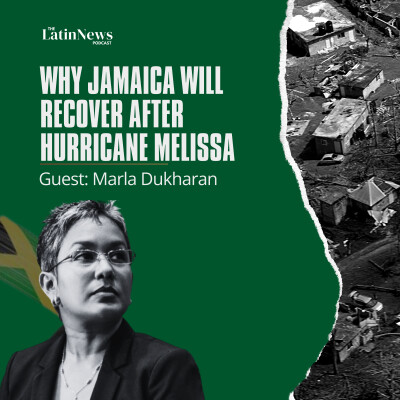
Over the past 12 years, Jamaica has faced up to challenging hardships in order to earn hard won gains in terms of ordering the economy, reducing the debt to GDP ratio from 150% to 60% and reducing unemployment to 3.3%. It was, in short, an incredible success story. And then in November 2025, the island was struck by Hurricane Melissa, leaving the country in tatters. The two main industries of tourism and agriculture have been severely damaged and the outlook appears bleak. However, on The LatinNews Podcast this week, we speak to Caribbean economist Marla Dukharan who believes, in spite of the tragedy that befell Jamaica, that there are reasons to remain positive, as the platform for growth and recovery remain intact for the island nation. For Dukharan, Jamaica's human capital, economic know-how, strong diaspora, resilience fund and CRIFF agreement will help the recovery. Questions remain, of course, as to how to mitigate climate events of this nature in the future and how to reform the nature of international aid donations. Hosted on Ausha. See ausha.co/privacy-policy for more information.
45min | Published on November 19, 2025
On The LatinNews Podcast this week, we look at the results of the recent presidential elections in Bolivia and the challenges ahead for president-elect Rodrigo Paz. Can this pragmatic leader respond creatively to tests including, a contracting economy, the current decline in the MAS party, the revisitation of diplomatic ties between the country and the United States, the Lithium question and regional relationships. In a far-reaching conversation with Martín Mendoza-Botelho, Professor of Political Science at Eastern Connecticut State University, we discuss Bolivia's immediate needs and how for the first time in a long time, the Paz presidency is one of pragmatism over ideology, for now. Hosted on Ausha. See ausha.co/privacy-policy for more information.
47min | Published on November 4, 2025
Why is there a build-up of the US armed forces in the southern Caribbean? According to Dr. Evan Ellis, Latin America Research Professor and General Douglas Macarthur Research Chair at the U.S. Army War College Strategic Studies Institute, our guest on The LatinNews Podcast this week, this is about putting an end to a significant strategic threat to U.S. interests that are threatening the core of things that President Trump said he was going to defend, issues of migration and issues of drugs. For the Venezuelan people, the importance of restoring Venezuelan democracy, and it’s likely that Venezuelans have never had a better opportunity than Edmundo Gonzalez and Maria Corina Machado to reunite a deeply divided country. How can this regime change take place? The sense is that the way that the current administration is looking at this challenge is that it's more through the lens of a threat that is generating harm against the United States. Drugs are the first little piece of that, but it's about those harms more than about democracy. Hosted on Ausha. See ausha.co/privacy-policy for more information.
54min | Published on October 21, 2025
Newly re-elected President Irfaan Ali will have to move fast on promises to convert his country's sizable oil income into tangible benefits for Guyana's poor, beyond huge prestige infrastructure projects. If President Ali is unable to capitalize and create a coherent development plan and enable a reorientation of Guyana's economy, there will be cause for concern, not least from Azruddin Mohamed, leader of the new WIN (the recently formed, We Invest in Nationhood party) who pulled in 25 per cent of the vote in the general election. Guyana’s offshore oil fields, discovered by ExxonMobil in 2015, have transformed the country into a burgeoning energy powerhouse. The country, which is estimated to have the world’s highest crude oil reserves per capita, has been one of the fastest growing economies globally since oil production began in 2019 and yet the wealth disparity is starkly evident. This week on The LatinNews Podcast, we welcome back Anand Persaud, Editor-in-chief of Stabroek News, to discuss the challenges facing President Ali and Guyana including, the Dutch Disease, massive infrastructure expenditure, the on-going dispute with Venezuela over the Essequibo, the US military build-up in the southern Caribbean and climate change. Hosted on Ausha. See ausha.co/privacy-policy for more information.
47min | Published on October 7, 2025
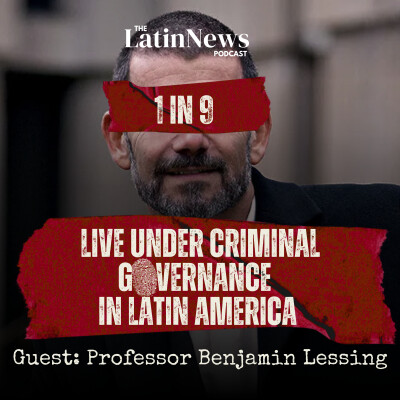
On The LatinNews Podcast this week, we look at how criminal organizations offer basic order and security in Latin America and how decades of authorities resorting to repressive strategies in order to address underlying social problems have provided fertile platforms for criminal shadow governments. Misguided state policies have shown that political questions have to change and there is now the need to rethink how to deal with the engines powering criminal governance in the region. We discuss how mass incarceration and repression strengthens the criminal groups it aims to constrain. We are joined by Benjamin Lessing, Associate Professor of Political Science at the University of Chicago and author of the forthcoming book: "Criminal Leviathans: How Gangs Govern from Behind Bars." Hosted on Ausha. See ausha.co/privacy-policy for more information.
59min | Published on September 23, 2025

Following the historic defeat of the MAS in the first round of presidential elections in August 2025, Bolivians are left with two options to vote for, both to the right of centre. Former president Jorge Quiroga will face Senator Rodrigo Paz Pereira in a run-off set to take place on 19 October 2025. On The LatinNews Podcast this week, we take a look at the results of the first round and explore some of the reason for the total collapse of the MAS party, we discuss the legacy of former president Evo Morales, who ruled Bolivia from 2006-2019, and his current predicament in Chapare. And what of the potential winner? Whoever wins in October will be faced with Bolivia's precarious economic situation, legal and political disorders and the always unpredictable subnational elections in 2026. Our guest this week is Dr Angus McNelly, lecturer in International Development at Kings College London and author of: " Now We Are in Power: The Politics of Passive Revolution in 21st Century Bolivia." Hosted on Ausha. See ausha.co/privacy-policy for more information.
47min | Published on September 9, 2025
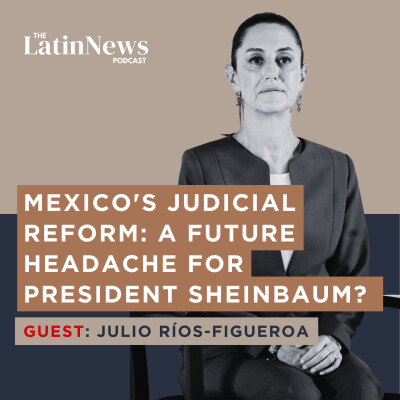
In one of his final acts as president of Mexico, Andrés Manuel López Obrador pushed through a contentious judicial reform. López Obrador celebrated the overhaul of the judiciary as a necessity and an important legacy of his government. A primary concern is that the reform weakens judicial independence, reducing checks and balances on the government. There are fears the election process could be open to political influence, reducing the judiciary’s autonomy from government and strengthening the Morena party's dominance. There are also concerns that organized crime groups could interfere in the election of judges, threatening access to justice for victims and further inflating impunity levels. On The LatinNews Podcast this week, we speak to Julio Ríos-Figueroa, Associate Professor at the Department of Law at ITAM in Mexico City. His research focuses on comparative judicial politics, the rule of law, and empirical legal studies with a focus on the Latin American region. Hosted on Ausha. See ausha.co/privacy-policy for more information.
43min | Published on August 26, 2025
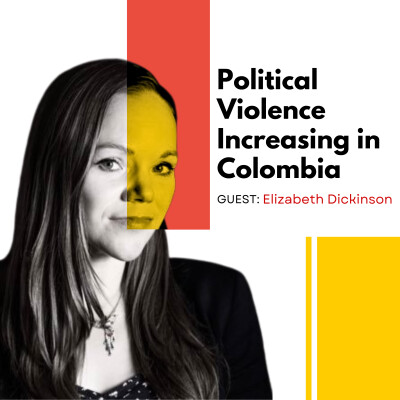
Threats of political violence and a deteriorating security situation are raising concerns as Colombia approaches its presidential elections in May 2026, while tensions with the United States have also increased. Security challenges are expected to weigh heavily on the upcoming electoral period. This week on The LatinNews Podcast, host Richard McColl speaks with Elizabeth Dickinson, Senior Analyst for the Andes Region at International Crisis Group, who explains the factors behind the current situation in Colombia and offers recommendations for the months ahead. Hosted on Ausha. See ausha.co/privacy-policy for more information.
38min | Published on August 12, 2025
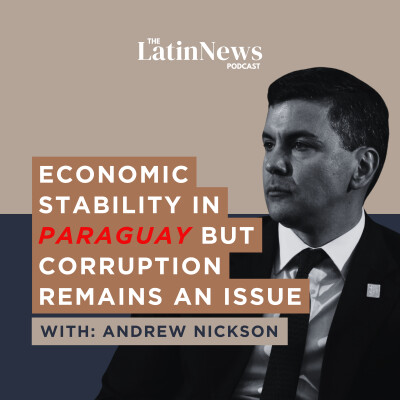
Under President Santiago Peña, Paraguay is enjoying economic stability, the fastest growth in Latin America, the lowest debt to GDP ratio in the region, a stable currency and the award of investment grade status for the first time ever. And, while this is impressive and cause for celebration, analysts are asking what the Paraguayan government is doing to combat corruption? On The LatinNews Podcast this week, we speak to Andrew Nickson, Honorary Reader in Public Management and Latin American Studies at the University of Birmingham and ask about Peña's successes and his shortcomings over the first two years of his government, and what we can predict for the remaining three years. Hosted on Ausha. See ausha.co/privacy-policy for more information.
49min | Published on July 29, 2025
Description
Hosted on Ausha. See ausha.co/privacy-policy for more information.
78 episodes
Season 1
Argentina's colourful President Javier Milei has been in power for two years and on The LatinNews Podcast this week, we take a look at his record so far and possible outcomes for the future after a successful midterm elections and significant public approval for his mandate. Joining us is Carlos Gervasoni, Associate Professor and chair of Political Science and International Studies at the Universidad Torcuato Di Tella. We discuss Milei's role as a stereotypical outsider, Argentina's disastrous macroeconomic legacy and the political and institutional weaknesses in the country in addition to Argentina's role as a spoiler at major multilateral negotiations in order to align itself with the Trump government in the United States. We ask, can President Milei solve Argentina's frustrating political economy pendulum and break the country's long tradition of institutional weakness? Hosted on Ausha. See ausha.co/privacy-policy for more information.
42min | Published on December 2, 2025
Over the past 12 years, Jamaica has faced up to challenging hardships in order to earn hard won gains in terms of ordering the economy, reducing the debt to GDP ratio from 150% to 60% and reducing unemployment to 3.3%. It was, in short, an incredible success story. And then in November 2025, the island was struck by Hurricane Melissa, leaving the country in tatters. The two main industries of tourism and agriculture have been severely damaged and the outlook appears bleak. However, on The LatinNews Podcast this week, we speak to Caribbean economist Marla Dukharan who believes, in spite of the tragedy that befell Jamaica, that there are reasons to remain positive, as the platform for growth and recovery remain intact for the island nation. For Dukharan, Jamaica's human capital, economic know-how, strong diaspora, resilience fund and CRIFF agreement will help the recovery. Questions remain, of course, as to how to mitigate climate events of this nature in the future and how to reform the nature of international aid donations. Hosted on Ausha. See ausha.co/privacy-policy for more information.
45min | Published on November 19, 2025
On The LatinNews Podcast this week, we look at the results of the recent presidential elections in Bolivia and the challenges ahead for president-elect Rodrigo Paz. Can this pragmatic leader respond creatively to tests including, a contracting economy, the current decline in the MAS party, the revisitation of diplomatic ties between the country and the United States, the Lithium question and regional relationships. In a far-reaching conversation with Martín Mendoza-Botelho, Professor of Political Science at Eastern Connecticut State University, we discuss Bolivia's immediate needs and how for the first time in a long time, the Paz presidency is one of pragmatism over ideology, for now. Hosted on Ausha. See ausha.co/privacy-policy for more information.
47min | Published on November 4, 2025
Why is there a build-up of the US armed forces in the southern Caribbean? According to Dr. Evan Ellis, Latin America Research Professor and General Douglas Macarthur Research Chair at the U.S. Army War College Strategic Studies Institute, our guest on The LatinNews Podcast this week, this is about putting an end to a significant strategic threat to U.S. interests that are threatening the core of things that President Trump said he was going to defend, issues of migration and issues of drugs. For the Venezuelan people, the importance of restoring Venezuelan democracy, and it’s likely that Venezuelans have never had a better opportunity than Edmundo Gonzalez and Maria Corina Machado to reunite a deeply divided country. How can this regime change take place? The sense is that the way that the current administration is looking at this challenge is that it's more through the lens of a threat that is generating harm against the United States. Drugs are the first little piece of that, but it's about those harms more than about democracy. Hosted on Ausha. See ausha.co/privacy-policy for more information.
54min | Published on October 21, 2025
Newly re-elected President Irfaan Ali will have to move fast on promises to convert his country's sizable oil income into tangible benefits for Guyana's poor, beyond huge prestige infrastructure projects. If President Ali is unable to capitalize and create a coherent development plan and enable a reorientation of Guyana's economy, there will be cause for concern, not least from Azruddin Mohamed, leader of the new WIN (the recently formed, We Invest in Nationhood party) who pulled in 25 per cent of the vote in the general election. Guyana’s offshore oil fields, discovered by ExxonMobil in 2015, have transformed the country into a burgeoning energy powerhouse. The country, which is estimated to have the world’s highest crude oil reserves per capita, has been one of the fastest growing economies globally since oil production began in 2019 and yet the wealth disparity is starkly evident. This week on The LatinNews Podcast, we welcome back Anand Persaud, Editor-in-chief of Stabroek News, to discuss the challenges facing President Ali and Guyana including, the Dutch Disease, massive infrastructure expenditure, the on-going dispute with Venezuela over the Essequibo, the US military build-up in the southern Caribbean and climate change. Hosted on Ausha. See ausha.co/privacy-policy for more information.
47min | Published on October 7, 2025
On The LatinNews Podcast this week, we look at how criminal organizations offer basic order and security in Latin America and how decades of authorities resorting to repressive strategies in order to address underlying social problems have provided fertile platforms for criminal shadow governments. Misguided state policies have shown that political questions have to change and there is now the need to rethink how to deal with the engines powering criminal governance in the region. We discuss how mass incarceration and repression strengthens the criminal groups it aims to constrain. We are joined by Benjamin Lessing, Associate Professor of Political Science at the University of Chicago and author of the forthcoming book: "Criminal Leviathans: How Gangs Govern from Behind Bars." Hosted on Ausha. See ausha.co/privacy-policy for more information.
59min | Published on September 23, 2025
Following the historic defeat of the MAS in the first round of presidential elections in August 2025, Bolivians are left with two options to vote for, both to the right of centre. Former president Jorge Quiroga will face Senator Rodrigo Paz Pereira in a run-off set to take place on 19 October 2025. On The LatinNews Podcast this week, we take a look at the results of the first round and explore some of the reason for the total collapse of the MAS party, we discuss the legacy of former president Evo Morales, who ruled Bolivia from 2006-2019, and his current predicament in Chapare. And what of the potential winner? Whoever wins in October will be faced with Bolivia's precarious economic situation, legal and political disorders and the always unpredictable subnational elections in 2026. Our guest this week is Dr Angus McNelly, lecturer in International Development at Kings College London and author of: " Now We Are in Power: The Politics of Passive Revolution in 21st Century Bolivia." Hosted on Ausha. See ausha.co/privacy-policy for more information.
47min | Published on September 9, 2025
In one of his final acts as president of Mexico, Andrés Manuel López Obrador pushed through a contentious judicial reform. López Obrador celebrated the overhaul of the judiciary as a necessity and an important legacy of his government. A primary concern is that the reform weakens judicial independence, reducing checks and balances on the government. There are fears the election process could be open to political influence, reducing the judiciary’s autonomy from government and strengthening the Morena party's dominance. There are also concerns that organized crime groups could interfere in the election of judges, threatening access to justice for victims and further inflating impunity levels. On The LatinNews Podcast this week, we speak to Julio Ríos-Figueroa, Associate Professor at the Department of Law at ITAM in Mexico City. His research focuses on comparative judicial politics, the rule of law, and empirical legal studies with a focus on the Latin American region. Hosted on Ausha. See ausha.co/privacy-policy for more information.
43min | Published on August 26, 2025
Threats of political violence and a deteriorating security situation are raising concerns as Colombia approaches its presidential elections in May 2026, while tensions with the United States have also increased. Security challenges are expected to weigh heavily on the upcoming electoral period. This week on The LatinNews Podcast, host Richard McColl speaks with Elizabeth Dickinson, Senior Analyst for the Andes Region at International Crisis Group, who explains the factors behind the current situation in Colombia and offers recommendations for the months ahead. Hosted on Ausha. See ausha.co/privacy-policy for more information.
38min | Published on August 12, 2025
Under President Santiago Peña, Paraguay is enjoying economic stability, the fastest growth in Latin America, the lowest debt to GDP ratio in the region, a stable currency and the award of investment grade status for the first time ever. And, while this is impressive and cause for celebration, analysts are asking what the Paraguayan government is doing to combat corruption? On The LatinNews Podcast this week, we speak to Andrew Nickson, Honorary Reader in Public Management and Latin American Studies at the University of Birmingham and ask about Peña's successes and his shortcomings over the first two years of his government, and what we can predict for the remaining three years. Hosted on Ausha. See ausha.co/privacy-policy for more information.
49min | Published on July 29, 2025