
Description
The LatinNews Podcast is a fortnightly deep dive into key developments from across Latin America and the Caribbean.
Hosted on Ausha. See ausha.co/privacy-policy for more information.
Description
Hosted on Ausha. See ausha.co/privacy-policy for more information.
78 episodes
Season 1
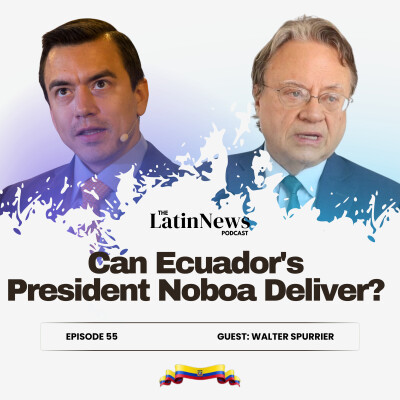
President Noboa’s victory in Ecuador seems to have owed a huge amount to his sweeping crackdown on organised crime, which has seen the military permanently mobilised against gangs. Insecurity is repeatedly identified as voters’ main concern. Can Noboa deliver? It's clear that Noboa stands and falls on security and voters gave him the benefit of the doubt that he needed more time and that his rival González would be too soft on crime. But, he has to deliver on this as well as addressing an increasingly fraught situation due to massive energy outages, the state of economy and keeping the all-important indigenous voters onside. On The LatinNews Podcast this week, we hear from Walter Spurrier in Guayaquil. Spurrier is the president of Grupo Spurrier, a columnist for the Diario El Universo newspaper, and the director of the political economic publication Analisis Semanal or Weekly Analysis. Hosted on Ausha. See ausha.co/privacy-policy for more information.
44min | Published on July 15, 2025

The biggest threat to Peru's efforts to further tap into its vast copper ore reserves is the growing number of informal and illegal mining activities. Conflicts between property owners and concession holders have become a critical issue, and the Peruvian government is striving to find a balance. Peru's rich copper and gold ore reserves have attracted hundreds of thousands of small-scale miners, most of whom operate in areas where they do not own mining rights. It is estimated that 40 per cent of Peru's gold exports come from informal mines. Many use a temporary registration process called REINFO, which allows them to operate while going through the formal process. The program is set to expire at the end of 2025, but the industry generally opposes it, arguing that these licenses serve as a cover for illegal activities. On The LatinNews Podcast this week, we discuss the complexities shrouding Peru's mining industry and what the government is and isn't doing to correct it with special guest Dr John Crabtree, research associate at the Latin American Centre at the University of Oxford, associate of the Politics Department at Brookes University in Oxford, and region head for Latin America at Oxford Analytica Ltd. Hosted on Ausha. See ausha.co/privacy-policy for more information.
38min | Published on July 1, 2025

Security and violent crime are the single most pressing issues on the minds of voters regarding the presidential elections in Costa Rica in February 2026 and so, on The LatinNews Podcast this week, we investigate the causes for these troubles - including inequality and marginalization - and what President Rodrigo Chaves has done to combat this. We discuss the broader trends in the region regarding the elections, Costa Rica's strong identity, Chaves' open admiration for President Bukele in El Salvador and the country's foreign policy plans. Joining us is Mary Fran T Malone, Professor in the Department of Political Science at the University of New Hampshire where she teaches classes on democratization, comparative politics, and Latin American politics. Hosted on Ausha. See ausha.co/privacy-policy for more information.
42min | Published on June 17, 2025

The recent election of American Cardinal Robert Prevost as Pope Leo XIV marks a historic moment for the Catholic Church. Not only is Leo XIV the first pope from the United States, but he is also a pontiff deeply connected to Latin America, where he dedicated nearly forty years to pastoral work, particularly in Peru. In this respect, Leo would appear to be another Latin American pope and there is great excitement in the region resulting from his nomination. On The LatinNews Podcast this week, we ask whether Pope Leo's deep connections to Latin America will ensure a continuation of Pope Francis' policies of diplomacy and solidarity with the region. As an advocate for human rights and the church's role in mediating social conflicts, will this put the pope at odds with the government of President Trump in the United States regarding their treatment of migrants and more? We speak to Mario I. Aguilar, Professor of Religion & Politics and Director of the Centre for the Study of Religion & Politics at the University of St Andrews. He is also a poet, an eremitic Camaldolese Benedictine Oblate, and has published widely in his interests in the theology of contemplation, the history of religion and issues of interfaith dialogue. Hosted on Ausha. See ausha.co/privacy-policy for more information.
1h16 | Published on June 3, 2025

How much is historical revisionism in South America's southern cone responsible for a rise in the far-right in Argentina, Brazil, Chile and Uruguay? What does this mean for the largely prevailing consensus on the brutality and the indefensible and egregious human rights violations perpetrated by the dictatorships in the 1970s and 1980s? Can we point to an amnesia of these periods which has contributed to a democratic backsliding in the region? Where do President Javier Milei, former president Jair Bolsonaro, Chilean politician Jose Antonio Kast, and others, fit into this? In this episode of the LatinNews podcast we look at this theme and hear from Scott Mainwaring, the Eugene P. and Helen Conley Professor of Political Science at the University of Notre Dame who specialises in political parties, democratic and authoritarian regimes and political institutions in Latin America. Hosted on Ausha. See ausha.co/privacy-policy for more information.
51min | Published on May 22, 2025

As if we hardly need reminding that Chile's controversial pension reforms were the focal point of protests at the heart of the civil unrest or "estallido social". This has been particularly incendiary in Chile with the AFP's origins dating back to the Pinochet dictatorship. Chile has always seemed like the Switzerland of Latin America, routinely topping regionally adjusted league tables, but obviously it was massively inequitable and the pension system bred particular resentment over time. On The LatinNews Podcast this week, we speak to Nicholas Barr, Professor of Public Economics at the London School of Economics and Political Science and author of numerous books and papers on the welfare state including pensions and higher education finance. Hosted on Ausha. See ausha.co/privacy-policy for more information.
39min | Published on May 6, 2025

On The LatinNews Podcast this week, we take a look at the implications of mass deportations from the United States and the possible effects of this on Trinidad and Tobago's society, the current state of emergency due to violent crime as well as the upcoming elections in April. With the surge in gang-driven crime due to transnational drugs, arms and people trafficking, Trinidad and Tobago finds itself negotiating a precarious balancing act in managing the challenges of being located alongside Venezuela and adhering to demands from the United States. We speak to Ivelaw Lloyd Griffith, an expert on Caribbean affairs, a scholar turned writer and author of ten books, a retired political scientist who has served as President of Fort Valley State University and Vice Chancellor of the University of Guyana amongst other accolades. Hosted on Ausha. See ausha.co/privacy-policy for more information.
39min | Published on April 22, 2025
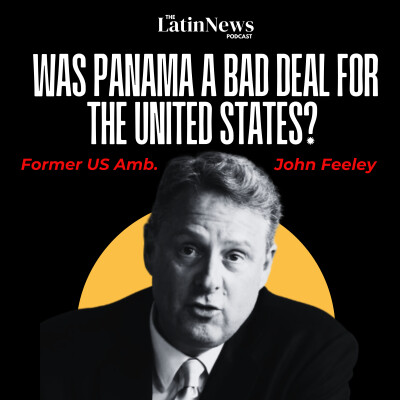
On The LatinNews Podcast this week, we take a profound look at current events involving Panama, most notably the statements about the country made by President Trump. Was Panama a bad deal for the US? Is there a possibility of the US invading Panama in a second take on 1989's operation Just Cause? Does China control the canal? It's a sign of the times that we have to seriously consider the possibility of President Trump ordering an invasion of a democratic ally. So, we put Panama's diplomatic tensions with the US into a historical context and deconstruct many of the baseless fallacies being repeated. Explaining in great depth and clarifying many of the complexities in the relationship between Panama and the US and the issues of the canal and Chinese involvement is John Feeley, former US ambassador to Panama, former political consultant for Univision, an officer and helicopter pilot in the Marine corps and a senior western hemisphere official. Hosted on Ausha. See ausha.co/privacy-policy for more information.
58min | Published on April 1, 2025

As his popularity continues to wane, President Lula appears as if disconnected to the new realities in Brazil as he faces the most testing time in his political career. The weakness of Brazil's currency, the rising cost of living, the disastrous municipal elections in October 2024, the fiscal deficit and investor concerns are all issues which Lula needs to face up to but, as yet, has been unable to address. This week on The LatinNews Podcast, we speak to Richard Lapper, author and journalist and expert on Latin America. Lapper speaks about the potential consequences of Lula's failure to encourage his Partido dos Trabalhadores, Workers' Party in moving beyond its core politics, which were developed in 1970s and 1980s, to the new national reality in which poorer Brazilians are increasingly individualistic in their economic opportunities and therefore more detached from decisions in Brasilia. We also look ahead at the presidential elections tabled for October 2026 and ask: is there an anointed successor to Lula or opposition figure and former president Jair Bolsonaro and how Brazil's judiciary and congress are gaining more power at the expense of the executive. Hosted on Ausha. See ausha.co/privacy-policy for more information.
45min | Published on March 18, 2025

Suriname will vote for a new president on 25 May 2025 in what are seen as crucial elections set against the backdrop of economic uncertainty and the forthcoming exploitation of potentially wealth-changing oil reserves for the country. Presently, there are 15 to 17 parties registered and in this episode of The LatinNews Podcast we provide an explainer of the main parties and political players, the most pressing concerns of the electorate such as the economy, healthcare and relations with Guyana. Joining us is journalist Ank Kuipers who provides us with insightful considerations of current events in Suriname. We delve into how the electoral process works in Suriname, the issues of corruption and clientelism, the protests of 2023 and the impact of the death of the controversial if charismatic figure of Desi Bouterse in December 2024. Hosted on Ausha. See ausha.co/privacy-policy for more information.
42min | Published on February 25, 2025
Description
Hosted on Ausha. See ausha.co/privacy-policy for more information.
78 episodes
Season 1
President Noboa’s victory in Ecuador seems to have owed a huge amount to his sweeping crackdown on organised crime, which has seen the military permanently mobilised against gangs. Insecurity is repeatedly identified as voters’ main concern. Can Noboa deliver? It's clear that Noboa stands and falls on security and voters gave him the benefit of the doubt that he needed more time and that his rival González would be too soft on crime. But, he has to deliver on this as well as addressing an increasingly fraught situation due to massive energy outages, the state of economy and keeping the all-important indigenous voters onside. On The LatinNews Podcast this week, we hear from Walter Spurrier in Guayaquil. Spurrier is the president of Grupo Spurrier, a columnist for the Diario El Universo newspaper, and the director of the political economic publication Analisis Semanal or Weekly Analysis. Hosted on Ausha. See ausha.co/privacy-policy for more information.
44min | Published on July 15, 2025
The biggest threat to Peru's efforts to further tap into its vast copper ore reserves is the growing number of informal and illegal mining activities. Conflicts between property owners and concession holders have become a critical issue, and the Peruvian government is striving to find a balance. Peru's rich copper and gold ore reserves have attracted hundreds of thousands of small-scale miners, most of whom operate in areas where they do not own mining rights. It is estimated that 40 per cent of Peru's gold exports come from informal mines. Many use a temporary registration process called REINFO, which allows them to operate while going through the formal process. The program is set to expire at the end of 2025, but the industry generally opposes it, arguing that these licenses serve as a cover for illegal activities. On The LatinNews Podcast this week, we discuss the complexities shrouding Peru's mining industry and what the government is and isn't doing to correct it with special guest Dr John Crabtree, research associate at the Latin American Centre at the University of Oxford, associate of the Politics Department at Brookes University in Oxford, and region head for Latin America at Oxford Analytica Ltd. Hosted on Ausha. See ausha.co/privacy-policy for more information.
38min | Published on July 1, 2025
Security and violent crime are the single most pressing issues on the minds of voters regarding the presidential elections in Costa Rica in February 2026 and so, on The LatinNews Podcast this week, we investigate the causes for these troubles - including inequality and marginalization - and what President Rodrigo Chaves has done to combat this. We discuss the broader trends in the region regarding the elections, Costa Rica's strong identity, Chaves' open admiration for President Bukele in El Salvador and the country's foreign policy plans. Joining us is Mary Fran T Malone, Professor in the Department of Political Science at the University of New Hampshire where she teaches classes on democratization, comparative politics, and Latin American politics. Hosted on Ausha. See ausha.co/privacy-policy for more information.
42min | Published on June 17, 2025
The recent election of American Cardinal Robert Prevost as Pope Leo XIV marks a historic moment for the Catholic Church. Not only is Leo XIV the first pope from the United States, but he is also a pontiff deeply connected to Latin America, where he dedicated nearly forty years to pastoral work, particularly in Peru. In this respect, Leo would appear to be another Latin American pope and there is great excitement in the region resulting from his nomination. On The LatinNews Podcast this week, we ask whether Pope Leo's deep connections to Latin America will ensure a continuation of Pope Francis' policies of diplomacy and solidarity with the region. As an advocate for human rights and the church's role in mediating social conflicts, will this put the pope at odds with the government of President Trump in the United States regarding their treatment of migrants and more? We speak to Mario I. Aguilar, Professor of Religion & Politics and Director of the Centre for the Study of Religion & Politics at the University of St Andrews. He is also a poet, an eremitic Camaldolese Benedictine Oblate, and has published widely in his interests in the theology of contemplation, the history of religion and issues of interfaith dialogue. Hosted on Ausha. See ausha.co/privacy-policy for more information.
1h16 | Published on June 3, 2025
How much is historical revisionism in South America's southern cone responsible for a rise in the far-right in Argentina, Brazil, Chile and Uruguay? What does this mean for the largely prevailing consensus on the brutality and the indefensible and egregious human rights violations perpetrated by the dictatorships in the 1970s and 1980s? Can we point to an amnesia of these periods which has contributed to a democratic backsliding in the region? Where do President Javier Milei, former president Jair Bolsonaro, Chilean politician Jose Antonio Kast, and others, fit into this? In this episode of the LatinNews podcast we look at this theme and hear from Scott Mainwaring, the Eugene P. and Helen Conley Professor of Political Science at the University of Notre Dame who specialises in political parties, democratic and authoritarian regimes and political institutions in Latin America. Hosted on Ausha. See ausha.co/privacy-policy for more information.
51min | Published on May 22, 2025
As if we hardly need reminding that Chile's controversial pension reforms were the focal point of protests at the heart of the civil unrest or "estallido social". This has been particularly incendiary in Chile with the AFP's origins dating back to the Pinochet dictatorship. Chile has always seemed like the Switzerland of Latin America, routinely topping regionally adjusted league tables, but obviously it was massively inequitable and the pension system bred particular resentment over time. On The LatinNews Podcast this week, we speak to Nicholas Barr, Professor of Public Economics at the London School of Economics and Political Science and author of numerous books and papers on the welfare state including pensions and higher education finance. Hosted on Ausha. See ausha.co/privacy-policy for more information.
39min | Published on May 6, 2025
On The LatinNews Podcast this week, we take a look at the implications of mass deportations from the United States and the possible effects of this on Trinidad and Tobago's society, the current state of emergency due to violent crime as well as the upcoming elections in April. With the surge in gang-driven crime due to transnational drugs, arms and people trafficking, Trinidad and Tobago finds itself negotiating a precarious balancing act in managing the challenges of being located alongside Venezuela and adhering to demands from the United States. We speak to Ivelaw Lloyd Griffith, an expert on Caribbean affairs, a scholar turned writer and author of ten books, a retired political scientist who has served as President of Fort Valley State University and Vice Chancellor of the University of Guyana amongst other accolades. Hosted on Ausha. See ausha.co/privacy-policy for more information.
39min | Published on April 22, 2025
On The LatinNews Podcast this week, we take a profound look at current events involving Panama, most notably the statements about the country made by President Trump. Was Panama a bad deal for the US? Is there a possibility of the US invading Panama in a second take on 1989's operation Just Cause? Does China control the canal? It's a sign of the times that we have to seriously consider the possibility of President Trump ordering an invasion of a democratic ally. So, we put Panama's diplomatic tensions with the US into a historical context and deconstruct many of the baseless fallacies being repeated. Explaining in great depth and clarifying many of the complexities in the relationship between Panama and the US and the issues of the canal and Chinese involvement is John Feeley, former US ambassador to Panama, former political consultant for Univision, an officer and helicopter pilot in the Marine corps and a senior western hemisphere official. Hosted on Ausha. See ausha.co/privacy-policy for more information.
58min | Published on April 1, 2025
As his popularity continues to wane, President Lula appears as if disconnected to the new realities in Brazil as he faces the most testing time in his political career. The weakness of Brazil's currency, the rising cost of living, the disastrous municipal elections in October 2024, the fiscal deficit and investor concerns are all issues which Lula needs to face up to but, as yet, has been unable to address. This week on The LatinNews Podcast, we speak to Richard Lapper, author and journalist and expert on Latin America. Lapper speaks about the potential consequences of Lula's failure to encourage his Partido dos Trabalhadores, Workers' Party in moving beyond its core politics, which were developed in 1970s and 1980s, to the new national reality in which poorer Brazilians are increasingly individualistic in their economic opportunities and therefore more detached from decisions in Brasilia. We also look ahead at the presidential elections tabled for October 2026 and ask: is there an anointed successor to Lula or opposition figure and former president Jair Bolsonaro and how Brazil's judiciary and congress are gaining more power at the expense of the executive. Hosted on Ausha. See ausha.co/privacy-policy for more information.
45min | Published on March 18, 2025
Suriname will vote for a new president on 25 May 2025 in what are seen as crucial elections set against the backdrop of economic uncertainty and the forthcoming exploitation of potentially wealth-changing oil reserves for the country. Presently, there are 15 to 17 parties registered and in this episode of The LatinNews Podcast we provide an explainer of the main parties and political players, the most pressing concerns of the electorate such as the economy, healthcare and relations with Guyana. Joining us is journalist Ank Kuipers who provides us with insightful considerations of current events in Suriname. We delve into how the electoral process works in Suriname, the issues of corruption and clientelism, the protests of 2023 and the impact of the death of the controversial if charismatic figure of Desi Bouterse in December 2024. Hosted on Ausha. See ausha.co/privacy-policy for more information.
42min | Published on February 25, 2025