- Speaker #0
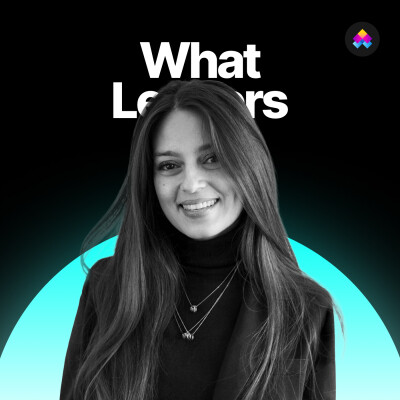
Welcome to What Leaders Want, the podcast series that features experts in the finance industry. Today, I'm happy to welcome Julia Paganelli. She knows SBS Inside Out. She spent already 18 years at the company. Her career has taken her across markets, cultures, major transformation in the industry. And so today, we're going to talk about her journey, the lessons that she learned. learned along the way and also her vision for SBS. Julia, welcome.
- Speaker #1
Thank you very much, Caroline.
- Speaker #0
So after 18 years at SBS, becoming CMO must feel significant. What was your first thought when you get the news?
- Speaker #1
Honestly, I was surprised. Generally surprised. It may sound obvious, but you know, when someone asks you, where do you see yourself in the next years? It's always like... For most of us, it's a difficult question. And CMO was not like out of reach, but it was distant. So, you know, it was something I was thinking about, but not like right now. And so I was surprised. But on the other side, everything went very fast these past days and months. So I can say like the D-Day, you know, when I learned, I was... proud. I was super proud. And I was also very grateful for everyone that worked with me, you know, the past few years, because, you know, I had like a great opportunity here.
- Speaker #0
So if we take a look back at your career, can you walk us through three significant moments that shaped your professional journey?
- Speaker #1
I'm thinking about a lot of moments. Honestly, it's difficult to choose only three, but the first moment I have in mind is probably 2012. It was a key moment in SBS history because it was the creation of Sopra banking software, which became SBS later. But at this time, we were part of Sopra group. So it was before Sopra Asteria. At this time, it was Sopra group. And inside the group, we had different activities in terms of financial services. So we already had solutions through address banks and financial institutions, but it was in different teams. And there was a series of acquisitions at this moment. So the decision was to bring all together and to build a new brand. So it was a subsidiary of the group. And it was a super opportunity for the marketing team, as you can imagine, to build a brand, to reimagine who we are. And together under one umbrella, different stories, different customers in a lot of countries already. Of course, different solutions. So, you know, make it one brand, one team was super exciting. you I learned a lot at this moment.
- Speaker #0
So you were at the very beginning of what SBS is today. That's interesting.
- Speaker #1
Some of us are still here. I'm not the only one, but I'm super proud to be part of this.
- Speaker #0
I can imagine.
- Speaker #1
Then if I think about the second moment, I think COVID moment was like the one. It's not funny when we say it like that, but it was an opportunity, if we see it differently, to complete. reinvent the way we were communicating. So, you know, we stopped everything from one day to another. We had no playbook, no guidelines about, you know, how to manage this. It wasn't only about crisis communication. It was also about, you know, thinking differently, being creative enough to think about, you know, what we can do now to communicate to a customer, to make it like an opportunity at the end. So we worked a lot on digital marketing campaigns and all the new channels we had. not only with customers, but also with the team itself. It was, you know, how we can make it really quickly, how we can move very fast. And it was a great moment for the team. And what is really interesting also is just what happened at the end when in-person meetings started again. We were able to measure the importance of connection again. You know, when you stopped everything, then you see what was missing. um And right after the pandemic, you know, all the events were like, you know, bringing together. It was a great moment for us. And then the last one, I have a lot in mind, but one key moment was early 2024. I took a global responsibility in the film marketing team. So for the first time, I had to cover all the regions. And it was really exciting because I had to learn, you know, what are the challenges of. you know, a building society in the UK, financial institution in the US, in the automotive finance industry. So it was, you know, a lot of learning. I met a lot of customers, partners, teams everywhere. And it was great.
- Speaker #0
You have dedicated an important part of your career to being a field marketing manager. You have traveled all around the world, especially in the Middle East Africa region. Is there a country in Africa that holds a special place in your heart?
- Speaker #1
This isn't an easy question because when we, you know, when we talk about Africa, people think about, you know, one market. Spits. in reality, Africa is a lot of singularities, a lot of culture, a lot of, you know, different dynamism. And what I really like about this region and what was really, you know, driving me was like the sum of all of this, you know, understanding the growth opportunities in one country versus another in one segment, etc. So it's difficult to say, you know, one that is representing everything that I have in mind when I think about Africa. But for... Personal reason, if I have to choose one, because I know where you want me to go. I would choose Morocco. May not be very surprising because we have a lot of link with Morocco, sorry. But it's also because my father was born in Morocco and grew up in Morocco. So Morocco for me is also like, you know, family memories when I was a child.
- Speaker #0
Okay.
- Speaker #1
So you have your own. It's nice to hear it.
- Speaker #0
So you've lived through multiple transformation in the industry. Which one challenged you the most?
- Speaker #1
It's difficult to answer with only one, but I will speak about one that is more recent and that is still, you know, in my mind is probably the sovereignty topic, you know, that other sovereignty, because, you know, when I started working, it was really about, you know, one client is choosing a solution for features, for speed, for cost, and for all of this. And suddenly the way we speak about sovereignty you who we are as a provider, as a, you know, as a company was really important. And then, you know, the question regulators ask. So it was a bit different. It's mainly in France and in other countries. But, you know, more recently this year, we spoke a lot about sovereignty. And I think this transformation is really something strong. And, you know, as SBS, we are already there. So as a marketer, it's important because. Then we are already there and we have to make it visible. We have to rewrite who we are and to make it, you know, visible for the market and to make it like a strength because now it's a differentiator versus, you know, where we stand before.
- Speaker #0
And what is a leadership habit that you will never give up?
- Speaker #1
You know, when I took the role, I think it's the same from... For many people, I was thinking, OK, maybe I need to be more like a leader. And probably one of the habits I don't want to lose is to be myself and to stay human. It may sound obvious, but still listening to people, being human. And I strongly believe in collective effort. I really prefer to have a strong team than just brilliant people working in different directions. So it's probably this answer.
- Speaker #0
Is there a decision that you made earlier in your career that looked wrong at the time, but turned out to be formative?
- Speaker #1
You know, we spoke about Africa. And I think the answer is, at several times, I had opportunities to move to other worlds with bigger responsibilities. And I said no, and not just once. So it wasn't probably on the paper. an easy decision and I had to explain myself several times you know about why I was saying no to this or this opportunity to move to another role and now like I feel it was a good decision because you know I was convinced that Africa was you know like helping me grow and learning because it's like a market where you know you have a lot of growth a lot of different context and it helped me also building relationship with like I met a lot of bank CEOs, for example, you can't do this when you're 25 in other regions. So I learned a lot about, you know, global marketing role because, you know, I was going in a lot of countries, working with many different contexts. And this is why I thought it was a good decision to stay. And I was really passionate. So I also think it's a bit of instinct, you know, saying no to something because you don't think it's a good moment. It's never the good moment, but it's like, you know, I was... strongly convinced that it was what I had to do. And I have no regrets because then it probably also shapes, you know, the way I see marketing today, you know, close to the client, close to the field. Of course, we have to be very close to the strategy and being corporate is really important. But I think it was probably where I found some of the belief I have now.
- Speaker #0
What kind of opportunities did you say no to?
- Speaker #1
Global role in marketing. You know, when we speak about the creation of software banking, software, even at that time, I said no to having like a more global role in the marketing team, but also sales, pre-sales.
- Speaker #0
So given the fact that you're now CMO, what excites you most about where SBS is right now and what is coming next?
- Speaker #1
As I was telling you, I went through... different transitions, different launches, different rebranding, and a lot of projects. But this one is really particular because right now we are launching SBS AI. And it's not only about one product. You know, it's not something like it's just one segment. It covers all the topics we have, all the solutions, all the markets. So this is really key. And what excites me the most is like everyone is involved. You know, it's not one business unit. working on AI in one product. This time, with SBS AI, we will have AI embedded into each of our solutions. So it concerns all the products and all the markets. And it's not right now. The big launch will be in January 2027. But for marketers and for everyone in the company, this is super exciting because we have the opportunity to promote something that is really key for all the customers. We are working with beta customers to make sure that the use cases we define are the good ones, to make sure that the business value in front of this launch is the right one. So it's like, you know, iterative project. But in January, we'll have the big launch.
- Speaker #0
Talking about AI, when every brand has access to the same tool, what makes SBS different? And also what... role does marketing play in this regard?
- Speaker #1
Yeah, that's a very good question because AI is, it's only a tool in this, I mean, internally and it's the same for everyone. But what we have, you know, as that is very different from everyone, we need to keep it and we don't have, you know, to look at AI only. Of course, the relationship we have with customers, like we are not a new player. We have, you know, a story with like a lot of customers. So All our customers is probably one of our strengths. All people, of course, because we deliver, we have a real commitment in our teams and our expertise also. We are not like a new startup. We have really strong expertise. So we ask all people, our clients, of course. Also the fact that we are independent and when we talk about sovereignty, it's also something that is one of our strengths. So we need to keep it. If we look at You know, in terms of marketing, what it means, it means that we have to think about SBS with all of this and probably to rewrite and to be able to be proud of who we are and not to think about AI only.
- Speaker #0
On a more personal note, is there something you wish someone had told you at 25?
- Speaker #1
Yes. You know, like it may sound obvious, but like voice your opinion. I wasn't particularly shy when I was 25, but I was probably thinking as many people and probably in particular women, that if you work hard, if you, you know, if you deliver, if you have like a strong performance, if you innovate, that, you know, everything will follow. It's not strong, but it's not enough. And when you're in a room with other people and, you know, if you don't bring your perspective, if you don't. both your opinion you know there is something that is missing uh so it's part of the expectation and it was something that i understood probably um you know later than at 25 i don't think it was it bottomed us for me so and
- Speaker #0
five years from now what would you like people to say change because of your time as chief marketing officer that's a great question
- Speaker #1
Let me change my mind. But what I'm thinking right now today is around two ideas. And I think the first one is the growth engine. I would be super happy and super proud if, you know, in five years, we say like, you know, we've built a real growth engine with IBM, with campaigns, with like, you know, real performance and involving all the team in this single objective, like, you know, supporting the growth of the company, of course. And the second one. is probably even more important is being a strategic partner, not, you know, making things nice and, you know, the marketing that it's supporting or the function, but really being part of the equation of the strategic decision. So it's like... bringing stronger function to make sure that we have the conviction to be part of the decisions.
- Speaker #0
Great. I hope that will happen. Thank you so much, Julia, for being with us and sharing your insights.
- Speaker #1
Thank you very much, Caroline. It was great. Thank you.