Description
Hosted on Acast. See acast.com/privacy for more information.
Hosted on Ausha. See ausha.co/privacy-policy for more information.

Description
Hosted on Acast. See acast.com/privacy for more information.
Hosted on Ausha. See ausha.co/privacy-policy for more information.
106 episodes
Season 3


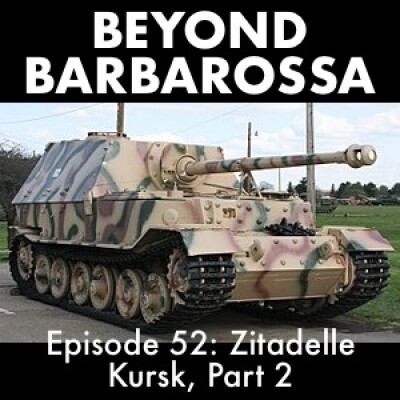
What I thought would be a single episode has turned into a series. Here is Part 2 of the biggest tank battle in history — or at least, of the Second World War. Map 1: The Eastern Front, 1943-44 Map 2: Battle of Kursk Map 3: Another map of the Battle of Kursk Image 1: The Tiger heavy tank Image 2: The Panther tank Image 3: The Ferdinand or "Elefant" self-propelled gun Restored Elefant at the United States Army Ordnance Training and Heritage Center. Source: Wikipedia. https://en.wikipedia.org/wiki/Elefant Hosted on Acast. See acast.com/privacy (https://acast.com/privacy) for more information. Hosted on Ausha. See ausha.co/privacy-policy for more information.
32min | Published on November 22, 2024


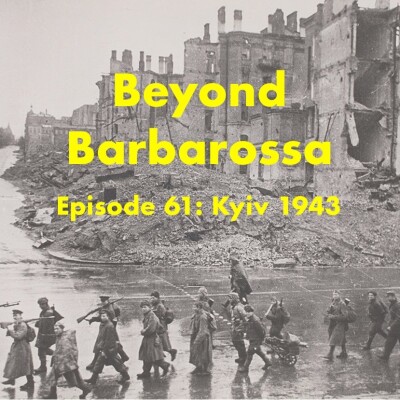
After crossing the Dnipro at Bukrin and getting bogged down by the panzers, the Red Army shifts focus northward to take the Ukrainian capital. Map 1: The Battle of Kyiv, 1943 Source: Warfare History Network.com (https://network.com/) Map 2: German war map of the Battle of Kyiv, 1943 Note the crossing at Ljutesch, German spelling of Lyutizh (Ukrainian) or Liutezh (Russian). Source: Alchetron, the Free Social Encyclopedia Photo 1: Crossing the Dnipro Soviet sappers building a raft to cross the Dnipro. The sign reads, in Russian, "To Kiev!" The soldier in the foreground appears to be looking up at approaching aircraft. Photo 2: Pavel Rybalko, commander of the Third Guards Tank Army Photo 3: Kirill Moskalenko, commander of the 38th Army during the second Battle of Kyiv Photo 4: Kyiv after recapture by the Red Army Links: The attack on Stalingrad: Episode 31 (https://beyondbarbarossa.podbean.com/e/attack-on-stalingrad/) Hosted on Acast. See acast.com/privacy (https://acast.com/privacy) for more information. Hosted on Ausha. See ausha.co/privacy-policy for more information.
35min | Published on November 18, 2024


In honour of Remembrance Day, 11 November 2024, this is a special episode available to all. A reading from Army of Worn Soles: Volume 1 of The Eastern Front Trilogy. (https://www.amazon.com/Army-Soles-Eastern-Front-Trilogy-ebook/dp/B00L3CNE0M/) Available exclusively on Amazon (https://www.amazon.com/Army-Soles-Eastern-Front-Trilogy-ebook/dp/B00L3CNE0M/). Hosted on Acast. See acast.com/privacy (https://acast.com/privacy) for more information. Hosted on Ausha. See ausha.co/privacy-policy for more information.
8min | Published on November 10, 2024


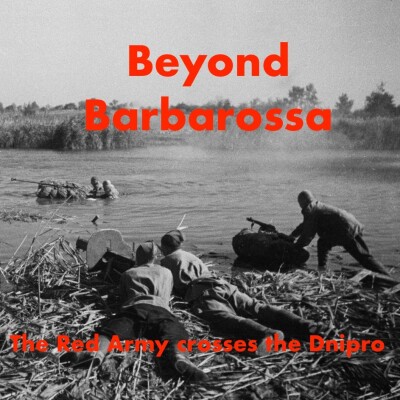
It's hard to believe we've reached the 60th episode! This is a big one: the Red Army reaches, and crosses the German East Wall along the Dnipro River in Ukraine. At a cost, of course. Let me know what you think. Crossing the Dnipro Map 2: The Bukrin Bend Sources: Prit Buttar, Retribution: The Soviet Reconquest of Central Ukraine, 1943. Osford, UK: Osprey Publishing, 2020. Evan Mawdsley, Thunder in the East: The Nazi-Soviet War, 1941–1945. London: Bloomsbury Academic, 2016. Anthony Tucker-Jones, Slaughter on the Eastern Front: Hitler and Stalin’s War 1941–1945. Stroud, Gloucestershire, UK: The History Press, 2017 Hosted on Acast. See acast.com/privacy (https://acast.com/privacy) for more information. Hosted on Ausha. See ausha.co/privacy-policy for more information.
31min | Published on November 4, 2024


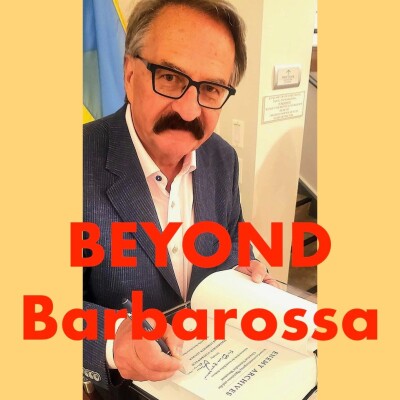
Dr. Lubomyr Luciuk of the Royal Military College of Canada and University of Toronto returns to describe the reality for eastern European people under occupation during the Second World, and draws the line from then to today. Latest book: Enemy Archives: Soviet Counterinsurgency Operations and the Ukrainian Nationalist Movement – Selections from the Secret Police Archives Montreal and Kingston: McGill-Queen's University Press, 2023. Available from Amazon (https://www.amazon.com/Enemy-Archives-Counterinsurgency-Operations-Nationalist/dp/0228014662/) and McGill-Queen's University Press (https://www.mqup.ca/enemy-archives-products-9780228014669.php) Hosted on Acast. See acast.com/privacy (https://acast.com/privacy) for more information. Hosted on Ausha. See ausha.co/privacy-policy for more information.
38min | Published on October 21, 2024


Professor of political geography at the Royal Military College of Canada and Senior Research Fellow of the Chair of Ukrainian Studies at the University of Toronto, shares his knowledge and insight into the experience of Ukraine under occupation by nazi and Soviet forces during the Second World War. Map: Ukrainian lands during World War II Source: Ukraine: A Historical Atlas, by Paul Robert Magosci and Geoffrey Matthews Image 1: Dr. Luciuk's latest publication, Enemy Archives. With Volodymyr Viatrovych. Available from Amazon (https://www.amazon.com/Enemy-Archives-Counterinsurgency-Operations-Nationalist-ebook/dp/B0B95WXCR7/ref=sr_1_1) and McGill-Queen's University Press (https://www.mqup.ca/search-results-pages-73.php?search_term=luciuk). Image 2: An UPA unit in the Carpathian Mountains collecting intelligence. Image 3: Galicia Division machine gun unit at the Battle of Brody Hosted on Acast. See acast.com/privacy (https://acast.com/privacy) for more information. Hosted on Ausha. See ausha.co/privacy-policy for more information.
37min | Published on October 14, 2024


Smolensk has a war history that is far more significant than its size would suggest. In September 1943, it was a key to Soviet Red Army strategy, and for the German defence. The best English-language podcast for staying up to date on the war in Ukraine is Ukraine: The Latest (https://www.telegraph.co.uk/news/2022/03/02/russia-ukraine-war-listen-daily-podcast/) from the Daily Telegraph. Its creator and executive producer was David Knowles, who passed away unexpectedly in September. My condolences and sympathies to Mr. Knowles' family, friends, co-workers and colleagues. Map 1: Battle of Smolensk, 1943 Map 2: Operation Suvorov Map 2: Smolensk region This gives you an idea of where the smaller towns are in relation to Smolensk. Photo 1: Gen. Yeremenko (right) with Nikita Khrushchev (left) during the Battle of Stalingrad. Photo 2: Yeremenko in about 1970 Photo 3: Gen. Vasily Sokolovsky in 1946 Sources: Antony Beevor, The Second World War. London, UK: Little, Brown and Co., 2012. Robert Forczyk, Smolensk 1943: The Red Army's Relentless Advance. Oxford, UK: Osprey Publishing, 2019. Evan Mawdsley, Thunder in the East: The Nazi-Soviet War, 1941–1945. London: Bloomsbury Academic, 2016. Anthony Tucker-Jones, Slaughter on the Eastern Front: Hitler and Stalin’s War 1941–1945. Stroud, Gloucestershire, UK: The History Press, 2017 Wikipedia: https://en.wikipedia.org/wiki/Smolensk_operation. Hosted on Acast. See acast.com/privacy (https://acast.com/privacy) for more information. Hosted on Ausha. See ausha.co/privacy-policy for more information.
40min | Published on September 30, 2024


After the Battle of Kursk, Stalin and the Stavka set their sights on recapturing Smolensk, and farther south, the wealth of the Donbas and eastern Ukraine. Map 1: The Chernihiv-Poltava Offensive Map 2: The Red Army perspective I guess you have to be a Red Army officer to understand this one. Photos: Ivan Konev, Marshal of the Soviet Union in 1945 General Nikolai Vatutin, Commander of the Voronezh Front, 1943 Konstantin Rokossovsky, Marshal of the USSR. Hosted on Acast. See acast.com/privacy (https://acast.com/privacy) for more information. Hosted on Ausha. See ausha.co/privacy-policy for more information.
31min | Published on September 2, 2024


When Germany attacked Kursk in 1943, they found an enemy that had prepared a complex strategy, and assembled immense forces poised to act as soon as the German attacks stalled. This strategy began with three operations named for three Russian generals from history: Kutuzov, Rumyantsev, and Suvorov — the practice for Operation Bagration. Map 1: Operation Kutuzov and revenge for Kursk Map 2: Operation Rumyantsev and the Fourth Battle of Kursk Map 3: Operation Suvorov, the liberation of Smolensk Hosted on Acast. See acast.com/privacy (https://acast.com/privacy) for more information. Hosted on Ausha. See ausha.co/privacy-policy for more information.
40min | Published on August 19, 2024


This was armoured warfare at its most brutal, with tanks slugging it out at point-blank range. The tanks were as close as 10–15m. Once hit, many of the crews had little chance of bailing out and were splattered all over the insides of their tanks. Those who did try to escape their blazing tanks were mown down and their lifeless bodies left obscenely charred and shrivelled. Map 1: The Kursk Salient Map 2: The battle of Kursk — the southern sector Map 3: The northern sector Map 4: Another look at the battle of Prokhorovka Sources: Ian Baxter, Kursk 1943: Last German Offensive in the East. Havertown, PA: Casemate Publihsers (US), 2019. Antony Beevor, The Second World War. London, UK: Little, Brown and Co., 2012. Robin Cross, Citadel: The Battle of Kursk. UK: Lume Books, 2018. Evan Mawdsley, Thunder in the East: The Nazi-Soviet War, 1941–1945. London: Bloomsbury Academic, 2016. Anthony Tucker-Jones, Slaughter on the Eastern Front: Hitler and Stalin’s War 1941–1945. Stroud, Gloucestershire, UK: The History Press, 2017 Wikipedia: The Battle of Kursk (https://en.wikipedia.org/wiki/Panther_tank). Katyusha sound effect by Sound Effect by kuiycb (https://pixabay.com/users/kuiycb-28265913/?utm_source=link-attribution&utm_medium=referral&utm_campaign=music&utm_content=114774) from Pixabay (https://pixabay.com/sound-effects//?utm_source=link-attribution&utm_medium=referral&utm_campaign=music&utm_content=114774) Some tank sound effects by Dennis (https://pixabay.com/users/dennish18-26151496/?utm_source=link-attribution&utm_medium=referral&utm_campaign=music&utm_content=143104) from Pixabay (https://pixabay.com/sound-effects//?utm_source=link-attribution&utm_medium=referral&utm_campaign=music&utm_content=143104) Hosted on Acast. See acast.com/privacy (https://acast.com/privacy) for more information. Hosted on Ausha. See ausha.co/privacy-policy for more information.
31min | Published on August 5, 2024
Description
Hosted on Acast. See acast.com/privacy for more information.
Hosted on Ausha. See ausha.co/privacy-policy for more information.
106 episodes
Season 3


What I thought would be a single episode has turned into a series. Here is Part 2 of the biggest tank battle in history — or at least, of the Second World War. Map 1: The Eastern Front, 1943-44 Map 2: Battle of Kursk Map 3: Another map of the Battle of Kursk Image 1: The Tiger heavy tank Image 2: The Panther tank Image 3: The Ferdinand or "Elefant" self-propelled gun Restored Elefant at the United States Army Ordnance Training and Heritage Center. Source: Wikipedia. https://en.wikipedia.org/wiki/Elefant Hosted on Acast. See acast.com/privacy (https://acast.com/privacy) for more information. Hosted on Ausha. See ausha.co/privacy-policy for more information.
32min | Published on November 22, 2024


After crossing the Dnipro at Bukrin and getting bogged down by the panzers, the Red Army shifts focus northward to take the Ukrainian capital. Map 1: The Battle of Kyiv, 1943 Source: Warfare History Network.com (https://network.com/) Map 2: German war map of the Battle of Kyiv, 1943 Note the crossing at Ljutesch, German spelling of Lyutizh (Ukrainian) or Liutezh (Russian). Source: Alchetron, the Free Social Encyclopedia Photo 1: Crossing the Dnipro Soviet sappers building a raft to cross the Dnipro. The sign reads, in Russian, "To Kiev!" The soldier in the foreground appears to be looking up at approaching aircraft. Photo 2: Pavel Rybalko, commander of the Third Guards Tank Army Photo 3: Kirill Moskalenko, commander of the 38th Army during the second Battle of Kyiv Photo 4: Kyiv after recapture by the Red Army Links: The attack on Stalingrad: Episode 31 (https://beyondbarbarossa.podbean.com/e/attack-on-stalingrad/) Hosted on Acast. See acast.com/privacy (https://acast.com/privacy) for more information. Hosted on Ausha. See ausha.co/privacy-policy for more information.
35min | Published on November 18, 2024


In honour of Remembrance Day, 11 November 2024, this is a special episode available to all. A reading from Army of Worn Soles: Volume 1 of The Eastern Front Trilogy. (https://www.amazon.com/Army-Soles-Eastern-Front-Trilogy-ebook/dp/B00L3CNE0M/) Available exclusively on Amazon (https://www.amazon.com/Army-Soles-Eastern-Front-Trilogy-ebook/dp/B00L3CNE0M/). Hosted on Acast. See acast.com/privacy (https://acast.com/privacy) for more information. Hosted on Ausha. See ausha.co/privacy-policy for more information.

8min | Published on November 10, 2024


It's hard to believe we've reached the 60th episode! This is a big one: the Red Army reaches, and crosses the German East Wall along the Dnipro River in Ukraine. At a cost, of course. Let me know what you think. Crossing the Dnipro Map 2: The Bukrin Bend Sources: Prit Buttar, Retribution: The Soviet Reconquest of Central Ukraine, 1943. Osford, UK: Osprey Publishing, 2020. Evan Mawdsley, Thunder in the East: The Nazi-Soviet War, 1941–1945. London: Bloomsbury Academic, 2016. Anthony Tucker-Jones, Slaughter on the Eastern Front: Hitler and Stalin’s War 1941–1945. Stroud, Gloucestershire, UK: The History Press, 2017 Hosted on Acast. See acast.com/privacy (https://acast.com/privacy) for more information. Hosted on Ausha. See ausha.co/privacy-policy for more information.
31min | Published on November 4, 2024


Dr. Lubomyr Luciuk of the Royal Military College of Canada and University of Toronto returns to describe the reality for eastern European people under occupation during the Second World, and draws the line from then to today. Latest book: Enemy Archives: Soviet Counterinsurgency Operations and the Ukrainian Nationalist Movement – Selections from the Secret Police Archives Montreal and Kingston: McGill-Queen's University Press, 2023. Available from Amazon (https://www.amazon.com/Enemy-Archives-Counterinsurgency-Operations-Nationalist/dp/0228014662/) and McGill-Queen's University Press (https://www.mqup.ca/enemy-archives-products-9780228014669.php) Hosted on Acast. See acast.com/privacy (https://acast.com/privacy) for more information. Hosted on Ausha. See ausha.co/privacy-policy for more information.
38min | Published on October 21, 2024


Professor of political geography at the Royal Military College of Canada and Senior Research Fellow of the Chair of Ukrainian Studies at the University of Toronto, shares his knowledge and insight into the experience of Ukraine under occupation by nazi and Soviet forces during the Second World War. Map: Ukrainian lands during World War II Source: Ukraine: A Historical Atlas, by Paul Robert Magosci and Geoffrey Matthews Image 1: Dr. Luciuk's latest publication, Enemy Archives. With Volodymyr Viatrovych. Available from Amazon (https://www.amazon.com/Enemy-Archives-Counterinsurgency-Operations-Nationalist-ebook/dp/B0B95WXCR7/ref=sr_1_1) and McGill-Queen's University Press (https://www.mqup.ca/search-results-pages-73.php?search_term=luciuk). Image 2: An UPA unit in the Carpathian Mountains collecting intelligence. Image 3: Galicia Division machine gun unit at the Battle of Brody Hosted on Acast. See acast.com/privacy (https://acast.com/privacy) for more information. Hosted on Ausha. See ausha.co/privacy-policy for more information.
37min | Published on October 14, 2024


Smolensk has a war history that is far more significant than its size would suggest. In September 1943, it was a key to Soviet Red Army strategy, and for the German defence. The best English-language podcast for staying up to date on the war in Ukraine is Ukraine: The Latest (https://www.telegraph.co.uk/news/2022/03/02/russia-ukraine-war-listen-daily-podcast/) from the Daily Telegraph. Its creator and executive producer was David Knowles, who passed away unexpectedly in September. My condolences and sympathies to Mr. Knowles' family, friends, co-workers and colleagues. Map 1: Battle of Smolensk, 1943 Map 2: Operation Suvorov Map 2: Smolensk region This gives you an idea of where the smaller towns are in relation to Smolensk. Photo 1: Gen. Yeremenko (right) with Nikita Khrushchev (left) during the Battle of Stalingrad. Photo 2: Yeremenko in about 1970 Photo 3: Gen. Vasily Sokolovsky in 1946 Sources: Antony Beevor, The Second World War. London, UK: Little, Brown and Co., 2012. Robert Forczyk, Smolensk 1943: The Red Army's Relentless Advance. Oxford, UK: Osprey Publishing, 2019. Evan Mawdsley, Thunder in the East: The Nazi-Soviet War, 1941–1945. London: Bloomsbury Academic, 2016. Anthony Tucker-Jones, Slaughter on the Eastern Front: Hitler and Stalin’s War 1941–1945. Stroud, Gloucestershire, UK: The History Press, 2017 Wikipedia: https://en.wikipedia.org/wiki/Smolensk_operation. Hosted on Acast. See acast.com/privacy (https://acast.com/privacy) for more information. Hosted on Ausha. See ausha.co/privacy-policy for more information.
40min | Published on September 30, 2024


After the Battle of Kursk, Stalin and the Stavka set their sights on recapturing Smolensk, and farther south, the wealth of the Donbas and eastern Ukraine. Map 1: The Chernihiv-Poltava Offensive Map 2: The Red Army perspective I guess you have to be a Red Army officer to understand this one. Photos: Ivan Konev, Marshal of the Soviet Union in 1945 General Nikolai Vatutin, Commander of the Voronezh Front, 1943 Konstantin Rokossovsky, Marshal of the USSR. Hosted on Acast. See acast.com/privacy (https://acast.com/privacy) for more information. Hosted on Ausha. See ausha.co/privacy-policy for more information.
31min | Published on September 2, 2024


When Germany attacked Kursk in 1943, they found an enemy that had prepared a complex strategy, and assembled immense forces poised to act as soon as the German attacks stalled. This strategy began with three operations named for three Russian generals from history: Kutuzov, Rumyantsev, and Suvorov — the practice for Operation Bagration. Map 1: Operation Kutuzov and revenge for Kursk Map 2: Operation Rumyantsev and the Fourth Battle of Kursk Map 3: Operation Suvorov, the liberation of Smolensk Hosted on Acast. See acast.com/privacy (https://acast.com/privacy) for more information. Hosted on Ausha. See ausha.co/privacy-policy for more information.
40min | Published on August 19, 2024


This was armoured warfare at its most brutal, with tanks slugging it out at point-blank range. The tanks were as close as 10–15m. Once hit, many of the crews had little chance of bailing out and were splattered all over the insides of their tanks. Those who did try to escape their blazing tanks were mown down and their lifeless bodies left obscenely charred and shrivelled. Map 1: The Kursk Salient Map 2: The battle of Kursk — the southern sector Map 3: The northern sector Map 4: Another look at the battle of Prokhorovka Sources: Ian Baxter, Kursk 1943: Last German Offensive in the East. Havertown, PA: Casemate Publihsers (US), 2019. Antony Beevor, The Second World War. London, UK: Little, Brown and Co., 2012. Robin Cross, Citadel: The Battle of Kursk. UK: Lume Books, 2018. Evan Mawdsley, Thunder in the East: The Nazi-Soviet War, 1941–1945. London: Bloomsbury Academic, 2016. Anthony Tucker-Jones, Slaughter on the Eastern Front: Hitler and Stalin’s War 1941–1945. Stroud, Gloucestershire, UK: The History Press, 2017 Wikipedia: The Battle of Kursk (https://en.wikipedia.org/wiki/Panther_tank). Katyusha sound effect by Sound Effect by kuiycb (https://pixabay.com/users/kuiycb-28265913/?utm_source=link-attribution&utm_medium=referral&utm_campaign=music&utm_content=114774) from Pixabay (https://pixabay.com/sound-effects//?utm_source=link-attribution&utm_medium=referral&utm_campaign=music&utm_content=114774) Some tank sound effects by Dennis (https://pixabay.com/users/dennish18-26151496/?utm_source=link-attribution&utm_medium=referral&utm_campaign=music&utm_content=143104) from Pixabay (https://pixabay.com/sound-effects//?utm_source=link-attribution&utm_medium=referral&utm_campaign=music&utm_content=143104) Hosted on Acast. See acast.com/privacy (https://acast.com/privacy) for more information. Hosted on Ausha. See ausha.co/privacy-policy for more information.
31min | Published on August 5, 2024