- FRICTIONS
Frictions
- Walid Hajar Rachedi
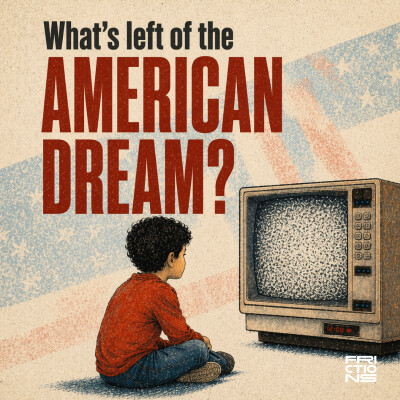
Before it was a country, before it was a shape I could point to on a classroom map, before it was even a place I imagined I might one day set foot on, America was, to me, a light. A light that hit my childhood eyes straight through an old boxy TV. No remote, just that low buzz in the living room of our damp little apartment in the suburbs of Paris. It's the late 80s. I don't have brothers or sisters. Not many friends coming over after school either. Maybe because I'm the only Arab kid in my class. Maybe because my parents come from Algeria, and our home runs on a different clock. My father comes back from work tired, barely speaks. My mother moves carefully around him, bracing for one of his sudden bursts of anger. At home, we speak French. We don't speak much, at all, actually. I become really fluent in one language. Silence. So I wait for Wednesdays, I wait for the light, and I wait for America. That country that isn't a country yet opens up worlds for me. Promises adventures, car chases, MacGyver, and his almost magical ingenuity. Arnold and his gimmicks. And Zack Morris. Walking the pastel hallways of his California high school. Looking straight into the camera. Straight at me. As if he could see me. Even the cartoons feel real. It isn't quite a dream yet, but it's already a refuge. A brighter, more colorful version of the world. Like Michael Jackson. His songs are movies. When he dances, he seems to fly. He feels like fiction that slipped into reality. There's something deeply reassuring in these stories. The universe seems to conspire in favor of outsiders. The nerdy boy with glasses. The new girl in town. The black kid, often, as long as they hold on. as they stay brave, as they stay true. This is the manifest destiny. My mother, even on her grey days, talks to me about merit, about perseverance, about a fate already written. She believes in God the way people wait for a happy ending. One summer, on vacation in Algeria, my father gets sick. When I start first grade, I'm already behind. The school says it's too late. She doesn't argue, she acts. She teaches me how to read and write. She takes me to the library. She gives meaning to hardship. Maktoub, she calls it. Destiny. Manifest destiny. Same fight, right? The American dream feels almost personal, like an optimistic translation of the story my mother wants to pass down to me. Deep down, even superheroes are just ordinary people waiting for someone to call them. Waiting for a chance. Like my mother. Like Mask, that cartoon where ordinary people climb into ordinary cars. And then the alarm goes off and everything flips. A door lifts. A helicopter rises from the hood. A mask clicks into place. Hidden powers are unlocked. A coalition is formed. Every mission is the same. Protect peace. Punish the villain. Stop the chaos. All you need is to be ready. All you need is to believe. January 17, 1991. Mask is no longer a cartoon.
- TV news
Unless Saddam Hussein withdraws from Kuwait by late winter, the U.S. will go to war. The Bush White House now says war with Iraq could begin at any moment.
- Walid Hajar Rachedi
So that's the new plot. A familiar villain. Same outfit, same moustache, now with a new name, Saddam Hussein. They say it's Baghdad. I don't see a city, just black sky, green flashes, blinking explosions. It looks like a movie, except it's live. TV showing TV. The pictures come from CNN. First time I hear that name.
- TV news
For more than 40 years, CNN has offered a front row seat to history in the making.
- Walid Hajar Rachedi
It goes on for days. I watch. Then I get bored. I want my Wednesday program back. A sure thing, at least. We're the good guys. Saddam has to be stopped. That's what school says too. France is part of the coalition. But one evening, my father, who never talks about these things, says, that is what you call a man. A real man. The Americans don't know who they are messing with. Suddenly everything blurs. He's not watching the same story I am. I look at him. He has the same mustache as Saddam. Maybe that's why. At home, on the wall, there's that big frame lined with seashells. Inside, an old bearded man praying in the desert. Mecca, holy ground. I start imagining Iraq like that. Algeria too, even though what I know best is Algiers, the coast, the beach.
- TV news
During his speech, he declared it was time to turn the page and to focus on problems back here at home in the US.
- Walid Hajar Rachedi
The war ends the day after my father's birthday. He's 44, the age I am now, speaking into this microphone. My mother overcomes her fear. She shakes up the Maktoub. She manifests her destiny. We move houses. And I don't know what to think anymore. Childhood gives you certainties. You spend the rest of your life unlearning them. About America. About everything. The program resumes. As a teenager, the setting changes. We live in another suburb, further from Paris. More working class and immigrant families like ours. And the images from America take up even more space in the world and in my head. At 13, I've got Air Jordans, a Chicago Bulls cap, a poster of number 23 above my bed. And I've never watched a single NBA game. In my 90s mixed banlieue, Michael Jackson is fading. Hip-hop takes over. It turns anger into punchlines. It teaches the eye to think we. At the movies, La Haine is a hit. But Boys in the Hood feels closer.
- Boyz N The Hood
Turn ed on the TV this morning. Had this shit about Living in a violent, a violent world. Showed all these foreign places. Started thinking, man. Either they don't know, don't show, or don't care about what's going on in the hood.
- Walid Hajar Rachedi
As the years go by, the books I read change my gaze. My world gets bigger, more political. What used to feel like a dream becomes something else. A lens. America isn't a model. But it has this strange power. It turns its margins into its center. It turns its rebels into icons, even the most controversial ones.
- Malcolm X
Bring about the freedom of these people by any means necessary.
- Nirvana
You know, it's really hard to believe everything you read.
- Walid Hajar Rachedi
Back in France, the contrast feels sharper. After the Black Blonde World Cup euphoria fades, the kid from the banlieue is still the anti-hero. In my early 20s, the light flickers. The screen goes dark.
- TV news
What came down? The crash. The other train center is down. It's down. 9-11.
- Walid Hajar Rachedi
America doesn't want to inspire anymore. It wants to punish. The other face shows up. Hard. Loud. Brutal. Sometimes it scares me. Sometimes it makes me sick. Especially when I see the photos from Abu Ghraib. Prisoners humiliated, tortured, stacked. And the torturers look like kids. In the media, Arabs become Muslims. And Muslims become the problem. Sartre said the anti-Semites invent the Jew. Du Bois called it double consciousness. I feel it too. The one I think I am. And the one I become in other people's eyes. Meanwhile, rap falls in line, get rich or die trying. And me, I'm prepping for business school, even though I secretly want to write. I spend a year in Mexico during my studies. I can breathe again. Before leaving, I visit the US, New York. For the first time, everything feels familiar and foreign at the same time, like a TV set. Back home, I find my father watching the shaky images of Saddam Hussein's hanging.
- TV news
Saddam, as we said, dressed in this raincoat, black suit. With his feet and hands tied, being taken from the execution room to the gallows, he is now being told that he can have the hood, but he refused that. He went to the rope...
- Walid Hajar Rachedi
It's aid, he mutters. The Americans got their sheep, and I wonder, will I ever hear just one version of the story? And who gets to decide which one you can tell, when I land my first job in New York? At 25, I think this country can't surprise me anymore. Until November 4th, 2008.
- TV news
Barack Obama, in the AP count, has been elected the president of the United States.
- Walid Hajar Rachedi
Barack Hussein Obama is elected the 44th president of the United States. His name alone says it all. It sounds like America trying to speak again to the rest of us. That night in Harlem, people cry. It feels almost too intimate to witness. I get my picture taken under the Malcolm X Boulevard sign, as if I, too, had some tiny part in this story. The emotion peaks when, on the giant screen, Obama says,
- Barack Obama
If there is anyone out there who still doubts that America is a place where all things are possible, tonight is your answer.
- Walid Hajar Rachedi
I am moved, because when he says that, I hear his Kenyan father in it, the one he wrote about in Dreams from my father. Because these dreams, like the dreams of anyone who lives home in search of a better life, feel, in some way, like my father's too. And I still don't know what to do with them. The child is far away now. The teenager isn't dazzled anymore. The adult tells himself, He understands this country's original sins, war, injustice, segregation. And yet, for a moment, I want to believe again.
- Barack Obama
Tonight is your answer.
- Walid Hajar Rachedi
15 years later, I can barely believe that night ever happened. I'm not even sure what it meant, what it changed, what it left behind. On both sides of the Atlantic, Old myths are cracking. Newcomers, refugees, migrants are cast as a threat. Children of immigrants like me are told, you can stay, but you will never truly belong. In the US, Donald Trump's return to the White House is the sharpest symptom.
- Donald Trump
They're poisoning the blood of our country. That's what they've done.
- Walid Hajar Rachedi
In France, the far right set the tone of the debate. My path owes a lot to France, and even more to my parents' sacrifices, but also, surely, to a certain audacity sparked long ago by the light in our living room. Without America, I might never have dared to leave my comfort zone, to live elsewhere, to walk away from a profitable career, to write. I've been lucky to travel. My map has stretched. And yet every time history speeds up, like everyone else, my eyes still turn back to America. And maybe that restless pull is what brought me to Atlanta, Dr. King City. This black mecca, where America's contradictions may be more embodied than anywhere else. A city where a black elite thrives, where HBCU's campuses shine, yet poverty and exclusion still have a color. It's also a place of arrivals, from other states, other countries, other hopes. I was there during the first hundred days of Donald Trump's second presidency. A moment of shock that tested everything I thought I knew. I met people still living the dream. People questioning it. And people who've never believed in it. This podcast was born from those encounters. Not a verdict, not a lesson, just a crossing. An exploration of what might still be worth dreaming. And for me... What remains of that childhood light I once mistook for America? In other words, one question as simple as it is hard to ask, what's left of the American dream? An audio documentary by Walid Hajar Rachedi.
- FRICTIONS
You've been listening to All Identities Combined, the podcast that explores our singular stories Produced by Frictions. Find all our stories on our website, frictions.co.