- Speaker #0
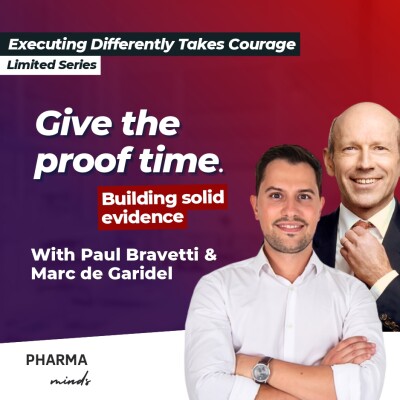
I wanted to place this episode between Paul Brevetti and Mark de Garadell in fourth position in this mini-series on execution. Because it actually represents this moment of truth in execution, when resources are limited, when science is not enough, and when every decision can be the one that makes a company live or die. In early stage biotech, execution is not just a performance discipline. It's a survival discipline, and that's what Paul Brevetti and Mark de Garidel highlight. It's something radical. Executing is first and foremost about choosing. And choosing means accepting not to do everything and above all sticking to it. After markets, systems and geographic areas, we thus arrive at this barest level of execution. Two people, science, a question of how we finance and what we believe in.
- Speaker #1
You don't die from dilution, but you die if you don't have cash. You have to know how to raise money when you have good news. You don't sell yourself, you get bought out. So if you're ultra focused all the time on your exit, you'll become a weathervane looking for opportunities and you won't really develop your core business.
- Speaker #2
It's that the better you develop the company, the more likely you are to be acquired.
- Speaker #1
We were one of the few oncology biotechs to have done this Series A last year, and it was extremely complicated. Now for us, the point is that we still have enough to see what's coming. This allows us to enter in good conditions to anticipate a future Series B, where we still go through storms, including Abivox.
- Speaker #3
This episode was recorded with the support of Breenis Pharma. Hello everyone, welcome to this new episode of Pharma Minds. This time, I don't have just one guest, but I have two. Here we go, who should I start with? With Mark, let's go. Priority to the most experienced. Marc Garadel, the CEO of Abivax. Well, we're introducing it again, but there you go. Abivax is a French biotech that has its products in phase three beautifully. Hello, Marc.
- Speaker #1
Hello.
- Speaker #3
And then Paul Brevetti. Hello, Paul.
- Speaker #1
Hello, Nathalie.
- Speaker #3
Paul, who is therefore at the head of Brainers Pharma, an oncology biotech, starting its clinical trials. Very proud to be starting these clinical trials.
- Speaker #1
Exactly. Very excited about these moments.
- Speaker #3
Great. So what I suggest we cover today is innovation, valuing innovation. We'll talk about financing. We'll talk about execution and then end with... the best part, leadership, knowing how to hold the helm in these good times and also in these storms. To value innovation, I'll start perhaps with Paul. Do you want to present your science to us a bit? What is it?
- Speaker #1
What do we do? Okay, absolutely. I'm the CEO of Brinus Pharma. So we're a startup from Lyon that develops new modalities in oncology. Our modalities are called in vivo immunotherapies, meaning we're able to educate the patient's immune system in vivo directly so that it can then target tumor cells that usually escape it and allow them to be destroyed as soon as they appear. So it's true that we're working on... what can be called disruptive technologies, even if it's sometimes a word that's a bit overused. We're on first in class, so purely innovation with all the challenges related to innovation. When you're a first modality, there's always ultimately a doubt that can set in. It's never been used in humans. And so right now we're in an extremely exciting phase for us because we've started our first clinical trials in humans in France and Belgium.
- Speaker #3
One might tend to say it's easy for you, you're first in class.
- Speaker #1
No, I think it's rather the opposite right now when you're in an economic context where you're looking for de-risking.
- Speaker #3
Super interesting. And Mark, then, the science on the Abivax side?
- Speaker #2
Abivax was the discovery of a remarkable molecule that essentially promotes the expression of MIR-124, which is a type of micro... This molecule's main mission is to temper and regulate inflammation.
- Speaker #3
There's also disruption.
- Speaker #2
It's also... It's a first in class. And so with all the anxieties there have been until now, because the environment is difficult, the economic environment, and investors don't really like things that are a bit disruptive.
- Speaker #3
It seems a bit counterintuitive. You think if you want to make a difference, you actually have to go for disruption. You have to go for new things. But in reality, how do we manage that? How do we manage that?
- Speaker #2
Well, we manage above all well. We have to try to get results fairly quickly, then try to clarify the science and show that as we progress, we're actually de-risking the molecule's progress and making it more and more interesting for patients.
- Speaker #3
So that means you have to start well with your innovation, try to provide evidence that meets the standards, which are very reassuring. Is that it? How do we go about it?
- Speaker #1
Yes, absolutely. I think you have to... You have to try to anticipate these different milestones and decide how to invest to reach them. Well, given this context again, which is a bit more complicated financially, you really have to prioritize. You can't go in all directions. Fundraising is also lower, so there's less possible investment too. And maybe to go back to what you said about it being counterintuitive, I don't think it's counterintuitive in the end, because an investment fund isn't really there just for pure development. It's actually there to help de-risk things and to invest when it honestly feels like it's going to work. What's a bit counterintuitive is that you sometimes see a gap between the current scientific consensus and investment funds. And that's because, given this context, some investment funds have spent a lot of time, well, working on reinvesting in their existing lines. So maybe a bit less time to go to conferences and stay informed. And in parallel, we also see many pharma companies that help guide us on, well, what the future is, where we need to take our innovation to also fit the criteria and not stray too far from what's expected.
- Speaker #2
And that's one of our future advantages. We're going to enter a market where, especially when patients are very young, they're diagnosed at age 35. They don't want shots. They don't want infusions. And taking a pill once a day is much easier.
- Speaker #3
Right. So we should bet on molecules like that?
- Speaker #2
No, but it goes back to what we were saying. You have to accept that when you make first-in-class products, well, development is never very linear. We move forward. We don't have all the answers at the start, right? And so you need solid people. You need, well, you need solid. You need solid investors to appreciate that, well, not everything will succeed on day one. But we learn, and as we learn, well, we get closer and closer to the right goal.
- Speaker #3
Right. And at what point do you think about market access?
- Speaker #2
Well, I think there are obviously several stages. Basically, it still needs to be the technology, yes. But the principle of what we do, we still need an assessment, at least at a high level, of the therapeutic interest. And for me, the major milestone is still phase two. In my opinion, it's phase two that will determine everything.
- Speaker #3
That's right. The design of phase two and how we're going to look at it.
- Speaker #2
The design of phase two. the characteristics, which population we're going to target, and so on. And that's where differentiation becomes, in my view, essential. And it starts in phase two. And so the importance of phase two, as a result, we probably need to do a phase two that's a bit larger than one might think. It also de-risks phase three, because phase three trials, the costs are much higher. And so everything is decided in phase two, in my opinion.
- Speaker #3
Right. And Paul, entering phase one, do you start to see who will be there, well, eventually in phase two?
- Speaker #1
For us, from the very beginning, actually. From the start, meaning if I take the market access in a perhaps slightly broader sense that is with all the CMC development part and the manufacturing platform. For us, it was kind of Brennus' DNA. One of our co-founders actually comes from pharma development. So when we talked about trade-offs, we invested very early too. And it was perhaps a risk we took as well in the CMC platform, in the standardization parts. And now I think it's actually, it's turning into a positive point, in fact, in our project. Yeah, these are issues we've invested in heavily right now. Yeah.
- Speaker #3
Thinking what? Thinking that it will stay as it is or that we also need to be able to bring creativity at the very end of the line?
- Speaker #2
Well, in any case, creativity, it also comes based on the results we get. You know, it's still the results that dictate the value. And it's true that, for example, in oncology, all the combinations, the question of choosing which is the right one, what will be complementary to its mechanism of action to enhance efficacy and also try to maintain tolerance at the best possible level. So all of that is also a bit of an art as we go along. We move forward. And that's also what's extraordinary is that we shape. The product shapes itself over time through experiences. But the part highlighted by Paul is very important. It's indeed the CMC. It's that very often, especially in oral drugs, well, small molecules, it's less true because generally they're easy to produce. But in everything that is, let's say, in the living world, CMC is kind of the heart of the reactor. And I remember a talk, it was the head of Novartis, it was Vass, who said, for example, in business development, 70% of the deals they look at for potential collaboration or to buy a company. 70% of the deals don't happen because of the manufacturing part, because small companies don't master this production part well and don't guarantee that the product can be manufactured consistently without issues.
- Speaker #3
And the newer and more complex the technologies are, the more it actually requires...
- Speaker #1
To educate people. Also to explain, because inevitably you've bet on tests as well. Since you're using technologies that don't necessarily exist, you have to guide your CMC too. Fortunately, you have pre-meetings with regulatory bodies that also allow you to anticipate these issues.
- Speaker #2
So...
- Speaker #3
To wrap up and see what we can take away from this innovation valuation phase, it means you need a breakthrough innovation, but be able to de-risk as much as possible. To write the de-risking plan, that's it, as early as possible, right?
- Speaker #2
Yes, yes. And then work with health authorities very early on, especially if we're really dealing with breakthrough innovations.
- Speaker #3
Come on, I'd like your main takeaways for this part on how, what should be kept in mind to properly value an innovation.
- Speaker #2
It's a bit like what we said, I think. Work well with health authorities early, clarify, clarify the added value of what we're going to do. have a plan that de-risks what we do over time and still have the support of the cores and the because it's obvious that that the medical establishment must support what you're doing you know yes and then actually anticipate milestones that we think should happen later because in the end we have collaborations and deals happening earlier and earlier actually you
- Speaker #3
have to be ready yeah okay okay we can move on to financing uh here too you've each opted for a different strategy one is listed one is private how was this choice made who Who wants to start?
- Speaker #2
No, but everything starts in private, you know. All companies basically don't start out listed.
- Speaker #3
I see.
- Speaker #2
Yes, it's actually very rare, even if a few years ago in 2020, at least in the United States, there was a bit of significant optimism and very early stage companies were listed. But generally speaking, the progression is that you're funded by private investors, who, by the way, have slightly different profiles as we move forward in the development of the molecule and the company. And then indeed, there's a moment when you have to know, do I go to the stock market or not? And the main reason people go to the stock market is simply because the increase, the financing needs increase enormously. And so it's easier to raise money when it's listed. And also it allows investors who have been there for five, ten years sometimes to be able to exit and let others in. There you go. So that the, let's say, virtuous cycle of development continues. So that's the main thing. But we all start as a private company. And then as we go along, the question is, do I stay private or am I listed? Abivax, we did it in two stages, you know, because we did it in 2015 on the first human trials. At that point, it was listed on the Paris Stock Exchange. The company raised roughly 60 million euros.
- Speaker #3
Right.
- Speaker #2
Then on a slightly larger scale, a few years later, we did the NASDAQ. It was roughly four times that amount.
- Speaker #3
And was that timing basically the right one, the timing to follow, meaning doing it once at the start and once later on?
- Speaker #2
Well, I think one of the rules, and in my opinion, that's where we in France need to learn. Because if you take the example of Abivax, what should have been done was when we had good results. So from phase 2B in 2021, at that point, we should have gone to the NASDAQ to raise a lot of money. And when you have good clinical news, when you have good results, it's always the right time to raise money. Even if some... Investors don't like dilution. You don't die from dilution, but you die if you don't have cash.
- Speaker #3
Die of hunger.
- Speaker #2
So you have to know how to raise money when you have good news. And then once again, the question is, if you want to go to the public markets to do a listing, then it's actually prepared one step ahead. You have to do a fundraising round with investors, known as a crossover in the industry jargon. So these are investors who will anchor the success of the IPO, who will not only put money into the final private round, but they're the ones who will ensure that when you do the IPO, they'll guarantee. that you'll have at least, let's say, 80% of the amount available, which helps attract other investors. Okay, so those are generally the steps.
- Speaker #3
And okay, and when that hasn't been done, for example, with positive phase two results?
- Speaker #2
Well, because for Abivax, there was a lot of enthusiasm because the results were very interesting. And I think at the time, the board of directors thought that they could sell the company, but they didn't sell the company and the cash dwindled over time. There was phase three to launch. It delayed the launch of phase three. Well, it's surely these are decisions that with hindsight, you realize. Dilution, of course, it's not very pleasant for investors to raise more money, but not having any money is even worse.
- Speaker #3
And this decision to want to sell it too? To want to prepare a company for sale? Well, we know Mark's opinion, but...
- Speaker #2
No, but once again, from my point of view, wanting to sell a company is a mistake. Well, on the...
- Speaker #3
From a philosophical standpoint, right?
- Speaker #2
Yes, because in fact, the great danger when you're obsessed with selling is that when you develop your company, you'll do things thinking, well, I'm not going to do that because we're going to sell the company. Best. Well, I'm not going to do that, etc. and as a result, what happens is you don't develop the drug properly. Now, the mission of a biotech company is to try to advance a good drug as much as possible, even if it means marketing it, and that's the mindset. You have to try to do everything well. If you start telling yourself, dreaming of making money by selling your thing, well, I can tell you it's not a very good thing. And besides, my personal experience is that the better you develop the company, the more likely you are to be bought, because big pharma, precisely, they want to de-risk. They don't want to take experience shows that developing a drug is already very risky. Only one in 10 products that enter human trials actually ends up being approved by health authorities. So my advice is to develop your thing well, make a good drug, and then whether you market it yourself or through another lab, that's a secondary question.
- Speaker #1
I completely agree with that. There's an important phrase, you don't sell yourself, you get bought out. If you're constantly hyper-focused on your exit, you'll become a weather vane chasing opportunities. And you won't develop your core business, which is what creates your value. I think that's a fundamental point. Now, there's also a need and investment funds push you to do it. We were talking a lot about equity story. You also have to work on it, of course. Your exit story, you have to know where you're going. I don't think that should be what dictates your investment decisions.
- Speaker #3
But then the Abivax example, maybe they also tell themselves, actually, we won't know how to do it. I mean, our expertise ends there.
- Speaker #2
It's true that once you reach commercialization, it becomes a different matter.
- Speaker #3
Even executing a phase three.
- Speaker #2
Yes, absolutely. Some might have said it's too big a leap forward to do it ourselves. And that could justify an exit. But that doesn't change the fact that money had to be raised anyway.
- Speaker #3
Yeah, to make something substantial.
- Speaker #2
To make something more substantial. To be, in any case, in a strong negotiating position with big pharma.
- Speaker #3
To actually face them, exactly.
- Speaker #2
Yes, because in any case, it's all about negotiation.
- Speaker #3
Yeah.
- Speaker #2
You always need to have money in your war chest. When you do a dual track, it also shows that you're capable of doing it on your own too.
- Speaker #3
Doing it yourself, you know, you increase your valuation on one side.
- Speaker #2
It's a bit of a power struggle.
- Speaker #3
So regarding that, what does it mean? Does it mean it's a matter of competence? Is it about being well surrounded? Is it a matter of mindset? What is it?
- Speaker #2
Well, I mean...
- Speaker #3
Clinical results too. I mean, having the results, of course.
- Speaker #2
Yes, yes. But then it's true that if we want to list, if we go back to the listing, it's true that it's still a major change for the company in the way it operates. You are forced to do reporting. You're constantly with financial analysts, with investors. For Abivax, I spend, well, obviously our reputation is now global, but I spend more than 50% of my time. I spent all of last week, I was in Miami, I was in New York. I'm in demand every day, almost every afternoon. I spend my time with investors. So it's still a fairly sudden change in there. And so... That's why when you do that, you need to have teams below you who are as competent as possible to move the projects forward.
- Speaker #3
Right, okay.
- Speaker #2
Honestly, otherwise, I'm not the one moving things forward much, even if I oversee a number of things. But the transition in any case to listing also has, you need a very good chief financial officer. I mean, it's a whole operation.
- Speaker #1
There are accounting standards and so on. Then it costs money too. You see, as a private company, we naturally asked ourselves about listing. Then, even if at the time of the Series A we did last year, ultimately the economic market on Euronext was catastrophic. And so then we didn't want to chase the listing. So it was clearly set aside. Then there's always the part where we list on NASDAQ at some point, because ultimately that's also what allows you to sustain. And as you said, to also very quickly increase your financing capacities and much faster than on the private side. Now, it costs a lot of money, too. So you have to look closely at the company stage of development. For us in phase one, it's too early. It's too early. But it can remain an open option, indeed, in a dual track, triple track, too, which can be set up in the future.
- Speaker #3
And this milestone, is that it? Going to Nasdaq, it becomes almost mandatory, right?
- Speaker #1
That is to say that, well, if you take Abivax, when we looked into raising a lot of money, we had to raise at least $250 million because of phase three.
- Speaker #2
We made a list of investors worldwide. It was still quite oriented towards the US and Europe. The banks helped us. Out of 200 investors, 180 were in the United States. So you can do a lot in Europe, but you are very limited. If you want to raise fairly large amounts of money, going to the US is almost indispensable. Now, there's also the Hong Kong Stock Exchange, which is growing thanks to Chinese development too. But the preferred route is NASDAQ. That's where you have the best analysts. That's where you have the best investors. That's where you are faced with the toughness and the high standards of those people.
- Speaker #1
And that's where you grow the most because, you know, when you're dealing with these investors, you learn a lot and they've been through so many stories themselves. They've seen so many things and it makes you stronger, obviously. Right. And then there's also the question, even beyond that side of things in the United States, it's about when a biotech should set up in the States, even with a headquarters. So for us, we've really asked ourselves that question. We also looked at, well, how much it would cost us. So it's no secret, right? If you set up in Boston, you'll have fixed costs that are quite high from the headquarters, from the... From the employees you're going to hire on site. So what we've put in place is a sort of soft landing. So in fact, we've set up collaborations on site. We have independent board members too, who are part of Brenus and who, well, are based in Boston, based in the US, and will also, well, be able to echo what we can do in Europe. We're very, very present there too in the end. I'm very present in the United States. And I think for us, the right time will be when we have the IND from the FDA validated. So we made a submission, a submission recently. We might have one in Q1, 2026. So then we can ask ourselves, say, well, now's the right time to enter with a clinical trial. That's also starting in the US and to start investing.
- Speaker #3
And going back to the stories of dilution, of loss of control, how should that be looked at as well?
- Speaker #2
Well, that's a dialogue between the investors on one hand and the management, right? The management itself is mainly there to execute, to develop the drug. The investors, it's up to them to exactly to agree among themselves and then to have this evolution. compared to, once again, those who arrive and are more specialized in early stage, in early development, from those who are more into the scale up, because each one, once again, brings their skills. And so everything is actually in the art of progressing, since as the company evolves, it's a team effort, you know, the development of a drug. There's obviously the management team and so on. There are the doctors, the centers and so on. But the investors, they have a lot of added value to bring as well. And what's needed is to try to find... exactly, a syndicate of, as they say, investors who also get along well, because sometimes they can also butt heads a bit from time to time. And that's not good for the company. And it's not good for the management. It's not good for the product either.
- Speaker #3
They have to buy into a project, basically.
- Speaker #2
Yeah, they have to buy a project. Exactly. They have to...
- Speaker #3
The story has to be clear and they have to either want to go for it or they leave.
- Speaker #1
Exactly. But the question of valuation is quite complex right now in the early stage. Because you have many, many companies that are in liquidation, so they're raising funds to replenish their coffers. So they're more or less forced to lay themselves bare, actually, in terms of that, which also has an impact on the valuation environment, actually. And that means that, well, you're pulled down a bit, even if you have an interesting tech, even if you're quite well-founded to begin with. And so, indeed, this question of not diluting too much becomes important because afterwards you have valuations, you're starting from very low. Now, you also have milestones that have comparables. So you also managed to try and say. Now, OK, we might do a big raise, but we'll tranche it. We'll try to agree that if we reach this milestone, there will be a valuation gap. Currently, it's more about trying to avoid the downside that's happening. But I hope that in the coming months we'll return to a positive period. Indeed, it's a question. It's a delicate balance to maintain between your investors and your future investors, too. And the funding needs you have, you know.
- Speaker #3
And so to protect yourself from all that, it's...
- Speaker #1
Protecting yourself isn't very easy.
- Speaker #2
If I look back at history, what happened was in 2020, there were all the investors who were, let's say, in early stage, who made a lot of money because they exited. Companies did IPOs at astronomical valuations. So then those investors, they were very happy. Those who bought, those who continued the story, they bought at extremely high valuations. And what happened? Stock prices lost more than half their value. And so eventually it's a bit like Paul described, the valuation of private companies. Because of those 2020 excesses, public investors got burned because they still lost more than 50% of their value. We tell private investors now, when you come in,
- Speaker #3
you're starting, yes.
- Speaker #2
Yes, so all the private valuation rounds have readjusted to this minus 50%. So even if the private company was adding value with new milestones, the new investors to fund the cycle would say, yes, you're very kind, but we took a real hit with past excesses. And so we're going to come in at this level. So it's this period that's very difficult. which precisely requires efforts from investors to do what we call down rounds, which isn't pleasant for anyone, and it's worse for management, who are trying to develop the thing, moving it forward, and in fact the company's valuation doesn't happen because of these historical problems. But for a few months now, we feel the market is starting up again, the public market, this year the biotech market, the XBI index is doing better than it's the first time in a very, very long time. we can hope that for private companies, valuations will start going up again and enter a slightly more virtuous cycle.
- Speaker #1
And then also thanks to Mark's efforts, Abbevax, you have an exceptional valuation currently. It also acts as a bit of a French spearhead. It helps put France back on the global biotech map. And inevitably, it's true, when you talk to American funds, you have these topics that can come up. Well, yes, you French biotechs, you also manage to do great science, great technology. We pulled Abbevax up. Also with the AMOLED story, which gave us an interesting international resonance. I have a lot of hope too that valuations can go back up in our sector.
- Speaker #3
And what's the, I don't know, the lesson to learn so that it doesn't happen again?
- Speaker #2
It's complicated because these are market effects and so on. But in any case, we've still gone through, well, a period of excess. Excess is never good, you know. There was a period of excess where we sold a preclinical idea. We hadn't even treated a monkey. And we'd say it's going to revolutionize medicine. And then...
- Speaker #3
What's the problem? Is it that people want to buy it or people are selling it?
- Speaker #2
No, but it's true. No, but it's no, but there are people. And that's true in the United States, maybe even more, who sell wonderful stories, who know how to do that. And, you know, some investors do get... Well, they can get caught up a bit in this sales pitch, let's say. The factory means that it's a fantastic sector. Value creation, we see it, for example, with Abivax, but with other companies, it can be, well, it can be massive. If you really develop a great technology that has, that's going to help patients survive or feel better and have a better quality of life, well, there will always, it will always be rewarded. The only thing is that the pathway, in the meantime, it's a bit, a bit winding and a bit chaotic.
- Speaker #1
That's it. Yeah. And that's how you lose your hair, you see. No, but it's. And actually, you have to stay the course, because it's true that over these last two years, it's been extremely complicated. And those who were able to keep their heads above water, well, now, finally, it's filtered out a bit. You know, what was happening between what was great tech didn't have much of a fundamental basis behind it to allow it to be applied. And I think that now we're reaching a point where precisely those who managed to keep their heads above water by various means, they're going to come out stronger because they'll be a bit more alone on the market in the end. And there is indeed capital present again, so there's also a need to invest.
- Speaker #3
From what you're both saying is that there are still actually some ongoing challenges, but it also allows for progress too. It's that it also allows everyone to become more professional and to explain that, in fact, you can't like just show up believing only in your science, or maybe that's the lesson, I don't know, regarding funding.
- Speaker #2
Yes, what doesn't kill you makes you stronger. As long as you're alive, you have hope. And we're getting stronger and stronger, you know.
- Speaker #1
It forces you to always have this awareness of trade-offs. So it's true that I think when you do Series A rounds of over 150 million. You can say, well, I have my platform, I've invested a bit everywhere, and then we'll see how it goes. Well, no, you can't do that.
- Speaker #3
Yeah, being selective, right?
- Speaker #1
Extremely selective.
- Speaker #3
And focused. Well, that's what we see in any case that gave Abivax the chance to be ultra-focused. Are these things to keep in mind and to think about?
- Speaker #2
I believe in it a lot. I learned that at Amgen. We were up against, we had Johnson & Johnson, Roche, and so on. Against us, they're fantastic companies. And we realized that when you're well-focused, when you're really close to the doctors, when you develop good science, when you only do that, you're better than the others, because simply they do lots of things at the same time. and days only have 24 hours. And so if you spend more time than the others, besides if you listen to Elon Musk, that's what he says too. What he says, a big part of his success is while they work six hours, I work 12 hours because I work on the same thing and we do better than the others. So I really do think that focus, you know, it still has some truly great virtues.
- Speaker #1
I think Mark said it all. We don't have a choice.
- Speaker #3
But for you, having both a drug candidate and a platform, is that also two things?
- Speaker #1
Absolutely. It's deciding when to develop our lead asset to the max, because on the lead asset, you can also do indication extensions. We have a lot of potential on the first asset. And then afterwards, you also have to be able to show that you can replicate the success or pivot if needed with your platform. So you also have to find the right balance in how far to advance your other platform assets to at least, and in my view, show proof of concept, even if it's just at the pilot stage that your platform is really there. It exists and it will support what's next.
- Speaker #3
We were still talking about money, which is in limited supply. How do you have ambition and at the same time stay frugal? Are there choices, mistakes and choices in resource allocation? Or where you say to yourself, actually, I didn't do it well?
- Speaker #1
Resource allocation is one of the big topics, I think, especially for the CEO, the general manager.
- Speaker #2
Because it's true that the temptation is always to do quite a few things. There are always new projects, new ideas. And so you have to be extremely disciplined about resource allocation. Then regarding the means themselves, well, people travel in economy. It's for sure that when you come from big pharma and you join a small company, for example, it's quite a shock because the number of people working for you, you do things yourself, you book your own flights, you do your own stuff. But well, sometimes it takes awareness. Money matters. It's not meant to be spent in nice hotels and things like that. I can tell you last year when we were at JP Morgan with Abivax, I can tell you that the hotel we stayed in, well, it was quite something. And it was still very expensive. I don't remember exactly. It was still $450 a night. But we could have gone to $1,000 hotels, which... wouldn't have been much better actually. But there you go. You have to be careful because it's not our money. It's the shareholders' money and it's for developing my drugs. So you have to be careful, but stay focused. Now I say this all the time. You have to spend your money on things that really make a difference and the things that don't make a... So for me, that's the number one criterion. Is this going to do something for the patient? Is it going to change the company's trajectory? If so, then yes, you have to go all in. Otherwise, rest.
- Speaker #1
Then the other difference is that, well, if you don't have a budget, you don't get paid either. So there's that too. So you're forced to prioritize everything you're going to do and you can't hide either. Meaning all the choices you make are, of course, discussed with the board, discussed with your colleagues. But it's you as CEO who makes those final choices and who must bear the responsibility for them. So it also involves, I'd say,
- Speaker #3
everything you do. Yeah, the future of the company. Cost control is about being able to adapt as well. To bring big pharma experience to a biotech, you also have to learn.
- Speaker #2
Oh, yes. But that's the charm of what we do. That's what's great about our jobs. We're learning all the time. Every day is different.
- Speaker #3
Yeah.
- Speaker #2
And above all, it's this drug that you see in patients and that's going to change their lives.
- Speaker #1
It's truly extraordinary.
- Speaker #3
Thank you both. We've had two visions of life and company journeys. Thank you. If any listeners have questions for you, who wants to offer their help?
- Speaker #1
No problem at all. On LinkedIn, it's fine.
- Speaker #3
Thank you.
- Speaker #1
And thank you, Natalie. Thank you very much.
- Speaker #3
The learning from this episode comes down to three formulas. Well, first, you don't die from dilution.
- Speaker #0
You die if you don't have cash. I think that's the strongest formula. But we also understand that 70% of deals don't happen because of manufacturing. And also that you don't sell yourself. You get bought out. We understand that making choices, owning them, knowing when to raise, not losing sight of what really creates value. That's what comes out of this discussion. In the next episode and final episode of this series on execution, we're changing gears completely. I'm taking you away from structures, financing systems to go towards something much harder to measure and much more essential. That moment when execution, in fact, simply becomes a personal act. Patrice Zagamin talks to us about commitment or more simply about what we're really ready to put on the line.
![[Insights] Produits frontières : transformer la réglementation en avantage stratégique cover](https://image.ausha.co/DxYZ9g83tTEC6Wr39rcUpzpTWcQsUBjd7hU5AZsG_400x400.jpeg)
![[Insights] Groupements de pharmacies : ce qu’il faut retenir du rapport IGF-IGAS, avec Hugues Villey Desmeserets cover](https://image.ausha.co/UgNUSqEle2cZH1rOVklykwyk35Rz2q4seXKVMgWM_400x400.jpeg)
![[EXTRAIT] Une innovation en prévention qui inspire jusqu'au Danemark... avec Anne Beinier cover](https://image.ausha.co/PuxqczYfLjqCYtMRA0dqMcN77dzaY8CoGDnOnLF2_400x400.jpeg)