- Speaker #0
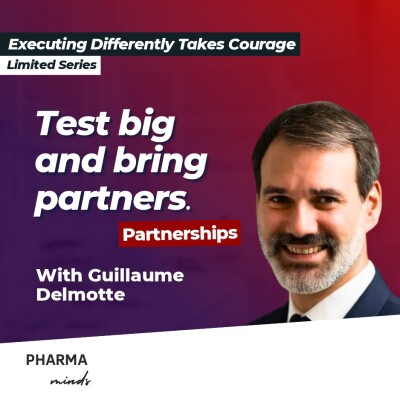
I've placed Guillaume Delmotte in the second position of this series on execution because he brings something that the other episodes simply don't have. To me, it's a systemic reading of execution. In China, execution isn't an individual decision. It's a mode of operation for the state. It's very centralized in its objectives and very decentralized in its application. And it's permanent in the testing. And what this model reveals has something fundamental to it. It's that large-scale execution is only possible when partnerships are built for the long term and when we accept to constantly reinvent how we reach the goal. So after Vincent, who spoke to us about staying the course, Guillaume shows us what happens when constant adaptation becomes the course itself.
- Speaker #1
So in an uncertain context, they might be stronger than us. It's a continual reinvention of the solution. The solution isn't unique, it's multiple and must adapt to the reality of the context. Asia is context. Context is the most important thing. So what they've created is digitized care pathways for all minor pathologies, the virtual hospitals that are certified with doctors who are connected. So there are players who have virtual hospital licenses, in fact, where it's as if you were going through a whole hospital, a care pathway connected to pharmacies. Plus, since they have the data, they plug in air to go even faster. So they have a playground where they play around with a lot of data. What is the technological ecosystem? of services, of companies already integrated into the chain and the flow of patient management. Instead of doing a partnership, we're trying to create an ecosystem.
- Speaker #0
Hello, everyone. Welcome to this new episode of PharmaMinds. Today, I'm very happy to be here with Guillaume Delmotte. Hello, Guillaume.
- Speaker #1
Hello. Thanks for having me, Natalie. Guillaume, why are you here today?
- Speaker #0
Because with a very international background, 20 years at Ibsen, including Europe, Russia, and China. And it's precisely this last stage that interests me most particularly. We're going to talk about China today. The goal of the conversation is to get a very detailed map of what's happening in China today from someone who's just back, who's just unpacked in Paris.
- Speaker #1
Exactly.
- Speaker #0
And who's going to tell us what he saw? I think he's seen a bit of the future of pharma. He's seen smart hospitals. He's seen how AI can transform a society. and also how pharma gets on board when it's in a society that's transforming. That's basically what I want to find out. Of course, around that, we're going to have a very interesting leadership journey, if that's okay with you.
- Speaker #1
That works for me. I've only been a witness to what I've seen. I don't know everything about China, but it's true that there are some quite interesting things for us to adopt or at least rethink probably in our societies and in this pharma world. Yeah.
- Speaker #0
Yeah. We can see that it's an emerging market.
- Speaker #1
China is still the second largest pharmaceutical market in the world with its own specificities. Over the last 20 years, there's been a technological leap, an economic leap in this country. It's worth taking a look at. And then we were talking about Shanghai as the New York of Asia. So we said, well, why not? Let's go for it. Let's go to China.
- Speaker #0
What year is this right before COVID?
- Speaker #1
That was November 2020.
- Speaker #0
2020, yeah.
- Speaker #1
The start of COVID. So I was appointed in January 2021. I've learned to take a step back. And actually for China, regarding this experience, you have to take a step back. They're used to navigating. There's also Guangxi, which is part of their daily work. Guangxi is the network. So there's the network, first, second, and so on. So they navigate the network. So the solution sometimes isn't technical.
- Speaker #0
Okay.
- Speaker #1
It's going to be a bit of relationship building that will definitely help to grease the wheels. So it's a continual reinvention of the solution.
- Speaker #0
So that means there are many possible solutions.
- Speaker #1
Exactly.
- Speaker #0
And that are also easily accessible to everyone.
- Speaker #1
Exactly. And then sometimes they don't imagine they can succeed at things. And then if we launch them, if we launch into a project that might be totally iconoclastic in a way, they'll go for it full tilt without asking questions.
- Speaker #0
Yeah, there's not too much reluctance. Yeah.
- Speaker #1
Exactly. Even breaking down the barriers they had in their minds.
- Speaker #0
Oh, yes.
- Speaker #1
Because the strength of this vision is that the solution isn't unique, it's multiple, and must adapt to the reality of the context.
- Speaker #0
Right, right.
- Speaker #1
You see?
- Speaker #0
Yeah, they're very used to...
- Speaker #1
Fluidity.
- Speaker #0
Okay, yeah, reinterpreting the context every time and clearing everything. Well, clean slate, blank page, and start over.
- Speaker #1
Asia is context. Context is the most important thing.
- Speaker #0
So they're strong right now then?
- Speaker #1
So in an uncertain context, they might be stronger than us.
- Speaker #0
They're confident.
- Speaker #1
But sometimes they can be paralyzed when things get circular as they reinvent a solution.
- Speaker #0
Yes, they take their time.
- Speaker #1
Optimization in progress is sometimes slowed down, meaning we start everything from scratch, even though...
- Speaker #0
Yeah, do you maybe have an example that you could possibly give me? When you say sometimes something iconoclastic, well, we can try them on that. And then after a moment, they finally say, OK, and they jump.
- Speaker #1
Well, I've had, for example, pricing is highly regulated in China with progression factors set by law. So a state rule written down. And one day, sort of jokingly, I said to them, what if we broke free from that?
- Speaker #0
What is it? What factors are linked?
- Speaker #1
We had one, three and six month formulations. So to simplify, let's say one, the three is three times the one. And the six isn't three times, it's 2.80. So it's a rule we have that comes from I don't know where. And so we wanted to launch a product in six months. We had to negotiate the price in 31 provinces. So it's a lot of work. And we were moving on to preparing for price access and so on. And I told them, what if we broke free from this rule? What if we invented a new one? Based, of course, on real world evidence data, health economics or whatever, to demonstrate the value offered over time. And so, well, once they got started, well, they managed to break that rule. Two or three accepted, and then through the network, they worked on the other networks.
- Speaker #0
So it kind of changed the local law a bit then.
- Speaker #1
It changed the local law, and especially now in tenders, it allowed us to strengthen the product value and not get caught up in the price drops of other formulations.
- Speaker #0
Yeah, yeah. Okay, so you, yeah, they invented a kind of new value model, a valuation model.
- Speaker #1
We cut the link between one, three, and six.
- Speaker #0
Yeah, yeah, by offering a different value.
- Speaker #1
Exactly. At least a different interpretation.
- Speaker #0
A different story. Yeah. A way, a vision.
- Speaker #1
So the official...
- Speaker #0
A different perspective. Yeah. Okay.
- Speaker #1
Interpreted the product's value, but outside the traditional scope.
- Speaker #0
They agreed to look at that. Okay.
- Speaker #1
And that's a continuous job of, well, negotiation, influence, reflection and interaction. Always ongoing.
- Speaker #0
So that means it's very close. Does it mean politicians are very close to, well, agree to be very close to... industry players to have that close contact? Or how does it work?
- Speaker #1
Well, what you have to see is that if I summarize China, to simplify it for everyone, China is like Europe in a way regarding a product cycle. You get a marketing authorization at the European level. In China, it's the same. You'll get a registration, so a marketing authorization for the market. And then once you've got the marketing authorization at the European level, you cascade it to each European country. which will have its own pricing rules and reimbursement rules. Well, it's the same in China. The only difference is that the price will be negotiated just once at the central level.
- Speaker #0
Okay, it's like a European price?
- Speaker #1
Exactly. We have a European price at the Chinese level. But after that, everything becomes the country's mechanics of interpretation and execution, meaning in each province we have to renegotiate reimbursement. a product status relative to the province's health policies.
- Speaker #0
Right, right. Oh, yes. Okay.
- Speaker #1
Getting the product into a tender. So on a marketing platform, it's like another country you have to plug into to get the trucks in. Then you have to get the product into the hospital level. Those are listings, which doesn't happen every day with, I'd say, a set number of products that can be present. So you have to bring one product in and practically push another one out.
- Speaker #0
Really? Okay.
- Speaker #1
Exactly. And so all of that multiplies. So this whole chain... means that in every province we had local market access teams, medical teams, of course, and commercial teams. By commercial, I mean distributors, distributor management, supply logistics, marketing teams practically, and of course sales teams. So we had many companies in each of the, practically every single province.
- Speaker #0
Right, right.
- Speaker #1
And then a province, just so people can really grasp what that actually means, so China is the same size geographically as Europe, but you have four times as many inhabitants. Province on average is 40 million inhabitants up to 180 million inhabitants. So it's a very, very big country. And a GDP that can be equivalent to Belgium. Shanghai has the GDP of Belgium all by itself, and it's 25 million inhabitants. So it's about understanding countries, even, for example, sometimes slightly different ways of thinking within the same country.
- Speaker #0
Right.
- Speaker #1
So this decentralization of execution means that we adapt the tactics. There's even a statement by Sun Tzu from The Art of War. which is geography, commands the strategy. So this dimension of context, of the landscape, of the forces at play will both guide a tactical strategy to be implemented in the country.
- Speaker #0
In any case, they have a local health policy and...
- Speaker #1
They have local health policies with their own objectives. Now, there are regions that are more or less poor compared to the rest of the country. So it's true that Shanghai is perhaps better off in terms of innovation, of innovation coverage. compared to a province that's further west and which might have fewer resources, which will focus more on cardiac or diabetes, for example. You have to fit your product into that logic.
- Speaker #0
Right. Because each province basically has its strategic axes, even for medications, when they say, I accept new ones for this, for example. And for others, well, I have more difficult conditions or...
- Speaker #1
That's exactly it. Every province, exactly, they have a general health policy that they must apply, of course. Then they have the capacity to have flexibility to adapt this general health policy to their local level, at least provincially. But they still stay within the framework. Then. We get back to classic elements because China, Poland, Russia, all these markets, all these countries have the same issues. Actually, just like France.
- Speaker #0
Yes, yes. Europe too, right?
- Speaker #1
Exactly. We're dealing with an aging population with a huge need for care. We're more into curative than preventive care. We have systems that are clogged, actually, in the end by the demand.
- Speaker #0
Everyone is in the same boat.
- Speaker #1
Exactly. Products coming in, which are revolutions, which have real technicality. but which states can no longer pay for full price, at least the price requested. So it's about finding the balance between how I provide good care in my country at a price that remains affordable. And they have the same constraint as we have, actually, in the end. And I think it's becoming more and more acute.
- Speaker #0
Yeah. And, well, could you tell me some ways, I don't know, smart ways maybe that they've tried to use to solve it or not?
- Speaker #1
Lots of things, actually. that I was able to experience. The first thing I'll focus on that is the hospitals, the smart internet hospitals. So since they are all hospital, all hospital-based, and for a cold, you go to the hospital. For unfortunately a cancer, you go to the hospital. For diarrhea, you go to the hospital. So it clogs up the system. So what they've created is digitized care pathways for all minor pathologies, for virtual hospitals that are actually certified with doctors who are connected. So there are players who have virtual hospital licenses, in fact, where it's as if you were going through a whole hospital, a care pathway connected to pharmacies. So they are trying to relocate a portion of the patient flow to virtual platforms that can be easily managed. To the point that when I say virtual hospital, we can practically have a care pathway and treatment for oncology, well, for cancer through the virtual hospital.
- Speaker #0
Right. Okay, yeah, the idea is that little by little, even with the progress of a drug, we shift pathologies to virtual care?
- Speaker #1
Exactly. We're just taking our first steps in telemedicine, for example, in France. And that's because they also have a very advanced culture of digitalization, you know? I have a phone, I didn't need a credit card or anything else anymore. They have WeChat, which is their local WhatsApp, but it integrates all the functionalities, meaning you can pay your electricity bill through WeChat, you can take out a life insurance. policy through WeChat. You can even open or buy a car through WeChat. So there you go. All these elements are already gathered in the phone. So they already have, I'd say, a digitalized culture for all of that. So this hospital, I've always found virtual hospitals to be fabulous. Plus, since they have the data, they plug in AI to go even faster. So they have a playground where they play around with a lot of data. And so I think these are things we need to think about. That would be interesting to bring back here. So they're trying to relieve congestion through the hospital. Of course, they take our ideas. They're thinking about the famous patient bundles instead of paying for each procedure, right? So from a T2A to a DRG or DIG. So they take our ideas, but I still found that they have some good thoughts on the, at least on the patient flow and how they've also created, if you will, what they call home inward. So you can be hospitalized and taken directly home with a whole set of metrics, of course. And people who will visit because there's still physical contact, it's to increase bed capacity.
- Speaker #0
Elderly people sometimes stay in hospital beds longer than needed.
- Speaker #1
But even a prostate cancer treated during the day, boom, with complications. Of course, for a type of patient, perhaps with low risk of complications.
- Speaker #0
So that basically means that, yeah, they feel that, well, it's actually safe enough. And that's going to save them a bed, right, from someone who needs to be monitored a bit more. Okay. And how does all that work? I mean, are there services that are... What is it? Is it care? It's almost the equivalent of home care here. Who does that?
- Speaker #1
Hospitals are practically businesses. They work with distributors, so logisticians, but very advanced ones. So these distributors no longer just deliver a product. They even sell services. They build services with hospitals or even with us. So everything is taken care of. Everything is handled and coordinated in a continuum of actors that will therefore allow the person of course to arrive in a secure and a safer way as possible in their own home.
- Speaker #0
And have you participated in things like that? I mean, are you integrated into...
- Speaker #1
We've started working on that particular area.
- Speaker #0
Solutions like that? Yeah.
- Speaker #1
We might come back to it later, but we wanted to think about it. We were launching a product for a rare disease, which means, well, we have three issues that are the same everywhere, which are, we have to find the patient. The patient doesn't know there's a delay. We must educate the doctor. And you need the right treatment at the right time. And the last point, so sometimes, right treatment at the right time, it's genetic test, if needed or whatever. And in the end, well, you have to support the patient if we're dealing with a rare disease. And so there's a chronicity, if you will, in the treatment. Actually, what I've noticed, at least through my various experiences, is that we reinvent something that already exists every day. For example, patient programs, patient management, the pharmaceutical industry has jumped into apps. We've all created our own app, our app.
- Speaker #0
Yeah.
- Speaker #1
Then afterwards, we had all the trouble in the world getting doctors to adopt it. And we pushed that for two years. Then after a while, the product manager would leave and then nobody cared anymore. And it would die a natural death. Nobody was using it. Come on, there were 20 doctors who had used it. So instead of finding redoing something actually with the team, we thought about it. What is the technological ecosystem of services of companies already actually integrated into the chain and the flow actually of patient management? In any case, the key moments where the patient will have a partner with whom we should work. And instead of doing a partnership, we're trying to create an ecosystem. So I'll take one of the elements. The distributor, well, two elements. A distributor has already set up its patient management app in diabetes because they understood that and they have their chain pharmacies. If they improve compliance, well, they have more stable revenues. Instead of taking the pill, I'd say six months out of the year or seven, eight months gain. So they had set up this project. So we proposed to them, well, we're going to do the same thing, but for this rare disease to support patients so they come back for their injection. So. It's with nurses calling. It's with support programs, actually, on, well, reflection, stress, psychology. So they had already put everything in place. So instead of reinventing the other thing.
- Speaker #0
There's the distribution circuit, right?
- Speaker #1
Plus they have the strength of having the distribution circuit, the pharmacists, the nurses. So instead of using, reinventing something, let's use the strengths of each and everyone because we're all going to benefit.
- Speaker #0
Okay.
- Speaker #1
And so that's the more conventional part. So we teamed up with them. We reworked the program. The more discovery part, we thought actually, this pathology is the sum of a certain number of symptoms. And it can also be the sum of a certain number of medications that you take. It's 10 years of therapeutic delay.
- Speaker #0
Yeah.
- Speaker #1
So before we find it. And so we asked them and we're working with them with a deep mining learning machine in all their pharmacies. Meaning that actually we're starting to work to screen a whole set of, well, not clients coming to the pharmacy. And we're trying to understand, could we bring together a list of medications taken over time to try to detect, well, patients who aren't yet aware that they're sick? That's actually the power of data, if you will, but working within an ecosystem of players.
- Speaker #0
Yes, we can activate right away.
- Speaker #1
Yes, exactly.
- Speaker #0
And legally, is everything possible, feasible?
- Speaker #1
Well, legally speaking, everything is possible, provided that, of course, all the necessary conditions are met. Well, there are all the data privacy regulations in China too, right? And those are definitely important to keep in mind. But actually access is in many cases somewhat simplified compared to some other places. Let's say, for example, there are generally more opportunities to access a wider range of data. So our players.
- Speaker #0
For you, for example.
- Speaker #1
Not necessarily for us.
- Speaker #0
For everyone.
- Speaker #1
But for institutional players or very Chinese players.
- Speaker #0
I see.
- Speaker #1
They have convenient access to data that is made much easier.
- Speaker #0
I see.
- Speaker #1
And that's where I come back to the point. Let's not reinvent something, you know.
- Speaker #0
Yes, yes. No, but. But then it works because there are precisely these, well, what you call distributors who do this, who already have an established bridge between the pharmacy, the patient and almost the hospital.
- Speaker #1
Yes. So it's more like something. But I've met players who have virtuous hospitals, sorry, virtual ones.
- Speaker #0
Yeah.
- Speaker #1
Well, all they're thinking today is how through AI they actually guide the diagnosis to have a more productive doctor time in the sense that they can see more people.
- Speaker #0
Yeah.
- Speaker #1
since it will still allow for treating people quickly. Support services, so all of them are really thinking about, I'd say, moving forward in the service, and therefore in the capture, if you will, of the patient. This is actually a vision for 2030, how we manage to provide better care for an aging population, because that represents 25% of their population, and above all, to catch up with health care and health standards worldwide. Today, one third of the molecules developed for the next 10 years come from China. 10 years ago, it was 3%. So there you go. They've tripled, quintupled, multiplied by 10. It's how we restart, how we reinitiate, actually.
- Speaker #0
So we're in this race then?
- Speaker #1
Well, exactly, that we give birth to a new biotechnology ecosystem. And I think that's key for us for the medicine of tomorrow.
- Speaker #0
So that means these are plans that, for example, you were talking about even the virtual hospital, these are things that were started how long ago, 20 years?
- Speaker #1
About 10 years ago.
- Speaker #0
10 years?
- Speaker #1
It's moving very, very fast.
- Speaker #0
So in 10 years, they managed to have an impact from a strategy at a nationwide scale?
- Speaker #1
Because there's always this capacity for local execution. interpreted locally. So for example, well, Shanghai, and there they've created, I think, X square meters, well, square meters or hectares of research and development laboratories, turnkey. So you as an industrial player can come and say, well, I'm interested. Well, I'll take the premises. Of course you pay rent or whatever. And so they are there to attract as much foreign investment or local investment as possible.
- Speaker #0
What does that mean? Do they also do things to work together? I mean, is it half? I mean, they mix the...
- Speaker #1
They want to mix public and private. Yes, yes, absolutely. It's all public-private. It's the public sector that actually built this R&D platform area.
- Speaker #0
Okay, sure.
- Speaker #1
And then they bring in the industrial players who are interested in working there. And so before it was only foreigners. Now 50% are Chinese players who could have, I think, the weight of a Pfizer of tomorrow very clearly.
- Speaker #0
What does that do? What does it change that it's like that? Is it the proximity between all the players? What is it? Or is it lines? I mean, being followed, having a strategic line, having...
- Speaker #1
Well, let's say that, well, initially, well, it's just managing an ecosystem. So the ecosystem needs to be well balanced and in any case, well structured and balanced. So they do everything they can to attract, I'd say, players who would be interested into an ecosystem. And besides, we see it. AstraZeneca today has reinvested heavily in R&D in China. We can clearly see that today innovation is happening, particularly here. Their development time is reduced because they use all the new, well, digital technologies with everything, like deep learning machines, and they are continuously learning. We have players like Tiger Med, so a clinical development, well, a CRO. There's XC, they do hard clinical trials there, so with classic arms. But alongside that, they continuously plug in a whole set of machines to be able to learn. And they compare clinical trial results with what was done. digitally, so artificial intelligence, and what was done in real life. And so that way, they do a lot of discovery and especially, well, pre-phase two, phase one, to see if it's going to work or not. So the decision time, they accelerate the decision and especially their orientation in the decision. And for me, there was a player there who was one of the most, well, who is still one of the biggest biotechnology players who overnight changed their entire strategy and totally refocused on vaccine technology. Before, He was in oncology. He was in neuroscience. Stopped everything to refocus. So I think most likely on mRNA technology.
- Speaker #0
But because actually it was, well, basically the small candidates they had, they brought them faster to the crash test and to say...
- Speaker #1
I don't know why, but in any case, a speed of decision-making, an ecosystem in place, well, of course, attractiveness, well, a tax system that can be attractive. And each province has a GDP goal. So value generation, so ultimately a bit of competition between them. So competition ultimately means conditions, a more favorable playing field, especially if you want to invest. So they compete a bit, I'd say, to try to build their center of excellence, their center of innovation. The big issue with this country is that there's a reservoir. Well, not an issue. For us as industrialists, it's that there's a reservoir, a market potential that is immense. That is to say that today it's the second largest pharmaceutical market in the world. If I just take innovation, it's the third. It will soon reach a certain number of billions, 50 billion, I think, by 2028 dollars. But that means that with those 50 billion, it only represents 10 to 15 percent of the U.S. market. And those 50 billion only treat a tiny part of the population.
- Speaker #0
Yeah.
- Speaker #1
So actually, I would say it's El Dorado or a mirage. Because there's an enormous value potential, a volume potential, of course, gigantic. But how to capture that value and that volume? Very, very difficult. So then the first thing I was talking about is market access. First step is, but what we call the landing for the patient, let's say the landing for the patient, extremely complicated, which requires a lot of commercial intensity, capital intensity, because you have to be everywhere to be able to permeate, if you will, the Chinese fabric. There are more than 15,000 to 20,000 hospitals. Just the first 300 represent 25% of the market, but we're all on them. So it's a bloody war. If we're in the blue ocean strategy concept, we're in a red ocean. So you have to go and permeate even lower. You have to fight continuously to keep the product. So already getting the product there is complicated. Price pressure. When I say price pressure, it means that if you want to enter the reimbursement system, you have to, because they are, I'd say they're motivated by the percentage drop more than the value that drops. So you have to give a 50%, 60% price drop. But then they set up volume-based procurement, either national or provincial, where we're at average drops of 60% to 80% of the price. Ah, because then the Chinese themselves have local production capacities that allow them to have perhaps more attractive prices. So already there's also the pay for innovations, which is compressed. So that's a real issue then to capture this value. And then the last one is that the market remains very much at the consumer's discretion, I'd say. Because 50% of the market in value is, it comes out of the patient's pocket.
- Speaker #0
Always.
- Speaker #1
Always. So, well, now we're talking about a macroeconomic crisis and people making treatment choices that can slow down, you know, growth. But still, we're seeing growth of 15 to 20%.
- Speaker #0
Yeah.
- Speaker #1
That's still pretty good. But so these three limiting factors, I think, lead us to ask if it's a mirage, can we really capture that value? Many companies had strategies, for example, of sacrificing price to get volume. Well, afterwards, you have to go and capture that volume and it's not that simple, you know?
- Speaker #0
Yeah, yeah. Yeah,
- Speaker #1
you're describing the life of someone who goes there and wants to do it.
- Speaker #0
And I'd like to get the, you know, the lesson from what, you know, is it, is it, well, how do we actually value it? How in Europe, you know, what lesson can you take? Because actually what, well, what's happening is that there are already Chinese products arriving in Europe that as a result smash, well, slash prices when they arrive. We have the, you know, the US questioning things. There's always, well, innovation always has a cost. What is, they don't say. Hey, let's link concrete innovation. Aren't there, I don't know, more grounded things to link innovation and cost?
- Speaker #1
So for us, do you mean in terms of what should we do about it? Or is it more, what can we learn from it?
- Speaker #0
Yeah, well, it comes down to, is it viable and what can we take? What's the trend that's, since we actually have three models that are completely different, but none of them work. Well, none except for one that rewards innovation, but isn't viable.
- Speaker #1
Ah, you have to find the right balance.
- Speaker #0
For sure. I'm gently leading you towards the vision of pharma, but it's true that it's a matter of, it's about pricing or models, quite simply.
- Speaker #1
So I think that in a rather iconoclastic way, the whole pricing discussion, at least regardless of the country, leads to the same conclusion. It's how much they can pay for a certain number of people.
- Speaker #0
Yeah.
- Speaker #1
So all the data, I'd say health economics, the value generated over time, I think in the end we just arrive at... well, it'll cost me 100 for 100 people, so that's 1,000, so on and so forth. So I think it's still complicated to find the right balance among these three visions, which is I pay for innovation, but people can't afford the treatment, or vice versa. Well, I don't pay for innovation, but I can't continue to develop. We need to find cooperation, collaboration. China has an execution firepower that's quite impressive, and it's worth it. I think it's a good move to do combined research with them because they can quickly test. a product's value or the potential power of the molecule. And they have the infrastructure, which has still greatly improved. It's not yet totally ideal, but it's still extremely significantly improved, all the technologies. So I think we can already learn, well, we can learn and reflect on how we use new technologies and how we reapply them in our European environment. But that would mean it's a regulatory reflection within a legislative framework. and even see tax incentives to be able to bring back, if you will, a creative energy. I'd say that's mostly it. With China, in execution, especially in detection, then patient testing, phase two, phase three, well, phase one, phase two, can really be a partner we should work with. I'd say we should do what China did to us, in a way, at the beginning. When we wanted to invest in China, we had to bring our technology. Well, let's bring in the Chinese with their thoughts, their proposals. And let's also start duplicating what they're putting in place. Then when it comes to the discussion of price specifically.
- Speaker #0
Or value.
- Speaker #1
Or when it comes to the value of innovation. Honestly, I think that's probably the thorniest and most challenging question there is to answer.
- Speaker #0
Would you like to share a bit, maybe a vision, a vision for pharma? Because everything you're telling me is fascinating. I think we've only covered a tiny part of everything you have to tell us, but I've already. Yeah, I've already understood a lot about the mindset, the organization, as you say, the vitality. And in terms of vision, how if we if we take a more global look at pharma, maybe, I don't know, you choose. Yes, so global, local.
- Speaker #1
European, yeah.
- Speaker #0
I'd say, well, my vision of things anyway, after 20 years of looking and seeing things here and there.
- Speaker #1
Yeah, sure.
- Speaker #0
Before getting into my vision, I'd say what's very interesting is that every time I went into a country or discovered a country, whether it was the Czech Republic, Sweden or whatever, every time I'd face local teams who'd tell me, yes, but you know, in my country, it's completely different. It's not different. I'd say 50% is the same in a way in the mechanism, the business model, in the state and institutional issues. Of course, 50% is specificity. Well, one is all hospital-based. One only does tenders in Denmark and France. So there are specificities, but there are still a lot of commonalities, things in common.
- Speaker #1
And contexts, too, that are somewhat similar.
- Speaker #0
Exactly, and similar contexts at different times, perhaps in that context, relative to the country's progress on its realities. What I find is we have a pharmaceutical purpose. We have an ambition. We have a vision as a pharmaceutical industry to provide care, good care, to save people in some way or another. And even for us, we talk about patients, but in the end, it can be our families.
- Speaker #1
That's why everyone feels concerned.
- Speaker #0
Exactly. And I'd find that if our large groups could re-embody a dimension, not of financialized success, but a dimension more of the care provided, the well-being in the care provided, with a political vision, you know, to relaunch innovation. relaunch a biotechnological ecosystem.
- Speaker #1
To be part of a society, you know.
- Speaker #0
I think it's a real turn we must take, but that requires taking courage, I think, to speak, to say, to re-educate. We have a big issue finally of putting back.
- Speaker #1
Yeah, yeah. The narrative of science, you know.
- Speaker #0
Exactly, in tomorrow's world. I think we need to rediscover how we can perhaps create a service package around the product, around patient support, in order to transform our business model. And maybe we've started to feel our way through that. So we'd move from a sale to advice, but that requires a lot of societal transformation and interaction with institutions too, because you need data. And I think there's a real revolution to be had there. It's about transforming the partnership. Partnership, we're in a win-win situation. I think we need to create ecosystems where everyone gains one and a half times what they expected.
- Speaker #1
These are major projects that don't happen on their own. Someone's going to have to lead them.
- Speaker #0
We'll have to try them, but it's like blue ocean strategies. From time to time, you just have to add two things together to make a new one.
- Speaker #1
Thank you very much, Guillaume, for those final words. To say we've been on a great journey through innovation, business models and innovation across geographies. To finally tell ourselves that, no, we're not all that different.
- Speaker #0
Exactly. I think we have the same goal.
- Speaker #1
If our listeners want to ask you questions or contact you, where would you like to direct them?
- Speaker #0
Well, through my LinkedIn.
- Speaker #1
On your LinkedIn.
- Speaker #0
There you go.
- Speaker #1
That's perfect. And thank you very much. See you soon.
- Speaker #0
Thank you very much.
- Speaker #2
The lesson of this episode, if there is one, is that execution is not a straight line. It's an ecosystem of actors, provinces, partners, whatever, solutions, whatever, that we reinvent as we go along. And what allows us to hold on in such a complex environment is the clarity of the final objective and not the rigidity of the path. I have the feeling that it's something we often tend to forget. In the next episode, we're changing gears once again. We're no longer talking about systems, we're talking about the field, unstable markets, teams under pressure. And a simple principle is that ultimately, when everything is moving, the only mistake is not to move forward. We'll be with Mark Gailardou, who talks to us about this from the EMEA zone, Eastern Europe, Middle East Africa, at MSD, where he was the head at the time this episode was broadcast.
![[Insights] Produits frontières : transformer la réglementation en avantage stratégique cover](https://image.ausha.co/DxYZ9g83tTEC6Wr39rcUpzpTWcQsUBjd7hU5AZsG_400x400.jpeg)
![[Insights] Groupements de pharmacies : ce qu’il faut retenir du rapport IGF-IGAS, avec Hugues Villey Desmeserets cover](https://image.ausha.co/UgNUSqEle2cZH1rOVklykwyk35Rz2q4seXKVMgWM_400x400.jpeg)
![[EXTRAIT] Une innovation en prévention qui inspire jusqu'au Danemark... avec Anne Beinier cover](https://image.ausha.co/PuxqczYfLjqCYtMRA0dqMcN77dzaY8CoGDnOnLF2_400x400.jpeg)