- Speaker #0
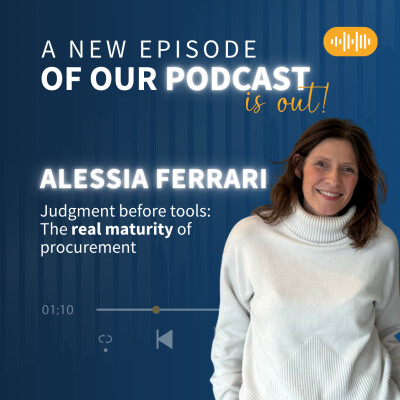
This podcast is hosted by Jean Aubrey, a senior business manager specializing in procurement.
- Speaker #1
Good afternoon, Ms. Alessia Ferrari. Thank you for being with us today. It's really nice to have you. I would like to point out, first of all, that you are speaking on your behalf and not on the behalf of your company or former employers. So to begin with, I would like to hear a short resume of your career. So in two minutes, who are you?
- Speaker #2
Okay, so first of all, as well, thank you for hosting me here today. Good afternoon to you, Gian. So I describe myself as an engineer with a passion for procurement. That's sort of, you know, the one line that I think best describes me. So I am a civil engineer as background. That's also, you know, like what I was doing in the first part of my career. and then Over time, I was enjoying, you know, the engineering career. I was in the US working, so that was also bringing a little bit of diversity lens. I'm originally from Italy. And then after a while, I felt that the very technical career was as enjoyable as it was. It was something that I felt was missing some elements of, you know, learning for me. So I left the US, I did an MBA and I joined procurement by chance. I had no clue what procurement was. But then I joined procurement as starting in the category of construction and capital equipment.
- Speaker #1
For which company was it?
- Speaker #2
For Johnson & Johnson.
- Speaker #1
Yeah. Okay.
- Speaker #2
and and that was for me you know like the the We'll have to put it on paper, you know, like the best way to enter in procurement, you know, coming from, you know, like leveraging your sort of expertise in one category, let's say. But now sitting on the other side of the table. And I will always be grateful to the colleagues that really made that choice of me to really enter in that path of procurement because it's then procurement became a passion for me.
- Speaker #1
OK. OK, thank you. If we focus more on the... the personal part. Do you have kids? What can you say to us?
- Speaker #2
Yes, so I'm married to an Italian and we have two beautiful little boys of almost one, almost two years and the other one almost five years. So our lives are rather busy. You know, at work and at home.
- Speaker #1
Okay, okay. I know what you mean. It's pretty much the same for me. Okay. If your friends and colleagues had to describe you in one sentence, what would they say about you?
- Speaker #2
Very passionate and energetic. empathic as well. I think that probably would be two words that I think my friends and colleagues could relate to.
- Speaker #1
Okay, that's the same adjectives I got. So yes. But I will come back to it just later. How are you in the office and how are you at home?
- Speaker #2
So I'm... Between office and home, I'm wearing two different roles, two different hats, mommy and wife at home and then a professional in the office. That said, you know, I think I remain genuine to myself in both roles, trying to really, you know, pass through the energy that, you know, I support me in either, you know, like the job that I do or, you know, my responsibilities at home and really transmit values, which, of course. are different values depending on the context. But then, you know, basically that's really my mission, really to be a little bit that kind of coach, if you will, and guide the team or, you know, my kids, well, my husband probably a little bit less guidance. He's guiding himself, you know, through, you know, through the core values that I believe on.
- Speaker #1
Okay. I was told that you bring always a lot of positive energy to teams, whatever what happens. How do you do that?
- Speaker #2
So I think I remember once at a certain point in my career, I came across a leader that said something that resonates with me since that says, you know, like it is important that the leader acts cool in a moment of crisis.
- Speaker #1
OK.
- Speaker #2
So I really try to keep, you know, if there is a crisis, you know, to make sure that. But somehow we manage the crisis through facts, through figures, you know, in a pragmatic way, but without letting emotions impact that. So if, you know, like there is a positive energy, I try to, you know, have that come across, you know, throughout the weather, you know, like we are living in a moment of, you know, that is more difficult or not. But of course, that's. It doesn't mean that I don't act with a sense of urgency, you know, in times of crisis, but it's really about, you know, like separating a little bit emotions from facts and managing accordingly. OK.
- Speaker #1
I was also told that you don't do politics at work. How can you become a CPO not doing any politics at all?
- Speaker #2
So, I mean, I think it's really, you know, what is politics? Politics is stakeholders management. And I do a lot. of stakeholders management. So, you know, if someone says, you know, you don't do politics, well, maybe I, you know, I remain transparent, but then I do a lot of stakeholders management. And I think that for me is my definition of policing, managing in the corporate environment. But then, you know, we're really keeping a sense of transparency and always be genuine towards, you know, like the different people that I face with.
- Speaker #0
Block one, Alicia's professional DNA.
- Speaker #1
So to fully understand your future answers, we start by situating your background a little. What shaped you in your relationship with purchasing?
- Speaker #2
So for me, I think my engineering background is an asset, I feel, that helped me throughout my career. OK, as I said at the beginning, because somehow I could, you know, I had an understanding of the category I was managing without, you know, like knowing procurement. But then I think over time is really how I analyze problems, situation, you know, that analytic mindset, dissecting elements and really questioning problems, understanding where the root cause of a problem is. So I think that one, which is not necessarily related with purchasing percent, but is really that sort of element because in procurement there is a lot of problem solving as well. That said, together with it is really that element of energy, again, that comes from knowing that procurement is in a unique position to, I always say, bring the... the outside in and the inside out when I refer to the market. And that also shaped a little bit, you know, how I am, you know, that possibility to influence your internal stakeholders by bringing them insights that come from the market and how the market in a category is evolving, but also bringing those insights on how a company is evolving the strategy priorities to suppliers so they can eventually build new solutions for you. that But also really that kind of energy helped me to grow, you know, like into procurement.
- Speaker #1
Have you had a mentor or a particular encounter that has marked your career?
- Speaker #2
Yes, there is one person that on paper is not a mentor.
- Speaker #1
Okay.
- Speaker #2
But he's really the person that... brought me into, you know, procurement in the first place and a leader that I highly regard.
- Speaker #1
Okay.
- Speaker #2
And I always say that if it was not thanks to me, a lot of things in my life would have not happened, starting from, you know, my procurement journey, but also my move to Belgium, where then I got married and, you know, like where, you know, I met my husband. So, you know, that's really, you know, it's this leader that for me, you know, I'm... Although, you know, like we now professionally, we are not connected anymore, but I'm still, you know, much highly regarding him and you. And then, you know, throughout also the journey, I met some other leaders that. were so inspirational that I really try to remain in touch maybe once every year and all that. And that's really for spot questions or really specific moments that where I think I really need their leadership or their view.
- Speaker #1
Yeah.
- Speaker #2
Okay.
- Speaker #1
Okay. Do you have principles you apply in all your project procurements?
- Speaker #2
Yes. So, one is the principle of transparency. For example, when we talk about suppliers, making sure that, you know, we treat them equally and, you know, we really are honest with ourselves on how we conduct, you know, a procurement process. I think another important principle is the principle of efficiency, because... A lot of time procurement, you know, internally, the value is not always as evident and why we need to spend time to conduct an RFP. So if we can be as efficient as possible in running our activities, then the stakeholders and an internal customer and the suppliers can really focus on the value and not on how long the process takes.
- Speaker #1
Okay. So transparency and value you bring to the stakeholder efficiency. I see. Yeah. Okay. Okay.
- Speaker #0
Block two, today's procurement.
- Speaker #1
What you really think of procurement today. So we get at the heart of the podcast, your personal vision of the profession. What do you like about this job and what drives you on a daily basis?
- Speaker #2
So I think it's really solving problems. So that's really, and okay, not to say that procurement is always problems or, you know, like, let's put it differently, creating, enabling opportunities.
- Speaker #1
Opportunities, yes.
- Speaker #2
Enabling opportunities. So, you know, really, whether it's helping an internal customer or, you know, helping the team that is struggling or trying to find, you know, process efficiency. So that's really is the driving of, you know, the... As I said, you know, before, you know, the breadth of the function and, you know, the fact that you can really spend your time on, you know, the different levers that drive a value for the function.
- Speaker #1
OK. What annoys or worries you about the recent evolution of the function?
- Speaker #2
So there is nothing that worries me as far as we all as. procurement professionals really do not work alone. You know, like it's very, very important that, you know, we are, you know, understanding the needs of the customer. If we understand well what the customer needs, the internal customer, and what the supplier needs, then there is nothing that worries me about the function. If, of course, you know, like we are building a function that... is only about strict rules and policies which is very important and should be there but then if it's only about that that's when you get a distraction from where the value for the internal stakeholders is seen, that's where the function is not, they're not going to perceive as they should.
- Speaker #1
Okay, okay, okay. Is there a trend at the moment that you find totally overrated?
- Speaker #2
Yes, with regards to technology.
- Speaker #1
Okay.
- Speaker #2
So there are a lot of solutions in the market to conduct the procurement process in a very efficient way and all that. And then sometimes I feel that we look at the solution without spending enough time before to streamline the process, to really... evolve capabilities like category management. You know, you cannot do category management if you're not a good category management, whether you have the best tool in the world or not. So that's a little bit this kind of belief that, you know, technology can, you know, like make you the dream professional of the future. Then I think it's something that, you know, I'm a little bit skeptical.
- Speaker #1
Okay. Okay. Okay. Most of the time, the answer we've got is AI will. or might replace buyers, but I don't think so.
- Speaker #2
But at the same time, I see that AI can really help a lot of buyers.
- Speaker #1
Yeah.
- Speaker #2
But you need to be a good buyer to start with.
- Speaker #1
Of course.
- Speaker #2
And then you can ask a good question to AI and then you can make your job very much efficient.
- Speaker #1
Of course, of course. And to me, procurement is also linked to the way you address also your stakeholders. And this is not a job that can be done by an AI agent. for sure. Exactly. For this, yeah. Okay.
- Speaker #0
Block three. Convictions versus reality on the ground.
- Speaker #1
So sometimes we have strong convictions but the reality of the organizations comes to shake them up. Is there a practice that you defend and that your teams or colleagues often challenge?
- Speaker #2
So I think procurement is A lot more beyond savings. And I think, you know, this is something that we can all agree to. At the end of the day, if we don't bring the savings, then it's sort of, it's very difficult that the stakeholders will really listen to you for all the other value levers. And that's where sometimes I find a little bit of a conflict. sort of, you know, the broader procurement teams that says, OK, we are much more than savings. And then they focus a lot on the much more.
- Speaker #1
Yes.
- Speaker #2
And they forget the savings.
- Speaker #1
Yeah.
- Speaker #2
And I think it's really about, you know, finding that exact balance because only savings is not good either. It's very transactional. It's very, you know, short term approach. So that I also agree. But then it's very important that we have a good discipline on that. part, you'll be able to be decent to the rest. It's difficult to do the opposite. And I think that's where sometimes I find myself in some very healthy debates with colleagues about, you know, the value of procurement.
- Speaker #1
Okay. How do you build a robust procurement organization? Yeah.
- Speaker #2
So it's important that that you identify first in the specific moment of your company, what are the capabilities that are key that procurement can drive. And those capabilities will vary. You know, there will be a moment when it's more category management. There will be a moment when it's more looking into process, operation and efficiency. So that will vary. And I think we, you know, make sure that those capabilities are there in your operating model.
- Speaker #1
Yeah.
- Speaker #2
And then you held the organization accountable to deliver to expectation with regards to those capabilities. So then really also the business can see that.
- Speaker #1
Okay.
- Speaker #2
That would be diversity, I think, is also very important. So it's something that diversity of all different elements, you know, diversity of... But also, you know, when we are in procurement, diversity of experience. because Sometimes, you know, someone that has always procured, let's say, one category will have that one view. But then also if you have, you know, like some people that have either procured more categories or that, you know, have done operations, procurement operation, but then now they are supporting category management. That kind of diversity of a mix of capabilities is very, very important, I think, to really raise the bar overall for the function.
- Speaker #1
Okay. Is there a transformation you were leading and where you got challenged or you failed?
- Speaker #2
So, yes, there have been a couple of transformations that I led, where both of them I got challenges and I think it's fair. to get challenges on those. And actually, that's what I'm expecting. Otherwise, sort of me, you know, like sitting down and, you know, like drawing a chart or something and then not facing it with reality. Challenges, you know, different transformation because different context. In one case, you know, the challenges were more about technology in the case because it was the right. I'm not against technology, you know, like as I said, technology is something I look at it with, you know, a bit of skepticism, but I'm not against it. So then, you know, sometimes it's difficult to build a business case on an ROI of technology for the function. And that's really where the challenge is that. was put on the table and that's where you know you need to see how to manage accordingly um some other times is about you know you really want to grow but then you know it's the usual challenges that any transformation could bring you know like with budget you know and then at a set the point then if that's you know those other type of challenge you said okay you know what are those two things that I really want to do right. And then, you know. With the budget and the figures that you have, make sure that you nail those down 100%. So, you know, challenges in transformation are healthy at the end. Failure, I wouldn't, I think, you know, the failures on transformation are, I mean, not failures, but some sort of moments that you say, OK, maybe I haven't considered the element.
- Speaker #1
Step back or just step down a bit.
- Speaker #2
It's through the implementation phase. Why? Because implementation is when you really have the change management that comes in. And sometimes maybe it was, you know, like it was communication not done enough or not really enough. did I not bring you know everyone on board as I intended to and then led maybe to some people that you know like high potential and valuable resources that somehow maybe have taken a decision to to leave the organization because maybe the change management was not done in the right way. So is the people dynamic that maybe in some cases put some challenges. Is that a failure? It's probably, I think it's impossible to go through a transformation thinking that everything will go fine. You need to factor in from the beginning that something will not go as you initially intended and then you have to be recognize those elements and then adjust.
- Speaker #1
Yes, adapt and adjust. Okay. Which negotiation are you most proud of?
- Speaker #2
The first negotiation ever was something I came back with. Oh, wow, this is negotiating, you know. So I remember I was, you know, I was starting the category of construction, you know, my first job in procurement. And then my boss said, OK, now you have to negotiate. I'm like, I've never done negotiation. Yeah, OK, you know, go and ask and assess and all that. So I remember, you know, I read the contract. I tried to understand the stakeholders, what they needed and all that. I had a face-to-face meeting and then, you know, I asked something and I got something in return that maybe was not 100% of what I asked. But it was and it was not just savings. And I remember the sense of... You know, I came back so pumped up.
- Speaker #1
Yes, of course.
- Speaker #2
So that was super, super good.
- Speaker #1
Okay.
- Speaker #2
It was not the most complex negotiation in that case, but it was the first. But the first part was. Yes, yes.
- Speaker #1
Okay. Okay. Interesting. You have known different sectors, such as finance, transportation, medicine. Which one is your favorite and why?
- Speaker #2
All of them. And then if there will be more, probably even more so. I think for me, there is each of the different industries that I supported gave me the possibility to expand my knowledge and to become a more rounded person. Not necessarily, yes, professional, but really person to understand better. economies, markets. So I think, you know, there is no favorite.
- Speaker #1
How do you defend your projects when you disagree with your management?
- Speaker #2
Well, first of all, I don't understand why the disagreement, because I think it's very important to, you know, like, it's not that I'm stubborn, but then, you know, like, have I forgotten something that they are telling me and I'm just not listening? So that is the first element that I do, you know, before there is a disagreement. I'm trying to understand the nature of the disagreement. If I really feel strongly about something, then what I do is really to spend more time to explain the why and the value. So that is really where, you know, how I try to tackle those kind of disagreements.
- Speaker #1
can be a bit of your influence with the American culture, because the previous CPU that we received was also... Defending his project, always understanding the why and the how, etc.
- Speaker #2
Yeah, maybe it's part of the encounter, but I think it's also part of, you know, taking the accountability for it's your project. So it's your accountability to sell it, you know. And, you know, if the disagreement is because you're not able to explain your project well, then, yeah, spend more time on it. You know, like, so I think it's really, yeah, it's really as simple as that. Yeah.
- Speaker #0
Block four, recruit, retain, develop.
- Speaker #1
What are the key skills you look for a buyer today when you have to recruit someone?
- Speaker #0
So soft skills.
- Speaker #1
What kind of soft skills?
- Speaker #2
The number one is influencing without authority. so assertiveness assertiveness assertiveness but not assertiveness with arrogance actually it's probably more than I think it's really influence yeah influence which means that of course you need to be assertive you need to be clear but you need to find a way to convince the stakeholders to do something that maybe they are not convinced themselves okay Like, for example, running an RFP, and I think it's a very common theme that we find in procurement, that, you know, stakeholders want to single source, you know, and then, okay, why an RFP? I will have to spend time. And at the end of the day, I know already I will be working with that, you know, like, so I think, you know, how do you demonstrate that running an RFP is very important and then influencing the auditory. So that I think is really that. And the second important skill is project management.
- Speaker #1
Okay.
- Speaker #2
More and more, you know, like RFPs are, they are like projects where the project manager is procurement, where, you know, we really need to fit in the time of the RFP into a macro scheme of other activities that needs to happen within, you know, the business. And I think, you know, it's very, very important that a buyer understand the role as... project manager and take that accountability as project manager of the RFP so now I mean of course conducting the RFP is very important but that kind of different lens to managing the RFP is key yeah how do you judge and challenge a good buyer in 45 minutes I think how Is the buyer, you know, assuming there is a certain category or, you know, like a cluster of categories, understanding, how is this buyer understanding the market?
- Speaker #1
Okay.
- Speaker #2
Because for me, you know, there is a process element, of course, when you buy. But then for me, what is more important is that a buyer needs to be able to use the process to get to. The outcome, that is what is needed for the business. So how is this buyer understanding the market of suppliers? How is this buyer understanding the industry of the company? How is this buyer understanding the challenges of the business? So that business element and then market lens, for me, are very important. Of course, you know, together with, you know, like experience in conducting F&P. But really, really understanding your role. For the organization. To question examples,
- Speaker #1
of course. Okay. So this is to me applicable for a senior or a media buyer, but for someone that is not properly trained, such in Belgium we don't have any schools, training junior buyers. So what would you do if tomorrow you have to recruit someone that is 25 years old that is telling you, okay, I want to be a buyer, but doesn't have any relevant experience? proving that he can do the job?
- Speaker #2
I never let.
- Speaker #1
Okay. Okay. Maybe the case will, okay.
- Speaker #2
No, I think it's really about what are your drivers. If you're saying, you know, like I want to be a buyer, but, you know, I don't have any experience, but tell me why you want to be a buyer. Because I think, you know, like running an RFP and all that, you know, like these are things that can be learned, you know, and that's really the learning on the job. And then it's important that, you know, we support the resources. In the learning journey, through training, you know, that. But those are all things that can be learned. But then your motivation on why you want to do something, your attitude. And then those things, you know, like they are there or not.
- Speaker #1
Okay.
- Speaker #0
Do you consider yourself a mentor to someone?
- Speaker #1
So again, in a similar way, as I mentioned, I don't have mentors on papers. I don't have people that officially I'm the mentor of. But I have some people that periodically reach out to me and they are interested in my view, whether it's on their career or, you know. on maybe, you know, like some sort of advice. Yeah. Yeah. But there is not an official mentor. Oh, Alessia, you know, you're my mentor. Can I call you? But I know my reference, let's say, to too few people, especially, you know, like that's actually that when I get, I enjoy it, you know, people that are growing through, you know, they're really at the beginning of their real path. And then, you know, like they They're interested in my perspective. That is a very, very, you know, I feel good about that. That I can help younger generation in their path. Yeah.
- Speaker #0
Okay. I know what you mean. Okay.
- Speaker #2
Block five. And tomorrow, what vision for the future of procurement?
- Speaker #0
If I give you a magic wand, which CEO are you going to see? And what are you going to say to him as a procurement director?
- Speaker #1
So I don't think I will, you know, I don't give you a name of one CEO specifically that I will be talking to. But if there will be a forum of European CEOs, it would be interesting to have a debate on how, you know, are these CEOs seeing, you know, like the economy overall between different continents, balancing and changing with different forces. market dynamics, political dynamics, and, you know, how are these considerations shaping decisions within those companies? And is there a role for procurement to help in that?
- Speaker #0
Okay, interesting. If you leave procurement tomorrow, Alessia, what do you do?
- Speaker #1
So this is a question that, you know, it's, I ask myself also, you know, so as much, you know, I love procurement, but then also, you know, there is a point where, you know, I'm also enjoying the industry that I'm at, you know, the company that I'm at. And then, you know, like you asked yourself, okay, you know, like, can I do something else? I think for me, probably it would be operations.
- Speaker #0
Okay.
- Speaker #1
You know, in an industry that is, you know, more. the industry that I'm at now, you know, or in manufacturing, that would be sort of a natural, you know, so sort of going back to my engineering, but, you know, from an operational standpoint or, you know, planning also. So yeah, supply chain, let's say. I will move from procurement to supply chain. So to our friends,
- Speaker #0
the next door is very much the same. Okay, If you have to give one advice to the next generations of buyers, what would it be? One advice.
- Speaker #1
I think an advice to every generation at the end, you know, whether you're a buyer or something else, find your passions.
- Speaker #0
Okay.
- Speaker #1
So if you are a buyer, you really, really need to enjoy running an RFP. So if you are seeing that running an RFP You're focusing more on, you know, like the process and it's long and it's, you know, sometimes annoying. Then, you know, these elements over time will unbalance the equation of your passion to procurement. So really, you know.
- Speaker #0
And just for the audience, what's the longest RFP in terms of months that you've run in the past?
- Speaker #1
And to end?
- Speaker #0
Yes.
- Speaker #1
One year.
- Speaker #0
Okay. That's quite fair.
- Speaker #1
Yeah, but it can be considered very...
- Speaker #0
Yes. It's quite okay. Okay.
- Speaker #2
Up next, the Q&A box presented by NeoHoop. A fast, spontaneous format designed to explore our guests' personalities.
- Speaker #0
I ask you questions and it's binary. You just can answer. You have two options. It's really easy. Ready?
- Speaker #1
Ready.
- Speaker #0
Long-term contracts or spot buys?
- Speaker #1
Long-term contracts.
- Speaker #0
Deep supplier collaboration or competitive bidding?
- Speaker #1
Competitive bidding.
- Speaker #0
AI agent or junior buyer?
- Speaker #1
Junior buyer.
- Speaker #0
Is procurement linked to technology or culture?
- Speaker #1
Culture.
- Speaker #0
One excellent supplier or many good ones?
- Speaker #1
Many good ones.
- Speaker #0
Risk management is proactive or reactive?
- Speaker #1
Proactive.
- Speaker #0
Cost control or risk mitigation?
- Speaker #1
Cost control.
- Speaker #0
In-house procurement, teams or outsourcing?
- Speaker #1
In-house procurement.
- Speaker #0
Negotiations are more about winning or compromising?
- Speaker #1
Winning.
- Speaker #0
Is the supplier diversity a strategic priority or a nice-to-have?
- Speaker #1
A strategic priority. Good.
- Speaker #0
We're done. Thank you. Question six, natures. So to conclude, three questions that we will ask to all our guests. Complete this sentence. Good buyers are those who and bad buyers are those who.
- Speaker #1
Good buyers are those who understand what they're buying. Bad buyers are those who focus only on the buying process.
- Speaker #0
Okay. What is the most unusual request you have received in your career?
- Speaker #1
Oh, sourcing private jets.
- Speaker #0
That's nice.
- Speaker #1
Yes.
- Speaker #0
Where was it? Can you quote?
- Speaker #1
One of the companies I worked before.
- Speaker #0
Okay, private jets.
- Speaker #1
And, of course, you know, like... I mean, only companies of certain sizes. As far as the CEO, the Philovels? As far as the CEO and the C-suite.
- Speaker #0
Okay.
- Speaker #1
So two private jets, so not only one, two. Okay,
- Speaker #0
two.
- Speaker #1
And of course, we had a little bit of a moment of panicking because how do we buy a jet? There is no knowledge and you don't buy a jet all the time. But yeah, okay, eventually we managed, but that was...
- Speaker #0
So it was to buy, not to lease, It was... Wow, to buy. Okay, interesting.
- Speaker #1
So that was even more complicated, yes.
- Speaker #0
Did you get some Falcon from Dassault? What was it? American brand? It was
- Speaker #1
American brand.
- Speaker #0
Okay, okay. And last question. If you had to invite someone to this podcast, who would it be?
- Speaker #1
I would invite Farid Doumit. Farid is the person that I was referring before as really the one that, you know, got me into the procurement path. A very strong leader and I think someone that can bring a lot of insights to the conversation and all these points that we discussed.
- Speaker #0
OK, for sure. I will propose him the seat. And now to conclude. Thank you very much, Alessia. You just left the procurement room, but your ideas will remain there. Thank you very much.
- Speaker #1
Thank you. Thank you very much to you.
- Speaker #2
A special thanks to Alicia Ferrari for sharing their insights. Join us on March 3rd, 2026 for the next episode of The Procurement Room, presented by MailHoop.