- Speaker #0
Hi Eleonore.
- Speaker #1
Hi Julien.
- Speaker #0
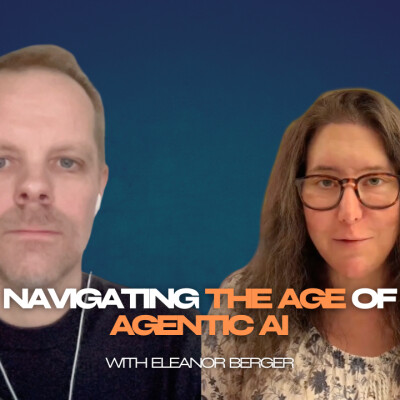
So super happy to have you today. So we'll be talking about AI agents because you're an expert in the field and you will tell us everything about agents, about cloud, cloud co-work and what we can build with everything with all of this in 2026. So first. to maybe introduce the topic. We've spent the last three years chatting with AI, with chat GPT, with Gemini, with Cloud. And how would you define the transition from a chatbot to an AI agent? What is the fundamental shift, the fundamental differences in the way we interact with AI?
- Speaker #1
Sure. So, yeah, thanks for inviting me and always excited to talk about agents. The shift has actually been quite gradual. in the sense that the same models improved, gained the ability to interact with the environment, not just by emitting text, but by calling tools, taking action, becoming more, quote unquote, agentic, sort of driving ongoing, long-running tasks. I think it kind of became more apparent to people really last year with... A lot of it through the introduction of the coding agents, but it was really a gradual development. The big difference, if we can make some kind of distinction, is can it take action? Talking is nice. We all like talking. But being able to do stuff to make changes in the world is very powerful. As soon as agents got the ability to do that, from there it's just... a process of gradual improvement. So the agents we have today are not radically different than the chatbot we had three years ago when ChatGPT first launched. They're just a lot more powerful. They're a lot better at carrying on these long running tasks and they're connected to the environment. They can take action.
- Speaker #0
Yes, they have impact. See if I may say on our environment, they can do something on your behalf. While you're doing something else, this is the very definition of being agentic, if I may say. When did you realize, so you mentioned it a little bit, but last year we started to talk about agents a lot. It was the buzzword of 2025, but actually more than a buzzword, because we started to realize it had real impact, that it started to change the workplace. and the way we interact with each other. When did you realize it would have such a massive impact and it was about to change the world or actually the way we work together?
- Speaker #1
You know, it's funny. I think as a child, I loved, and even later, I loved reading science fiction books. Many of them had this kind of computerized agents that can do stuff. It was always obvious to me that once we have something like this, it will change everything. Until very recently, I was quite skeptical, though, that we were having something like this. And I think for a long time, the word agent was kind of used as a marketing buzzword, not really with proper sort of relation to what was possible in practice. And as I said, it was a gradual improvement of the models that made a big difference. Not necessarily the products around them or the way they've been packaged, but it's just that But at some point, kind of middle of last year, we started having models that were powerful enough to say, OK, we could really let them now run and make tool calls, make changes, make decisions and come back to us. I think the O3 model from OpenAI was the big revelation when it became clear that it's so powerful. later on the Claude Four models from anthropic. And now we're already a generation after this, and the models are amazingly strong in their ability, and they can run for hours doing things, making decisions, keeping track of context. So it became clear that, okay, it's happening. We finally have this thing, this thing we read about in the science fiction books as children. It's now a reality.
- Speaker #0
Yes, it's true that we moved from, and very quickly, from the buzzword to the actual impact in the world. And you've mentioned recently in one of your videos that 2026 would be a golden year for launching a business. How do you think the convergence of these specific AI agents makes it the ideal moment for new entrepreneurs?
- Speaker #1
I mean, I think every year now is going to be the golden year, right? I'm sure 2016 will be even better than 2016 because things are moving so fast. But it is really this year for the first time that we can have something like a virtual artificial employee. Like we can really get help, not just by having helpful software. We've had helpful software for decades. But we can really delegate work to. AI employee that can do things. And of course, if we can have one of them, we can have many of them. And so the constraints now on what any one person can do really lifted like radically.
- Speaker #0
Yes, because when we think about it, so one example that is often taken is the junior developer. is that if you use cloud code, it's like having, so you were mentioning an employee, it can be a junior developer, it can be an assistant, it can be anyone you would like to delegate something. And you can add an agent over an agent over an agent. So the marginal cost to start a company is not zero, but it's closer and closer to zero. So I think that's what makes the big difference. And one thing we've been talking about a lot also last year is the vibe coding trend. And it's more than a trend because it's linked to AI agents. So we've seen a surge in solopreneurs over the last four or five years, let's say. But it seems to be supercharged by the agentic revolution. And you can now build... a complex SaaS product in weeks or even days, do you think we have permanently lowered the cost of starting a company or that you have some costs that remain and that will remain in the future?
- Speaker #1
I think it's actually really useful to look at it from the lens of economics because I don't think the fact that you can now write software, it's more like you can... ask an agent to write software and it's basically free. I don't think it means that the economics of starting a company are necessarily that favorable. What I'm saying, so we have now this trend of lots of people building like clones of their favorite software as a service app and getting very excited about the ability to launch that. But I think what that misses again with this economic lens is that it can't possibly be valuable if the cost is zero. Maybe a good way to think about it by analogy, imagine that you're living in the 1920s and you notice that horses become really cheap. I can get a horse for 10 pence. They're everywhere. Just go to the yard, just take the horse. We don't need it. I think, oh, I have this brilliant idea. I'm going to buy 20 horses, cost almost nothing. I'm going to start a horse and carriage business. And that's a terrible business plan, right? Because no one wants to ride a horse and carriage anymore. They want to go with an automobile. And I think a lot of people are now buying these proverbial horses. Sure, you can start a software-as-a-service company and the coding costs are very low. But the whole point of software-as-a-service companies is they were created to amortize the cost, the very high cost previously. of software development and to make complex software available to many people and in that way pay for the high cost. Now that the cost is zero, who's going to buy the software from you? They could do the same thing themselves. So I think there is this radical change now, but it's important to pay attention to what is scarce and what is very common. And writing software, this is it. It's problem solved. I'm saying this is someone who spent most of my life writing software or managing software. It's a solved problem. You don't need to worry about it. The cost is approximating zero.
- Speaker #0
Yeah, we've come full circle, like you were mentioning, because we used to buy a SaaS or a subscription to make sure that everything was running well, that we didn't run into, you know, issues and we didn't have to build it ourselves. But now that anyone can build pretty much anything, well, it's easy to build, but nobody will buy it because it's so easy to build that you can do it yourself. So that's another problem. And that makes starting a company easier, but starting a meaningful company that can be profitable and be relevant over time. I think that's... Now, the main, well, it used to be, it's always been a problem for an entrepreneur, but it is more than ever. How do you add value to the market? What do you bring to the conversation in this new era?
- Speaker #1
Yes, what's special? What can only you do? Because if you and your neighbor and someone on the street can all do the same thing, that's not valuable. But there's something that only you know, that only you understand about the world. Maybe a good idea you've had, maybe something really creative, a little bit crazy. Who knows? That's going to be valuable, right? That's not zero cost. That's special.
- Speaker #0
Yes, indeed. We can think now about really niche products when you think about it. That would benefit maybe a few dozen people. Before, I mean sense to build them because we would have so little. potential on the market, you know, with a few dozens of users. But now that the cost of building is actually super affordable, well, it can make sense to market this to really specific kind of customers and be profitable anyway. So I think it's, we will see a lot of really specific, bizarre software products of experiences in the coming months and years. So we I think we talked about that a little bit, but in the previous years, what was a strategic move was to raise capital to hire a team. Now you just need agency instead of capital. You orchestrate your agents to get things done. So how would you see the role of an entrepreneur in the future? It's changing from managing employees to managing agents. What does it change on a daily basis for you?
- Speaker #1
I think the speed is a lot faster, which is great on the one hand. You want to be able to do things fast, but it's also really hard. I think we are all used to taking our time, thinking through things. But what I see from my own experience now as a small business founder and people I talk to is when you're able to make really quick decisions and hopefully high quality decisions, you can then delegate these decisions to your AI agents or... outsourcing or all the other options we have. And then things are happening. As long as you didn't make the decision and delegate, nothing is happening. And this is actually really, really stressful. I sometimes feel it. I think like if I'm sitting here now, I'm having my breakfast and I'm relaxing, like nothing is happening because I'm the only person who can make a decision and decide to action something. But I still need to rest from time to time. And so I think getting kind of systematic about. making fast decisions, iterating quickly, trying different things. Like you said, like maybe sometimes a little bit crazy thing, but like very quickly running an experiment to see if it works. If it doesn't work, kill it. If it does, scale it. I think the better you get at this, the more you can do business in this kind of environment.
- Speaker #0
Yes, because I think what you've said is really on point. So either you kill it or you scale it, but you can test and iterate faster and faster than ever. So you don't even need to think about it too much. So I'm not saying that you shouldn't think about your product before launching it. But what I'm saying is that the time required for decision making is shrinking too.
- Speaker #1
Yes.
- Speaker #0
So if we move to a specific agent on the market, Cloud. So Cloud Code has been some kind of a revolution. And it was... a big surprise for me to learn these past months that it's not only beneficial to software engineers, to developers, that anybody or almost everybody can use it. And you're a real supporter of that because I think you have an entire video that just explains how cloud can benefit anyone, product people, marketing people, anybody who wants to build. something. So if we deep dive a little bit in the anthropic ecosystem, how does cloud code benefit non-tech profiles, people who are not developers?
- Speaker #1
Yeah, so I think we don't have to over-index on cloud or cloud code. There are many of these agents. They're all as good as Codex, Copilot. They're all the same. They've been branded as something for software development because that was the first market where the impact was so obvious. And Cloud itself became kind of the category-defining product, the name everyone remembers. But the truth is we now have general agents. These agents have a strong model. One of many could be Gemini, could be GPT-5, could be Clodopus. They're all good. It's connected to an execution environment, basically a computer. So that could be your laptop. It can be in the cloud, a virtual machine or a container or some more restricted environment, maybe in a consumer product. And it can do stuff, right? That's their genetic platform. It's great for coding, but it's great for anything you want to do, right? It's great for writing text if you want. is great for generating and editing images and videos. You could connect it, I don't know, maybe you can connect it to your 3D printer. I've actually seen people do that. And now it's like it's printing actual like objects in the world. It's good for all of these things. So initially it was branded as something for developers, but you don't need to be a developer in the sense that you don't need to write any code, right? It writes the code. So I'm a developer and I don't write any code anymore. I just talk. to the agent and they say what they need done. And so that's what follows from that is that anyone can do this without writing code. And anything, you need to want something. You want to make a decision, like we said, about something you want done. And then once you do, if this thing is accessible from a computer, maybe because it's a digital thing like a website or a text file or... Anything like this, or maybe it's connected through the computer. Maybe it's connected to your 3D printer or to some other machinery you have or to some other websites. The agent will do it and it's getting really good at it. Definitely with the latest crop of models. So I think now is a good time. And we've seen it also with the release of CloudCoreWork, which already kind of tries to rebrand it. It's the same thing, right? You realize that CloudCoreWork is basically CloudCore rebranded. as something that people who are not coders can start using for doing things.
- Speaker #0
Yeah, so that was a big new product from Anthropic that launched, I think, two weeks ago, something like that. And it changes the daily workflow of non-technical people. And for solo creator, I think it's a really great tool. How does it change the relationship we have with AI compared to a standard chatbot? What I mean by that is, what does it bring to you? Because we cannot yet build an entire app if we don't understand code. Or can we?
- Speaker #1
The question is what you define as an app. Again, coming back to our discussion of software as a service, if an app is something that has to have this... very fine California design with rounded corners and needs to run at scale and serve millions or even billions of users. No, maybe you can't do that. This is a complete engineering discipline. But if there's something I do every day, for example, I'm doing a lot of teaching and lecturing now. I need to generate slides. I'm creating the whole process where I create the... content and I create handouts out of these, like booklets, and then I create slides and I want them to have very nice images, but I'm not at all an artistic person, so I have no access to this. And this is all done for me now to amazing quality with beautiful images and great layouts. And this is something I do with an agent. I didn't write a line of code. I didn't use my non-existent knowledge of aesthetics. which really isn't my strong suit. I just define what it is I need. What does good look like? When will I be happy? And once I'm able to define that, I can delegate it to the agent. So Cloud Code or Cowork or Copilot or whatever I'm using, it's always the same. I'm saying, here's the end goal. This is what I'm trying to achieve here. Here's all the information, all the context, everything I wrote that you should make use of. And it's created for me. It's amazing. I would have had to hire someone to do this. I can't even do this myself.
- Speaker #0
Yeah, you are a one-person company, a solopreneur, like we were mentioning. And I think we will see more and more one-person business emerge in the future. It's already happening. Another new product from Entropic. that is linked to Cloud Code, to Cloud Cowork, is the skills, the agent skills that they have launched really recently, if I'm not mistaken. Can you tell us a bit more about that? And are they the missing layer for personalized AI? How do you see them?
- Speaker #1
Exactly, yes. So I'm very excited about skills. And in fact, that's most of what I do now is in various ways convincing people that skills are very important and helping them learn how to think about them and use them. Agent skills, they're now an open standard, so it's not just on Tropic. They're available in all the different agents. And they're the apps. They're the apps of the future. When I say, look, really, let's not think about this big software as a service thing. There's a new thing. This is what I'm talking about. So we have a Nogentic platform, which is a Nogentic model, an execution environment. It has fantastic general purpose capabilities, but it doesn't know the things you're trying to do. Like, I like to do my slides in a particular format and someone else likes to do, I don't know, 3D print components for their machinery and someone else wants to, I don't know, connect to some website and take some action. Whatever it is, we need a way to teach, quote unquote, the agent how to do this. And skills are this way. They're very, very simple format. They're a folder with some text, with a markdown file, and maybe some other resources like scripts or assets. The challenge with them is not so much the technique, which is very easy to pick up, but the mindset. Thinking, okay, now I'm not thinking anymore about apps as this like a window. with this button. I'm thinking of capabilities. What does my agent need to know, my virtual employee? What does it need to know to do the kind of work I need it to do? And I don't think... Yeah,
- Speaker #0
go ahead. Sorry to interrupt, but I was about to say that you focus on the jobs to be done now. And it doesn't really matter if it's a workflow or if it's an app or an agent that gets it done. I think... The outcome is now the main focus, not the tech part.
- Speaker #1
Yes, the outcome and the context. What does it need to know? What information will it need to do the work? Does it need some files? This is all stuff that goes into the skill. It's a package of these things. Instructions, definitions, library of knowledge, files, anything you need. And when we have this library, imagine it like a... like a big shelf. Imagine the head here behind me, like a big shelf with folders of all kinds of things my virtual employees need. It can then go and pick up one of these folders, one of these skills whenever it needs something and work. This is an incredibly powerful mechanism. It's kind of amazing. So one of the things I'm doing now is I'm teaching workshops for people to learn how to, again, not just the technique of using skills, but learning how to think in this way. And there's always this moment when it clicks for people and they finally realize and they're like, oh, wow, I have this amazing superpower. Now I have an agent that actually knows everything that's happening in my business, in my line of work, in my cultural world, whatever it is I care about. And I can continuously evolve it. And that's really powerful.
- Speaker #0
Yeah. I must say that when you realize that you can actually use it, that it actually works, meaning that it has. you know, a positive impact in what you're trying to accomplish, there's a wow effect. You have the moment where you realize, wow, it really works. You know, it was like you were mentioning earlier in our childhood when you were reading science fiction and you had this kind of supercomputer with, you know, you can talk to it and it does what you ask it to do. And well, we're here now and it's there's some kind of magical moment that we're experiencing right now.
- Speaker #1
Yes.
- Speaker #0
One thing we were talking a lot about a few years ago, and we still talk about it to an extent, is no code. And no code was a great way, even if it had its limitations, but for non-technical people to actually build products or prototypes or MVPs. Do you think it's over for no code? It has just morphed into agents and it's the natural evolution, I would say, of what no code tried to accomplish.
- Speaker #1
Yeah, I think no code won. This is it. No one has to write code anymore. I'm exaggerating. They're still at the market and some very specialized things that people still code by hand. But it's going to be over very soon. And so I think the original no code products, they were cheating a little bit, right? Because you're still coding. Maybe you're like connecting some icons with some lines. But this was still code. It was just code in icons in the programming language. But there was so much desire. There was an indication of how much people want to build stuff, create stuff, and are limited by the need to deal with the complications of writing code. This is it. They won. It's their day. Anyone who ever wanted to build something and couldn't because coding stood in the way. This is it, they are liberated now. They have the means of production.
- Speaker #0
Yes, indeed. I think the future of work will see more and more people building what they have in mind because when you have to rely on someone else, so a software engineer or a technical team or whatever, you still need to convey the idea of what you want to build, what you want to accomplish. And most of the time it works pretty well. But you sometimes have to do a lot of back and forth. And now it's over. Or you do some back and forth with the AI, but I think it goes faster, to say the least. So we are about to witness an hyper-automation era, if I may say. And I think some time ago, Sam Holtzman of OpenAI mentioned that in the future we'd be able to build a one-person billion-dollar company. Do you think this is something that is already possible, or it's just still a myth and a little bit of marketing from his side?
- Speaker #1
I mean, I think that the specific claim about a one-billion, one-person company is very unlikely, because if you have a billion dollars, you'll want to hire someone. Maybe you'll want to hire a barista or a coach. or, I don't know, someone to give you a massage, but still you'll hire someone. It's unlikely that someone who has a billion-dollar company will not hire anyone. But yes, you can do a lot with very few people. I think that's the more down-to-earth version of it. You don't need to build this gigantic company with tens of thousands or hundreds of thousands of employees to do something really impactful.
- Speaker #0
What would you say is the... If an agent can execute the how, let's say, what happens to the value of the technical skills? Because I understand that we still need developers to actually run the show behind the scenes, if I may say. If something breaks down and the agent isn't capable of solving the problem, we still rely on the developers and the engineers. But Do you think there will be fewer and fewer of them or their role will just evolve? They will have to reinvent themselves. What is the future for tech profiles?
- Speaker #1
There will be fewer and fewer of them until they are known. Obviously, these things, these revolutions, they don't happen overnight. They happen gradually. And then in hindsight, we can say it was, you know, 20, 28, 9, 20, 30, whatever, was the year when we saw the last. software engineer, but this is the trend. I mean, every time some things are getting easier. In the beginning, we were told, okay, the front-end development, this is now a day I can do it, but you still need for more kind of serious programming, you need to intervene manually. Now that's not so much the case. I'm traditionally coming from the world of distributed systems and complex server engineering. I don't write any code, honestly. never do. I'd like to tell you some story about how important I am in going and reading the code and making some last minute changes, but I don't. The AI is better than me at doing this. And so I'm not foolish enough to intervene where I know that I'll just make it worse. There are still things, right? So we have all the people, for example, working in machine learning research, building these amazing models, and they're still doing a lot of the work. Eventually... they will probably be replaced too when the AI will become better at doing that. And I think the same is true for everything where we can give the AI agents access. So right now, hardware, anything happening in the physical world is still very manual. But once you have a robot and a 3D printing machine and some other things, you realize this too will be automated by AI. So I think it's a gradual process, but it's happening very fast.
- Speaker #0
Yes, but... So if we focus on the developers, and I agree with everything you said, that I think step by step, everything will end up being automated. But don't we lose control of everything that's happening? I mean, if you take, so the comparison is maybe not the best, but if you take cars nowadays, there are more and more. complex, and you cannot, as your car breaks down, there's little chance that you're able to repair it yourself. It's used to be otherwise in the past. With AI, if everything ends up being automated, even, you know, the creation of new models or machine learning innovation and all that, don't we lose the plot at some point?
- Speaker #1
Yeah, man, we are losing control. The best we can hope for I think is to lose control in a slightly controlled way, right? Yeah,
- Speaker #0
okay. I like the way you put it. Yes, absolutely.
- Speaker #1
To manage the transition in such a way that will not be catastrophical, because you can imagine catastrophical scenarios of losing control, or you can imagine very good, right? If you have a very super powerful, very benevolent AI that can do everything humans do and just takes care of us, like some very loving parent, then that's great. But we need to make sure this is our future, not some very messy transition that causes a lot of suffering. I think that's the focus now, or it should be.
- Speaker #0
Yeah, that's the issue of alignment, which is, I think, the main issue of our times. Well, there are a few of us, obviously, but I think regarding tech and AI, I think alignment is really... what we should be maybe not worried, but what we should focus on. Even if AI is super benevolent, we will still need challenges and a way to improve ourselves. I mean, this is why we do sports. This is why we climb mountains. This is why we actually do things, because if everything is served on the plate to us on a daily basis, and I think there's a long way to go before we get there. But if we imagine such a future, we still need ways to maybe not measure to one another, but challenges just to prove ourselves that we exist. So it's a more philosophical question, but I was wondering what would be your take on that?
- Speaker #1
My personal take is I'm going to focus on drumming because I'm a very bad drummer. I started two years ago. I thought I was going to be nice. I'm a musician. I like music a lot. And I thought this is something different. I never really drummed and it's quite physical. And I'm terrible at it. It's really embarrassing how bad I am at drumming. I don't have a lot of time to practice because I have to work. So maybe when I don't have to work, I can practice drums the whole day. I will never be the best drummer in the world. I will probably not be one of the best million drummers in the world, but I will still find a lot of meaning and joy in it. because it's just a lot of fun. And I think the same is true for many people. How many people do we know who retired from work and now they find joy in writing or gardening or spending time with their friends? I don't think people have difficulty finding meaning. Look at children. You look at children. They find meaning in anything. It's quite amazing, right? If you spend some time with... children before they're spoiled, before we tell them that they need to make money and have all these goals. Everything is meaningful to them. And I don't think it's going to be different for people when we are liberated from work.
- Speaker #0
I like this optimistic vision of the future. And I share it to an extent because we hear and read a lot of doom and gloom, I would say, about the future that AI will take over, that it will get rid of humanity and all that. And I'm not saying it's not a concern that we shouldn't be careful with everything. But if we manage to keep the alignment, well, aligned, if I may say, I think this is something we could see unfold in the future. and if AI is able to run society and to provide everything we need. Indeed, that would make us maybe more present and more available for each other, which would be a great improvement compared to today. If we move into the future, we've done that a little bit already, but we've seen figures recently talking about abundance and universal abundance. I think some... Goldman and Elon Musk talked about that. There was an article the other day in the Wall Street Journal saying that money would maybe become irrelevant in the future because AI and robotics would run everything for us. Do you buy into this idea that money could become obsolete and abundance is in reach?
- Speaker #1
I both think that abundance is. within reach. If we don't mess it up, I think that's where we're getting to. I don't know if you can, like, if there would not be money, people would have to invent it like we did in the past, because it's a signaling mechanism where money in itself is meaningless. We just use it to signal what we want, what we like. And I don't think that's going to go away, even in a world of abundance, because we will want some way of telling each other, hey, like, whatever it is you do, You danced really nice. I want you to dance more. How do I say this at scale? By giving money, saying, OK, I'll pay every time you dance. I really like the way you dance. Or I really want you to do another one of these really nice statues that you built. How am I going to signal if not by giving you money? Then we'll have to invent something and this thing will be money. But hopefully it's not the case that there's scarcity, that people have worries about what they'll eat. and whether they'll have a roof over their head and whether they'll have all their needs because of lack of money. Because in a world that is so rich, we hopefully figure out how to make sure everyone benefits from it.
- Speaker #0
I think that's very interesting the way you put it because when we think about abundance, I think it's about material things. It's about a roof over your head. It's about food in your plate. it's about opportunities, having the opportunity to get an education. It's all of these things that make you safe in a working society, if I may say. But it's also true that things will remain scarce or rare, like an artistic performance. You were mentioning someone dancing for you. It's not something you can 3D print or have being developed by your AI agent. So I think we will... maybe refocus on more meaningful things. I don't know if I can call that a service, but performances or happenings or moments that we could share together. I think if things tend to go into this direction, it's a really exciting and hopeful future that we have within Reach.
- Speaker #1
I hope so. The only thing is we need to do better. I mean, look at the world we live in today. You're talking about this fantastic world of abundance, but we are already living in the age of abundance.
- Speaker #0
To an extent, yes.
- Speaker #1
We're very rich in comparison to anything in human history. But there are still hungry people. There are still people who are worried that they will not have roof over their heads in the night when there's rain. And so we haven't done so well. We'll need to make sure that we do in the future. to eyes. There's no guarantee. It's not deterministic that we'll end up in this utopia. We need to create it.
- Speaker #0
So, yeah, I agree. I think, of course, there's a long way to go before we reach this universal abundance. But the fact that we can even envision it is something that is quite amazing when you think about it. There's also, so it's one thing that is really debated is the matter of meaning, because a lot of people define themselves, at least to an extent. what they do for a living or what they build if they are entrepreneurs. And if tomorrow an AI is able to take care of everything and build things better than you can do, isn't there a meaning crisis that could threaten, let's say, the society as we envision it? Because you were mentioning, you know, learning how to be a drummer or you can write poetry or you can travel or you can do a lot of meaningful things. But at the end of the day, there's also what you bring to society as a person. What is your value? And I wouldn't say that your value is only measured by your work, but it's part of it. So don't you think that some people could have a hard way living the transition?
- Speaker #1
I think they... It's exactly the transition that we should worry about, because I'm very optimistic in the long time. I don't think people struggle with finding meaning. I mean, that's what people are good at, is finding meaning. That's kind of our core competency. In fact, you know, if you go back to, I don't know. Marx always said it's because people work so hard they lose meaning in life. Maybe he was right. I don't know. I'm not a Marxist. But I think there is a point there that we got so focused on work as the central thing in life, but maybe lost opportunity to find meaning in other things. So long time it'll be okay. But what happens in the transition? What happens when people lose their job? and they have economic worries, and they lose their status maybe in society, that can be very painful. And maybe you can tell them, hey, don't worry, there's going to be in a few years, you'll be living in a utopia of abundance. I don't think it's going to make them very happy. They'll say, yeah, maybe that's in the future. But right now, I'm in pain. And so I think we need to start thinking seriously how to make this transition a bit easier. bit less painful to people. I think if we cross the transition, we'll be fine. But if it's too much, if it's too extreme, the changes, the pain people go through, I'm worried about that.
- Speaker #0
Yeah, I think it depends on how we can ease the transition, how long it lasts, because it's not the same if it takes five years or if it takes 30 years. and how we can have people buy into it somehow because I think a lot of people are not aware of what is coming and might be a little bit scared and refuse it to an extent. So I think it's really important that we have a conversation, we can debate how we will handle the future basically.
- Speaker #1
I think there's a lot of denialism and ignorance right now. And in some ways, for people like us, and I guess everyone listening to us, it's our responsibility to talk about it more, to make sure that everyone around us starts thinking together about solutions, about how we're going to do this. Because if people bury their head in the sand, like the ostrich, and one day wakes up to a world that's radically different than the one they're used to, that can be quite a shock.
- Speaker #0
Yeah. When you think about it, the world has changed, maybe not radically, but significantly since ChatGPT was released. And it was only three years ago. And it's only an LLM or a chatbot. And I'm not trying to diminish in any way the impact it had on work, on society, on everything. But. it's still in the infancy of what's coming and we don't really have a conversation i mean political leader even traditional business leaders if i may say non-tech people let's say don't see that coming or don't really know how to address this topic so we don't talk about it and i think that's a big mistake because it will hit some people really hard and really fast and there could be some unrest or some some trouble ahead but um Hopefully, we will find a way to start this conversation and we can maybe contribute at our little level, you know, as professionals to maybe start the conversation. So to move a little bit again into the future, I wanted to ask you about your vision. So we've discussed extensively already what's coming and what the future will look like. And maybe we're right. I think we are to an extent, but maybe we'll... also be mistaken on other topics. But if we try to envision, let's say, 2030, so four years from now, what do you think will have changed? Do you think AGI is inside? It's a big buzzword at the moment, but do you think it's something realistic? What will be the main evolution, according to you, in the next four years?
- Speaker #1
Well, obviously, it's hard to make predictions because we always know the direction. We don't know exactly when things are going to happen. AGI, I find it's quite confusing because I think we have AGI in a way. It's just that it keeps improving. And when is exactly the threshold where we say, no, this is really, really AGI? And I don't know, for me, what I have now with something like Cloud Code or... one of these agents and operas that's artificial, is general, it's highly intelligent, highly capable. It's only going to get better. And I think the diffusion is going to increase and to increase exponentially. That's part of the thing people miss when people look and say, I saw this nice trick, you vibe coded a little app, very cool, but I'm not seeing the effect in the economy, in society yet. And I think the mistake they're making there is they don't realize it's diffusing very quickly. This is powerful general technology that's very compelling. In a few years, it will be really everywhere, really involved in everything people do. And so it's really a good idea to not wait too long with familiarizing ourselves, with learning these tools so that, like you said, so that we are in control. So it's not something that... surprises one day when we realize, oh, now it's really everywhere. But we understand, we know how to control these tools. We know how to use them. And I think robotics will improve. That's a big change. When all of a sudden it's not just in your computer screen, it's out there in the world. Prices will continue going down a lot. Right now it's a bit of a luxury technology, rightly. You need to be kind of in the developed world, quite wealthy, to be able to afford something like a cloud subscription or something like this. But we've seen that the prices are decreasing exponentially. In four years it will be very marginal, almost like almost zero, or some low-value utility. That's going to be a difference. And I think. it will be very hard to ignore. It won't be radically different. It's the same technology. Maybe there'll be some new technological developments that we're not even aware of now, but the same technology just distributed everywhere, working in everything. Your watch has it, your toaster has it, all the cars are driving themselves. You have robots, you go somewhere, you see a building works and it's all autonomous robots building it in a very short time. I can imagine this is all science fiction fantasies, but we should expect something that looks a lot like today's science fiction fantasies in three, four years.
- Speaker #0
Wow. Yeah, I agree. I agree with that. I was thinking about diffusion when you were explaining all this. And I think for diffusion to happen, I think affordability is key, like you were mentioning, because a cloud or chat GPT subscription is still a lot of money for. most people on earth. But with open source and 3D printing, I think everything at some point will become a commodity because you don't, even today, you don't need the latest model to accomplish things. I think you can have a really good quality output with open source models. And if tomorrow we are able to 3D print robots, simple robots to accomplish a specific task, I think the value creation will be... gigantic for most people on earth and it's a really exciting thing to see happen when you think about it yes it's it's very exciting and especially when you think yeah
- Speaker #1
so currently inference of ai is very expensive but a lot of it is is also the economics of how the companies are selling it we're using the chinese open model that's kind of almost equivalent it already costs Thank you. 10%. That's a big jump. And they're now building all the data centers and power stations. They haven't built this stuff for many years. And so now there's a little bit of catching up. What happens when it's all built? The prices are going to sink again. It's very different. If today you are thinking, should I spend my monthly allowance on this project or is it not worth it? No one's going to think of it. You just run, you know, yeah, millions of little experiments. Maybe you have your robot building all kind of things. You say, okay, if I don't like the things it built, it can, you know, take them apart and build something different. So I don't care. That's a very exciting future. The only thing is to realize it's coming probably a lot sooner than people imagine.
- Speaker #0
Yeah. And again, we need to get ready for that and to maybe spread the word and help people benefit from it in the best way possible. So thanks a lot. It's been a pleasure to have you. Where can people follow you, Eleanor? I think you have a great sub stack.
- Speaker #1
Sure, you can follow my sub stack. If you're specifically interested in marching into this crazy agentic world, go to agenticventures.com. This is my platform for everything agentic. I have quite a lot of free content I'm sharing and some workshops I'm running that I think are really great opportunity to learn the technique and also the mindset and approach to these things. And yeah, on Substack, on LinkedIn, YouTube, lots of places to find me.
- Speaker #0
OK, all the links will be in the description. And I invite everybody to follow you because, again, I think, well. YouTube is really interesting, but I really enjoy your sub stack because I think you have a way to describe what's coming and what already is. That is really exciting. So thanks again for being here today and hope to talk to you again really soon.
- Speaker #1
Thanks, Joanne. Talk soon.