
Description
The LatinNews Podcast is a fortnightly deep dive into key developments from across Latin America and the Caribbean.
Hosted on Ausha. See ausha.co/privacy-policy for more information.
Description
Hosted on Ausha. See ausha.co/privacy-policy for more information.
78 episodes
Season 1

Bolivians go to the polls on 1 December 2024 in a referendum to decide on the removal of fuel subsidies and to define whether to admit continuous or discontinuous presidential re-election. As if this weren't enough, on the same date, there are also judicial elections and another challenge to be clarified in the referendum is the shortage of dollars in the country. Everything points to a significant clash of politics and personalities between the current embattled President Luis Arce and former president Evo Morales as we gear up for the first round of presidential elections in August 2025. On the LatinNews podcast this week, we talk to Dr John Crabtree, research associate at the Latin American Centre at the University of Oxford, associate of the Politics Department at Brookes University in Oxford, region head for Latin America at Oxford Analytica Ltd. and author of: "Business Power and the State in the Central Andes. Bolivia, Ecuador, and Peru in Comparison," published by University of Pittsburgh Press. Hosted on Ausha. See ausha.co/privacy-policy for more information.
37min | Published on September 3, 2024

On The LatinNews Podcast this week, we look at what is being done to resolve the long standing conflict between the Chilean government and the Mapuche indigenous people, inhabitants of parts of south-central Chile, who have suffered from a policy of "pacification" which resulted in a tragic history of exterminations and displacement. Tracing its roots back to the time of Chile's independence from Spain in 1810, the Mapuche conflict has evolved over time and there is now an increase in violent acts as militant Mapuche groups seek greater recognition and rights to ancestral lands. The magnitude of the challenge is not lost on President Boric who launched a commission in 2023 to find a solution. So, how can Chile address this long standing historical debt to the Mapuche? Joining us on the podcast is Dr Pablo Policzer, Associate Professor of Political Science and former director of the Latin American Research Centre at the University of Calgary in Canada who provides us with contexts from the very beginning of the conflict to the current day. Hosted on Ausha. See ausha.co/privacy-policy for more information.
58min | Published on August 6, 2024

Venezuela will vote for a new president on 28 July in what will not be free and fair elections, that much is certain. But, which way will it go? On The LatinNews Podcast this week we explore some of the worst case scenarios facing Venezuela including the possibility of increased repression and massive voter fraud. Or, will Nicolas Maduro seek a negotiated exit for himself and his entourage? Joining us is Dr Javier Corrales, the Dwight W. Morrow 1895 professor of Political Science at Amherst College in Amherst, Massachusetts to share his thoughts on the elections, the influence of external actors and discuss all possible outcomes. Hosted on Ausha. See ausha.co/privacy-policy for more information.
39min | Published on July 24, 2024

Colombia’s cluster of armed conflicts seem interminable on the surface but President Gustavo Petro, the country’s first leftwing premier and a former guerrilla himself, has made Total Peace (Paz Total) a cornerstone policy of his government in an attempt to pull the nation from continual asymmetrical conflicts scattered all about the territory. And while Petro’s approval rating sits at a perilous 32% at the half-way point of his tenure, behind the scenes, Total Peace, a sequence of parallel dialogues conducted with each warring faction, from left wing guerrillas to organized crime syndicates, may just yield some positive results. On The LatinNews Podcast this week, we talk to Andrei Gómez Súarez, a Senior Researcher at the University of Winchester and General Director of Rodeemos el Dialogo, the Anglo Colombian peacebuilding organizing association and hear his take on Total Peace and how this policy may be showing some significant advances despite press reports to the contrary. Hosted on Ausha. See ausha.co/privacy-policy for more information.
50min | Published on July 9, 2024

The Mexican electorate made history on 2 June by electing the country's first woman president in Claudia Sheinbaum, former Mexico City mayor, scientist, academic and protege of outgoing president Andrés Manuel López Obrador (AMLO). Much has been reported about Sheinbaum's possible difficulty in distancing herself from AMLO's influence, but ironically, rather than giving her some freedom to pursue her own policies, her supermajority in Congress will mean that she is almost obliged to continue her predecessor's reform agenda. On the LatinNews podcast this week, we discuss the relevance of the election results and what these mean for the country's short and medium-term outlooks. We ask Mónica Serrano, PhD in International Relations from Oxford University, Professor of International Studies at the Colegio de México, and Member of the Board of the United Nations University, about President-elect Sheinbaum and her policies regarding security, health, education and economic opportunities in the country. Hosted on Ausha. See ausha.co/privacy-policy for more information.
38min | Published on June 25, 2024

On this week's LatinNews Podcast, we discuss the reach and main characteristics of the Tren de Aragua criminal group, from its beginnings in the Tocorón prison in Venezuela, to its spread through South America. We speak to Chris Dalby, director of the World of Crime media company and publishing and expert on organized crime, about the reasons for the Tren de Aragua's startling growth, adaptability and violence. The Tren de Aragua currently control a broad criminal portfolio of crimes including drug trafficking, illegal mining, extortion, migrant smuggling, trafficking of women for sexual exploitation and kidnapping, among others. Hosted on Ausha. See ausha.co/privacy-policy for more information.
40min | Published on June 11, 2024

Murder rates in Brazil have fallen under President Luiz Inacio Lula da Silva, but surveys show that people believe violence to have increased in the country. There is little trust in the police and judicial system, 64,2 million live in households with food insecurity, there have been more than 4 million cases of dengue in the first four months of 2024 alone, so how can Lula reduce the massive inequalities in Brazilian society, combat organized crime run from prisons and address poverty? On The LatinNews Podcast this week we speak to Graham Denyer Willis, Professor of Global Politics and Society in the department of Politics and International Studies at the University of Cambridge, how can Brazil address its historical condition to violence and poverty? Hosted on Ausha. See ausha.co/privacy-policy for more information.
36min | Published on May 14, 2024

On The LatinNews Podcast this week, we ask Dr Jacqueline Jimenez Polanco, Associate Professor of Sociology at the Bronx Community College of the City University of New York, to what can we attribute the success of the anti-corruption and anti-impunity politics in the Dominican Republic? With elections on the horizon for May 2024, will the victor continue in the same vein of combating official corruption, addressing tensions with Haiti and protecting the country's all-important tourism revenue? We explore these topics and the historical background to current politics in the Dominican Republic. Dr Jimenez Polanco is the author of numerous books and articles including, "Dominican Politics in the 21st Century: Continuity and Change," "Divagaciones II, An Anthology by Dominican Lesbian, Bisexual and Queer Women," and the forthcoming, "Dominican American Politics: Immigrants, Activists and Politicians." Hosted on Ausha. See ausha.co/privacy-policy for more information.
48min | Published on February 27, 2024
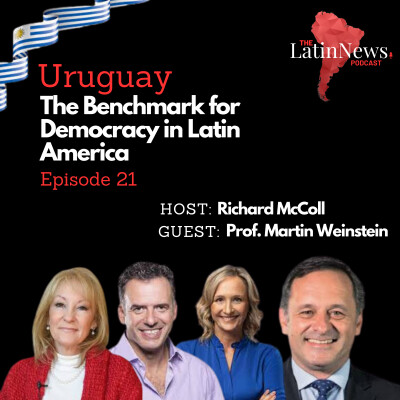
On The LatinNews Podcast this week, we speak to Martin Weinstein, Emeritus Professor of Political Science at William Paterson University in New Jersey and author of dozens of books on Uruguay, his opinions on the upcoming presidential elections in Uruguay in October 2024. Uruguay is unlikely to lose its reputation as the "Switzerland of Latin America," however there are challenges ahead for the successful candidate in the elections, be they from the leftist Frente Amplio or right-of-centre Partido Nacional. These include the issues of security and narco-trafficking, continued tensions with Mercosur and an urgent need to reform the primary and secondary education systems. Tune in for this far-reaching conversation on the LatinNews podcast. Hosted on Ausha. See ausha.co/privacy-policy for more information.
50min | Published on February 13, 2024

On this episode of The LatinNews Podcast, we ask Rosemary Joyce, Distinguished Professor of Anthropology at the University of California, Berkeley, how governable is Honduras considering the challenges facing the country and President Xiomara Castro? In reality, Hondurans can point to the 2009 coup against President Zelaya (current President Xiomara Castro's husband) as a pivotal moment of seismic proportions and consequences in Honduras' political landscape. After that moment, the country endured 12 years or three presidential terms of mismanagement under President Porfirio Lobo (now charged by the US with having taken bribes from narco-trafficking organizations) and President Juan Orlando Hernández, who has been extradited to the US on corruption charges. How can President Castro govern a country and address the three main issues affecting the Central American nation? 1. Corruption, 2. Improving the Economy, 3. Safety and Security. We look at these issues and address the current state of Honduras. Hosted on Ausha. See ausha.co/privacy-policy for more information.
42min | Published on January 30, 2024
Description
Hosted on Ausha. See ausha.co/privacy-policy for more information.
78 episodes
Season 1
Bolivians go to the polls on 1 December 2024 in a referendum to decide on the removal of fuel subsidies and to define whether to admit continuous or discontinuous presidential re-election. As if this weren't enough, on the same date, there are also judicial elections and another challenge to be clarified in the referendum is the shortage of dollars in the country. Everything points to a significant clash of politics and personalities between the current embattled President Luis Arce and former president Evo Morales as we gear up for the first round of presidential elections in August 2025. On the LatinNews podcast this week, we talk to Dr John Crabtree, research associate at the Latin American Centre at the University of Oxford, associate of the Politics Department at Brookes University in Oxford, region head for Latin America at Oxford Analytica Ltd. and author of: "Business Power and the State in the Central Andes. Bolivia, Ecuador, and Peru in Comparison," published by University of Pittsburgh Press. Hosted on Ausha. See ausha.co/privacy-policy for more information.
37min | Published on September 3, 2024
On The LatinNews Podcast this week, we look at what is being done to resolve the long standing conflict between the Chilean government and the Mapuche indigenous people, inhabitants of parts of south-central Chile, who have suffered from a policy of "pacification" which resulted in a tragic history of exterminations and displacement. Tracing its roots back to the time of Chile's independence from Spain in 1810, the Mapuche conflict has evolved over time and there is now an increase in violent acts as militant Mapuche groups seek greater recognition and rights to ancestral lands. The magnitude of the challenge is not lost on President Boric who launched a commission in 2023 to find a solution. So, how can Chile address this long standing historical debt to the Mapuche? Joining us on the podcast is Dr Pablo Policzer, Associate Professor of Political Science and former director of the Latin American Research Centre at the University of Calgary in Canada who provides us with contexts from the very beginning of the conflict to the current day. Hosted on Ausha. See ausha.co/privacy-policy for more information.
58min | Published on August 6, 2024
Venezuela will vote for a new president on 28 July in what will not be free and fair elections, that much is certain. But, which way will it go? On The LatinNews Podcast this week we explore some of the worst case scenarios facing Venezuela including the possibility of increased repression and massive voter fraud. Or, will Nicolas Maduro seek a negotiated exit for himself and his entourage? Joining us is Dr Javier Corrales, the Dwight W. Morrow 1895 professor of Political Science at Amherst College in Amherst, Massachusetts to share his thoughts on the elections, the influence of external actors and discuss all possible outcomes. Hosted on Ausha. See ausha.co/privacy-policy for more information.
39min | Published on July 24, 2024
Colombia’s cluster of armed conflicts seem interminable on the surface but President Gustavo Petro, the country’s first leftwing premier and a former guerrilla himself, has made Total Peace (Paz Total) a cornerstone policy of his government in an attempt to pull the nation from continual asymmetrical conflicts scattered all about the territory. And while Petro’s approval rating sits at a perilous 32% at the half-way point of his tenure, behind the scenes, Total Peace, a sequence of parallel dialogues conducted with each warring faction, from left wing guerrillas to organized crime syndicates, may just yield some positive results. On The LatinNews Podcast this week, we talk to Andrei Gómez Súarez, a Senior Researcher at the University of Winchester and General Director of Rodeemos el Dialogo, the Anglo Colombian peacebuilding organizing association and hear his take on Total Peace and how this policy may be showing some significant advances despite press reports to the contrary. Hosted on Ausha. See ausha.co/privacy-policy for more information.
50min | Published on July 9, 2024
The Mexican electorate made history on 2 June by electing the country's first woman president in Claudia Sheinbaum, former Mexico City mayor, scientist, academic and protege of outgoing president Andrés Manuel López Obrador (AMLO). Much has been reported about Sheinbaum's possible difficulty in distancing herself from AMLO's influence, but ironically, rather than giving her some freedom to pursue her own policies, her supermajority in Congress will mean that she is almost obliged to continue her predecessor's reform agenda. On the LatinNews podcast this week, we discuss the relevance of the election results and what these mean for the country's short and medium-term outlooks. We ask Mónica Serrano, PhD in International Relations from Oxford University, Professor of International Studies at the Colegio de México, and Member of the Board of the United Nations University, about President-elect Sheinbaum and her policies regarding security, health, education and economic opportunities in the country. Hosted on Ausha. See ausha.co/privacy-policy for more information.
38min | Published on June 25, 2024
On this week's LatinNews Podcast, we discuss the reach and main characteristics of the Tren de Aragua criminal group, from its beginnings in the Tocorón prison in Venezuela, to its spread through South America. We speak to Chris Dalby, director of the World of Crime media company and publishing and expert on organized crime, about the reasons for the Tren de Aragua's startling growth, adaptability and violence. The Tren de Aragua currently control a broad criminal portfolio of crimes including drug trafficking, illegal mining, extortion, migrant smuggling, trafficking of women for sexual exploitation and kidnapping, among others. Hosted on Ausha. See ausha.co/privacy-policy for more information.
40min | Published on June 11, 2024
Murder rates in Brazil have fallen under President Luiz Inacio Lula da Silva, but surveys show that people believe violence to have increased in the country. There is little trust in the police and judicial system, 64,2 million live in households with food insecurity, there have been more than 4 million cases of dengue in the first four months of 2024 alone, so how can Lula reduce the massive inequalities in Brazilian society, combat organized crime run from prisons and address poverty? On The LatinNews Podcast this week we speak to Graham Denyer Willis, Professor of Global Politics and Society in the department of Politics and International Studies at the University of Cambridge, how can Brazil address its historical condition to violence and poverty? Hosted on Ausha. See ausha.co/privacy-policy for more information.
36min | Published on May 14, 2024
On The LatinNews Podcast this week, we ask Dr Jacqueline Jimenez Polanco, Associate Professor of Sociology at the Bronx Community College of the City University of New York, to what can we attribute the success of the anti-corruption and anti-impunity politics in the Dominican Republic? With elections on the horizon for May 2024, will the victor continue in the same vein of combating official corruption, addressing tensions with Haiti and protecting the country's all-important tourism revenue? We explore these topics and the historical background to current politics in the Dominican Republic. Dr Jimenez Polanco is the author of numerous books and articles including, "Dominican Politics in the 21st Century: Continuity and Change," "Divagaciones II, An Anthology by Dominican Lesbian, Bisexual and Queer Women," and the forthcoming, "Dominican American Politics: Immigrants, Activists and Politicians." Hosted on Ausha. See ausha.co/privacy-policy for more information.
48min | Published on February 27, 2024
On The LatinNews Podcast this week, we speak to Martin Weinstein, Emeritus Professor of Political Science at William Paterson University in New Jersey and author of dozens of books on Uruguay, his opinions on the upcoming presidential elections in Uruguay in October 2024. Uruguay is unlikely to lose its reputation as the "Switzerland of Latin America," however there are challenges ahead for the successful candidate in the elections, be they from the leftist Frente Amplio or right-of-centre Partido Nacional. These include the issues of security and narco-trafficking, continued tensions with Mercosur and an urgent need to reform the primary and secondary education systems. Tune in for this far-reaching conversation on the LatinNews podcast. Hosted on Ausha. See ausha.co/privacy-policy for more information.
50min | Published on February 13, 2024
On this episode of The LatinNews Podcast, we ask Rosemary Joyce, Distinguished Professor of Anthropology at the University of California, Berkeley, how governable is Honduras considering the challenges facing the country and President Xiomara Castro? In reality, Hondurans can point to the 2009 coup against President Zelaya (current President Xiomara Castro's husband) as a pivotal moment of seismic proportions and consequences in Honduras' political landscape. After that moment, the country endured 12 years or three presidential terms of mismanagement under President Porfirio Lobo (now charged by the US with having taken bribes from narco-trafficking organizations) and President Juan Orlando Hernández, who has been extradited to the US on corruption charges. How can President Castro govern a country and address the three main issues affecting the Central American nation? 1. Corruption, 2. Improving the Economy, 3. Safety and Security. We look at these issues and address the current state of Honduras. Hosted on Ausha. See ausha.co/privacy-policy for more information.
42min | Published on January 30, 2024