- Speaker #0
Hello, and welcome to the sixth episode of Trajectoire. Before we hear from Tatiana Desdelmas, who will discuss her career in finance, I would like to welcome our sponsor, 8 Advisory, an independent European consulting firm specializing in restructuring and transformation with 1,000 employees. I am joined by Athelie Paris-Cohat, the Human Resources Director at 8 Advisory. to discuss the issue of gender parity in the sector. Hello, Atelier. Today, do women have easy access to leadership positions in the finance sector?
- Speaker #1
Well, I would say I think there is still a glass ceiling in the world of finance, unfortunately. When you look at the top management positions and when you look at the promotions, women represent only 30% of the appointments in the world of finance in these top management positions. In the investment banking, it's only 17%. We can see that in some new jobs, new top management jobs like innovation, for instance, there is more promotion of women. So we don't know exactly why, but probably because there is no track record in these specific jobs. And maybe people are more OK to take risks by nominating women. It's sad to say that, but...
- Speaker #0
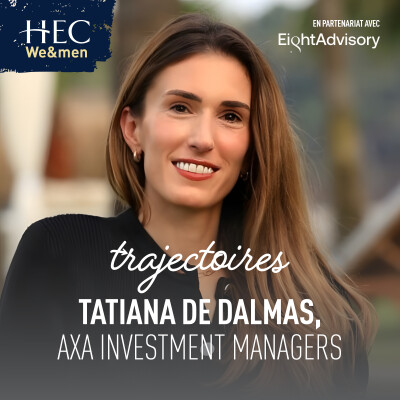
Welcome to Trajectoire, the podcast created by the HEC We and Men Club, shining a light on women who inspire us. In each episode, we give the floor to a recognized expert in her field, someone determined to drive change. 20 minutes to discover a role model. I'm joined today by Tatiana de Delmas, one of Trajectory's award winners in 2025 and a proud ambassador of the HEC We and Men community. Tatjana is currently co-leading Nordic Institutional Sales for Alternatives at AXA Investment Managers, where she raises capital from large institutional investors across Europe, covering real estate, infrastructure, private equity and hedge funds. Her role places her at the heart of Europe's financial ecosystem, shaping long-term investment strategies for one of the world's largest asset managers. But her story is also one of personal transformation. Born and raised in the US, Tatiana began her career in private equity, before making the bold decision to move to France, shift industries and return to school for an executive MBA, all while raising a young family. With curiosity, grit and a deep sense of alignment between her personal and professional values, she has turned every challenge into a step forward. Today she is not only a leader in finance, but also a rare and sought-after voice for women in an industry still navigating questions of inclusion and balance. I'm Janet O'Sullivan, Network Director at HEC 11i, and I'm delighted to welcome Tatiana de Delmas, HEC We and Men Ambassador. Hi, Tatiana. Thank you for joining us. Let's start at the beginning. Did you always know you wanted to work in finance, or did the path reveal itself over time?
- Speaker #2
Thank you for having me today. I did not always know I wanted to work in finance. I was more passionate about medicine and becoming a doctor. But being French American and having traveled a lot in my younger in my childhood, I was attracted to a career where I could travel and move around the world. And I was attracted also to the fast paced environment that finance could offer.
- Speaker #0
Great. You are currently co-leading Nordic Institutional Sales for Alternatives at AXA Investment Managers. What does that involve?
- Speaker #2
That involves, it's a sales role, it's a client-facing role. It involves traveling to the Nordic countries, meeting pension funds, insurance companies, family offices, and discussing and talking to them about what their goals are in terms of investing, as well as introducing to them and talking to them about the AXA IAM Alts platform. which is a 185 billion euro platform covering several different asset classes and alternatives. So being on top of the market trends and what's going on in these different asset classes and the strategies that we have and keeping up to date on what the clients in front of us are doing and what they're looking for.
- Speaker #0
You started out in deal sourcing and investment, and now you're on the fundraising side of the table. What motivated that shift? And what did you learn from changing both company and role at the same time?
- Speaker #2
Well, there are some parallels between the two. And so in some ways, the shift made sense and was an easy one. But in deal sourcing, I had a role where I was also facing a lot of external people from the company that I was at before. I was in a role where I was speaking about the company, the strategy of the company, and looking for interesting deals for the investment team. but at the end of the day it's I wasn't the one making the decision on whether or not the investment would be made. And so I felt like I couldn't control the process and I was more of a middle person, which ended up being a little bit frustrating, even though I really liked the aspect of covering different markets in Europe and seeing different investment opportunities. I wanted a role where I could have a little bit more control on the end result. And I think that that's where when I started thinking about fundraising and fundraising. I could have more control over closing a deal, meaning raising money from institutional investors. And it very well aligned with my desire to continue working with people, being client-facing, but also being able to solve problems more and take a project from the beginning to the end.
- Speaker #0
And you're also a mother. You took your executive MBA while raising a second child. That's a lot. What helped you to hold it all together during that period?
- Speaker #2
I really took it one day at a time. First of all, it was a lot and it was scary to think about before jumping into it because I also started a new job right after starting the executive MBA. But what I realized going through it was that I had to take it one day at a time. and also what surprised me is having such a different environment from the work environment and the family environment, which was really a space that was 100% for myself, that I was forced to take because I made the commitment before accepting a new job, was actually ended up being like a source of energy in a way. And that was unexpected, a good surprise. And of course, that helped me get through it, even though there were some difficult times.
- Speaker #0
Super. And have you any anecdotes about your time at HGC or any memorable moments?
- Speaker #2
Yes, one thing that stuck with me was during the beginning, we had a workshop, like a case study that we were doing with our classmates. And most of the classmates that I had, well, they were from different countries. And they were also very much from different industries. There were not a lot of people in finance during the executive MBA, which is actually one of the reasons why I wanted to do it because they had much, much more operational roles working in really big teams and coming from a very different place than, than. I did. So it was opening up new perspectives. But what was interesting was during this case study where we were discussing management change at a company and how we would each overcome it. During this work, we all discussed some of the personal challenges that we had. And I was very surprised that even though we came from such different backgrounds, the Personal challenge that we each had, actually, there were a lot of similarities. And I think it made me but my colleagues realize that we tend to hide some of the difficulties that we have or not talk about them. But actually, most of us go through the similar things at some point in our career. And it's actually very common, whatever industry you're in.
- Speaker #0
One challenge you've mentioned is adapting to French work culture after growing up and working in the US. What was the hardest part about that transition? And how do you think it's shaped your leadership today?
- Speaker #2
First of all, it surprised me because I grew up speaking French at home and going to the French American school. So I was not surprised for such a culture difference. When I moved to France, I thought, you know, I speak French, this is going to be easy. But actually, in the US, I considered myself somebody with a good amount of an emotional intelligence where I can read between the lines and understand the situation I was in and the context I was in, which is obviously very important at work. When I moved to France, I found myself in situations at first where I couldn't really read between the lines. I didn't know what people were thinking. And that was, I felt like a setback at the time. And how I overcame it is resilience, patience, and learning from mistakes. And well, now it's been over 10 years, so it's much easier, and I can say I'm fully... Biocultural now.
- Speaker #0
Let's move on to women in finance. Today, women still represent only about 20% of senior roles in asset management globally. And according to Livia Wyman's 2023 report on women in financial services, the percentage in private markets is even lower. How have you seen the industry evolve or not when it comes to gender equity and inclusion?
- Speaker #2
I don't think I've seen a huge difference since I started working in the financial industry. I mean, I think the numbers probably speak for themselves, but there has been a lot of discussion and awareness about this subject, and that's obviously positive. I think there has been a shift since the pandemic. I think the pandemic has helped open up you know some workplaces to being a little bit more flexible not only in terms of working from home but also maybe leaving a bit earlier and reconnecting and so I think that's helped women especially but men as well but yeah I don't think there has been a huge shift unfortunately in the industry.
- Speaker #0
You've said that early on being a woman in finance was more of a disadvantage but that over time it became an advantage. Can you tell us more about what that shift in perception and what it took to get there?
- Speaker #2
Well, when I started in finance, I felt like it was a disadvantage to be a woman because I was very different from everybody else in the room. I was one of the youngest people. I was a woman. I was in private equity, so there was mostly men. And I didn't really feel like I fit in. So, yeah, I had a little bit of imposter syndrome. And it was an uncomfortable feeling. I felt like I had to make myself fit in to the environment around me. As I got older and more confident and my skills and my career moved along, I had more space to assert myself and be myself. That made it obviously easier. And I think also, unfortunately, for the industry, there are less women as you go up in finance. But that actually, for those who stay, can be an advantage because you're more of a rare asset and people really respect you as a woman in finance. So right now, at this point in my career, I feel that it's an advantage, but it was definitely difficult at first for anyone, either women, for young people and for minorities, whoever doesn't fit in, it can be more difficult when you start.
- Speaker #0
Even without overt sexism, you mentioned the weight of unconscious bias, especially as a young mother. In concrete terms, what did that look like?
- Speaker #2
I think that people saw me differently after I got married and when I became pregnant, when I had kids. I think people just assumed that I would become less ambitious or not care as much. And of course, having a family did change me. I had to balance my priorities more. And I think it changes men the same way. But as a woman, people would assume more, not everyone, but some people that my priority changed completely, that I don't care as much about work. And that's just not, that just was not the case for me. And I think that as women, we need to prove harder than men do that we actually are ambitious and that we do care. Because some people will just assume, whether they are aware of it or not, that we will change once we have children, which we do, of course, but that does not mean we are not as ambitious and if not even more ambitious in terms of our career after having kids.
- Speaker #0
Let's talk about a few personal matters. You talk a lot about staying aligned with your values, both personally and professionally. What does that mean for you in practice?
- Speaker #2
Well, there are a few things that are important to me as a person that I try to to that I try to have and follow, whether it's my personal life or professional life. For example, integrity is very important to me, learning from my mistakes, being open-minded, and also seeking adventure and growing in life. And these are just a few, but these are things that obviously are very important to me in my personal life. They're how I try to live my life by and it's very important for me to be able to stay true to these values in the professional space as well. Because I truly believe that if I am not in line with my personal values at work, I'm not going to be successful and I'm not going to be happy. So it's very important to me that I'm always in touch with these values, whether it be in my personal life or my professional life.
- Speaker #0
Outside of work, you're passionate about health, nature and well-being. How do these passions fuel your professional life or maybe even help you recover from it?
- Speaker #2
I would say these passions are very complementary to my professional life. It's completely different and health, nature, well-being, cooking, for example, are things that help me connect with my body. So they're maybe a little bit more spiritual. I think it helps me Listen to myself, listen to my body, what are things telling me, what is the environment around me telling me, and I think sometimes in our professional life we can be very busy chasing after the latest deadlines or what's urgent, and we can forget or not make time to listen to ourselves and breathe and meditate and get in touch with our bodies. think that it's, well, it's important for me, it makes me feel good, but I think it also helps me in my professional life to make time for these priorities.
- Speaker #0
You mentioned Dr. Vedat, a breast cancer specialist you interned with in college as a role model. What did she teach you that you still carry with you today, even in a completely different field?
- Speaker #2
Dr. Vedat is a very impressive woman. I interned with her in college. She's a breast cancer oncologist, as you mentioned. What was impressive about her is she was really a woman who was doing it all with a smile on her face and never complaining, facing challenges. She was obviously a successful breast cancer doctor, but also leading clinical trials for patients, responsible for fundraising to raise money for these different clinical trials and research. And she was also a doctor facing her patients, which I was there along with her for a summer. Facing her patients, patients that were very sick, speaking with them, connecting with them on a personal level. So she was really a multifaceted person, very successful in her career, having a great attitude and managing several things at once, including her family, including the business and administrative side of being a doctor and being a doctor. So a very well-rounded, impressive person with a great attitude. and she was a role model for me earlier in my career, well, before I started working. And I often think about her even still today in a completely different field. When I think about somebody that I admire and respect, she's really somebody that comes up and come to mind. And I think I learned a lot from her because she inspired me.
- Speaker #0
You chose to become a We and Men ambassador because you believe women are still underrepresented in finance, especially in roles like yours. What kind of impact do you hope to have by sharing your story?
- Speaker #2
Well, I think that, as I mentioned before, we talk a lot in women groups and there are many women in finance groups and there's a lot of awareness around women being underrepresented in finance, which I think is great. I think what I've seen missing is there are not that many roles of women in finance in a capital raising or fundraising role like mine. A lot of the times the women that are being represented are women in investment teams, which is also an amazing career. and very inspiring. But I thought it would be interesting to have another side of the story, another role within finance. There are many different roles within finance and capital raising is just one of them. But I wanted to share a little bit about what I do and share my passion for the job and hopefully inspire other women to look into that career path because I think it's a great one. And I think we should have more women in this role.
- Speaker #0
And the final question. If you could talk today to the younger Tatiana, what would you say to her?
- Speaker #2
I would definitely tell the younger me to listen to myself more and to trust my instincts more. There were many situations where I had an idea or a feeling about something, but I would sort of put it aside because people around me that were more senior and had more experience than me had a different idea and that my thoughts or feelings were not in line with the status quo. and you know I thought, you know, I should really listen to the experts here and they're probably right. They probably know better than me. I put those feelings aside or didn't act on them many times when I was younger. And I think with, yeah, with experience now, I realize actually your instincts are there for a reason. Just because you're younger and not as experienced, it doesn't mean that you can't see things that other people can or vice versa. I think it's very important to listen to yourself no matter what stage you are in your career. And I continue to do that now. And I do it now much more with ease. And that's part of maturing and growing up in a career. But I think I would tell myself definitely trust yourself more, listen to yourself more. You are more right than you think.
- Speaker #0
Tatiana de Delmas, thank you. It's been a real pleasure. And thank you for being such a great We and Men ambassador.
- Speaker #2
Thank you for having me.