- Speaker #0
Hello, and welcome to the ninth episode of Trajectoire. Before we hear Maria Zahir share her journey in the finance sector, I welcome Atali Paraskoat, the Human Resources Director at AIT Advisory. AIT Advisory is an independent European consulting firm specializing in restructuring and transformation with 1,000 employees. It is also a sponsor of this podcast. Athalie discusses the challenges of gender parity in the finance sector with us. Hello, Athalie. What is the current proportion of women in finance?
- Speaker #1
Well, if you look at the top management positions, it really depends on the position. So if you take a general manager, for instance, it's only 20% of general managers that are women today in France. At the opposite, if you look at some positions like support functions, then then Women are more represented, I would say even over-represented. For instance, women represent 65% of head of legal or 70% of head of people. So you see that they are more, of course, represented in support functions than unfortunately in business functions today.
- Speaker #0
How can we attract female talent to these professions?
- Speaker #1
Well, we need to work on the pipeline, I would say, and really work on the attract. women in the sector of finance. So this means that on a daily basis, we need to go to the business school and engineering school and promoting our jobs for the women to know more jobs. We need to work on the role models and to show that we have already some role models they can identify to. That's some initiative. There are many others that we can do, but I think the top priority is probably to work on the pipeline and really promote our jobs. and the role model we already have today.
- Speaker #2
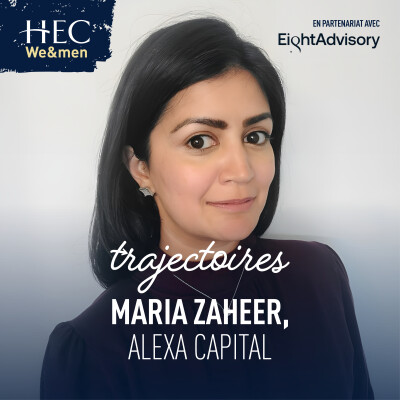
Welcome to Trajectoire, the podcast created by HEC Women Club, which highlights the women who inspire us. In each episode, we give the floor to a woman who is recognized in her field and determined to drive change. 20 minutes to discover a role model. Today, I am joined by Maria. She is an investment banker, a CFA chart holder, and someone who has built her career at the crossroads of finance and climate action. Maria started her career in the private capital markets and spent many years working on energy and infrastructure deals across Latin America, North America, and Europe. One of her biggest achievements, building MUFJ's private capital market business in Latin America from scratch, Despite language barriers, complex regulations and a male-dominated environment. And then pivoting to Alexa Capital to similarly build a business in what was a new platform expanding from Europe to North America. As a woman in finance, Maria knows how challenging this world can be. But instead of giving up, she chose to lead and to lift others as she climbed. She's passionate about supporting young women in finance and using her voice to push for more fairness, opportunity and innovation. Today she is uniting finance to support the energy transition and make a real difference for the planet. I'm Anna, replacing today Daphne, and I'm very happy to welcome Maria, Ambassador of HSE Women. Hello Maria, thank you for being here with us. You have... had a truly international career from North America to Latin America and Europe. What led you into finance and more specifically into the energy and climate space?
- Speaker #3
Thank you so much for having me, Anna. Really excited to talk about my career. You know, I think, truth be told, my direction into finance was a little bit more driven by just my natural ambitions to be top of my class. you know, top of my year, go to the best university, go to the highest ranking university, etc. And so I kind of naturally fell into, in Texas at the time, the top university there in their top program, which happened to be within the business administration program. You know, at that time, when you're young, there's a couple of career tracks that kind of rise to the top of the ranks in terms of definitionally being considered successful, and finance, banking was definitely considered one of them. And so I kind of drove my career towards that direction. And a combination of things from my youth, really, a combination of traveling through different countries, living in different countries, being exposed to different cultures. And having some exposure to the energy sector by virtue of my parents' professions kind of led through a natural discovery in and around the energy space. So, you know, it just landed itself to me becoming a then energy banker. And following that kind of career through the last two decades.
- Speaker #2
Nice. And so you mentioned your parents, and you have said that you were raised in a very conservative immigrant family and learned early to break boundaries. What did that look like for you growing up?
- Speaker #3
Yeah, that's always a really interesting question, because I think throughout my youth, it has kind of prepared me. for pushing and breaking boundaries to kind of move to the next step or move towards the dreams and standards that I've set for myself. You know, because of my complex background in terms of being a Pakistani Asian woman with a Muslim background. I was moved to Texas. My parents moved to Texas when I was quite young and my father spent most of his professional career overseas further. And so my mother ran a very tight ship and most answers to most questions were no, you cannot. and that included moving away from home, going far away for university. But, you know, I learned through that journey that the first time somebody says no to you is not necessarily the final answer and that you can explore alternatives and kind of seek other paths. And I think that that's an inadvertent lesson that has helped me through banking in terms of my next step, my next journeys, and some of the challenges that I've been willing to face. So, you know, grateful for that experience that I learned how to say no in the appropriate way. very early on.
- Speaker #2
Super inspiring. It's like it's a lifetime journey to learn how to say no. So it's nice seeing that you learned that early as well. Could you tell me a bit more about why did power and energy actually became your sector of choice?
- Speaker #3
It's, you know, when I first fell into it, it was just because that's where the job and the opportunity was. And the minute you start to kind of dig into the energy sector, and you realize how vast it is and how impactful it is in terms of the adjacency it has to any other sector, whether it's consumer, retail, tech, telecom, and what have you. At the end of the day, energy kind of sits at the nexus of it, and you need energy in all regards to drive things. And, you know, having joined that market about two decades ago, It's also been quite remarkable the exponential amount of change that has occurred in that market. And so that's probably been one of the primary drivers that I have continued my career in hour and energy, respectively. And as you kind of progress, you know, the desire to have an impact versus the desire to just succeed in a career start to blend together. I would say around, you know, the 15-year mark, maybe even for some around the 10-year mark, you're like, okay, you know, there's my career and then what am I doing with my life? And I think the excitement around the changes, the very real-time changes that were happening in power and energy, the dynamic, the shifting environment really just motivated me to kind of continue to stay in and around that space. And I think a lot of the... career movements I've made have really been with always that one anchor in mind that, you know, just irrespective of what platform I'm joining or what job I'm doing is I want to be at the edge of where power and energy is evolving to because I think, you know, in another two decades from now, the way we think about power and energy today is going to be so different than I thought about it when I started my banking career, let alone, you know, two decades prior to that. And so to continue to be part of that change movement that is very much happening real time, and impacts every other industry, just felt like that's how I wanted to define my profession, my career and my value add.
- Speaker #2
You also very inspired as well, have built something from scratch at MUFG in Latin America. What did that experience teach about leadership and also yourself?
- Speaker #3
Um... You know, I would parallel my experience moving to MUFG as well as my experience at Alexa Capital to be quite similar in terms of, you know, I felt like I was jumping into the deep end. It's this idea of doing something that A, I had not done before. You know, B, on paper, it probably looks like, you know, somebody would question, do I have the right skills to do it? And then, you know... The already high bar that I kept setting for myself was I setting myself up for failure. In both regards, they were new business practices that didn't exist. And so somebody had to come in and set up the platform. set up not only the business, but then also be able to deliver business and then deliver on complex transactions in that space, all whilst competing with probably a laundry list of other people who've been doing that exact same for a much, much longer period of time. So I felt like I was diving into the deep end. But I think from MUFG to Alexa Capital, the lesson I think that I learned really for myself was I can dig deep and I can identify that I've got probably strengths that I don't recognize within myself that allow me to deliver what the team or management were expecting in and around that business, that I've got skills that I probably haven't been able to identify and probably don't give myself enough credit for. So I did that on a smaller scale at MUFG and did that on a larger scale at Alexa Capital. So it was like learning all of these skills that I didn't know that I had. And so I've spent since those journeys really trying to learn more about myself because you spend most of your career hearing from others what you're good at and what you're not good at. And you look for that kind of that outward feedback, which is great to have. And it's an important piece of feedback and growth. But I think there is a very big element of you know, identifying for yourself what you're good at and where other people are probably missing some things as well.
- Speaker #2
Nice. I agree. It's very important as well. And I'm moving to very like a touch topic about being a woman in finance. Women only hold 24% of decision making roles in investment, corporate finance, and less than 20% of general manager or presidential role in France. Have you personally felt those gaps in your own experience? And could you tell us a bit more about this?
- Speaker #3
Absolutely. I mean, I think those numbers for me are actually quite surprising to hear because they sound quite positive. So things have clearly changed and moving in the right direction. I think during my earlier days in banking, I spent a lot of meetings, a lot of transactional work being the only woman in the room. And then being the only woman in the room of color and of ethnicity as well. And so that was definitely a big challenge because you realize not only from a gender differentiation perspective that males approach banking and the product that we offer and the service that we offer quite differently. There is a natural tendency for them to be a lot more forthright, if I may, aggressive about tines and But it's all kind of accepted as part of them being in banking. Whereas one of the challenges has always been, A, finding your own voice in that environment where you are clearly siloed and differentiated. But B, then having the ability to step up and have an equally heard voice versus those individuals. So that has always been a challenge. I would say it's much. better now than it used to be per the statistics that you just gave. So the market is improving, and it's great to kind of hear that. But I think that you really have to learn to build your own voice and have confidence in your deliverability of the work that needs to get done, right? It's not the loudest voice in the room is not necessarily the smartest voice in the room. The most aggressive voice in the room is definitely probably not. the smartest voice in the room and accept that and take your voice, right, and find a way to make sure it's heard. And that doesn't mean you have to be the loudest and it doesn't mean that you have to be the angriest. But what it does mean is you have to have confidence in what you're doing and, you know, really delivering quality work as opposed to kind of some of these other behavioral elements that really drive a wedge between gender behavior differences.
- Speaker #2
And linked to this, you also said that you're proudest of the impact you had on junior women. What kind of culture do you try to create as a leader, specifically in this very male-dominated space?
- Speaker #3
Yeah, and this is largely due to the fact that, you know, I didn't have the benefit of a mentor or a role model, and candidly still don't, unfortunately. but I always think back to what what I would have really lucked out from having earlier in my career, what would have made me even more successful, what would have made me seek out even additional opportunities. And it really was this lack of a mirror of myself in any of the seniors or even equivalent peers in and around me. And so, you know, when I think how do I give back to this community, and I put community in air quotes that you can't see. But... it really is this idea that as a woman, you can be equally as successful, if not more successful than the men in this space. But, you know, the younger, more newer people into the field need to be nurtured, and they need to be kind of welcomed. And so I try to open my book up as much as possible, whether that's through informal communication channels, I'm always open to just talking to females about my career. And I think this is where women don't reach out as often because they think they're going to get a negative response, but I'm always open to those conversations. And I think, you know, within the floor itself, the women who I work with, I go out of my way to ensure checking in on them, right, aside from what HR is doing or what their reviews are doing, that there really is somebody in the environment who is directly and personally supportive of them. And I think that that makes a really big difference. At the end of the day, I am a firm believer that women and men are different creatures, and that, you know, our lovers are slightly different. And so this idea of creating a more nurtured environment, as opposed to a programmatic review environment, really helps women speak up a little bit more about what is bothering them, what challenges they may be having, or what things that, you know, they're enjoying doing, but creating that warm space and that inviting space to allow in whatever challenges and have a discussion around it. And so that's something I've really prided myself on. And, you know, the women who I have worked with at a junior and it in a junior capacity through the years, you know, it makes me really happy to see most of them are still in finance. And I don't think that that's something that a lot of people can kind of reflect and go back and say, by no means am I taking credit for that. I just mean to say that, you know, I do think that having that environment then gives them the ability to build their own self-confidence, which at the end of the day was really what carried me through to where I am.
- Speaker #2
Your message to women is strong. The industry won't change, so you must be ready. Is that something you learned the hard way? And if so, how?
- Speaker #3
It was definitely not something I learned the easy way. As a woman, I in particular have this natural tendency to be what may be described as overly loyal. And I remember the first firm that I worked at, I think I worked there for about eight years. And, you know, in banking, even in that day and age, nobody stuck around for eight years. And the reason I ended up moving was because the bank went bankrupt. So I literally had no choice. And so that really shoved me into, okay, yes, scramble for go find another job. Do you want to stay in banking? How hard do you want to work in banking? What product do you want to do? And the inadvertent result of that was I took what I would describe as an even harder job in banking at a level that I was not trained for appropriately. But I dived into it. And, you know, the net result of that is I did that second job for about five years. It was in a slightly different product than where I was for the first eight years. when I came out of that, right, is I learned that I have the capability. to step up and identify what I've done in my prior role, how it can add value in a different way in this new product role and shape a new perspective, whilst continuing to learn the elements that I was not familiar with. And that making that pivot, although very unnatural for most people in banking who tend to just do one product for most of their careers, I came out of that. realizing that I loved the idea that I pivoted into a different product, and that I should pivot into another product again, right and push myself to, to do something harder to do something different to set myself up even to potentially fail. But that those dynamics at the end of the day, I felt like not only personal growth, but also, you know, if I look back at my my career and my resume, I think, have added tremendous value to... to me as a banker and my skillset.
- Speaker #2
And looking back at your resume, there is like a whole impact as well in finance and climate. And so I would like to move to this part. What impact do you hope to leave for your work at the intersection of finance and climate?
- Speaker #3
I think, you know, when you start off in banking, there is this element that you're just climbing the ladder. You're doing it for the money. And you're just kind of tracking along, right? And at some point, as I was mentioning earlier, you get to an inflection point to really ask yourself, is this a profession? Is this a career? Is this my life, right? And those things start to merge together. I think the sooner one can ask themselves that question, the better off you are in terms of the decisions you make in terms of where you work, who you work with, how you work. And I got to that point about five years ago, maybe a little bit too late, to be honest. But, you know, I was thinking about, okay, well, what do I want to be doing for the next 30 years of my life? Because that's how long our careers are, right? 50, 60 years, whatever the case may be. But I wanted to not just be a banker, I wanted to think about the skill set that I had, and how to leave an impact in this world. and That skill set for me naturally lends itself to this idea of accelerating capital to drive change in climate. And having been earlier in my career at the intersection of power and energy, it was, what can I do more to make sure the right type of money is flowing towards the right types of companies that at the grassroots movements level, et cetera, are making real and tangible impact? And so that's what I would describe as, you know, when I retire, I want to tell people my life's work was helping these companies who are changing the way the world operates and the impact that we're having on a day to day basis and on a large scale and small scale in climate. That is my legacy. And that's what I want to work towards. But I made an affirmative decision to do that. And that's kind of then directed some of the moves that I've made subsequently.
- Speaker #2
It's nice and also gives purpose. It is very important as well. And regarding this, and you told, you mentioned about this 50 to 60 years of careers, and I never thought this way. It's very interesting as well. What would you like to say to the younger marriage just starting out? And related to this, what do you wish more young women knew as well when considering a career in investment banking or starting a journey like you did as well?
- Speaker #3
Yeah, I think I would say two things. One would be, be, you need to embrace change. Don't be afraid of it, embrace it entirely. And I think if you spoke to anybody, male or female, whatever the case may be, that anybody who's ever taken a chance, you will be hard pressed to find somebody who says that they regret it. And, you know, candidly my experience at my current platform. It was a very big roll of the dice. And it has been probably one of the most rewarding. And by rewarding, I don't mean, you know, bank account rewarding. I mean, just like truly gratifying experiences and learning experiences. And I think the other thing I would say to my younger self is, do what you need to do to build your confidence. And that looks different for every single person, right? Not all of us are half the same natures. and the same personalities. But we all can be very confident people. And again, confident doesn't mean that you are sitting at the table with the loudest voice, but it means that you believe in what you are saying and do the work that you need to do in order to find that voice. Because especially in banking, that will be the key to carry you through all of the challenges and stresses that ultimately will come with this type of a job.
- Speaker #2
So it's your turn now to inspire others and to instill this confidence as well. And I hope like everyone listening to us will also dare to reach out, dare to ask, dare to be confident as well. And it's, I love everything you said here. Just to almost finish and to kind of link it to the all the other episodes of podcast, how would you personally define the term of empowering women? What does it mean to you?
- Speaker #3
I think it means to... Create enough space for other women to be brave, right? To take any leaps that they need to, to take any small steps, but to know that there is space to do that. And that space includes, you know, not knocking it out of the park. And maybe you are failing, but there is growth in that failure. any step whether it's financial. But... But be brave and don't let anyone stop you from being brave. The only person who stops you from being brave is you.
- Speaker #2
Very true. But also kind of sometimes difficult to apply in your business. And it's a very final question. And I'm sorry, it's a very broad question as well. But if you could reshape one single thing in the finance industry today to make it more inclusive and purpose-driven, what would it be?
- Speaker #3
Oh, that one's easy. I would tone down the level of formality of that industry, that practice. I think that there is a level of professionalism that is needed, absolutely, but formality can get toned down. And I think that that creates an environment of ease and calmness and openness, which I think could naturally soften some of the edges of its culture. I encourage women to wear more dresses and skirts to work. Be loud, wear prints. It's okay. You don't have to blend into where everybody else is doing things and how they're dressing and approaching things. So if there was a way to just become a little bit more of a relaxed banker, I would highly encourage that.
- Speaker #2
Thank you so much, Maria, for sharing all of this insight with us. It was really inspiring. I hope that everyone hearing us today will be inspired as well. And thanks as well for all the impacts, everything you did during all these years for this very purposeful career as well. Thank you so much for being with us today. Thank you for having me.