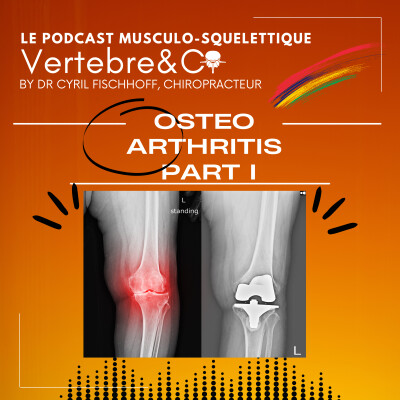
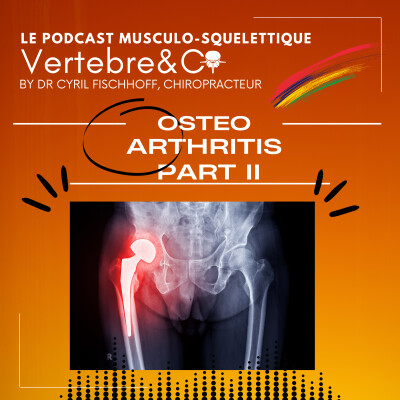
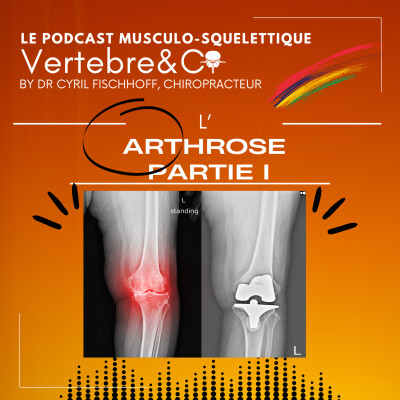
Speaker #0I am Dr. Cyril Fischhoff, a chiropractor and a specialist in musculoskeletal ultrasound practicing in Mauritius. I invite you to listen to a new episode of the Vertebra & Co. podcast every first and third Monday of the month. This podcast is dedicated to the world of musculoskeletal medicine and is for everyone. We discuss the mechanisms involved, diagnoses, treatments and the prevention of various musculoskeletal pathologies through short clinical stories, the latest scientific research and interviews with specialists. Hello everyone, today we are going to talk about a topic that saturates search engines and waiting rooms, yet remains one of the most misunderstood. Osteoarthritis. For too long we've been sold osteoarthritis as an inevitability, simple wear and tear, as if our joints were mechanical parts destined for the scrap heap. But before we dive into this new biological perspective, I want to clear up a confusion I hear almost daily in my practice. People often ask me, wait, do I have osteoarthritis or arthritis? In many people's minds, they're the same thing. Yet, understanding the difference is already half the battle toward healing. So, to clearly distinguish the two, I like to use the image of fire and stone. Arthritis is fire. It's a primary inflammation, often sudden. It can be autoimmune, infectious, or linked to crystals, as in gout. The joint is red, hot, and swollen, and the pain is often nocturnal. It wakes you up. Osteoarthritis, on the other hand, has long been perceived as stone, like stone, a cold, slow, purely mechanical process. But beware, this view is outdated. Today, we know that osteoarthritis is a biological remodeling process. It's not so much that the joint wears out, but that it's trying to adapt to an environment it can no longer manage. And sometimes this process flares up. This is what we call a flare-up, where osteoarthritis suddenly takes on the characteristics of arthritis. But it isn't. So why is it important and urgent to talk about osteoarthritis? Well, because we are facing a true global pandemic wave. According to data from the Global Burden of Disease, osteoarthritis now affects over 500 million people worldwide. In France, it's estimated to affect about 10 million people. But what's striking is the trend in the numbers. The number of cases has increased by over 110% in 30 years. And contrary to popular belief, it's not just an issue for seniors. We're seeing a staggering 40% increase in 40 to 60-year-olds. We can no longer ignore the impact of youth sports injuries, like those famous torn ACLs in the knee, which program osteoarthritis 15 or 20 years down the road. Today, it's the leading... cause of disability in people over 65. So, we're going to talk about the different structures that make up the joint, starting with what we call the subchondral bone. When we look at an x-ray, we always focus on the joint space narrowing, where the cartilage seems to have disappeared, and we think, well, it's my cartilage that hurts. Well, that's wrong. Cartilage has neither nerves nor blood vessels. It's incapable of sending you a pain signal. The real culprit, the one screaming when you walk, is the subchondral bone. Unlike cartilage, this bone located just underneath is extremely rich in nerve fibers. Imagine a house. The cartilage is the carpet. The subchondral bone is the concrete slab. If the concrete slab is healthy, it absorbs shock silently. But in osteoarthritis, the bone is under enormous pressure. It becomes too hard, what we call sclerosis, or develops microedemas. This bone distress causes high pressure inside the joint. And it's this pressure, picked up by the bone's many nerves, that creates that deep pain. sometimes like a toothache. Plus, this bone releases enzymes that digest the cartilage from underneath. Cutting-edge research, notably the work of Loris and Goldring, proved this toxic dialogue. To save the cartilage, we must first soothe the bone supporting it. Another structure making up the joint is the ligaments, which really act as pain sentinels. If, as we've just seen, the bone is the source of deep pain, the ligaments are the transmitters of movement pain. In osteoarthritis, ligaments undergo two phenomena. First, a sort of microtraumatic instability. When the cartilage thins, the joint becomes loose. The ligaments are then put under abnormal tension. They stretch and send sharp pain signals as soon as you change direction. The second phenomenon is the loss of proprioception. Ligaments are packed with position sensors. Inflammation scrambles these sensors. As a result, you feel less stable, which brings us directly to the crucial role of your muscles. Indeed, we too often forget that the joint doesn't hold itself up. Your periarticular muscles around the joint are your active shock absorbers. The problem in osteoarthritis is what we call arthrogenic muscle inhibition. It's a defense mechanism of the brain and nerves. of a system. Because the joint hurts, the brain, quote-unquote, partially shuts down the surrounding muscles, like the quadriceps for the knee, to protect the joint. As a result, the muscle wastes away, it atrophies. And since the muscle no longer acts as a shock absorber, the subchondral bone takes 100% of the impact with every step. It's a dramatic vicious cycle. The less muscle you have, the more your bone suffers, the more your cartilage degrades, and the more the ligaments stretch. Muscle isn't just a tool for movement. It is truly the biological shield for your cartilage. And then there's that moment when everything shifts, what we call a flare-up. Your osteoarthritis was silent and suddenly your joint is on fire. Microdebris falls into the joint fluid. Your body detects them as intruders. The synovial membrane becomes inflamed and produces excess fluid filled with inflammatory molecules called cytokines. These molecules act like tiny acids and a flare-up isn't just painful, it's an acceleration phase of the disease. At this stage, inflammation is the engine of destruction that must be stopped urgently to protect your tissues. So to conclude this first episode on osteoarthritis, remember that osteoarthritis is a puzzle. It's not just wear and tear, it's bone distress, a warning from the ligaments, a failure of the muscles, all against a backdrop of inflammatory chemistry. But the good news is that we have solutions for each of these points. So in the next episode of Vertebrinco, we'll take action. How do you wake up your muscles despite the pain? How do you put out the chemical fire of a flare-up? And what are the cutting-edge therapies, from nutrition to regenerative medicine, that are changing the game today? Take care of your structure. It is your freedom of movement. See you next episode. Join me again very soon for a new episode of the Vertebras & Cobra podcast. Meanwhile, take care, stay active, and if you ever have any questions for me, please feel free to contact us on the podcast page vertebranco.com.