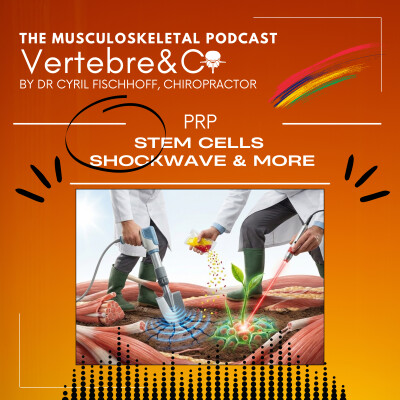
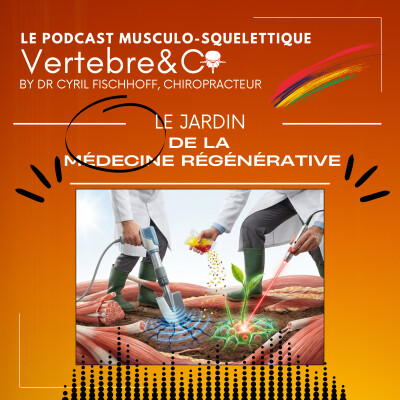
Speaker #0I am Dr. Cyril Fischhoff, a chiropractor and a specialist in musculoskeletal ultrasound practicing in Mauritius. I invite you to listen to a new episode of the Vertebra & Co. podcast every first and third Monday of the month. This podcast is dedicated to the world of musculoskeletal medicine and is for everyone. We discuss the mechanisms involved, diagnoses, treatments, and the prevention of various musculoskeletal pathologies through short clinical stories, the latest scientific research, and interviews with specialists. Hello everyone, so today we are going to talk about regenerative medicine. As musculoskeletal system clinicians, we have long treated the body as just a simple lever and pulley mechanism, but when faced with chronic conditions such as stubborn tendinopathies, osteoarthritis or ligament injuries, the mechanical view shows its limitations. Today, we are entering the era of so-called regenerative medicine. And to understand how to repair living tissue, We need to put down the toolbox and embrace a gardener's view. Why? Because our tissues aren't replaced like car parts. They are grown. In this episode, we're going to explore how, for instance, PRP, shockwave therapy, or even laser treatments act as accelerators for your body's natural healing processes. I was speaking, therefore, of a gardener's approach. Well, we're going to start by preparing the ground by reactivating the inflammatory phase. And then we will discuss techniques such as prolotherapy or shockwave therapy. The primary challenge in musculoskeletal pathology is the inert tissue itself. Chronic tendinosis is like soil that has become compact and fibrous where circulation can no longer properly flow. The healing process is therefore blocked and this is precisely what explains the chronicity of the pain. Well this is where shockwave therapy or prolotherapy come into play. In our musculoskeletal garden it's like turning the soil through mechanical impulses, which are shock waves or with the aid of a natural irritant solution, which is prolotherapy, we create a controlled micro-inflammation. The objective is to turn over the soil. We break down the fibrosis and we force the body to recreate vascularization. We're not breaking anything, we're just waking up the local metabolism. This is the crucial step for preparing the ground. Without loose and oxygenated soil, no regeneration is possible. Let's stick to gardening terms, and we'll discuss seeds and fertilizer, autologous biology. In this context, we'll be discussing several techniques, but essentially stem cells and PRP. So, once our ground is prepared after digging, we need to introduce structural components. Here, we use what nature has most effective. First of all, PRP, which is relatively well known, is our fertilizer. We draw blood, your blood, we concentrate your own platelets that we re-inject, ideally under ultrasound guidance so they can release your own growth factors. It's a natural and massive chemical signal that will instruct tissues to rebuild. Stem cells, a relatively recent technique but still much more expensive than PRP, are the equivalent of seeds. They possess pure repair potential, capable of differentiating to restore the quality of cartilage or a tendon. This is the very definition of natural medicine. We don't introduce any synthetic chemicals. We use technology to concentrate your own internal pharmacy and deliver it. precisely where the gardener needs it. So, after the tilling, the seeds and fertilizer, the sun and water, that is to say, metabolic optimization. For example, we'll discuss photobiomodulation, also known as laser therapy, and pulsed magnetic fields. Every growth process demands a tremendous amount of energy. At the cellular level, this energy is ATP, which is produced by your mitochondria. Photobiostimulation, or high-intensity laser, is our sun. This light will penetrate deep into musculoskeletal tissues to stimulate the energy powerhouses of your cells. The other technique, pulsed magnetic fields, is water. They optimize the permeability of cellular membranes, facilitating the entry of nutrients and the elimination of metabolic waste products. By optimizing this cellular environment, we ensure that the fertilizer, PRP, and seeds, for example stem cells, have the necessary resources to transform biology at the solid tissue level. Finally, Once all this gardening has started to take hold, we're going to discuss the tutor, that is the powerful force of mechanotransduction. The primary technique for this is physical exercise or rehabilitation. It is therefore a crucial element that every expert in musculoskeletal medicine must place at the very center, the tutor. We can have the best soil, the best fertilizer in the entire world. If we allow a plant to grow without proper guidance, it will become fragile and quite disorganized. In the field of regenerative medicine, the crucial guide, the key factor, is movement. This is precisely the fundamental principle known as mechanotransduction. Your cells, whether in tendons or in bones, will only truly strengthen if they are subjected to mechanical stress. Targeted physical exercise acts as the tutor that carefully aligns the collagen fibers. This is what transforms a chaotic scar into functional and resistant tissue. Without a support, there is no structure, and your involvement is what gives the final direction to the healing process. In conclusion, treating a musculoskeletal pathology today, especially a chronic one, means shifting from the role of a repairman to that of an expert gardener with a whole series of tools at their disposal from digging to staking. So, by combining deep tissue work, shockwave therapy, PRP treatment, laser light and exercise support, we offer your body optimal conditions for natural regeneration. So, observe your structure, cultivate your movement and we'll see you very soon for a new episode. Join me again very soon for a new episode of the Vertebras and Cobra podcast. Meanwhile, take care, stay active, and if you ever have any questions for me, please feel free to contact us on the podcast page vertebrainko.com.